Yunnan 2026: The Roads Behind the Tea Names
Five days between Menghai and Yiwu, following Lao Banzhang, Mengsong and Guafengzhai from famous names back to gardens, village roads and the long night of making tea.
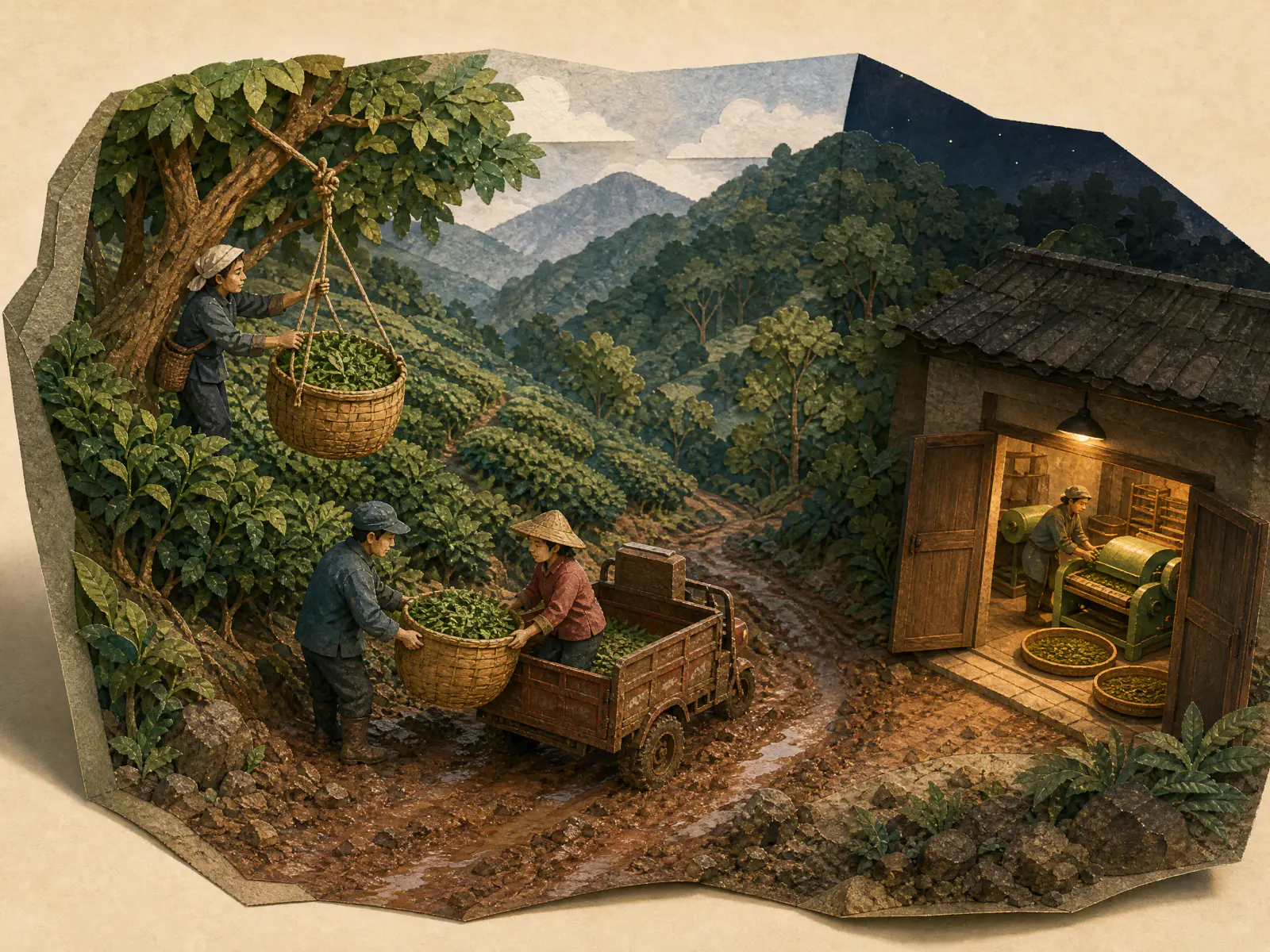
I went to Yunnan carrying the usual tea vocabulary: mountain, village, ancient tree, spring material, first flush. On a wrapper, those words sit neatly beside one another. On the ground, they are separated by hours of driving, broken roads, steep paths, baskets, meals, people waiting for leaf, and work that continues after dark.
This notebook follows the trip in the order the camera recorded it. The route began in Menghai County, moved through the Bulang Mountain and Mengsong systems, then crossed east into Yiwu and Guafengzhai. The last full day continued south of Yiwu toward the Huanglianshan area, where a road repeatedly disappeared into a stream before the leaf returned to a small processing room that night.
The photographs are all from the trip. Where their embedded GPS data supports a location, I use it. Where the signal is incomplete—or obviously wrong—I keep the label broad. A famous tea name is not a licence to pull every nearby photograph under it.
The route in four lines
| Date | Camera trail | What the photographs show |
|---|---|---|
| 31 March | Shenzhen Bao’an → Xishuangbanna | Airport boards and the beginning of the road journey. |
| 1 April | Bulang Mountain township, Menghai County | Lao Banzhang gardens, village entrances, fresh leaf and an evening meal. |
| 2 April | Mengsong township, Menghai County | Tea growing among forest at roughly 1,900–2,070 metres, followed by drying leaf and maocha. |
| 3–4 April | Yiwu → Guafengzhai → Huanglianshan area | Village visits, river roads, forest gardens, leaf comparison and night processing. |
Lao Banzhang was a place before it was a price
The first full day supplied the trip’s clearest correction. Lao Banzhang is often encountered as a number: the expensive reference point on a spring price list, the name printed largest on a cake, the village against which less famous Bulang teas are compared.
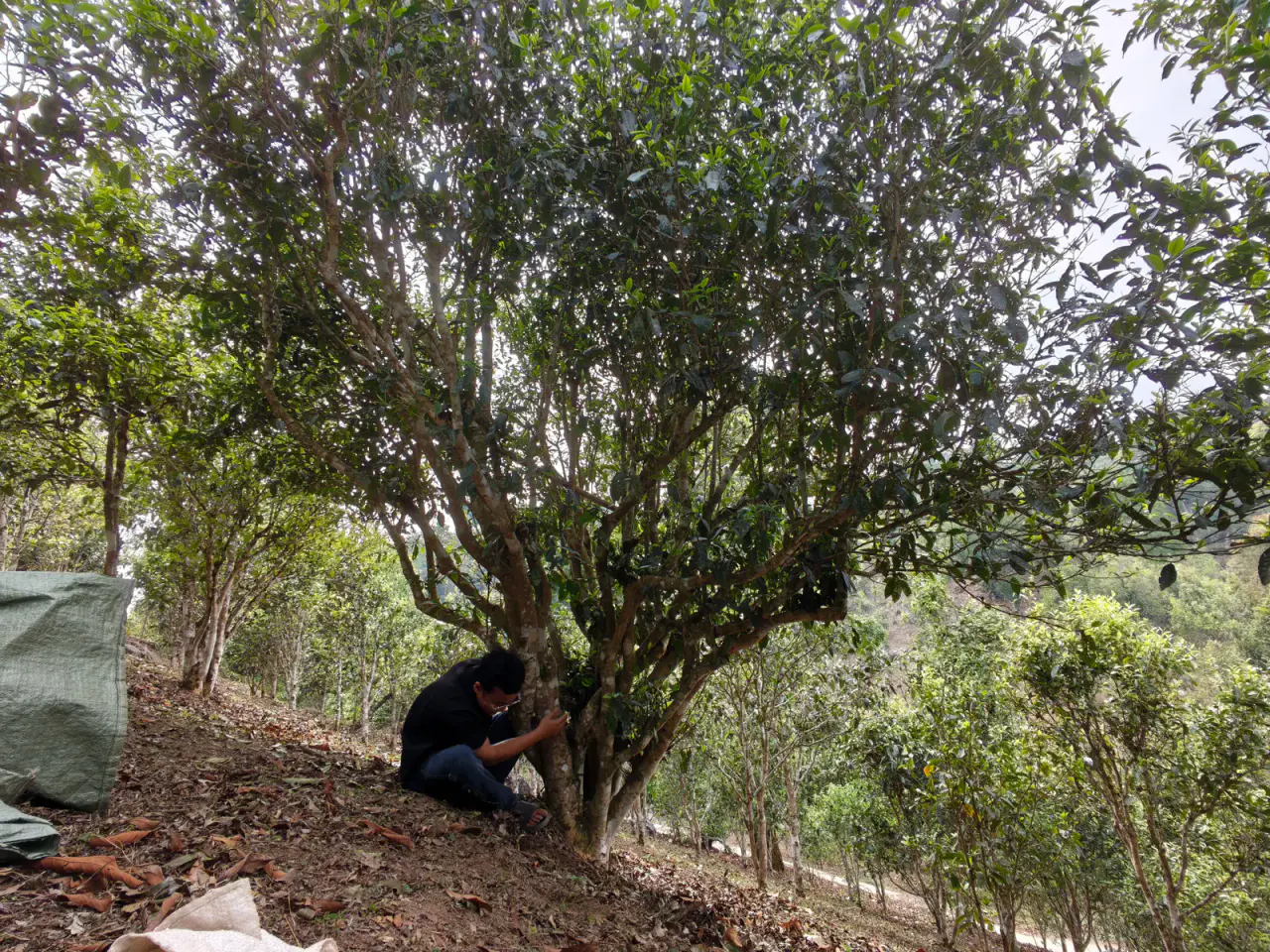
In the garden, the useful details were smaller. The ground was dry and steep. Many trees had several trunks rising from the base. Picking cloths and carrying sacks sat beside the trees. Paths were made for people who knew the slope, not for visitors trying to keep their shoes clean.
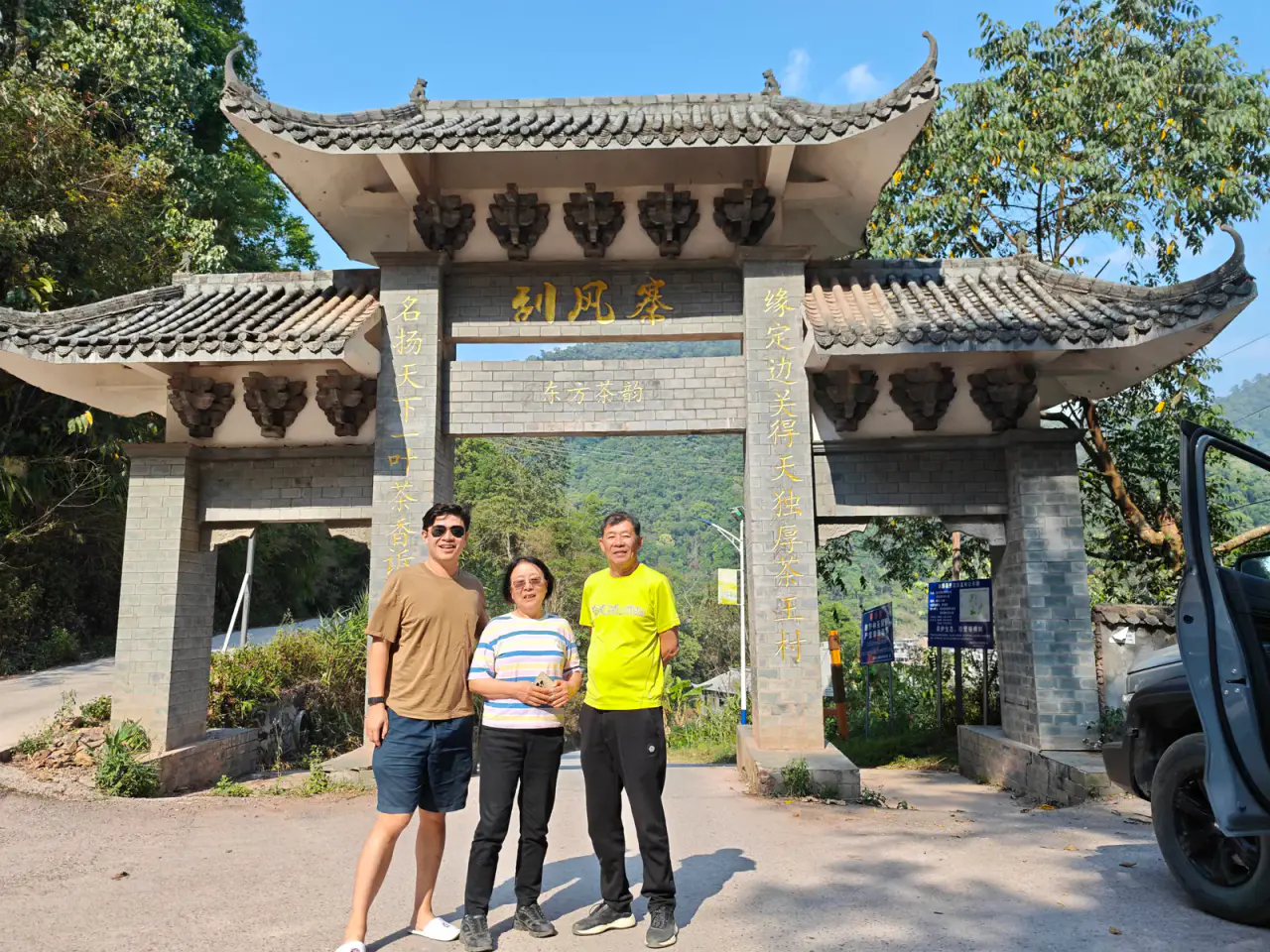
The camera moved from those trees to fresh leaf, a village gate and dinner. That sequence says more about origin than a heroic photograph of one trunk. Tea here is not a monument waiting to be admired. It is part of a working day.
Read the full entry: Lao Banzhang Is a Village, Not a Wrapper.
Mengsong changed the scale
On 2 April the GPS altitude climbed above 1,900 metres and briefly passed 2,070. The garden looked different from the more open Bulang slopes. Tea plants rose through a mixed canopy; paths narrowed; bright new growth caught the hard midday light while the forest behind it remained dark.
“Forest tea” can be lazy marketing language. Here it was a visible arrangement: tea beside other trees, leaf litter on the ground, uneven spacing, and no clean plantation horizon. That does not prove age, cultivar or quality. It does show the growing environment with far more precision than a wrapper can.
Read the full entry: At 2,000 Metres in Mengsong.
Yiwu made distance part of the tea
Guafengzhai is about 32 kilometres from Yiwu town by the official local account. A kilometre in this landscape is not a neutral unit. Road condition, weather and the point where four wheels give way to two all change what “nearby” means.
The most honest photograph from this part of the trip may be the motorbike crossing a shallow stream. A picking basket is tied behind the driver. Someone waits on the rocks. Nothing is staged as hardship, yet the image explains why remote material is difficult to separate from the labour of reaching it.
The following photographs move through forest, across a harvested valley and back into a processing room. Two small piles of wet leaf sit side by side on a tea tray. Later, leaf is fed into a rolling machine while bamboo trays wait on the floor. By then the scenic part of the day is over, but the tea is still unfinished.
Read the full entry: From Guafengzhai to the River Road.
What I want to keep from the trip
The trip did not make provenance simple. It made the questions better.
- Which village did we actually reach?
- Which garden did the leaf come from?
- How far did the pickers travel after the road ended?
- Was the leaf processed where it was picked or carried elsewhere?
- When two piles look different on the tray, what changed upstream?
Those questions are less glamorous than a famous mountain name. They are also closer to the tea.
This first set of entries is a photographic field notebook, not a complete account. There are more frames in the archive—meals, temples, tea rooms, roads and duplicate bursts around particular trees. I have started with the sequences whose time and location data are strong enough to support a clear story. The rest can stay unlabelled until memory or a field note supplies the missing name.
Quick answers
Frequently asked questions
Which Yunnan tea areas are covered in these field notes?
The route covers Lao Banzhang and Mengsong in the Menghai area, followed by Yiwu and Guafengzhai east of the Lancang River. It is a five-day personal field record rather than a complete regional survey.
What did the trip change about reading Pu-erh labels?
It made scale and logistics more visible. A famous name may cover a village, several gardens or a wider blend, while road access and the timing of fresh-leaf processing can matter as much as the wrapper story.
Do these visits authenticate tea sold under these names?
No. Visiting a place helps explain geography and production, but it does not verify an unrelated retail cake. Provenance still belongs to the specific batch and its chain of custody.