Why Yiwu Tea Feels So Thick
Yiwu raw pu-erh can taste gentle while its tea soup feels unusually dense. Tea chemistry offers a good explanation, and also explains why the same leaf can make an awkwardly thick kombucha.
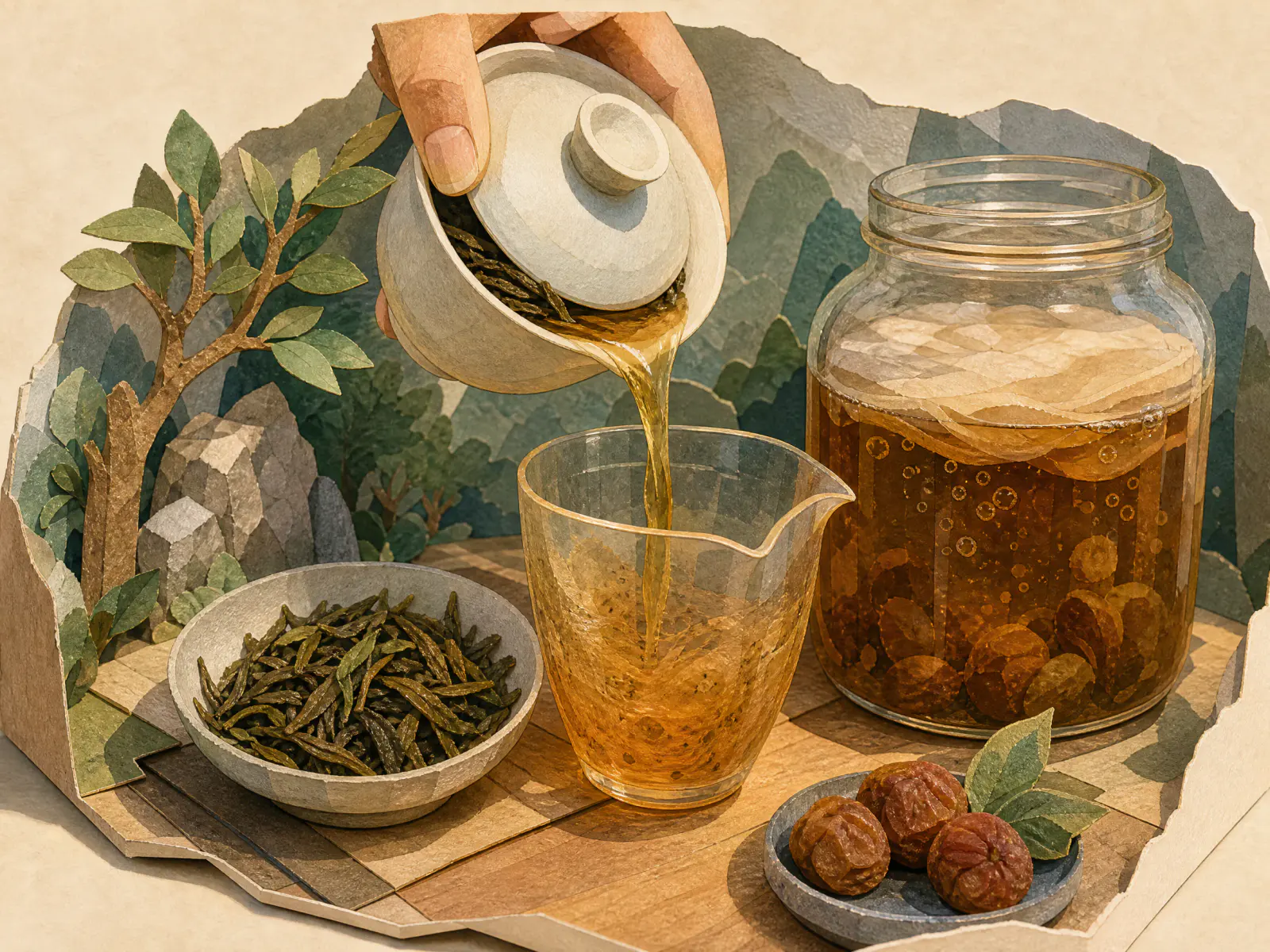
The strange thing about Yiwu tea is that its strength does not always announce itself as flavor.
A young raw pu-erh from another part of Yunnan may lead with bitterness, sharp fragrance or astringency. Yiwu can seem quieter. Then you notice the tea soup. It moves slowly across the tongue, coats the mouth and remains present after the obvious flavor has gone. Some Yiwu teas feel closer to a very light broth than scented water.
I noticed the same quality for the wrong reason when I used Yiwu as a kombucha base. The finished drink was too thick. Fermentation gave the tea acidity and aroma, but it did not give it the brisk, refreshing shape I wanted. It made the texture harder to ignore.
That raised a useful question. Is Yiwu simply sweet, causing the brain to read the drink as thicker, or is there something in the liquor that physically changes its body?
The research points to both. Soluble sugars matter, but “Yiwu has more sugar” is too simple. A better explanation involves several kinds of carbohydrate, especially polysaccharides and pectin, along with proteins, polyphenols and all the other material dissolved or suspended in the cup. Tea soup is not just flavored water. It is a dilute, complicated colloidal system.
Thick is not the same as strong
Strength can mean bitterness, aroma or flavour concentration; thickness concerns body, coating and perceived weight. A quiet tea may carry substantial non-volatile material, while a sharply bitter or fragrant cup can still feel thin.
Bitterness and much of raw pu-erh’s grip come mainly from caffeine and polyphenols, including catechins. Free amino acids contribute sweetness, umami and freshness. Small soluble sugars contribute sweetness. Aroma comes from another set of volatile molecules that reach the nose from the cup and retronasally while drinking.
Thickness is less tidy. It combines physical viscosity and coating with smoothness, salivary effects and the way sweetness changes our perception of weight.
| Quality in the cup | Main contributors | What it feels like |
|---|---|---|
| Bitterness and grip | Caffeine and polyphenols, including catechins | Immediate intensity or drying structure |
| Aroma | Volatile compounds | Floral, fruity, green, roasted or aged notes reaching the nose |
| Sweetness and freshness | Small sugars and free amino acids, among other compounds | Sweet, umami or fresh impressions |
| Thickness and coating | Soluble solids, polysaccharides, proteins, polyphenol assemblies and perception | Weight, smoothness or a lingering film across the mouth |
A 2025 LWT study supports that distinction. Researchers centrifuged Keemun black-tea infusions to alter their suspended particles. As soluble solids, proteins and polysaccharides changed, trained tasters’ thickness ratings changed with them. This was black tea, not Yiwu sheng, but it shows that tea body reflects a physical system of dissolved molecules and tiny assemblies rather than poetic language alone.
Sugar is only one member of the family
Simple sugars mainly add sweetness; long-chain polysaccharides and pectin can bind water and change flow at much lower concentrations. Their size, branching and interactions with proteins or polyphenols matter as much as a total-carbohydrate number. One Journal of Tea Science experiment found that two isolated tea-polysaccharide preparations differed roughly fourfold in apparent viscosity.
Pectin is another credible contributor because processing can move it from plant cell walls into water-soluble forms associated with smoother liquor. None of this proves that Yiwu contains more useful polysaccharides or pectin than Bulang, Jingmai or Mengku; no controlled regional comparison has measured both composition and viscosity.
What has actually been measured in Yiwu?
One peer-reviewed paper compared raw pu-erh from two Yiwu sites: Manxiu on a sunnier slope and Zhengjialiangzi on a shadier one.
The difference between the two samples was striking:
| Dry-leaf measurement | Manxiu | Zhengjialiangzi |
|---|---|---|
| Tea polyphenols | 18.25% | 16.35% |
| Catechins | 13.42% | 13.38% |
| Total soluble sugar | 0.92% | 0.55% |
| Free amino acids | 1.18% | 1.28% |
| Water extract | 45.57% | 32.14% |
Water extract measures how much dry-leaf material can move into hot water under test conditions. Manxiu’s 45.57% is compatible with a dense cup, while its higher soluble-sugar result supports a sweeter presentation. Yet the large difference between these two Yiwu sites is the real lesson: “Yiwu chemistry” is not fixed.
The study included no other mountains, viscosity measurements, isolated polysaccharides or pectin. It supports soluble sugar, amino acids and high water-extract potential in particular Yiwu samples; general tea research supplies the link between soluble material and thickness. No published study has yet joined those halves with matched Yiwu and non-Yiwu viscosity tests.
How a quiet flavor can sit inside a dense liquor
Imagine two cups with the same total mass of extracted material. Cup A is dominated by compounds that taste bitter, sharp and drying. Cup B carries more neutral or gently sweet carbohydrate, soluble protein and colloidal material. Cup A will announce itself immediately. Cup B may feel heavier even though its flavor seems less forceful.
Proteins and polyphenols can form particles that alter both astringency and body, while sweetness can increase perceived thickness without a large change in measured viscosity. This is why “soft” need not mean weak: a good Yiwu may enter gently, then reveal concentration through coating, salivation and a long sweet return.
Brewing also changes the effect. More leaf, hotter water, longer contact and smaller particles generally extract more material. Water chemistry changes astringency and particle stability, while cooling makes the same liquor feel physically thicker.
What about the relaxing feeling?
I find Yiwu unusually relaxing, but no controlled trial has compared its bodily or mood effects with other raw pu-erh regions. A 2025 review found modest evidence for some attention effects from tea or theanine, but much weaker evidence for relaxation. Dose, food, caffeine tolerance, expectation and the slower rhythm encouraged by a soft tea may all shape the session. The experience is worth recording; it is not a proven Yiwu biochemical trait.
Is Yiwu raw pu-erh suitable for kombucha?
Kombucha adds a second carbohydrate system to a tea that may already have plenty of body.
Yeasts break added sugar down while bacteria make acids, cellulose and sometimes other extracellular polysaccharides. That gives three plausible contributors to an overly thick batch:
- The starting tea already contains a relatively high load of dissolved and dispersed solids, including plant polysaccharides and possibly soluble pectin.
- Residual sucrose, glucose and fructose add sweetness and can increase perceived thickness even if the change in physical viscosity is small.
- Cellulose fibrils, microbial biomass and extracellular polysaccharides produced during fermentation can add suspended structure and bind water.
Fermentation time does not produce a simple upward viscosity curve. A 2026 study found rises and falls under different time and temperature conditions, while a laboratory study confirmed that a kombucha culture can produce extracellular polysaccharides in a pu-erh medium. The latter used optimized, high-sugar conditions, so it demonstrates a route rather than a normal drinking recipe.
Raw pu-erh is not inherently poor for kombucha. Researchers fermented it successfully with several cultures in 2024, and a 2025 experiment produced well-liked batches at two sugar levels. My Yiwu was unsuitable for the brisk style I wanted; the tea, sugar, starter culture, extraction and schedule formed that result together.
A useful experiment for the next batch
I would compare three small batches: Yiwu, a similar non-Yiwu sheng, and the tea that normally makes a good kombucha. Keep leaf, water, sugar, starter, vessel and temperature identical. Before and after fermentation, record pH, Brix, liquid temperature and flow time through the same narrow outlet; repeat the flow test after fine filtration.
If Yiwu is slower before inoculation, the tea matrix matters. If it thickens only during fermentation, the culture is the stronger suspect. If filtration removes the difference, suspended cellulose or biomass is involved. This is a comparison, not a substitute for a viscometer.
For anything intended for drinking, normal kombucha sanitation and acidification checks still take priority over the experiment. A batch that does not acidify normally is a failed batch, however interesting its texture may be.
Where the evidence leaves us
The thick Yiwu tea soup is not imaginary. Long-chain polysaccharides and pectin can change water binding and flow; proteins, polyphenols and other solids help form the infusion’s structure; small sugars add sweetness and can make that thickness more obvious.
Yiwu-specific measurements fit this account but do not close the case. The two samples differed sharply, and we still lack matched regional measurements of pectin, polysaccharide structure, dissolved solids, particle size and viscosity.
Until then, I would describe good Yiwu this way: the flavor does not have to shout because the tea is carrying its weight somewhere else.
For more context on the place behind the label, read the Yiwu tea mountain guide and the field note From Guafengzhai to the River Road.
Research cited
Wang J, Xue Q, Hu Y, Yang H. Analysis of Physicochemical Composition of Yiwu Ancient Tree Tea. Science and Technology of Food Industry. 2021;42(15):211-217.
Li Y, Pan W, Feng Z, et al. Deciphering composition-structure-taste relationship of black tea-infusion via assessments of nanoparticles by centrifugal treatment. LWT. 2025;222:117601.
Li L, Wang D, Zhou X, Ding Q. Study on Food Functionality of Tea Polysaccharides. Journal of Tea Science. 2006;26(2):102-107.
Payne ER, Aceves Martins M, Dubost J, Greyling A, de Roos B. Effects of Tea, L-theanine, or L-theanine Plus Caffeine on Cognition, Sleep, and Mood in Healthy Participants. Nutrition Reviews. 2025;83(10):1873-1891.
Zhang J, Ma H, Wang H, et al. Flavor and sensory profile of kombucha fermented with raw Pu-erh tea and evaluation of the antioxidant properties. LWT. 2024;200:116220.
Yao L, Ma H, Yao L, et al. Initial Sugar Concentration on Sensory Characteristics of Raw Pu-Erh Tea Kombucha and Multi-Omics Analysis. Foods. 2025;14(18):3216.
Wu Y, Chen Q, Ruan H, He G. Optimization of Liquid Fermentation Process for Improved Exo-Polysaccharides Production by Kombucha ZJU1. Advance Journal of Food Science and Technology. 2013;5(2):217-224.
Salinas-Ruiz JP, Guevara García J, Rios Tovar D, et al. Effects of Fermentation Time and Temperature on the Physicochemical Quality of Kombucha. Foods. 2026;15(7):1226.
Quick answers
Frequently asked questions
Why does Yiwu pu-erh tea feel thick?
A plausible explanation combines dissolved and suspended material in the infusion: soluble sugars, longer-chain polysaccharides, pectin, proteins and polyphenol complexes. Yiwu-specific measurements show high water-extract potential in one sample, while broader tea research links soluble solids and polysaccharides with perceived thickness. Direct regional viscosity comparisons are still missing.
Is thick tea the same as strong tea?
No. Strength can mean bitterness, aroma or flavour concentration, while thickness concerns body, coating and perceived weight. A tea may have restrained aroma and bitterness yet carry substantial non-volatile material. Conversely, a sharply bitter or fragrant cup can still feel physically thin.
Does all Yiwu tea have a thick mouthfeel?
No controlled study shows that every Yiwu tea is thicker than tea from other Yunnan regions. Two measured Yiwu samples differed sharply in water extract, soluble sugar and aroma compounds. Garden, plant material, season, processing, storage, brewing and water can all change the body of the cup.
Do tea polysaccharides make Yiwu tea thick?
They are a credible contributor, not a complete regional proof. Long-chain polysaccharides and pectin can bind water and interact with proteins and polyphenols, while general tea studies connect soluble polysaccharides with thickness. Yiwu research has not yet measured matched polysaccharide structure, pectin and viscosity against other origins.
Is Yiwu raw pu-erh suitable for kombucha?
It can be, but Yiwu is not guaranteed to produce the brisk style you want. The starting tea, sugar level, extraction, microbial culture and fermentation schedule all shape texture. My batch became too thick; published studies show that other raw pu-erh kombuchas fermented successfully, so the result is batch-specific rather than a regional rule.