Yunnan's Uneven Spring: The 2026 Weather Story Behind Your Tea
Rain came when it wanted, not where it was expected. Here's how the 2026 spring season played out across Yunnan's tea mountains — and what it means for the cup.
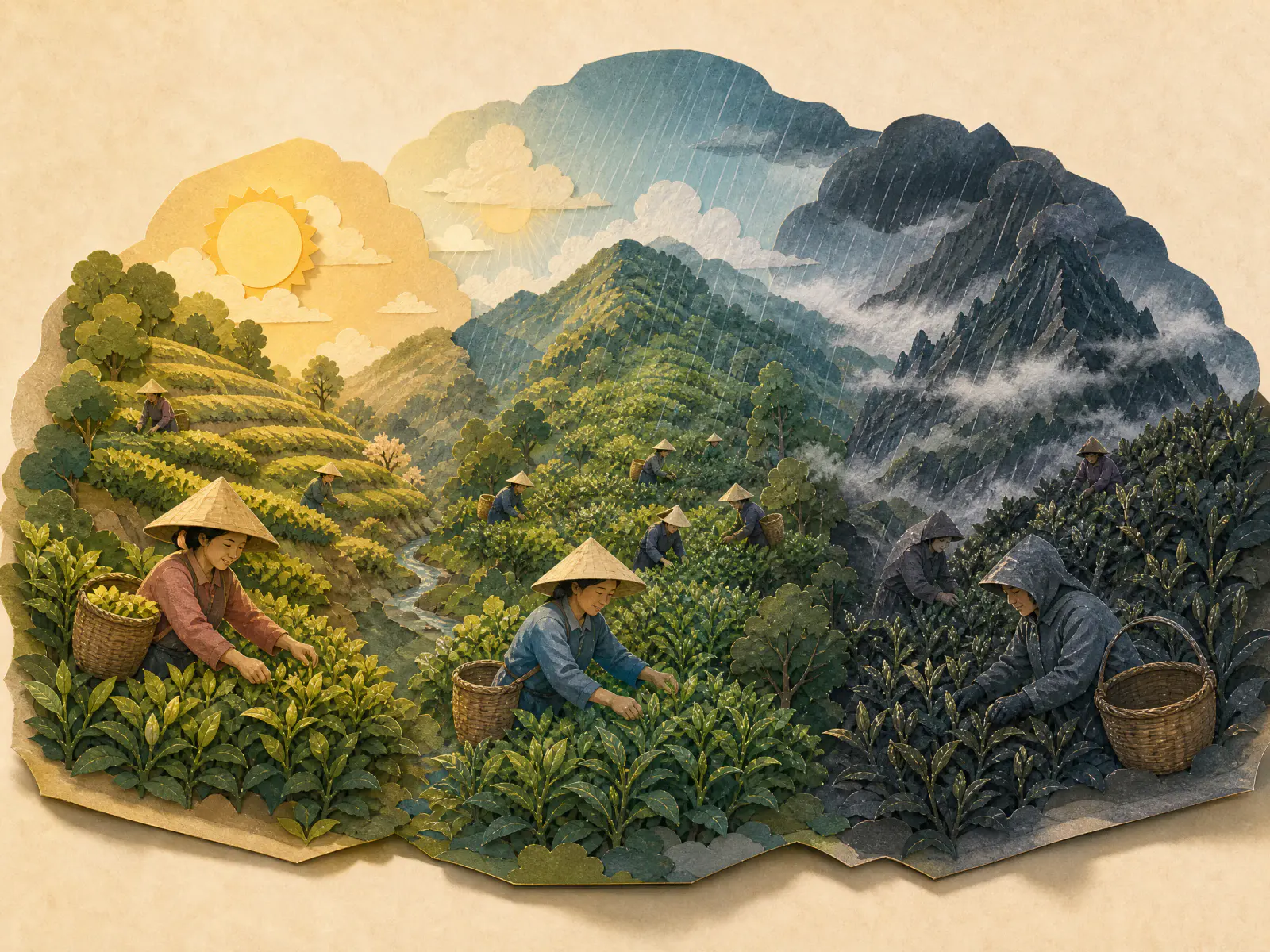
The rains didn’t read the forecast.
Yunnan entered its 2026 spring harvest season with meteorologists predicting a dry spell — 10–20% less rain than usual across the main tea belt. What actually happened was messier, more interesting, and more局部. Some mountains got perfectly timed showers. Others got cold snaps. A few got almost nothing. The result was a harvest defined by contrast: between gardens that thrived and gardens that struggled, between mountains five hours apart, between tea that cost more and tea that sat unsold.
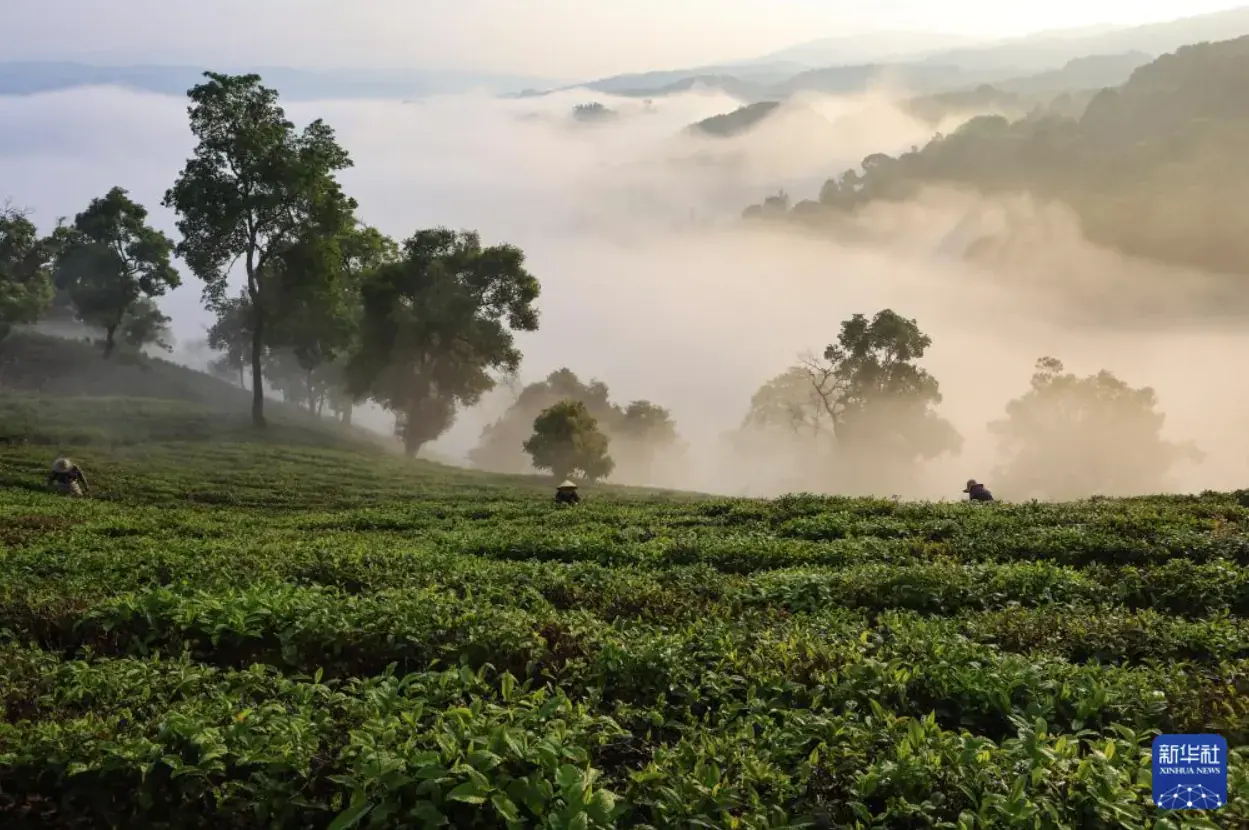
Mist over Menghai’s tea gardens, mid-March 2026. Photo: Li Yunsheng/Xinhua, via Yunnan Daily.
Overall production across Xishuangbanna, Lincang and Pu’er was up 5–10% on the year — but most of that was plantation and small-to-medium-tree leaf. Ancient-tree output barely moved. That distinction matters more than it might seem, because Yunnan tea doesn’t trade on volume alone. It trades on name, age, and increasingly, on proof.
Changning: the early riser
In Baoshan’s Changning County, February felt like March. Temperatures climbed early, and the early-budding Huangdan cultivar started pushing new growth well ahead of schedule. Picking opened on February 27 — one of the earliest starts anyone could remember.
The early harvest gave growers a clean shot at the “first fresh” market, where buyers pay a premium for novelty. Fresh leaf prices held around RMB 30/kg, roughly level with the previous two years. Ancient-tree finished tea sold at RMB 1,500–2,000/kg.
The cup reflected the conditions: an early, warm spring generally gives lighter, more floral teas with brisk astringency and less of the deep, slowly-developed sweetness you get from a slower-growing spring flush. Changning’s 2026 teas were solid daily drinkers — pleasant, forward, clean — but not particularly concentrated or complex. Perfectly fine, nothing landmark.
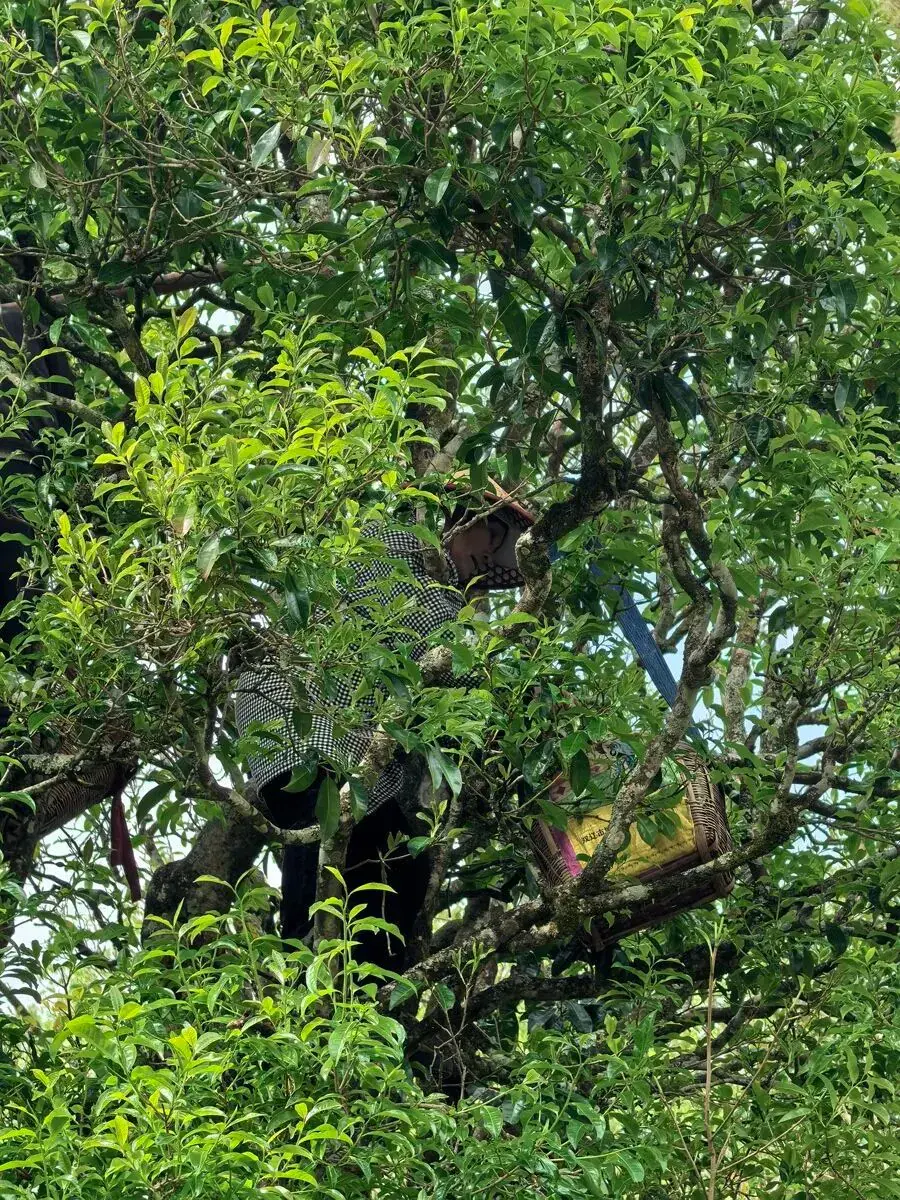
Ancient-tree harvest in Changning, April 2026. Photo: Baoshan municipal government.
Jingmai: the season’s standout
Jingmai Mountain had the kind of spring that makes growers quietly optimistic. Rainfall was evenly distributed, sunlight was ample, temperatures were stable — no late cold snaps, no sudden dry spells. By early April, the 114,800-mu tea landscape was projecting a 3,947-tonne spring harvest, including 511 tonnes of ancient-tree material, with a total output value around RMB 397 million.
Mainstream Jingmai spring tea — the volume tier, not single-village or ancient-tree — reportedly traded at RMB 1,800–3,000/kg, up roughly 10% on the year. That may not sound dramatic, but for a broad market tier, it’s a meaningful move.
The taste profile matched the conditions: steady, well-watered growth without stress tends to produce fuller-bodied teas with richer aromatic development, clean huigan, and more depth than a compressed or drought-affected harvest. Several industry reports noted the 2026 Jingmai character as notably more developed than 2025. If you had one cup to make the case for a good Yunnan spring, Jingmai 2026 was it.

Jingmai Mountain in early April. Image: Lancang County Media Center/Xinhua, via Xinhua.
Zhenyuan: the cold shoulder
Less than five hours’ drive north of Jingmai, Zhenyuan County had a different spring.
Cold spells and persistent rain delayed picking across higher-elevation gardens in the Wuliang Mountains — some areas by more than a week. High-altitude tea is always more exposed to temperature swings; in 2026, that exposure cost them. Delayed picking means uneven leaf maturity: some buds had moved past optimal development while others were still tight, producing a less coherent final product.
The price response was selective rather than broad. Reduced supply can support prices, but only when buyers trust what they’re buying and believe the scarcity is real. In a market where buyers can source from half a dozen other mountains, a Zhenyuan delay didn’t move the market — it just meant the good, documented lots sold at a small premium, while the rest competed on price.
Taste-wise, delayed-pick teas from stressed conditions tend toward sharper bitterness, thinner body, and a less satisfying huigan. Not ruined — but not the benchmark Zhenyuan can produce in a kinder season.
Xishuangbanna: more tea, same market
Menghai was picking by mid-March — a relatively normal opening for the lower, warmer valleys of Xishuangbanna. With regional production up on the year, there was no shortage of leaf.
But the broader market remained cautious. Tea companies and traders could pick and choose across producing areas with limited pressure to chase any single origin. Plantation tea and material from less-famous villages faced real price competition. More leaf did not automatically mean more money.
At the top end, nothing budged. The price index from Kunming International Spring Tea Week told a familiar story:
| Village | Grade | RMB/kg |
|---|---|---|
| Laobanzhang | Ancient tree | 8,500 |
| Laobanzhang | Mixed / large tree | 3,500 |
| Yiwu Bohetang | First | 25,000 |
| Yiwu Bohetang | Second | 9,000 |
Quality in Xishuangbanna was broadly good — better body and sweetness than the leaner 2024–25 vintages. But a good year only matters if the tea in your cake is actually from where the label says it is. Provenance questions remained as live as ever.
Lincang: the Bingdao exception
Lincang was forecast dry and got better rain than expected — enough to push production up across the region despite the outlook.
In Shuangjiang County, home of Bingdao, the official conversation in April was telling. The focus was less on supply concerns and more on quality control and geographical-indication protection. Because for Bingdao, the real commercial risk isn’t weather — it’s counterfeit.
Bingdao Laozhai first-grade: RMB 35,000/kg. Second-grade: RMB 20,000/kg. That gap between a village name and commodity pricing is the entire story of Yunnan tea in one number.
The non-Bingdao Lincang crop was solid. Better sweetness, reasonable body. But it sold at commodity prices because it lacked the village identity that commands a premium. Same latitude, same rain, radically different outcome.
The 2026 takeaway
The official survey of 108 well-known Yunnan mountains showed prices generally moving lower across the board — even as quality and volume improved. Only a handful of famous ancient-tree or single-tree lots rose more than 15%.
The reasons weren’t complicated:
- Plantation tea supply rose faster than demand. Buyers had options.
- Ancient-tree supply stayed controlled — conservation picking, once-a-year harvesting, deliberate restraint.
- Pu-erh prices have always been set by identity more than quality.
- Livestream fraud and false mountain claims made buyers more cautious, not less. Provenance documentation started mattering as much as provenance itself.
| Area | What happened | How it priced |
|---|---|---|
| Jingmai | Even rain, good sun | Mainstream RMB 1,800–3,000/kg, ~10% up |
| Zhenyuan | Cold + rain, delayed pick | Small premium for scarce documented lots only |
| Menghai / Xishuangbanna | Normal timing, higher volume | Plantation leaf soft; ancient-tree unchanged |
| Shuangjiang / Lincang | Better rain than forecast | Bingdao RMB 20,000–35,000/kg; ordinary leaf under pressure |
| Changning / Baoshan | Warm February, early pick | Fresh leaf ~RMB 30/kg; ancient-tree RMB 1,500–2,000/kg |
What this means in the cup
Weather writes the first draft of every spring tea. But in Yunnan, the final edition is edited by provenance, brand, and increasingly, paperwork.
The useful questions for anyone buying 2026 Yunnan spring aren’t “was it a good year?” — it was, in most places — but: which mountain, at what elevation, picked when, from what kind of tree, and can you prove it?
The answer to those questions is what determines the cup and the price.
Sources
- Yunnan spring 2026 climate outlook, China Weather/Yunnan
- Jingmai spring production and growing conditions, Yunnan Department of Agriculture and Rural Affairs
- Jingmai harvest report, Xinhua
- 2026 Yunnan spring-tea season assessment, Hong Kong Commercial Daily
- Menghai spring harvest photographs, Yunnan Daily/Xinhua
- Zhenyuan 2026 spring-tea review
- Lincang/Shuangjiang spring-tea industry report
- Changning early spring harvest and fresh-leaf prices, Baoshan municipal government
- Changning ancient-tree harvest and prices, Baoshan municipal government
- Officially reported prices for 108 Yunnan tea mountains, China News Service
- Indicative 2026 village-level price reporting, Yunnan rural information service
Photo-rights note: photographs displayed with source attribution. Permission and licensing should be confirmed with the originating publishers before reuse elsewhere.
Quick answers
Frequently asked questions
Was Yunnan's 2026 spring tea weather the same everywhere?
No. Timing and conditions differed across producing areas. Broad statements about a good or bad Yunnan spring hide local differences in warmth, rainfall, harvest timing and yield.
Does difficult weather always make better tea?
No. Stress, slower growth and lower yield can affect concentration, but excessive rain, cold, drought or delayed picking can also reduce quality. Processing and the specific lot still matter.
How should a buyer use a seasonal weather report?
Use it as context for harvest timing, yield and possible style differences, then ask about the exact village, picking date and batch. Weather cannot predict the taste or quality of every cake from a region.