Pu-erh Tea and Your Gut: What the Science Actually Says
Looking at recent research on how pu-erh tea's microbial fermentation changes the gut microbiome — and what's evidence versus hype for the average pu-erh drinker.
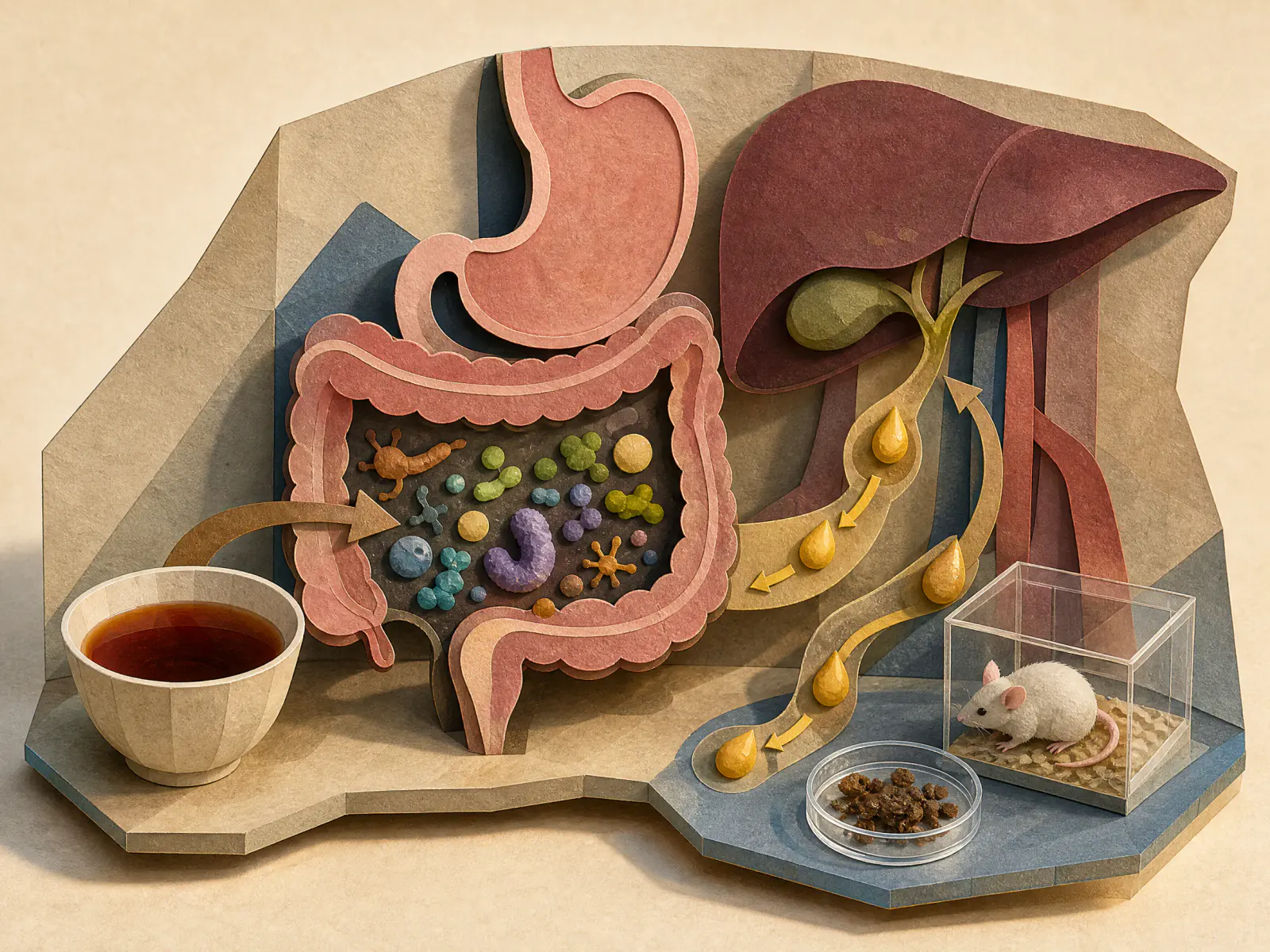
I found a 2022 review paper on pu-erh and metabolic health that does something rare: it takes the gut microbiome research seriously without turning tea into a miracle cure. Online claims tend to bounce between “pu-erh melts belly fat” and “it’s just tea.” The research sits somewhere in the middle, which is much more interesting.
What makes pu-erh chemically different from other teas
It took me a while to get this straight in my head. Pu-erh is not “fermented tea” in the same sense that black tea is oxidised. Black tea gets its colour from enzymes in the leaf breaking down catechins. Pu-erh gets its character from bacteria, yeasts, and fungi living in the tea pile and transforming it from the outside in. Think cheese, kombucha, or miso rather than an ordinary cup of black tea.
The review names a few of the microbes involved. Aspergillus species appear early and produce many of the flavour compounds. Bacillus, Rasamsonia, Lichtheimia, and Debaryomyces become dominant later. Ripe (shou) pu-erh goes through this over 30 to 60 days in a wet pile. Raw (sheng) pu-erh takes years, changing through whatever microbes colonise the cake during storage.
One molecule that comes out of this activity is theabrownin, a brown pigment formed when microbes oxidise and polymerise the catechins found in fresh leaf. It gives ripe pu-erh its familiar dark reddish-brown liquor. Green and black tea contain almost none of it, while pu-erh contains a lot.
The gut microbiome connection
This is where the research gets useful for regular pu-erh drinkers. The paper summarises several animal studies, mostly involving mice on high-fat diets, in which pu-erh and theabrownin produced measurable changes in the gut:
- The Firmicutes/Bacteroidetes ratio drops. This ratio is consistently higher in obese mice and humans, and pu-erh moves it back towards the lean profile.
- Beneficial bacteria increase. These include Akkermansia, which is negatively correlated with weight gain; Bacteroides acidifaciens, which improves insulin sensitivity; Parabacteroides goldsteinii; and Blautia, a producer of short-chain fatty acids.
- Several studies found lower levels of circulating inflammatory markers such as LPS, IL-6, and TNF-α.
One experiment was particularly neat. Researchers transplanted faecal matter from pu-erh-fed mice into obese mice, and the recipients showed improved metabolic measures. This suggests that at least part of the effect comes through the microbiome itself, rather than only through compounds absorbed from the tea.
The most concrete lead is cholesterol
Cholesterol is one pu-erh claim with at least some human data behind it. Most of the proposed mechanism comes from mouse experiments, and it looks like this:
- Theabrownin suppresses certain gut bacteria that produce bile salt hydrolase (BSH).
- Without BSH, bile acids stay in their “conjugated” form longer.
- Conjugated bile acids inhibit a receptor called FXR in the intestine.
- The liver responds by burning more cholesterol to make new bile acids.
- Net result: serum cholesterol drops.
This was the main finding of a 2019 Nature Communications paper from the same research group, Huang et al. The paper also included a four-week intervention with 13 male participants. That is an interesting lead, but far too small and short to turn into a clinical recommendation.
What I would take from this as a tea drinker
After reading the paper, I sorted the claims into three rough piles.
The reasonably supported pile:
- Pu-erh has a real, measurable effect on the gut microbiome in animal studies.
- A short human intervention found changes in blood lipids and gut microbes, although it needs much larger independent trials.
The plausible but less proven pile:
- Fermentation and theabrownin content may change how a pu-erh interacts with the body, but “ripe is more bioactive than raw” is too simple a rule.
- Long-term daily pu-erh consumption might contribute to weight management, but that has not been established.
- Pu-erh may influence inflammation, but the evidence is mostly from mice and does not establish an effect in people.
And the marketing pile:
- Anti-cancer claims. Mouse and cell-line studies exist, but the leap to preventing cancer in humans is enormous.
- “Detox” claims. Mostly meaningless.
- Anti-ageing claims based on neuroprotection studies. This work is at a very early stage.
The honest caveats
A few caveats matter when we bring this back to the tea table.
Most of the data comes from mice, especially the gut microbiome research. Mouse microbiomes are not human microbiomes, and mice on high-fat diets are not healthy people drinking tea for pleasure. The patterns are interesting, but we do not yet know whether they translate to everyday tea drinkers.
Whole tea is not the same thing as purified theabrownin. The paper points out a curious contradiction: whole pu-erh increases Faecalibacterium prausnitzii, an anti-inflammatory microbe, while purified theabrownin decreases it. Tea contains several active compounds that can pull in different directions, so one isolated molecule cannot tell the whole story.
The microbial strain and processing method matter too. A 2018 paper cited in the review, Pedan et al., found meaningfully different chemical fingerprints in aged raw pu-erh and young ripe pu-erh. A 20-year-old raw cake and a 2-year-old ripe cake are probably not interchangeable in terms of health effects, even though both are called pu-erh.
My tea-table conclusion
If you already enjoy pu-erh, treat the microbiome and cholesterol research as an interesting extra, not a promise. The best reason to drink it is still that you like it.
I would love to see long-term human trials that track stool metagenomics, lipid panels, and inflammatory markers over years rather than weeks. Until then, I am happy to treat pu-erh as a pleasant fermented food that may offer a modest benefit. People have been drinking it that way for centuries.
References
Jia W, Rajani C, Lv A, Fan TP, Zheng X. Pu-erh tea: A review of a healthful brew. Journal of Traditional Chinese Medical Sciences. 2022;9:95-99. https://doi.org/10.1016/j.jtcms.2022.04.005
Huang F, Zheng X, Ma X, et al. Theabrownin from pu-erh tea attenuates hypercholesterolemia via modulation of gut microbiota and bile acid metabolism. Nature Communications. 2019;10(1):4971.
Liu JY, He D, Xing YF, et al. Effects of bioactive components of pu-erh tea on gut microbiomes and health: A review. Food Chemistry. 2021;353:129439.
Pedan V, Rohn S, Holinger M, Huhn T, Chetschik I. Bioactive compound fingerprint analysis of aged raw pu’er tea and young ripened pu-erh tea. Molecules. 2018;23(8):1931.
Quick answers
Frequently asked questions
Does Pu-erh tea improve gut health?
Animal and laboratory studies suggest plausible effects on gut microbes and bile-acid pathways, but human evidence is still limited. The research does not support promising a specific gut-health result from drinking Pu-erh.
What are theabrownins in Pu-erh tea?
Theabrownins are complex dark-coloured compounds associated especially with fermented teas. Researchers are studying their relationships with microbes, bile acids and lipid metabolism, but composition and effects vary by tea and study.
Can Pu-erh tea lower cholesterol?
Some studies report promising mechanisms or changes, particularly in animals, but Pu-erh is not a substitute for cholesterol testing, diet advice or prescribed treatment. Human clinical evidence is not yet strong enough for a reliable personal promise.