Why does Xiaojinggu matter?
Xiaojinggu (小景谷, Xiǎo Jǐnggǔ) is the tea-trade name for the country around today’s Jinggu Town in northern Jinggu Dai and Yi Autonomous County, Pu’er City. It is not a current administrative unit or one mountain. The easiest way to get to know it is village by village, especially through Wenshan Village and its best-known tea area, Kuzhushan.
Young raw Pu’er from the better-documented areas often opens with firm bitterness, floral or sweet aroma and salivation, then gathers sweetness after the swallow. There is plenty of room for surprise. One Wenshan Ding example was notably soft and almost free of bitterness, while Kuzhushan examples can be forceful. That makes Xiaojinggu fun to compare, but useless as a guaranteed flavour. The name alone cannot establish a village, garden, tree age, cultivar or season. Ask what sits underneath it.
What does Xiaojinggu tea taste like?
No provenance-audited ImperfecTea flight exists yet, so the profile below combines product-specific vendor accounts, public drinker reviews and local descriptions. It is most reliable for Kuzhushan raw Pu’er, less so for the whole town.
| Dimension | Recurring evidence | Important variation |
|---|---|---|
| Aroma | Floral, sweet, grassy and cup-bottom fragrance recur | Smoke, roast and greenness may come from processing; older storage changes the picture |
| Taste | Bitterness followed by sweetness is common in Kuzhushan examples | Farmer Leaf’s 2022 Wenshan Ding was deliberately soft, with no bitterness and low astringency |
| Texture | Medium-to-full, rounded, juicy or smooth in several accounts | Some examples emphasize fragrance more than body; leaf grade and rolling can change extraction |
| Astringency | Usually present but secondary to bitterness in the better-described raw examples | Strong brewing quickly amplifies dryness; one cannot infer a mountain from it |
| Huigan | Returning sweetness is the most consistent through-line | Speed and duration differ by product and brewing |
| Shengjin | Salivation appears in regional and product descriptions | Needs controlled comparison; water and dose matter |
| Finish | Floral-sweet, grassy or sugar-like aftertaste | Storage and processing can dominate |
| Stamina | Several individual teas lasted well in reviewers’ sessions | “Twelve steeps” is a product/session result, not a regional fact |
| Body sensation | Relaxed, mellow or forceful effects are reported | Subjective and not useful for authentication |
The contradictions are the interesting part. Three public tastings of Yunnan Sourcing’s 2015 Kuzhushan found strong early bitterness, grassy/floral sweetness and a gradual sweet turn; one taster used an unusually heavy 12.8 g in 160 ml. Yunnan Craft’s 2022 cake was described as intensely floral, generally smooth and gentle, but astringent under hard extraction. Farmer Leaf’s 2022 Wenshan Ding went further in the soft direction: juicy texture, building sweet aftertaste, almost no bitterness and low astringency, with customer notes ranging from thick and meadow-sweet to merely predictable.
That spread rules out the lazy sentence “Xiaojinggu tastes like X.” A better tasting question is: does the tea keep its aroma, texture and sweet return when brewed firmly, and does the seller’s locality claim explain why this lot differs from another one made in the same town?
Where is Xiaojinggu, and what kind of name is it?
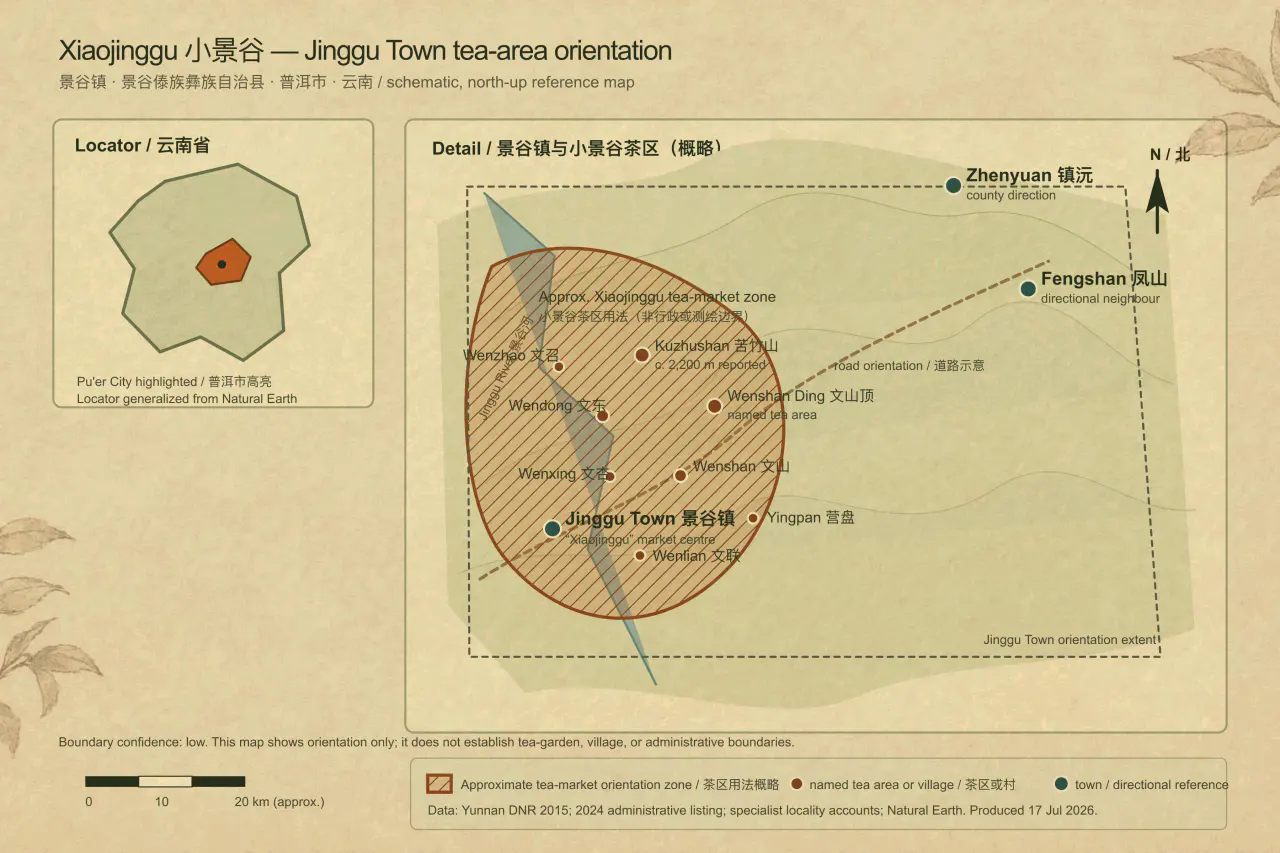
Existing Xiaojinggu orientation graphic, produced 17 July 2026. Its Yunnan locator uses Natural Earth, but the detail panel’s boundary, road, river, terrain, scale and locality positions are illustrative rather than GIS-derived. “Yingpan” is also not a current village committee. The image is therefore a research aid, not the licensed, publication-qualified composite map required by this guide series. Boundary confidence: low.
The naming puzzle is easier once the layers are kept separate:
- Jinggu Dai and Yi Autonomous County (景谷傣族彝族自治县) is the county. Its seat is at Weiyuan Town, not Jinggu Town.
- Jinggu Town (景谷镇) is a township-level unit in the north of the county. It was Jinggu Township (景谷乡) until the town was formally inaugurated in August 2013; the territory, administrative affiliation and government seat remained the same.
- Xiaojinggu is not in the current administrative list. Tea sources use it to distinguish the old town and its tea country from the larger county, but no public legal or surveyed boundary was found.
- Jinggu Town currently has nine administrative villages-Jinggu, Yunpan, Wenxing, Wendong, Tuanshan, Wenlian, Wenzhao, Wenshan and Xiangshui-plus Chayuan Community in more recent reporting.
- Kuzhushan is a village group and tea area within Wenshan administrative village. Wenshan Ding is a tea-area or mountain-top name, not a village committee.
The present graphic cannot prove more than rough orientation. A replacement needs official county/town boundaries, verified locality points, a real road and river layer, measured scale, sources and licensing. Until then, do not read the hatched shape as a terroir polygon or the dots as coordinates.
The administrative change sounds larger than it was. In the 2013 establishment report, the former township’s territory became the town’s territory without moving the government seat; it still had nine village committees and 95 village groups at that date. Chayuan Community was added later and was formally inaugurated in 2021. That is why a newer source can describe nine villages plus one community and more groups without contradicting the older record. For tea drinkers, the practical lesson is simple: an older cake marked 景谷乡 and a newer one marked 景谷镇 may point to the same broad administrative country, but neither wording identifies the leaf’s village or garden.
Which of the five ‘Wen’ villages is on the label?
Xiaojinggu articles often copy a string of similar-looking names. The resemblance is orthographic, not evidence that the places are synonyms or one continuous garden. This matrix keeps administrative villages, village groups and commercial tea names apart.
Wenshan contains Kuzhushan
Wenshan is the place to begin because it has the clearest bridge between administration and tea. Recent reporting describes it as the town’s easternmost mountain village, names Kuzhushan as one of its village groups, and places the best-known production area around that group and neighboring settlements. The same reporting also shows why a famous name should not be mistaken for a single garden: Wenshan as a whole had more than 10,000 mu of tea in 2023, while Kuzhushan was described as a smaller center within it. “Kuzhushan” on a cake can therefore be more specific than “Wenshan” or “Xiaojinggu,” but the label still needs a household, lot and season before it becomes traceable.
The name matrix
| Name | Current type | Tea relationship | What is supported | Confidence |
|---|---|---|---|---|
| Wenxing 文杏 | Administrative village in Jinggu Town | Tea gardens and certified fresh-leaf scope appear in official certification material | A current village committee; not interchangeable with Wenshan or Wenshan Ding | Verified hierarchy; garden specifics partial |
| Wendong 文东 | Administrative village | Current organic-certificate lists include Wendong tea-garden fresh leaf | A current village committee. Some older tea pages attach Kuzhushan to Wendong, but stronger recent local reporting puts Kuzhushan under Wenshan | Verified hierarchy; old tea-geography claim disputed |
| Wenlian 文联 | Administrative village | Tea-garden fresh leaf appears in provincial organic-certificate lists | A current village committee, not a natural-village alias | Verified hierarchy; internal garden matrix incomplete |
| Wenzhao 文召 | Administrative village | Official land-project records identify Xiaowenzhao as a lower-level place under Wenzhao | A current village committee; its precise role in premium Xiaojinggu tea remains under-documented | Verified hierarchy; tea evidence thin |
| Wenshan 文山 | Administrative village east of the town | Strongest documented tea center; contains Kuzhushan and Ma’jiu village groups and more than 10,000 mu of tea in 2023 local reporting | Parent village for the best-supported named gardens in this guide | Verified hierarchy and tea importance |
| Kuzhushan 苦竹山 | Village group / named tea area under Wenshan | Best-known Xiaojinggu raw-Pu’er name; local reporting centers a wider production area on the group | Not its own township or administrative village | Supported to verified |
| Ma’jiu 马厩 | Village group under Wenshan | Modern tea, purple-leaf Zijuan planting, and interplanting of tea with medicinal crops are reported | A real village group; not an old-tree synonym | Verified locality; project claims supported |
| Wenshan Ding 文山顶 | Mountain-top / tea-area name | A narrower sourcing label used for forest gardens east of the town | Not found as a current administrative unit; relationship to every Wenshan garden is not defined | Supported commercial/local usage |
| Dashi Temple 大石寺 | Historic site/locality in Wenshan | Used as an orientation point in Wenshan Ding accounts | A protected historic building/locality, not a garden certification | Supported as locality; tea boundary unknown |
| Yunpan 云盘 | Administrative village | Part of the current town; tea references occur but are less specific | Parent of Old Yingpan village group in 2022 local reporting | Verified hierarchy |
| Old Yingpan 老营盘 | Village group under Yunpan | May explain some loose “Yingpan” references | Not “Yingpan administrative village”; not proven identical to commercial Yingpanshan | Verified locality; tea identity unresolved |
| Yingpanshan 营盘山 / “Yingpan” 营盘 | Commercial or older tea-place wording | Appears in specialist tea lists | No current Jinggu Town village committee with this name was found; do not merge it with Yunpan or Old Yingpan without evidence | Reported / unresolved |
What remains unresolved
The current town also includes Jinggu, Tuanshan and Xiangshui administrative villages. They belong to the geography, but evidence is not yet strong enough to give each a premium-tea personality. We still need a complete natural-village and garden register before making more specific claims.
What may shape a Xiaojinggu cup?
Elevation and topography
Wenshan is the town’s easternmost and most remote mountain administrative village, 18 km from the town government in 2023 local reporting. The same report places important Kuzhushan gardens around 2,200 m. A 2025 village report places Ma’jiu around 1,600 m. These observations demonstrate internal height and exposure differences; they do not establish a 1,600-2,200 m tea-garden range for every Xiaojinggu lot.
Climate, soil and drainage
The safe description is a subtropical mountain-monsoon landscape with a wet growing season and pronounced local topography. A Jinggu white-tea association standard publishes county-wide climate and soil parameters, but those requirements apply to the broader Jinggu Dabaicha production area, not specifically to old gardens in Xiaojinggu. This guide therefore does not turn its county averages into a Wenshan microclimate or a flavor explanation.
Likewise, no plot-level Xiaojinggu soil study was located. Acidic red soils are plausible in the county, but “red soil creates sweetness” is not evidence. Drainage, organic matter, shade, fertilizer, pruning and harvest pressure need field measurements before they can explain a cup.
Forest and mixed cultivation
Recent Wenshan reporting documents two very modern forms of diversity: Ma’jiu growers have planted the purple-leaf cultivar Zijuan, and tea gardens are being interplanted with Polygonatum kingianum, a medicinal crop. Tuanshan reporting shows tea interplanted with food crops and poultry in broader town experiments. These examples are more useful than romantic “untouched forest” language. They show that Xiaojinggu is a working, changing farm landscape.
Plant material and “vine tea”
Farmer Leaf distinguishes Jinggu Dabaicha from what its producer calls an older, seed-grown large-leaf population and documents tengtiao (藤条, vine-style) management in the area: growers maintain fewer, longer branches rather than a low, dense picking table. That is good field evidence for the practice in particular gardens, not proof of one Xiaojinggu cultivar or of superior quality.
“Old tree,” “ancient tree,” “wild,” “arbor,” “forest” and “vine tea” answer different questions. None should supply an age by itself. Local reports quote old-garden acreage and expert-estimated tree ages at Kuzhushan, but no public tree-by-tree inventory or age method was located. The guide records those as local heritage claims rather than measurements.
Where the evidence stops
Xiaojinggu clearly contains different elevations, villages, garden histories, cultivars and management systems. Those variables can plausibly change leaf growth and processing decisions. The current evidence supports variation, not a single causal flavor recipe. We cannot yet assign bitterness to altitude, sweetness to soil, or body to tree age. A carefully made Wenshan tea may be soft; a Kuzhushan tea may be bracing; neither result disproves its origin.
How can processing change Xiaojinggu tea?
Raw Pu’er from the region begins with the familiar sequence of spreading/wilting, heat-fixing (shaqing), rolling and sun drying, followed by sorting, resting, blending and sometimes compression. The geography does not control those steps. A hot or smoky pan can flatten fragrance; insufficient heat-fixing can leave a sharply green, unstable tea; aggressive rolling can make a young tea feel thick and bitter; light rolling can make it seem airy. Sourness, heavy smoke and a rough drying finish should first trigger questions about process and storage.
Spring is the prestige reference in the product sources reviewed here. Autumn and summer material are not automatically inferior, but they should not borrow a spring profile or price. The town’s current industry also makes ripe Pu’er, white tea and sun-dried black tea. A Kuzhushan ripe cake and a Wenshan raw cake test different processes, not just origins.
Aging softens some green and bitter edges and can add wood, dried fruit or deeper sweetness, but storage is the competing variable. An old cake labeled “Jinggu” may be a county blend, a Xiaojinggu-area lot or simply an old commercial recipe. Without factory records and storage history, the wrapper cannot reconstruct the leaf.
How should I make a Xiaojinggu claim smaller?
A useful label moves from broad to specific:
Jinggu County → Jinggu Town / Xiaojinggu → administrative village → village group or garden → household/maker → season and lot.
Ask a seller:
- Does “Xiaojinggu” mean the whole town, Wenshan Village, Kuzhushan, Wenshan Ding or a blend?
- What is the Chinese locality name and its administrative parent?
- Which harvest and picking standard supplied the leaf?
- Is “old tree,” “forest,” “wild” or “tengtiao” a field observation, an invoice category or marketing shorthand?
- Who made the maocha, where was it pressed, and what lot records remain?
- Is the product raw Pu’er, ripe Pu’er, white tea or sun-dried black tea? The shared origin word does not make those comparable.
Do not treat an organic certificate for one organization or fresh-leaf base as a blanket certificate for the town. Do not treat “Wen-” as a single subregion. And do not pay a Wenshan Ding or Kuzhushan premium when the seller cannot get past “Jinggu ancient tree.”
No current market-price range is published here. The available offers mix years, seasons, raw and ripe processing, cake weights and unverifiable tree claims; two genuinely comparable dated observations were not found. For value, choose specificity over drama. A named Wenshan or Kuzhushan lot with a known maker is more educational than an anonymous “pure Xiaojinggu gushu” cake.
Useful comparisons include Wuliang-side tea with its county stated, Ning’er/Kunlu material, and a Jinggu County Yangta tea. They are not Xiaojinggu subregions. They help a drinker separate town, cultivar, process and storage.
How should I brew a Xiaojinggu comparison flight?
For young raw Pu’er, begin with 7 g per 100-110 ml, 95-100°C water, a brief rinse if compressed, and 5-8 second early steeps. If the first cups are punishingly bitter, reduce leaf or water temperature slightly before declaring the region harsh. If the tea seems weightless, extend one steep rather than adding a mountain story.
Track five things: aroma in the warm cup; the shape and location of bitterness; when salivation begins; whether texture builds in the middle; and how long sweetness remains after swallowing. Note smoke, sourness, roast and greenness separately as possible processing signals.
A useful four-tea flight is:
- a documented Kuzhushan spring raw;
- a Wenshan Ding raw of similar season and age;
- a broader Jinggu Town raw that does not claim either micro-origin;
- a Wuliang or Ning’er reference matched as closely as possible for maker style and storage.
Use one vessel, water, ratio and timing. The objective is not to guess the map blind. It is to learn which differences survive a fair session.
How did Jinggu Town become a tea market?
Xiaojinggu’s strongest story is not an ancient-tree superlative. It is the rise of a town-scale tea economy.
| Date | Development | What the evidence supports |
|---|---|---|
| Late Qing / early Republic | Local histories remember Ji Xiangting as a promoter of planting in the Jinggu area | Meaningful local tradition, but exact acreage and every garden attributed to him are not documented |
| 1912 | Tea-history accounts say Ji Xiangting and Ji Renshou opened Hengfengyuan on Xiaojinggu street | Supported by Pu’er magazine’s history account; original business archive not located |
| 1919 | The same account records a Kunming branch selling Jinggu tea | Supported secondary history |
| 1958 | People’s Daily reports that Jinggu commune’s production exceeded 10,000 dan, earning provincial recognition as a “ten-thousand-dan tea township” | This is the clearest dated basis found for the nickname; it corrects the unsupported claim that the town traded that amount by 1937 |
| August 2013 | Jinggu Township became Jinggu Town; the territory, affiliation and government seat remained unchanged | Officially reported; old “Jinggu Township” labels are now historical wording |
| 2020s | A trading market, organic certification, cooperatives, intercropping, and an industry alliance between town and villages expanded the modern tea economy | Supported by government and local reporting; certification applies to named certificate holders and scopes, not every Xiaojinggu tea |
Jinggu County is ethnically diverse, and the town’s tea is contemporary work by farmers, processors, cooperatives, traders and factory staff, not a preserved tableau from the Tea Horse Road. The Ji family matters because it helps explain planting and trade organization. It does not confer provenance on a modern cake using an old firm name.
One further correction matters: Jinggu Dabaicha white tea originates in Yangta village group, Dacun Village, Minle Town, according to Yunnan agricultural authorities. That is elsewhere in Jinggu County, not Xiaojinggu. Dabaicha cultivars and white-tea production now occur more widely, including in Jinggu Town, but a county brand must not be rewritten as a Xiaojinggu invention.
Sources and research notes
This guide synthesizes 31 logged sources accessed 18 July 2026. Strongest sources include current administrative and land records, provincial certification lists, government agricultural reporting, a national Pu’er standard record and peer-reviewed tea research. Commercial and community tasting pages are used only for product-specific sensory patterns and market language.
Selected sources:
- Jinggu local government report on the change from Jinggu Township to Jinggu Town
- Yunnan Department of Natural Resources records for Jinggu Town villages
- Yunnan.cn reporting on Wenshan Village and Kuzhushan
- People’s Daily Yunnan reporting on Ma’jiu and Jinggu Town’s tea economy
- Jinggu local reporting on Ma’jiu’s Zijuan and intercropping projects
- Yunnan Market Regulation’s June 2024 organic-certificate list
- Yunnan Department of Agriculture on the Yangta origin of Jinggu Dabaicha
- National standards record for GB/T 22111, geographical-indication Pu’er tea
- Pu’er magazine history of Hengfengyuan
- Farmer Leaf’s product-specific 2022 Wenshan Ding account and customer notes
- Public tastings of Yunnan Sourcing’s 2015 Kuzhushan raw
- Yunnan Agricultural University study comparing Jinggu and Fuding white teas
Important unresolved points are recorded in the companion dossier: the full natural-village/garden register; the identity of Yingpanshan versus Old Yingpan; conflicting older placement of Kuzhushan under Wendong versus current Wenshan reporting; exact commercial extent; plot-level elevation and soil; tree ages; historical primary records; and controlled tasting. The current map has no defensible detail geometry or scale, and no licensed photographic package has been assembled. Keep these gaps in mind when using the more specific claims in the guide.
Quick answers
Frequently asked questions
What does the Xiaojinggu tea name identify?
Xiaojinggu is the tea-trade name for today's Jinggu Town in northern Jinggu County, Pu'er City. Its most useful identity is historical and tea-market umbrella centred on Jinggu Town, so the name alone does not guarantee a particular garden, tree age or quality level.
What does Xiaojinggu tea taste like?
Better-documented young raw teas often combine floral or sweet aroma, salivation, firm bitterness and returning sweetness; softer Wenshan Ding examples resist a town-wide profile. Use that profile as a tasting guide, not as proof of origin.
What is Xiaojinggu commonly confused with?
Xiaojinggu, Jinggu County, Jinggu Town, Wenshan Village, Kuzhushan and Wenshan Ding describe different geographic scales.
What should I ask before buying Xiaojinggu tea?
Start with: Does Xiaojinggu mean the whole town, a named village, Kuzhushan, Wenshan Ding, one garden or a blend? Also ask for the harvest year and season, producer or household, processing details and storage history.