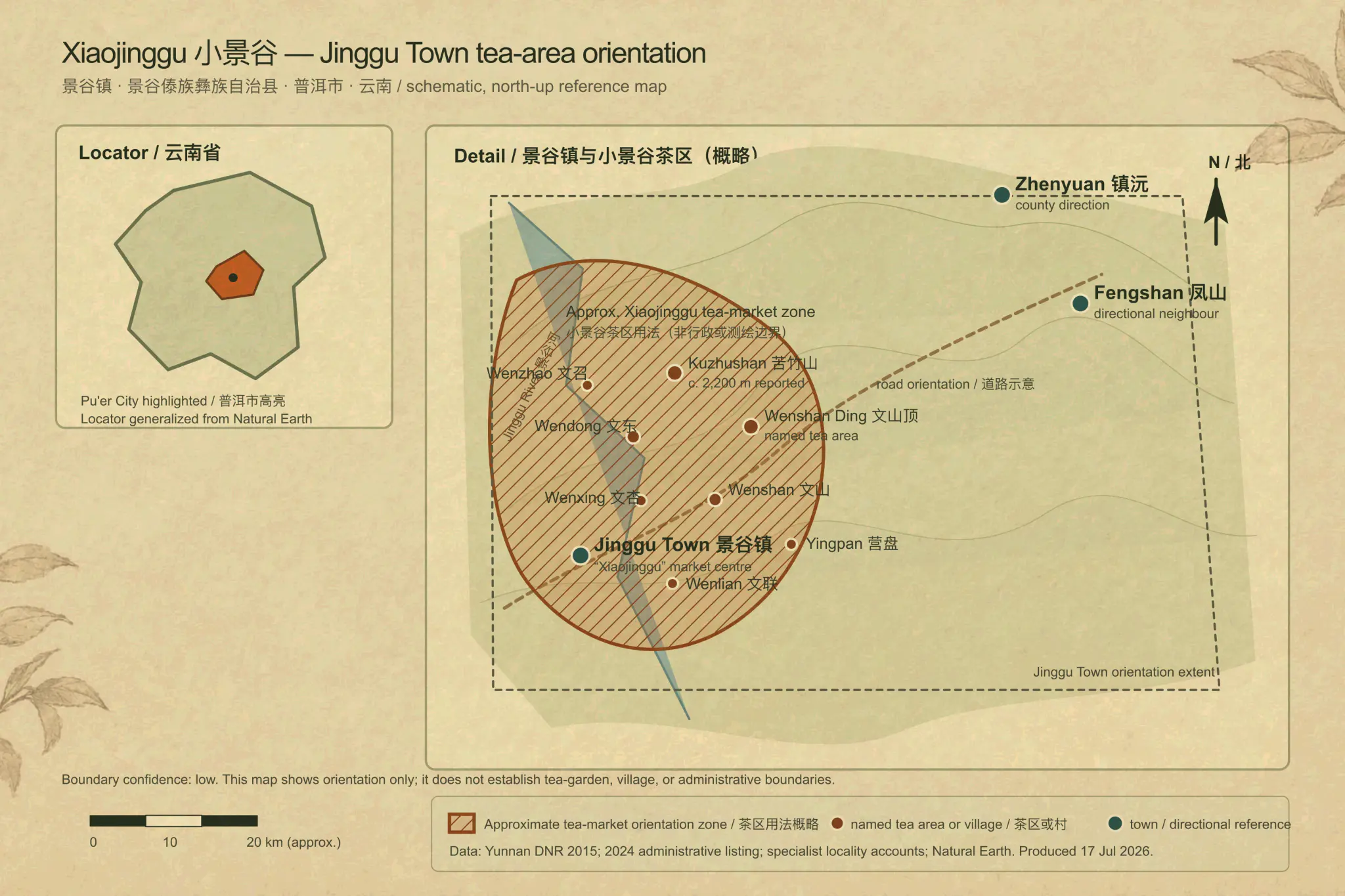
Orientation guide notes and sources
Boundary confidence: Administrative relationships come from text sources, not this graphic; all dots, roads, rivers, terrain shading, tea-use areas, and scale are schematic and cannot establish distance, boundary, or parentage
- Yunnan Department of Natural Resources records for Jinggu Town administrative villages
- Yunnan Net and Jinggu local reporting for Wenshan, Kuzhushan, and Ma'jiu relationships
- Natural Earth public-domain locator data; internal detail is an ImperfecTea orientation schematic
Why does Wenshan Village matter?
If you have bought a cake marked Kuzhushan, the administrative address hiding behind the mountain name is likely Wenshan village (文山村). Wenshan sits at the eastern edge of Jinggu Town in northern Jinggu County, Pu’er City. Recent provincial and local reporting places both the Kuzhushan and Ma’jiu village groups inside it.
That sounds straightforward until the other names arrive. “Xiaojinggu” is the tea-trade nickname for Jinggu Town and its surrounding tea country. “Wenshan Ding” is a narrower mountain-top or forest-garden label used by tea sellers. Five current Jinggu Town villages begin with “Wen,” but they are separate administrative villages. And this Wenshan is not Wenshan Prefecture in southeast Yunnan, nor Taiwan’s Wenshan tea district.
Getting the address right matters because the cups are not all alike. Some named Kuzhushan teas hit hard with early bitterness, then settle into grass, flowers, and sweetness. Others are soft, creamy, and easygoing. One Wenshan Ding product was sold specifically for its juicy texture and lack of bitterness. Rather than squeezing all of that into one flavor slogan, this guide helps you ask which place, garden, maker, season, and lot you are actually drinking.
What does Wenshan tea taste like?
There is no provenance-audited ImperfecTea flight for Wenshan. Instead, we have several seller-labelled products tasted by real drinkers, with years, brewing notes, and plenty of disagreement. That is a stronger starting point than a generic regional flavor list, but it is still product-level evidence rather than a traceable village fingerprint.
| Dimension | What appears repeatedly | Why it can change |
|---|---|---|
| Aroma | Flowers, grass, sweet grain, fruit, wood, and a fragrant warm cup | Processing, age, storage, and water can all move the aroma |
| Bitterness | Strong and quick in several young Kuzhushan sessions | Other Kuzhushan and Wenshan Ding examples are notably gentle |
| Sweetness | Often builds after the bitter phase or remains in the throat | Some softer lots begin sweet and stay there |
| Texture | Full, creamy, juicy, or rounded in several reports | A few teas feel lighter and more aroma-led |
| Astringency | Can jump quickly with extra seconds or extra leaf | Some named lots show very little dryness |
| Huigan | Returning sweetness is one of the more dependable threads | Speed and duration are product and session specific |
| Shengjin | Salivation appears, but not in every report | Dose, vessel, water, and age all matter |
| Finish | Grass, flowers, fruit, wood, smoke, mineral notes, or sweetness | Smoke and hard roast may say more about making and storage than origin |
Here are four useful cup-level examples:
- Three community notes for Yunnan Sourcing’s 2015 Ku Zhu Shan found strong early bitterness that gradually became grassy, floral, and sweet. One drinker admitted using 12.8 g in a 160 ml gaiwan, which explains at least part of the wallop.
- A detailed 2014 TeaTalk session with a 2005 Kuzhushan Babacha found soft, light liquor, forest and spice, apple and apricot, then a sweetness that settled into the throat. The taster also saw soot and reported smoke, so processing belongs in the explanation.
- TeaTalk drinkers revisiting a 2012 Nannuoshan Kuzhushan in 2021 described spice, sweetness, plum, rooibos, wood, softness, and moderate dryness. That is an aged, stored product, not a young-region template.
- Farmer Leaf’s 2022 Wenshan Ding was sold as a twenty-tree forest blend sourced and made by Luo Kai Yin. The seller described juicy texture, building sweetness, no bitterness, and low astringency. Customer notes on the page ranged from thick, meadow-sweet, and calming to simply pleasant and predictable.
So which is the “real” Wenshan taste? There is no single winner. The helpful pattern is a tension between perfume, bitterness, texture, and sweet return. The exact balance belongs to the lot.
Where is Wenshan Village?
The useful address runs like this:
Yunnan > Pu’er City > Jinggu Dai and Yi Autonomous County > Jinggu Town > Wenshan village.
Jinggu Town was Jinggu Township until 2013. Older wrappers and articles may use 景谷乡, while newer ones use 景谷镇. That wording change does not identify the leaf any more precisely. You still need the village or garden name.
Current records and reporting identify five separate Jinggu Town villages whose names begin with “Wen”:
| Name | What it is | Tea note |
|---|---|---|
| Wenxing 文杏 | Administrative village | Appears separately in town and land records |
| Wendong 文东 | Administrative village | Some older tea pages place Kuzhushan here, but newer local evidence places Kuzhushan under Wenshan |
| Wenlian 文联 | Administrative village | Separate village, not an alias for Wenshan |
| Wenzhao 文召 | Administrative village | Separate village; Xiaowenzhao appears beneath it in official project records |
| Wenshan 文山 | Administrative village | Current best-supported parent for Kuzhushan and Ma’jiu |
The map above reuses the existing Xiaojinggu orientation graphic. Read it as town-level context, not as a hiking map or land survey. Its dots, roads, rivers, terrain shading, tea-use area, and scale are illustrative. They cannot establish distance, boundary, or administrative parentage, and the graphic does not show a verified Kuzhushan, Ma’jiu, or Wenshan Ding garden boundary.
A licensed cadastral map would be a lovely upgrade. It is not necessary for explaining the address honestly.
Which Wenshan name is on the label?
The four names most likely to appear on a specialist tea page are not equivalent:
Wenshan village
Wenshan is the current administrative village. A 2023 Yunnan Net report places it 18 km from the Jinggu Town government and calls it the town’s easternmost, most remote mountain village. The same report describes tea as the village’s main industry and records more than 10,000 mu of tea at that time.
Kuzhushan
Kuzhushan (苦竹山, “Bitter Bamboo Mountain”) is a village group and a wider tea production name centred on that group. The 2023 report places the village group under Wenshan and says the commercial production area reaches neighbouring groups. That last detail is important: even a supported Kuzhushan label may describe more than one compact garden.
Older tea pages sometimes put Kuzhushan under Wendong. We did not find a boundary-change record that fully reconciles the conflict, so the guide follows the stronger recent local reporting and keeps the old wording as a warning for researchers.
Ma’jiu
Ma’jiu (马厩) is another village group inside Wenshan. A 2024 People’s Daily Yunnan report and 2025 Jinggu reporting both use the full Wenshan and Ma’jiu relationship. The newer report describes a 150 mu Zijuan project and tea gardens intercropped with Polygonatum kingianum. This is a working farm community trying new things, not a frozen “ancient forest” postcard.
Wenshan Ding
Wenshan Ding (文山顶) appears in specialist tea sourcing as a mountain-top or forest-tea area east of Xiaojinggu. We did not find it in the current administrative hierarchy or verify its civic parent. Treat it as a narrow seller-used sourcing claim that needs a maker, garden, and lot, not as another village or a confirmed place inside Wenshan.
What may shape a Wenshan cup?
Wenshan stretches across visibly different farming contexts. Kuzhushan tea is reported around 2,200 m, while Ma’jiu is reported around 1,600 m. Older trees, modern gardens, shade, open plots, vine-style pruning, Zijuan, and intercropping all appear within the same administrative village.
The 2023 Yunnan report gives a useful description of tengtiao management at Kuzhushan. Growers remove side growth and older leaves while keeping growth at the end of long branches. Over time, the branches develop the thin, extended form that gives “vine tea” its name. Tengtiao describes management and tree shape. It does not prove a cultivar, age, or flavor.
The same report describes older gardens and an expert-estimated old tree, but we did not find the underlying survey, a public tree register, or an age method. This guide therefore does not publish its acreage or age figures as reader-facing facts.
Wenshan’s newer gardens are just as relevant. The Ma’jiu cooperative has Zijuan plantings and tea with medicinal-crop interplanting. A 2025 local report discusses controlled white-tea processing alongside those gardens. This is useful terroir context because people, plant choices, shade, farm economics, and processing all help shape the tea landscape.
What we cannot do is point to one elevation or tree style and predict the cup. The independent tastings already show why. One Kuzhushan is sharply bitter, another is mild and creamy, and an older one tastes of wood and plum. Terroir is part of the story, not a magic flavor dispenser.
How do processing, season and age change it?
Most specialist Wenshan and Kuzhushan examples are spring raw Pu’er, but the village economy is broader. Local reporting includes raw and ripe Pu’er, white tea, sun-dried black tea, and Zijuan products. The style on the packet matters as much as the mountain name.
For raw tea, picking maturity, wither time, pan temperature, rolling, sun-drying weather, sorting, compression, and storage can all move the cup. The smoky 2005 Babacha session is a good example: the taster reported both smoke and visible soot, so it would be silly to call every smoky note “Wenshan terroir.”
Spring receives the premium attention, but we found no complete village-level comparison of spring, summer, and autumn leaf. Ask for the harvest date and picking standard rather than assuming “spring” is a complete quality certificate.
Aging evidence is equally product specific. The 2005 and 2012 examples developed wood, spice, fruit, smoke, and softer texture, but their storage histories were not audited. They show what happened to those cakes. They do not forecast the future of a fresh one.
How should I buy Wenshan tea?
A useful label gets smaller as you read it:
Jinggu County > Jinggu Town or Xiaojinggu > Wenshan village > Kuzhushan, Ma’jiu, or a supported garden name > household or maker > harvest and lot.
Ask the seller:
- Does “Wenshan” mean the administrative village, Wenshan Ding, Kuzhushan material, or a blend?
- If the label says Kuzhushan or Ma’jiu, what is the Chinese village-group name and who bought the fresh leaf?
- What harvest date, season, and picking standard supplied the lot?
- Who made the maocha, who assembled it, and where was it pressed?
- Does “old tree,” “forest,” “wild,” “tengtiao,” or “organic” describe field evidence, a registry or valid certificate, or marketing copy?
- Is the tea raw Pu’er, ripe Pu’er, white tea, or sun-dried black tea?
Do not pay a Kuzhushan or Wenshan Ding premium when the explanation stops at “Jinggu ancient tree.” Also do not assume that all five “Wen” villages are one continuous tea area. Similar spelling is not provenance.
No market-price range is published here. Available listings mix years, seasons, raw and ripe tea, cake weights, single-tree claims, and sold-out archive prices. We did not find two dated, like-for-like observations strong enough to turn into a fair range.
How should I brew a Wenshan comparison flight?
For a young raw Wenshan tea, begin with 7 g per 100 to 110 ml, water at 95 to 100 °C, and a quick rinse if the cake is tightly compressed. Start with 5 to 8 second steeps.
Watch what happens when you add only a few seconds. Kuzhushan can punish enthusiastic pouring, and that is not always a flaw. A hard early bitterness that clears into sweetness is different from bitterness that leaves the mouth rough and tired.
Track five things:
- Is the fragrance in the liquor, the empty cup, or both?
- Where does the bitterness sit, and how quickly does it clear?
- Does salivation build after swallowing?
- Does the texture become fuller in the middle of the session?
- What remains after the obvious flavor fades?
A useful comparison flight is:
- A documented Kuzhushan spring raw
- A Wenshan Ding raw of similar age and season
- A broader Jinggu Town raw that claims neither micro-origin
- A Wuliang or Ning’er raw matched as closely as possible for year and storage
Use the same vessel, water, ratio, and timing. If one tea feels weak, increase the leaf or steep time before blaming the village. If another feels brutal, shorten the steep before declaring it undrinkable. The tea table is a better place for curiosity than mountain-name fortune telling.
How have Wenshan growers shaped the tea economy?
Wenshan’s story is easier to understand when the people stay in it.
Local reporting says tea is the village’s central industry, but it also shows residents working in agriculture, trade, construction, medicinal crops, and newer white-tea processing. In Ma’jiu, a cooperative reportedly grew from 26 households to more than 60 by 2025. Around other Wenshan groups, families maintain older tea, modern gardens, and intercropped plots. That is more believable and more interesting than pretending every leaf comes from an untouched grove.
The Kuzhushan history has a mix of evidence and tradition. A local official quoted in the 2023 report connects early planting to descendants of Li Hu and later expansion to the Guangxu-era scholar Ji Xiangting. The report says these conclusions come from related documents and local accounts, but it does not provide the underlying primary records. The guide therefore treats them as local history, not a fully audited chronology.
At the town scale, Jinggu has a clearer documented tea-trade identity. Jinggu Township became Jinggu Town in August 2013 without changing territory or the government seat. A 2025 Shanghai municipal cooperation report describes the town as a production and trading centre with nine villages and one community working through a shared development organisation.
One nearby tea story also needs correcting. The official origin of Jinggu Dabaicha is Yangta village group in Dacun Village, Minle Town, elsewhere in Jinggu County. Dabaicha plantings and white-tea production now occur more widely, including around Jinggu Town, but Wenshan should not borrow Yangta’s origin story.
Sources and research notes
Research refreshed 10 August 2026. The most important sources are:
- Yunnan Net’s 2023 Wenshan and Kuzhushan report, which supplies the clearest recent administrative relationship and attributes local garden, elevation, and history claims
- People’s Daily Yunnan’s 2024 Ma’jiu report and Jinggu’s 2025 village-industry report
- Yunnan Department of Natural Resources records for the separate Jinggu Town administrative villages
- Yunnan’s June 2024 organic certificate register, used only as a historical record: the relevant entries expired by September 2024 and prove no current holder, garden, village, or Xiaojinggu-wide certification
- Independent product-specific tasting records from Steepster and TeaTalk’s 2005 and 2012 Kuzhushan discussions
- Farmer Leaf’s 2022 Wenshan Ding field and product account, treated as commercial and product specific
The guide publishes with limits in plain sight. It does not claim surveyed Kuzhushan or Wenshan Ding boundaries, audited individual tree ages, village-wide organic status, a market-price range, or an ImperfecTea-controlled tasting profile. Better cadastral data and a controlled flight would improve a future revision, but the current evidence is sufficient for a useful, honest guide to the place names, tea styles, and buying questions.
Quick answers
Frequently asked questions
What does the Wenshan village tea name identify?
Wenshan is an administrative village in Jinggu Town, Jinggu County, Pu'er City, containing named tea areas including Kuzhushan. Its most useful identity is administrative village and parent for smaller tea areas, so the name alone does not guarantee a particular garden, tree age or quality level.
What does Wenshan village tea taste like?
Kuzhushan examples often pair floral or sweet aroma with firm bitterness, salivation and returning sweetness; Wenshan Ding lots can be softer, making suborigin and processing decisive. Use that profile as a tasting guide, not as proof of origin.
What is Wenshan village commonly confused with?
Wenshan Village, Wenshan Ding, Kuzhushan and the four other 'Wen' villages do not identify the same place.
What should I ask before buying Wenshan village tea?
Start with: Which Wenshan village group, tea area or garden supplied the leaf, and who processed this harvest? Also ask for the harvest year and season, producer or household, processing details and storage history.