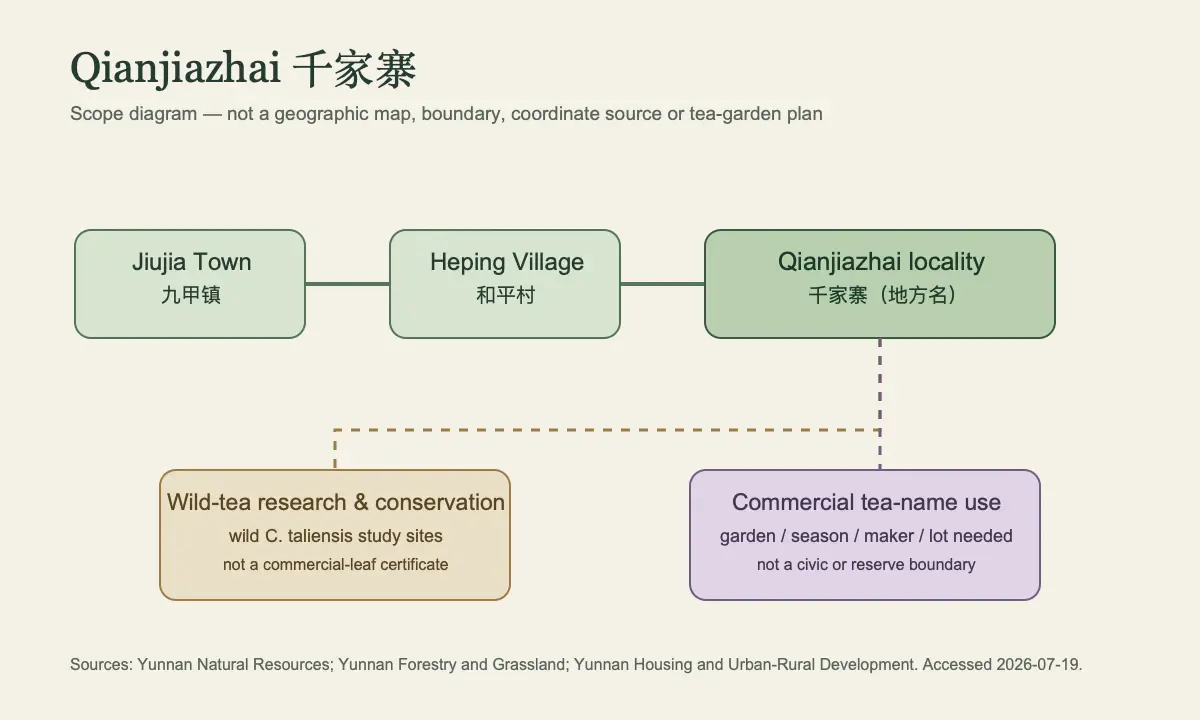
Place relationship diagram notes and sources
Diagram status: Not publication-grade: this is a scope diagram, with no asserted coordinates, road lines, locality boundaries or tea-garden geometry.
- Yunnan Natural Resources, Yunnan Forestry and Grassland Bureau, and Yunnan Housing and Urban-Rural Development Department sources logged in the dossier; schematic prepared 2026-07-19
Why does Qianjiazhai matter?
Qianjiazhai (千家寨, Qiānjiāzhài) carries several stories in one name. It is a locality in Heping Village (和平村), Jiujia Town (九甲镇), Zhenyuan Yi, Hani and Lahu Autonomous County, Pu’er, Yunnan. It is also the name of a scenic area, a conservation and research setting for wild tea, and a powerful commercial Pu-erh label. Those meanings touch, but they are not interchangeable.
Research identifies the protected wild-tea populations as Camellia taliensis and includes some celebrated very old trees. A cake labelled Qianjiazhai may contain something quite different: cultivated Yunnan large-leaf material, old-garden material, small-tree leaf, a blend or a broad Zhenyuan product. The tea can offer a fragrant, bittersweet raw-Pu’er frame, but a famous-tree photograph or the word “wild” cannot tell you what went into the wrapper. Qianjiazhai becomes much more useful when a seller can name the village, garden or household, season, processing and lot, rather than simply repeating the legend.
What does Qianjiazhai tea taste like?
There is no independent, controlled, multi-producer tasting series sufficient to declare a Qianjiazhai fingerprint. The available evidence is a small, product-specific set and should stay that way. A 2024 small-tree Qianjiazhai seller listing and customer note moved between smoke, astringency, fruit, light bitterness and sweetness. A spring 2023 dragon-ball listing described orchid and honey aroma with a sweet finish. A cultivated Ailao product reported dried apricot, citrus peel and bitter grip; a review of an aged 2011 Qianjiazhai cake found wood, cocoa, cherry and an oily texture.
Those reports support a useful tasting hypothesis: aromatic, bitter-sweet and often salivating, with substantial variation. They do not prove a single mountain flavour. Smoke can reflect fuel and heat management; citrus-like bite can be fresh leaf, picking or processing; woody notes in old tea can be storage. Compare lot to lot rather than treating a seller’s descriptor as a geographic fact.
| Dimension | What to assess |
|---|---|
| Aroma | Separate dry leaf, warm lid and cooled cup; write the actual floral, fruit, honey, smoke or herbal note. |
| Structure | Track bitterness and astringency independently and ask whether either clears in later steeps. |
| Return | Separate huigan (returning sweetness) from shengjin (salivation). |
| Texture / finish | Note coating, dryness, throat feel and late-steep stamina; body sensations are personal reports. |
| Provenance | Keep source locality/garden claim, tree category, season, maker, pressing and storage beside the note. |
Where is Qianjiazhai, and what can the map prove?
This is a scope diagram, not a geographic map. It preserves the supported path from Jiujia Town through Heping Village to Qianjiazhai, and separates the wild-tea research/conservation context from the commercial name. It deliberately draws no coordinates, roads, reserve boundary, village boundary or tea-garden polygon. Provincial scenic material offers orientation for the scenic area, but that is not a licence to construct a tea-origin boundary.
A publishable replacement needs licensed locality and protected-area data, a Yunnan locator plus Zhenyuan/Jiujia detail panel, scale and north indicators, a dated bilingual legend, and explicit distinction between scenic, reserve and commercial-tea extents. Until then, do not use an image, a reported scenic point or a study plot to authenticate a garden.
Which Qianjiazhai claim is on the label?
Qianjiazhai locality 千家寨
The clearest current institutional wording is “Jiujia Town, Heping Village, Qianjiazhai” in a 2022 Yunnan Natural Resources response concerning a geological-culture-village application. This gives a real civic anchor. Older material may say Jiujia Township (九甲乡); current official usage is Jiujia Town (九甲镇). The sources reviewed do not provide a complete current natural-village roster or a surveyed boundary for Qianjiazhai, so this guide does not invent one.
Provincial scenic-area material treats Qianjiazhai as a wider visitor landscape of forest, waterfalls and famous trees. Its account links the place name to the mid-nineteenth-century Li Wenxue uprising. That is a useful, attributed public history of the name, not a settlement survey or an etymology proven beyond dispute.
Ailao Mountain and the national nature reserve
Ailao Mountain (哀牢山) is a long central-Yunnan range. The Ailao Mountain National Nature Reserve is a distinct protected area spanning six county-level areas, including Zhenyuan; it is not identical to the whole range, nor to one tea origin. Forestry sources use the Qianjiazhai/Jiujia setting for monitoring three famed wild tea trees, while related reserve material documents wildlife and wild-tea protection pressure elsewhere, including Jingdong. Those facts belong to conservation context. They do not prove that a cake was legally harvested inside protected forest.
Wild tea versus cultivated tea
This is the essential distinction. Peer-reviewed Qianjiazhai work studies wild Camellia taliensis populations, their elevation-linked physiology, soil microbial associations and genetic diversity. A retail raw Pu-erh can instead be cultivated Camellia sinensis var. assamica, older cultivated garden material, plantation leaf or a blend. Terms such as 野生 (wild), 古树 (ancient tree), 乔木 (arbor), 生态 (ecological) and 森林 (forest) are not interchangeable and do not authenticate each other.
Provincial forestry sources describe the famed wild trees as important germplasm and repeat an expert-attributed extreme-age claim. The public material reviewed does not show a reproducible tree-dating method. It is therefore fair to report the official conservation claim with attribution; it is not fair to assign that age, or even wild origin, to a tea lot without traceable evidence.
The commercial tea name
Zhenyuan has promoted Qianjiazhai Yehao (千家寨爷号) as a county public tea brand bringing together products from eight ancient-tea-mountain areas. That is important market context: a Qianjiazhai label may point to the Heping locality, but it may also participate in a wider county-origin story. A serious seller should state which meaning applies. “Ailao,” “Zhenyuan,” “Qianjiazhai scenic area,” and “Heping Village” form a useful narrowing sequence, not automatic synonyms.
What can the wild-tea research actually explain?
The strongest science here is specific and limited in a good way. Qianjiazhai wild-tea studies sampled at 2,050, 2,200, 2,350 and 2,500 metres and reported dense forest canopy at their study sites. A Scientific Reports study found elevation-linked differences in rhizosphere bacterial communities and an association with measured ammonium nitrogen; later genetics work found substantial diversity and environmental differentiation among wild populations. These are meaningful reasons to protect the landscape and its germplasm.
They do not establish a cultivated-garden elevation range, soil recipe, universal cultivar or “mineral taste.” Nor should a commercial tea borrow the study sites’ forest conditions simply because it carries the place name. For a claimed old-garden tea, ask for the actual garden, its plant material, management, shade, picking date and processor.
How can processing change the cup?
Qianjiazhai does not have one verified house style. For raw Pu-erh, withering/resting, kill-green (杀青), rolling, sun drying, blending, compression and storage can all change what a broad place name appears to taste like. Wet or difficult weather can make drying and fixation especially consequential; smoke, red stems, sourness and harsh green bite are production observations first, not inherited wild-mountain character.
Compare spring to spring before comparing named origins. Identify whether a tea is loose maocha, freshly compressed sheng or aged cake, and whether the maker claims cultivated, old-garden or wild material. For brewing, start around 6-7 g per 100 ml at 95-100 °C with short infusions. Lower dose or temperature if bitterness overwhelms aroma before treating that bitterness as terroir.
How should I buy Qianjiazhai tea?
Read a provenance claim from broad to narrow:
Ailao → Zhenyuan → Jiujia → Heping Village → Qianjiazhai locality / named garden or household → season → maker and batch.
The missing steps matter more than a heroic tree-age number. Ask:
- Does “Qianjiazhai” mean the Heping locality, the scenic-area vicinity, a county public brand or a blend?
- Is the leaf cultivated large-leaf tea, claimed wild material, or another taxon? How was that determined?
- Who picked and processed it, where, and on what dates? Is a batch or traceability record available?
- What evidence supports “old tree”: a registered garden, measured records, planting history, or a marketing grade?
- Was the tea blended, and how was it stored after processing?
No current comparable price range is published here. The offers located differ in year, material claim, compression, seller and storage, so two retail asks would create a false market number. A transparent cultivated Zhenyuan or Jiujia tea is often a better purchase than an opaque “wild tea king” story.
How should I brew a Qianjiazhai comparison flight?
Try four teas under matching water, vessel, dose and timing:
- a traceable cultivated Qianjiazhai/Jiujia spring sheng;
- a named Zhenyuan tea without a Qianjiazhai claim;
- an Ailao-side Jingdong tea of similar year and processing;
- a Wuliang or Xiaojinggu raw Pu-erh at a similar price and age.
The point is not to prove a mountain essence in one session. It is to see which sensory differences remain once processing, freshness and label scale are brought under control.
Sources and research notes
Sources accessed 19 July 2026. The dossier preserves claim-level confidence, conflicts, map limits and tasting provenance.
The companion dossier logs Chinese official, academic and tea-market sources, access dates, working translations and conflicts. What we still do not have: a licensed geographic composite map, natural-village/garden matrix, independent tasting record across several producers, reproducible tree-age evidence or comparable current price observations.
Quick answers
Frequently asked questions
What does the Qianjiazhai tea name identify?
Qianjiazhai is a locality associated with Heping Village, Jiujia Town, Zhenyuan County, Pu'er City, on the Ailao range. Its most useful identity is locality, protected landscape and elastic commercial tea name, so the name alone does not guarantee a particular garden, tree age or quality level.
What does Qianjiazhai tea taste like?
Cultivated examples often suggest floral, honey, fruit or citrus aroma, firm bitterness, salivation and returning sweetness; smoke, processing, age and storage cause substantial variation. Use that profile as a tasting guide, not as proof of origin.
What is Qianjiazhai commonly confused with?
Protected wild-tea study sites, cultivated Heping-area leaf, the scenic name and a county-wide Qianjiazhai-branded blend are different claims.
What should I ask before buying Qianjiazhai tea?
Start with: Does Qianjiazhai mean Heping Village, another Zhenyuan mountain, a county blend or only a brand on this lot? Also ask for the harvest year and season, producer or household, processing details and storage history.