Why does Kunlu Mountain matter?
Kunlu Mountain (困鹿山, Kùnlù Shān) is a small, famous tea origin north of Ning’er in Pu’er City, Yunnan. The most useful modern address is not “imperial garden.” It is Kunlu Mountain village group, Kuanghong Village, Ning’er Town. Around that settlement sit cultivated tea, newer gardens and a celebrated old-garden site, all gathered into one of central Pu’er’s premium origin stories.
Kunlu is often described as fragrant and sweet-returning rather than brutally bitter. Across several examples, drinkers mention floral, vegetal or honeyed aroma, gentle bitterness, salivation and a smooth to medium body. They disagree about thickness and stamina, which makes a side-by-side tasting more interesting. “Kunlu,” “royal ancient garden,” “tribute craft” and “old tree” are four separate claims. The heritage matters, but it cannot authenticate the leaf in a cake. A good label keeps going down to village group, garden or household, season, maker and lot.
What does Kunlu tea taste like?
There is no provenance-audited ImperfecTea Kunlu flight yet. The profile below comes from product-specific commercial descriptions and independent reviews, so it is a comparison frame rather than a mountain guarantee.
| Dimension | Recurring evidence | Variation to expect |
|---|---|---|
| Aroma | Floral, vegetal, hay, honey, dried fruit and cup-bottom fragrance recur | Young processing can emphasize greens; age and storage can move the aroma toward earth, wood, citrus or dried fruit |
| Taste | Gentle-to-moderate bitterness followed by sweetness is the most consistent shape | Some examples are delicate and passive; stronger extraction reveals peppery greens, tart fruit or firmer bitterness |
| Texture | Smooth, rounded or slippery appears often | Reports range from light and thin to unusually thick; grade, maker and storage are plausible competing causes |
| Astringency | Usually described as lower than the bitterness, but not absent | A 2024 example became distinctly drying in later steeps; aged examples can also retain substantial dryness |
| Huigan | Returning sweetness is repeatedly noted | Speed and duration vary; seller language tends to overstate persistence |
| Shengjin | Salivation appears in Chinese regional descriptions and several drinker notes | Leaf dose and water strongly affect it |
| Finish | Floral sweetness, vegetal freshness, dried plum, cooling or a dry mineral finish | Storage history matters especially for older cakes |
| Stamina | Disputed | A Chinese educational summary calls Kunlu relatively light and not especially durable, while some sellers describe long-lasting aroma and sweetness |
| Body sensation | Calm, heaviness or cooling are sometimes reported | These are subjective session notes, not geographic facts |
Bitterleaf’s 2024 spring “Oh Deer” is useful because it identifies a picking window and sells the tea as arbor material, not as royal-garden leaf. Its seller notes emphasize mineral sweetness, vegetal flavor and gentle bitterness; customer notes range from passive and delicate to rounded, floral and cooling. Lancang Ancient Tea’s Kunlu product description adds cup fragrance, low bitterness, sweetness, smoothness and fuller liquor. Chen Sheng Academy’s compiled regional shorthand agrees on fragrance, smoothness and returning sweetness but describes the liquor as not thick and the tea as not durable. An independent review of a 2010 Wymm Tea Kunlu cake found the opposite texture: very thick, alongside steamed vegetables, straw, tart stone fruit, and increasing dryness.
The contradiction is useful. “Kunlu is delicate” may describe some young lots; it cannot explain every tree, picking, process or stored cake. A Kunlu tasting should test aroma, bitterness-to-sweetness transition, salivation and finish while leaving room for body and stamina to vary.
Where does Kunlu Mountain become a village claim?
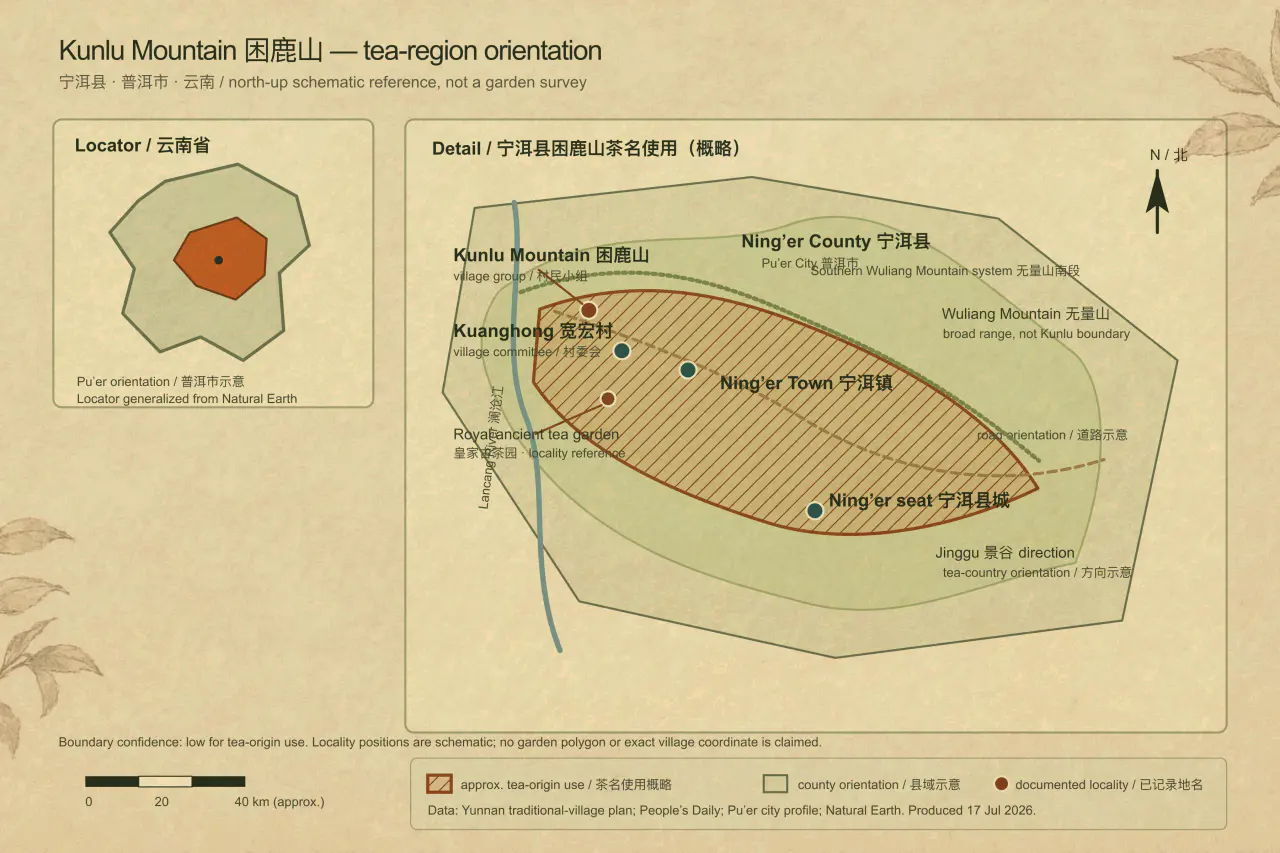
Existing Kunlu orientation graphic, produced 17 July 2026 from Natural Earth locator data and published locality descriptions. It correctly communicates the administrative nesting, but its internal terrain, river, road, locality positions, tea-use polygon and scale are illustrative rather than GIS-derived. It is therefore a research aid, not yet the publication-qualified composite map required by this guide series. Boundary confidence: low.
Kunlu is easiest to understand as nested names:
- Ning’er Hani and Yi Autonomous County is the county-level home and the modern holder of a much wider Pu’er and tribute-tea history.
- Ning’er Town is the current township-level unit. Older pages may say Fengyang Township; that wording should not be used as the current address.
- Kuanghong Village (宽宏村) is the administrative village.
- Kunlu Mountain village group (困鹿山村民小组) is the lower-level settlement recognized in provincial traditional-village material and county audit documents.
- The “royal ancient tea garden” (皇家古茶园) is a heritage and commercial place-name associated with the village group. It is not a separate village and does not define every Kunlu-labelled garden.
Provincial reporting places the mountain in the southern Wuliang system and describes it as a divide between the Lancang and Red River watersheds. That is useful regional orientation, not proof that every tea sold as Kunlu comes from one slope or elevation. Xiaojinggu and broader Wuliang teas are sensible comparison origins; they are not Kunlu subregions.
Which places sit inside the Kunlu name?
Kunlu does not have a credible list of many named “subregions.” The evidence instead supports a short hierarchy and a market-use matrix.
| Name | Type | Relationship to Kunlu tea | What is actually supported | Confidence |
|---|---|---|---|---|
| Kunlu Mountain village group 困鹿山村民小组 | Village group / traditional village | Strongest current locality anchor | Official provincial and county documents place it under Kuanghong, Ning’er Town | Verified |
| Kuanghong Village 宽宏村 | Administrative village | Parent administrative unit | Current official hierarchy; not a synonym for the Kunlu village group | Verified |
| Ning’er Town 宁洱镇 | Town | Parent township-level unit | Current official address | Verified |
| “Royal ancient tea garden” 皇家古茶园 | Named heritage garden / promotional term | A specific old-garden story near the village; often expanded into a label claim | Official cultural sources use the name, but no licensed cadastral garden boundary or complete public tree register was found | Supported as a named site; boundary unknown |
| Kunlu Mountain 困鹿山 | Mountain / commercial umbrella | May mean the locality, nearby mountain gardens or a seller’s source claim | No legal Pu’er sub-appellation or surveyed commercial boundary was located | Supported as common usage; extent unknown |
| Fengyang 凤阳 | Older administrative wording | Appears in legacy descriptions | Not the current township address; do not treat as a separate Kunlu subregion without dated records | Historical/legacy usage |
| Bian / Babian 把边 | Confusing legacy geography | Some old marketing copy stretches a broad “Kunlu” landscape across former township lines | Current official sources do not make it a Kunlu village subdivision | Reported and unresolved |
The absence of a longer village list is not a research failure. It prevents nearby Ning’er names from being promoted into fake Kunlu subregions. If a seller offers “upper Kunlu,” “core Kunlu,” “new Kunlu” or another micro-origin, ask for the Chinese place name, its administrative parent and a mapped or household-level explanation.
What may shape a Kunlu cup?
Elevation and topography
The published 1,410-2,271 m figure describes a mountain landscape, not the minimum and maximum of harvested tea. Reports commonly place cultivated old trees around the village near 1,900 m, but no plot-level elevation survey was found. Aspect, shade and distance from the settlement may matter within a steep landscape, yet the current evidence cannot connect a particular slope to a particular flavor.
Climate and seasonality
Kunlu is consistently described as humid and forested, with spring as the high-value picking season. The guide does not repeat generic Ning’er rainfall or temperature as garden data because no nearby station-to-garden analysis was located. Spring leaf can be more aromatic and concentrated than wet-season material, but picking maturity, weather and handling remain confounders.
Soil and drainage
A 2016 Yunnan Agricultural University study is unusually useful but easy to misuse. Researchers sampled seven Kunlu soils, from three modern-garden sites and four old-garden sites, as part of a 34-sample Pu’er City comparison. Their published aggregate found acidic soils across the whole study, with mean pH 4.75 for modern gardens and 4.82 for old gardens. Those means combine Kunlu with other study areas; they are not a Kunlu flavor formula or Kunlu-only average. The study does establish that “Kunlu” includes materially different garden histories and that plot-level nutrient variation deserves attention.
Forest and agroforestry ecology
Government and local reports describe old cultivated trees around the settlement and broader forest tea resources. They also report ecological-garden conversion, manual weeding and village environmental works. These are real management changes, not proof that every labelled cake is organic or forest-grown. The 2023 provincial organic-certificate list contains an organization with “Ning’er Kunlu” in its name, but certification attaches to the named holder, product scope and valid certificate, not to the mountain word.
Plant material
Local and commercial sources repeatedly describe large-, medium- and smaller-leaf forms and a mix of cultivated and other tea-tree categories. Without a published accession-level genetic survey for the commercial gardens, these should remain observed or marketed morphotypes, not fixed Kunlu cultivars. “Wild,” “transitional,” “arbor,” “old tree” and “ancient tree” are not interchangeable botanical terms.
Tree-age claims are especially unstable. Provincial rules now define an “ancient tea tree” administratively as a tea-group plant at least 100 years old or with a qualifying basal diameter, but that rule is for registration and protection; it is not dendrochronology. Counts of 400-, 500- or 1,000-year-old Kunlu trees circulate widely without a public tree-by-tree method. Treat them as heritage claims until a register shows how each age was established.
Human management and processing
The strongest living heritage here is a technique, not an emperor. National and provincial records describe Ning’er’s Pu’er tribute-tea craft as household or master-apprentice work involving leaf selection, heat-fixing, rolling, sun drying, steaming and shaping. Modern Kunlu raw Pu’er may use those broad steps, but maker choices such as picking standard, wither, pan temperature, rolling force, drying weather and blending can easily outweigh a vague mountain name.
Where the evidence stops
Kunlu offers plausible reasons for variation: elevation, forest exposure, mixed garden histories, plant morphology and household processing. The evidence supports heterogeneity, not a single causal recipe. We cannot presently say that a certain soil makes the tea taste mineral, that altitude creates fragrance, or that smaller leaves prove royal-garden origin. Those are tasting or provenance hypotheses to test, not facts to print on a wrapper.
How can processing change Kunlu tea?
For young raw Pu’er, watch the hand of the maker before assigning every sensation to Kunlu. Hard heat-fixing can mute high aroma or create roast; insufficient heat can leave an aggressively green, sour or unstable character. Heavy rolling may build body and bitterness, while light rolling can produce a fragrant but seemingly thin session. Smoke may come from fuel and drying conditions rather than mountain ecology.
Spring material dominates premium Kunlu storytelling. A rainy-season or autumn lot can still be worthwhile, but it should not inherit a spring comparison without disclosure. Similarly, “old-tree spring” and “arbor blend” are different products even if both are honestly Kunlu.
Aging claims require equal restraint. Floral and green notes may recede; sweetness, wood, dried fruit and texture can develop. Storage humidity, airflow and temperature will shape that development at least as strongly as origin. The thick, dry 2010 review and lighter 2024 example are not evidence for a fixed aging trajectory because maker, storage and claimed material all differ.
How should I buy Kunlu tea?
On labels, look for 困鹿山 and then the next layer down: 宁洱镇, 宽宏村, the Kunlu village group, a named household or garden, and a processing record. Common spellings include Kunlu, Kunlu Shan and Kunlushan. 困卢山 is a variant worth recognizing in older material.
“皇家古茶园,” “贡茶,” “古树,” “单株,” “纯料” and “有机” do not validate one another. Ask:
- Does “Kunlu” mean the village group, a nearby mountain garden, leaf bought through a Kunlu household, or a blend?
- What are the Chinese garden or household name, harvest date, season and picking standard?
- Who made the maocha, who assembled the lot, and where was it pressed?
- What does “old tree” mean here, and was age measured, registered by diameter, or simply reported?
- If the product claims the royal garden, what chain of custody links the leaf to that particular site?
- If it claims organic certification, which certificate holder, product scope and validity period cover this lot?
No Kunlu market price range is published here. The available observations compare unlike things: retail cakes, arbor material, old-tree claims and exceptional “single-tree” stories. Two dated like-for-like observations were not found. A transparent Kuanghong or Ning’er blend can be a better learning tea than an expensive “pure royal ancient tree” cake with no records.
For value comparisons, try a clearly sourced broader Ning’er tea, a Wuliang-side tea with its county stated, and Xiaojinggu material of similar year and storage. They are not substitutes for Kunlu; they reveal how much of the experience comes from maker, age and regional style.
How should I brew a Kunlu comparison flight?
For young or middle-aged raw Kunlu, start with 7 g in 100-110 ml, water around 95-100 °C, and a brief rinse only if compressed. Use 5-8 second early infusions. Smell the lid and empty cup, then follow four questions:
- Does the aroma remain in the liquor, or only in the cup?
- Does bitterness turn into huigan (returning sweetness), and how quickly?
- Does salivation build around the cheeks and under the tongue?
- Does texture and flavor persist after the fragrance fades?
If the tea becomes rough before it becomes expressive, lower the dose slightly or try 92-95 °C water. If it seems too quiet, keep the ratio and lengthen one infusion at a time. Brewing can manufacture the impression of “delicate” or “powerful,” so hold water, vessel and timing constant in a comparison.
A useful four-tea flight is: a documented Kunlu/Kuanghong lot; a broader Ning’er tea that does not claim Kunlu; a Wuliang-side tea; and a Xiaojinggu or Jingmai raw of similar age. Match storage and price as closely as possible. The goal is not to identify a mountain blind after one session, but to learn which traits survive fair controls.
How did tribute heritage shape modern Kunlu?
The Qing tribute association is central to Kunlu’s reputation, but the public sources are stronger on modern heritage recognition than on the complete historic supply chain. Government cultural pages call the site a royal ancient garden and describe a living Ning’er tribute-tea craft. The 2022 peer-reviewed study by Tao Wei, Li Xiaoxuan and Cai Haohui is especially helpful: it treats “royal garden” not merely as an old fact but as a modern discourse that helped turn local tea into a high-value commodity and reshape the village.
| Date | Development | What it proves |
|---|---|---|
| Qing era | Official and local heritage accounts associate Kunlu with tribute tea | A durable regional historical tradition; the reviewed sources do not establish a lot-by-lot archival chain from every surviving tree to the court |
| 2008 | Pu’er tea-making technique, including Ning’er tribute-tea technique, entered China’s second national intangible-cultural-heritage list | Recognition of a living craft, not certification of all Kunlu leaf |
| 2011 | The Ministry of Culture named Ning’er Kunlu Gongji Tea Farm a national productive-protection demonstration base | Institutional support for transmission and production at a named organization |
| 2013 | Kunlu Mountain village group entered the second batch of China’s traditional villages | Recognition of settlement heritage and its current administrative identity |
| 2021-2024 | County and provincial projects improved village environment, buildings, roads and tea-tourism infrastructure | Tea value is reshaping the lived settlement, not preserving it unchanged in amber |
| 2022 | Ning’er tribute-tea technique was identified by Yunnan authorities as part of China’s UNESCO-listed “Traditional tea processing techniques and associated social practices in China” element | International recognition of the technique’s cultural context; again, not product provenance |
The people are not scenery for an imperial legend. Provincial planning material describes a mainly Yi village and architecture combining Yi and Han forms. Research on commercialization documents how tea value changed housing, work and daily life. Ecological relocation and village works are discussed in older reporting, but the timing, household scope and long-term effects need a dedicated field study before being summarized as a simple conservation success.
Sources and research notes
All sources below were checked on 18 July 2026. Official records establish the present locality and protected craft; scholarship supports the village-change and soil discussions; commercial and reader sources are used only for product-specific sensory evidence. The prior Manus version supplied search leads but is not treated as an external authority.
Administration, heritage and environment: Yunnan traditional-village catalogue; Ning’er County audit report; Yunnan Provincial Planning Institute village study; Ministry of Culture heritage-base record; State Council national heritage list; Yunnan Agriculture and Rural Affairs tribute-craft profile; UNESCO element record; People’s Daily mountain report; People’s Daily garden-management report; Yunnan organic-certificate register; Yunnan ancient-tea-tree registration procedure; and Yunnan Transport Department road report.
Scholarship: Tao, Li and Cai’s peer-reviewed Kunlu village study and Gao, Li and Zhao’s Pu’er City soil study.
Market and sensory context: Bitterleaf’s 2024 spring arbor lot; Lancang Ancient Tea’s Kunlu product account; Chen Sheng Academy’s compiled regional profile; Oolong Owl’s review of a claimed 2010 Wymm Tea Kunlu cake; TeaDB’s broader Pu’er-prefecture orientation; and a Reddit review of a claimed 2013 Yunnan Sourcing Kunlu cake. These accounts differ in maker, age, storage and claimed material; none independently verifies garden provenance. No ImperfecTea sample was tasted.
Conflicts and omissions: current official records support Ning’er Town, while older Fengyang and Bian/Babian descriptions still lack a boundary-change record. Published distance, garden-area, tree-count and tree-age claims use incompatible scopes or lack methods. Exact coordinates, the royal-garden boundary, harvested-garden elevation, production volume and a price range are therefore omitted. The recurring fragrance and sweet-return pattern is provisional; thickness and stamina conflict across examples.
Map and image record: the locator base cites Natural Earth’s public-domain data, but the detail geometry has no GIS source or coordinate reference system and its scale bar is not measurement-valid. No photograph is licensed to this guide. The displayed asset is explicitly a research aid, not the required publication map.
Important gaps remain: a legitimate licensed composite map and visual package; independently verified locality points, garden extent and harvested-garden elevation; the underlying current tree register; stronger archival evidence for the royal-garden scope; and controlled tasting. A market range should remain absent unless two comparable dated observations become available. Keep those limits in mind when using this guide to compare teas or evaluate seller claims.
Quick answers
Frequently asked questions
What does the Kunlu Mountain tea name identify?
Kunlu Mountain tea is anchored around Kunlu Mountain village group in Kuanghong Village, Ning'er Town, Pu'er City. Its most useful identity is mountain origin and premium commercial name, so the name alone does not guarantee a particular garden, tree age or quality level.
What does Kunlu Mountain tea taste like?
Examples often show floral, vegetal or honeyed aroma, gentle bitterness, salivation and returning sweetness; conflicting reports of delicate versus thick liquor make texture a key comparison. Use that profile as a tasting guide, not as proof of origin.
What is Kunlu Mountain commonly confused with?
Kunlu Mountain, its village group, the royal ancient garden, tribute craft and an old-tree lot each describe a different claim.
What should I ask before buying Kunlu Mountain tea?
Start with: Does this Kunlu claim identify the village group, garden or household, material, harvest, maker and lot? Also ask for the harvest year and season, producer or household, processing details and storage history.