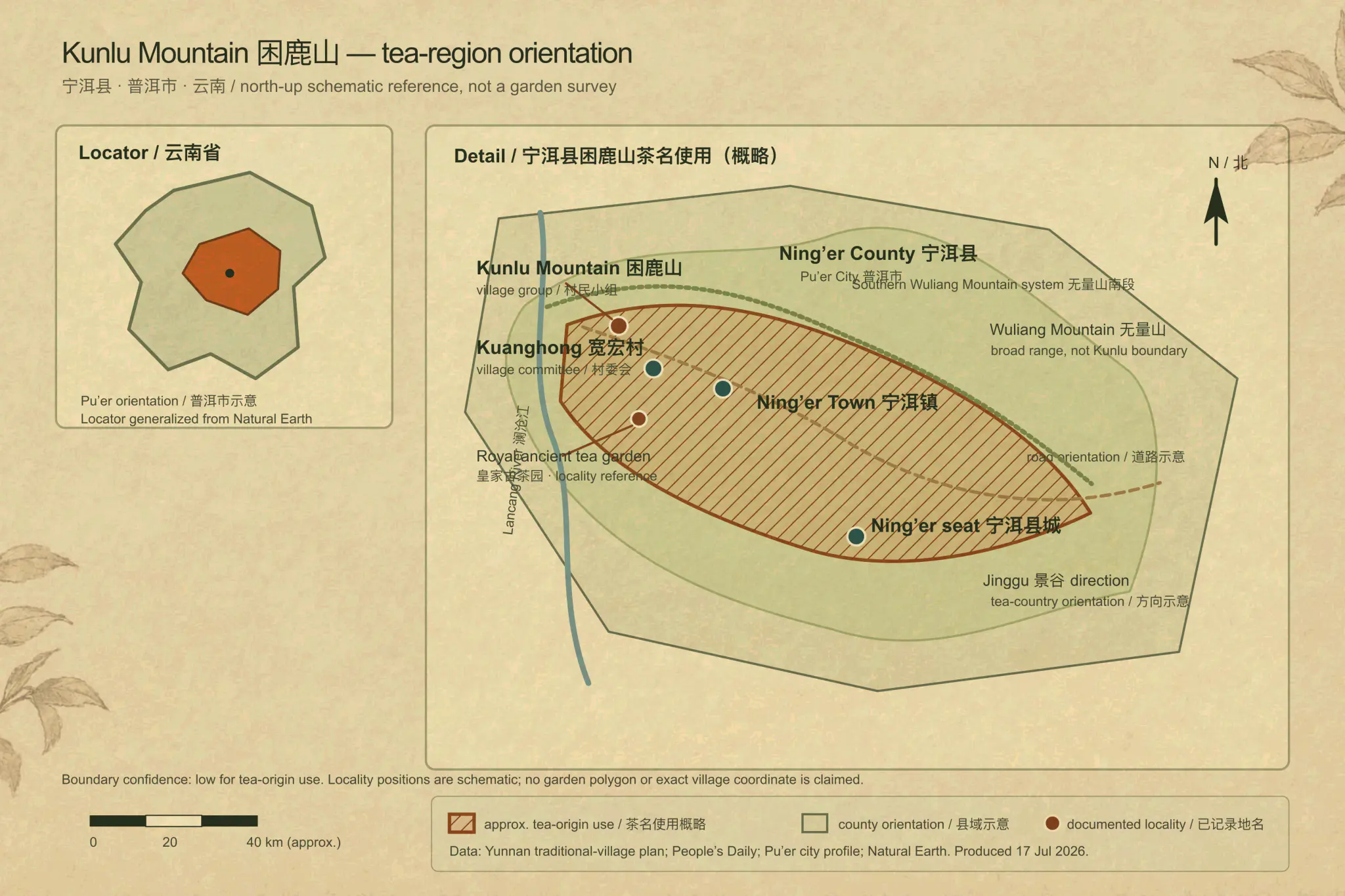
Orientation guide notes and sources
Boundary confidence: Administrative nesting is verified; all internal positions, tea-use shapes, roads, rivers, and scale are schematic and not suitable for measurement
- Yunnan provincial traditional-village catalogue for the current administrative hierarchy
- Ning'er County Audit Bureau records for the Kuanghong and Kunlu village-group address
- Natural Earth public-domain locator data; internal detail is an ImperfecTea orientation schematic
Why does Kunlu village group matter?
Kunlu is one of those tea names that arrives with a lot of luggage. There is a royal-garden story, old-tree language, tribute-tea history, and a price tag that can make a shopper sit up straight. Before any of that, though, Kunlu is a real settlement.
The Kunlu Mountain village group (困鹿山村民小组) sits inside Kuanghong Village, in Ning’er Town, Pu’er City. That is the useful address to remember. It gives us something firmer than the loose mountain name printed on a wrapper.
Tea sold as “Kunlu” can still mean several things: leaf from the village group, a garden using the Kunlu name, material bought through a Kunlu household, or a blend. The heritage is meaningful, but it does not authenticate the tea in your cup. A strong provenance story gets smaller as it goes: village group, garden or household, harvest, maker, and lot.
As for the tea itself, the most consistent thread is an aromatic, sweet-returning style. Floral, vegetal, hay-like, honeyed, and stone-fruit notes all appear in product-specific tastings. Bitterness is often gentle to moderate. Texture is the argument at the tea table: some drinkers find Kunlu soft and delicate, while others report surprisingly thick liquor and long stamina. That disagreement is more helpful than a tidy slogan.
What does Kunlu village tea taste like?
We do not have an ImperfecTea-controlled flight with audited leaf from the village group. The profile below comes from several named products and reviews, each with its own sourcing, processing, age, storage, water, and brewing choices. Think of it as a tasting conversation, not a flavor fingerprint.
| Dimension | What keeps turning up | Where the cups disagree |
|---|---|---|
| Aroma | Flowers, hay, vegetation, honey, dried fruit, and a fragrant empty cup | Very young tea can lean greener; stored cakes can move toward wood, earth, or dried fruit |
| Taste | Gentle to moderate bitterness followed by sweetness | Stronger brewing can bring peppery greens, tart fruit, or firmer bitterness |
| Texture | Smooth, rounded, or slippery in several accounts | Reports run from soft and light to notably thick |
| Astringency | Often quieter than the bitterness, but not absent | Some older examples dry the mouth in later steeps |
| Huigan | Returning sweetness is one of the most repeated traits | Its speed and duration depend on the lot and brewing |
| Shengjin | Salivation around the cheeks and under the tongue is often reported | Dose, water, and temperature can change it dramatically |
| Finish | Floral sweetness, vegetal freshness, dried plum, and cooling notes | Storage matters most for older cakes |
| Stamina | No honest single answer | Some lots fade gently; others hold sweetness and texture for many infusions |
The named examples make the variation easy to see:
- Bitterleaf’s 2024 “Oh Deer” was sold as spring arbor material picked from 19 to 23 March. The seller describes mineral sweetness, vegetal flavor, gentle bitterness, and a long fragrance. Customer reviews on the same page range from “passive” and soft to rounded, floral, and cooling. This is seller-hosted evidence, not an origin audit.
- TeaDB’s 2015 report on a 2007 Kunlu cake found thick liquor, stone fruit, developing earth, cooling, mouth coating, and late astringency. The tea reportedly lasted beyond ten infusions. Age and storage make it a poor template for young Kunlu, but a useful reminder that the region is not always delicate.
- Oolong Owl’s 2015 review of a 2010 Wymm Kunlu also found thick texture, alongside steamed vegetables, straw, tart stone fruit, lemon, and increasing dryness. The reviewer disclosed that the sample was provided for review.
So, does Kunlu taste delicate? Sometimes. Does it have to? No. If a seller gives you a poetic flavor list but cannot identify the lot, keep your wallet in your pocket and enjoy the poem for free.
Where is Kunlu village group?
Here is Kunlu’s address from broadest to most precise:
- Yunnan Province > Pu’er City > Ning’er Hani and Yi Autonomous County
- Ning’er Town (宁洱镇), the current township-level unit
- Kuanghong Village (宽宏村), the administrative village
- Kunlu Mountain village group (困鹿山村民小组), the settlement listed in Yunnan’s traditional-village catalogue
Use this map to understand the administrative nesting, not to navigate between gardens. Its internal terrain, roads, rivers, locality positions, tea-use shape, and scale are illustrative rather than surveyed GIS data. It does not show a cadastral boundary for the royal garden or any individual tea plot.
That limitation does not stop the guide from being useful. It simply means the map answers “roughly where does this place sit?” rather than “which side of this line did my leaves come from?”
Which Kunlu name is on the label?
Kunlu is not a large appellation with a neat list of official subregions. The strongest current locality is the Kunlu Mountain village group itself. Kuanghong is its parent administrative village. The “royal ancient tea garden” is a heritage and commercial place-name associated with the settlement, not another village and not a blanket name for every local tea plot.
The market use is wider and messier. A 2025 Yunnan Net spring-harvest report discusses a named Nalan garden and Dazhuqing in nearby Xisa Village under the wider Kunlu tea story. That is useful evidence of how elastic the trade name can become. It is not proof that those places are subregions of the Kunlu village group.
This is why a bag simply marked “Kunlu Mountain” still needs a follow-up question. Ask whether the name points to this village group, a named garden, a household’s buying network, or a broader commercial area.
What may shape a Kunlu village cup?
A lived-in tea landscape
Provincial planning material describes Kunlu as a traditional settlement with tea around the village and architecture combining Yi and Han forms. This is not an untouched forest with a few mythical trees. It is a lived-in landscape where household work, older cultivated trees, newer gardens, roads, tourism, and premium tea commerce all overlap.
A 2016 Yunnan Agricultural University soil study included seven Kunlu plots, three modern-garden plots and four old-garden plots, within a larger 34-sample Pu’er City comparison. That supports a simple but important point: Kunlu contains different management contexts. The paper’s average pH values combine several study areas, so they cannot be turned into a Kunlu-only flavor formula.
Old trees, new gardens, and slippery numbers
Local and commercial sources describe cultivated old trees near the settlement, newer or arbor gardens, and mixed material. A provincial planning article reports 372 recorded or tagged old tea trees. We did not find the underlying public tree register, so that number is best treated as a planning-source report rather than a complete current inventory.
Yunnan’s ancient-tea-tree registration procedure is especially useful here. For administrative registration, an ancient tea tree can qualify through reported age of at least 100 years or a basal-diameter threshold. Registration is a protection tool. It is not the same thing as individually dating every tree.
That means claims such as “400-year-old,” “500-year-old,” or “1,000-year-old” need a method and a traceable record. Tree size, family memory, and local tradition can all matter, but they are not dendrochronology.
What we can and cannot call terroir
Slope, shade, moisture, soil, plant material, harvest maturity, and garden management may all influence a cup. Processing and storage can influence it just as strongly. Without controlled comparisons, we should not explain honey aroma, mineral sweetness, or thick texture by pointing at one soil number or one elevation claim.
The practical terroir lesson is less glamorous and more useful: Kunlu contains more than one garden type, so the lot matters.
How do processing, season and age change it?
Ning’er’s protected tribute-tea craft gives Kunlu an important cultural backdrop. The Yunnan Agriculture and Rural Affairs Department describes ritual and leaf selection, heat-fixing, rolling, sun-drying, then steaming and shaping for compressed tea. It also distinguishes this inherited handcraft from mechanical manufacture and the artificial pile-fermentation process developed for ripe Pu-erh.
That does not mean every modern Kunlu cake follows one recipe. Wither time, pan temperature, rolling pressure, drying weather, sorting, blending, compression, and storage can all change what reaches your cup.
Spring is the premium reference in most available Kunlu material. A spring label still needs a date, picking standard, and maker. We did not find a complete village-level seasonal production survey, so there is no responsible basis for saying exactly how spring, rain-season, and autumn Kunlu compare.
Aging is equally lot-specific. The TeaDB and Oolong Owl examples show that older Kunlu can develop dried fruit, earth, wood, cooling, and later dryness, but two stored cakes cannot predict how a fresh cake will age. Storage history deserves at least as much attention as the mountain name.
How should I buy Kunlu village tea?
A useful origin label gets more specific as you read it:
Kunlu Mountain > Ning’er Town and Kuanghong Village > Kunlu Mountain village group > named garden or household > season, picking standard, maker, and lot.
Ask the seller:
- Does “Kunlu” mean the village group, a nearby garden, leaf bought through a Kunlu household, or a blend?
- What are the Chinese garden or household name, harvest date, season, and picking standard?
- Who made the maocha, who assembled the lot, and where was it pressed?
- What does “old tree” mean here: measured age, provincial registration, diameter-based qualification, or a producer report?
- If the wrapper claims the royal garden, what chain of custody links this leaf to that site?
- If organic certification is claimed, which certificate holder, product scope, and validity period cover this lot?
The terms 皇家古茶园 (royal ancient tea garden), 贡茶 (tribute tea), 古树 (old tree), 单株 (single tree), 纯料 (single-origin material), and 有机 (organic) do not prove one another.
We also withhold a market-price range. The available observations mix ordinary cakes, arbor material, old-tree claims, and exceptional single-tree stories. Turning those into one number would create confidence the evidence does not deserve.
How should I brew a Kunlu comparison flight?
For young raw Kunlu, a friendly starting point is 7 g in 100 to 110 ml, water at 95 to 100 °C, and a quick rinse only if the tea is tightly compressed. Begin with 5 to 8 second infusions.
Then pay attention to four things:
- Does the fragrance stay in the liquor, or only in the empty cup?
- How quickly does bitterness turn into huigan, or returning sweetness?
- Does salivation build around the cheeks and under the tongue?
- What remains after the perfume fades: texture, fruit, sweetness, dryness, or not much at all?
If the tea feels too polite, add leaf or extend the steep before declaring the mountain weak. If it feels harsh, lower the temperature or shorten the steep before blaming the garden.
For a useful comparison session, try:
- A documented Kunlu village-group lot with a known maker
- A broader Ning’er tea that does not claim Kunlu
- A county-stated Wuliang-side tea
- A Xiaojinggu or Jingmai raw of a similar year and storage history
The goal is not to perform a blind-tasting magic trick. It is to learn which qualities keep showing up when the brewing and storage variables are reasonably fair.
How did Kunlu heritage shape the market?
Kunlu’s royal and tribute stories should neither be swallowed whole nor tossed away. They are part of the place’s living heritage.
Ning’er’s tribute-tea technique entered China’s national intangible cultural heritage list in 2008. A Kunlu-linked tribute-tea farm was named a national productive-protection demonstration base in 2011, and the broader Chinese traditional tea-processing element entered UNESCO’s Representative List in 2022. Kunlu Mountain village group also entered the second batch of China’s traditional villages in 2013.
A 2022 peer-reviewed study by Tao Wei, Li Xiaoxuan, and Cai Haohui looks at how tea commercialization reshaped village life and how the royal-garden story became part of Kunlu’s modern value. That does not make the story fake. It shows how heritage, identity, and commerce now work together.
What we did not locate was a complete Qing palace procurement trail linking a named modern plot, tree, or cake to the court. So the careful version is: Kunlu has an officially recognized tribute-tea heritage and a strong royal-garden tradition, but that tradition does not certify a modern lot.
Sources and research notes
Research refreshed 10 August 2026. The most important sources are:
- Yunnan traditional-village catalogue, which lists the Kunlu Mountain village group under Kuanghong Village in Ning’er Town
- Ning’er County Audit Bureau’s 2021 final-accounts report, which repeats the current village-group address in an environmental-works record
- Yunnan’s tribute-tea craft record and UNESCO’s traditional tea-processing element
- Tao, Li, and Cai’s 2022 Kunlu village study
- Gao, Li, and Zhao’s 2016 Pu’er tea-garden soil study
- Yunnan’s ancient-tea-tree registration procedure
- Product-specific tasting evidence from Bitterleaf, TeaDB, and Oolong Owl
The guide publishes with explicit limits rather than pretending the gaps do not exist. We do not claim a cadastral royal-garden boundary, an audited public tree-age register, a village-wide organic status, a market-price range, or an ImperfecTea-controlled sensory profile. Those would improve a future revision, but none is required to explain the verified locality, the source-bounded heritage, and a responsible way to taste and buy the tea.
Quick answers
Frequently asked questions
What does the Kunlu village tea name identify?
Kunlu Mountain village group sits inside Kuanghong Village, Ning'er Town, Ning'er County, Pu'er City. Its most useful identity is village group and associated tea landscape, so the name alone does not guarantee a particular garden, tree age or quality level.
What does Kunlu village tea taste like?
Named products often show lifted floral, vegetal, hay or honey aroma, gentle-to-moderate bitterness, salivation and returning sweetness; texture and stamina vary sharply by lot. Use that profile as a tasting guide, not as proof of origin.
Which Kunlu place names should I distinguish?
Kunlu village group, Kunlu Mountain, the royal ancient garden and a household or garden lot are not interchangeable claims.
What should I ask before buying Kunlu village tea?
Ask which garden or household supplied the lot, and request its harvest, material, maker, processing and storage details.