Why does Ailao matter?
Ailao Mountain (哀牢山, Āiláo Shān) runs for roughly 400 kilometres across central Yunnan. That makes “Ailao tea” the start of a conversation, not one tidy village, garden, cultivar or flavour. The name becomes more specific around Qianjiazhai (千家寨, Qiānjiāzhài), a locality in Heping Village, Jiujia Town, Zhenyuan County. Its protected forest contains exceptionally old wild tea trees and Camellia taliensis populations studied by scientists.
The commercial tea in your cup is a different matter from those protected trees. Cultivated raw Pu-erh sold as Ailao or Qianjiazhai often brings floral, fruit or honey aromas with clear bitterness, salivation and returning sweetness. Examples range from smoky and gripping to soft and citrus-bright. Bring those possibilities to a tasting, but keep the legal boundary clear: the celebrated wild trees are conservation resources, not automatic cake ingredients. A useful label should keep narrowing from mountain to county, town, village, garden, season and maker instead of stopping at a famous tree.
What does Ailao or Qianjiazhai tea taste like?
The available tasting record is commercial and product-specific, but several independent examples give us a sensible comparison frame.
| Dimension | Recurring observations | Important variation |
|---|---|---|
| Aroma | Orchid, honey, flowers, fruit, dried apricot and citrus appear repeatedly; some lots show smoke, wood, bean or incense | Processing, fire source, leaf maturity and storage can create or mute these notes |
| Taste | A sweet-bitter structure is common in the small sample set. Citrus-peel bitterness, light astringency and delayed sweetness are more useful expectations than a single “mountain flavor” | One 2024 small-tree lot was bitter, funky and smoky; another spring 2023 product was marketed as smooth and sweet |
| Texture | Reports range from oily, rich and full to clean, mellow or tongue-drying | Compression, age, extraction and storage compete strongly with origin |
| Huigan / returning sweetness | Appears across fresh and aged examples, often after an early bitter or drying phase | Duration and intensity vary, and seller prose tends to overstate both |
| Shengjin / salivation | Mouthwatering or juicy finishes appear in several accounts | Brew strength and individual response matter |
| Finish | Fruit, floral sweetness, citrus peel, wood, cocoa and cooling notes appear in different products | A 2011 aged tea cannot define a fresh 2024 maocha profile |
| Body sensation | Reviewers sometimes report calm, heaviness, energy or “fog.” These are subjective session notes, not geographic facts | Caffeine, dose, food and individual sensitivity are major variables |
The most defensible shorthand is aromatic, bitter-sweet and salivating, with enough structure to reward short infusions. Even that is a hypothesis. Bitterleaf’s 2024 Qianjiazhai was explicitly small-tree material and moved from smoke and astringency toward fruit, light bitterness and sweetness. Chinese Tea Alliance’s spring 2023 dragon ball emphasized orchid, honey and a smooth sweet finish, while Jing’s cultivated 1960s-garden Ailao cake leaned toward dried apricot, citrus peel and a tangy bite. An aged 2011 Qianjiazhai review developed cocoa, cherry, wood and a deeper oily texture. The differences are the lesson: maker, plant material, age and storage are not noise around terroir; they are part of the tea.
Where do Ailao and Qianjiazhai begin and end?
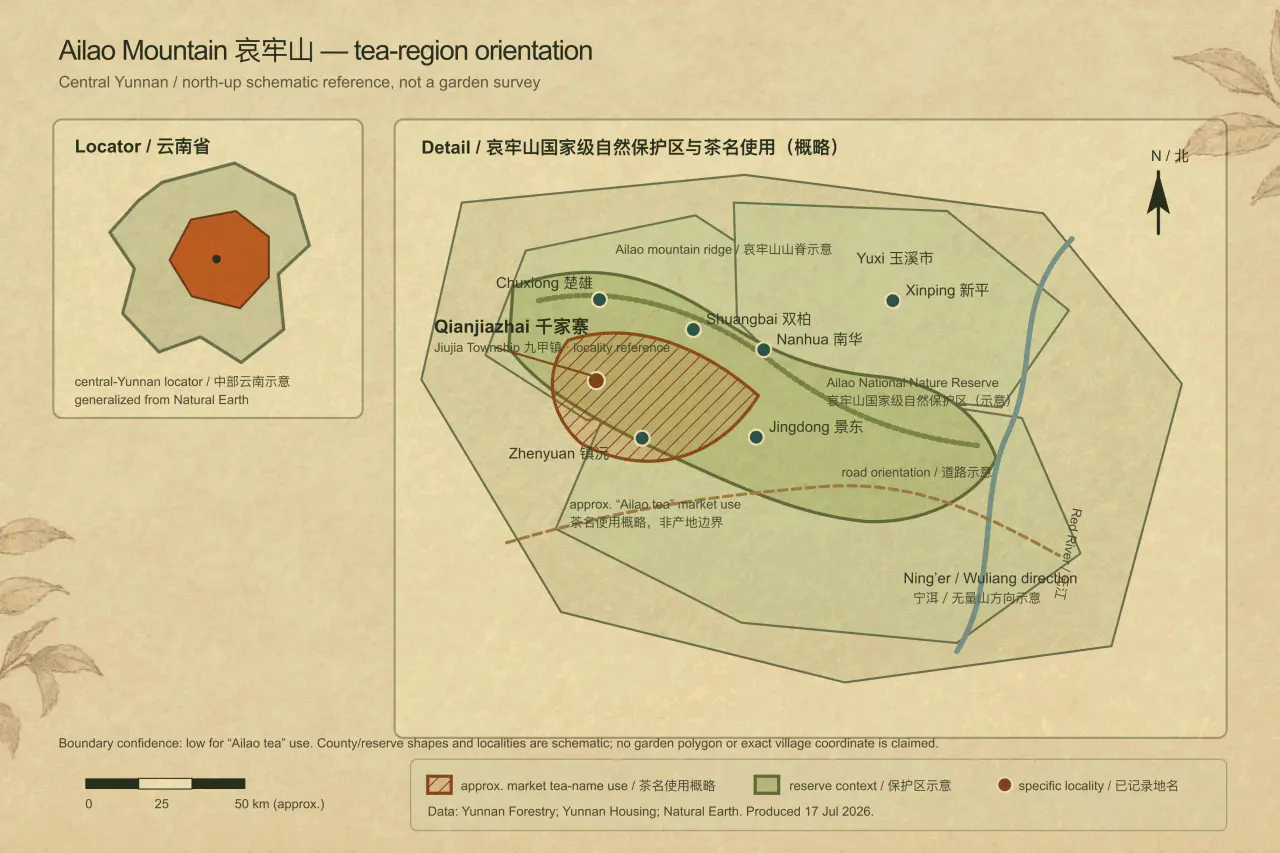
Ailao Mountain orientation map. The locator and six-county reserve context explain relative position; Qianjiazhai is an orientation label in the Zhenyuan-Jiujia area. The hatched “Ailao tea” zone is a schematic market-use prompt, not a garden, village, reserve or legal origin boundary. Because the internal geometry is illustrative, its scale bar must not be used to measure distance; the Jiujia label also retains the older English “Township” wording. Base locator: Natural Earth public-domain data; administrative, reserve and locality context: Yunnan Forestry and Grassland Bureau and Yunnan Housing and Urban-Rural Development Department, accessed 18 July 2026. ImperfecTea schematic produced 17 July 2026. Boundary confidence is low.
Four different things are easy to collapse into one:
- The Ailao mountain range is a long northwest-southeast landform. Xinhua describes it as stretching about 400 kilometres through central Yunnan.
- Ailao Mountain National Nature Reserve is a 67,700-hectare protected area across Chuxiong City, Shuangbai, Nanhua, Jingdong, Zhenyuan and Xinping. It does not equal the whole range.
- Qianjiazhai is the named Zhenyuan locality associated with waterfalls, a scenic-area designation and a well-studied wild-tea population. Current official wording places it under Jiujia Town’s Heping Village. A secondary heritage listing further associates the site with the Dashifang group, but that lower-level placement remains provisional until the underlying county notice is available.
- “Ailao” or “Qianjiazhai” on tea is a commercial provenance claim. It may refer to cultivated leaf from nearby communities, a broader Zhenyuan blend, or simply a market story. It does not prove harvesting inside the reserve.
Jingdong appears in the Ailao story because its reserve section also contains documented wild-tea populations. Zhedong (者东), Madeng (马邓) and other Zhenyuan tea names appear in broader county branding, but they should not be silently folded into Qianjiazhai. Wuliang Mountain lies in the wider Pu’er-side landscape and makes a useful comparison; it is a separate mountain system.
Which places sit inside the Ailao name?
Qianjiazhai 千家寨
Qianjiazhai is the strongest tea-specific anchor. A 2022 provincial natural-resources response uses the phrase “Jiujia Town, Heping Village, Qianjiazhai,” and official scenic-area material places the locality in northeastern Zhenyuan. It is also a tourist and conservation name: the scenic area is wider than a farm, and the wild-tea research plots are not a commercial garden survey.
The name is linked in provincial tourism material to a mid-nineteenth-century uprising associated with Li Wenxue, whose forces camped in the mountains. Treat that as the published official place-name account rather than a settled linguistic etymology; alternative Ailao-name stories circulate, but no single derivation was strong enough to present as fact.
Jiujia Town 九甲镇 and Heping Village 和平村
These are the modern administrative anchors a serious Qianjiazhai claim should be able to name. “Jiujia Township” appears in older English and Chinese sources because the unit was formerly written 九甲乡; current official records use 九甲镇. Heping Village is an administrative village, while Qianjiazhai is a smaller locality/scenic reference within its orbit. A secondary heritage listing associates the site with Dashifang, but the underlying county notice was not available for this review. The exact lower-level placement and natural-village boundary therefore remain unconfirmed.
Zhenyuan 镇沅
Zhenyuan Yi, Hani and Lahu Autonomous County is the county-level home. It has deliberately expanded Qianjiazhai into a regional public tea brand: an official 2021 report says the “Qianjiazhai Yehao” system integrated products from eight ancient tea mountains. That branding can improve traceability, but it also proves why label scale matters. A county-wide Qianjiazhai brand is not the same claim as leaf from the Heping Village locality.
Jingdong 景东
Jingdong is a neighboring Pu’er county and another section of the Ailao reserve. A 2019 forestry report recorded 8,947 wild tea plants across five fragmented populations in its Ailao section and described theft, damaging harvest and illicit transplanting pressure. This establishes important conservation context. It does not make Jingdong tea Qianjiazhai tea, nor turn protected plants into a legal commercial supply.
What may shape an Ailao cup?
Elevation and topography
Peer-reviewed work sampled Qianjiazhai wild tea at 2,050, 2,200, 2,350 and 2,500 metres. Another paper describes the population across roughly 2,100-2,500 metres and more than 85 percent canopy. Those numbers belong to wild-tea research locations. A cultivated garden lower on the mountain cannot borrow them, and an elevation printed by a seller remains a lot claim until independently located.
Climate and water
The high forest research setting is cool and humid. Published study-area descriptions put mean annual temperature around 10-12 °C, annual precipitation above 1,500 mm and relative humidity around 78-88 percent, with much rainfall in July and August. Provincial scenic material also names the Dulu River and major waterfalls. These conditions help explain a moist evergreen-forest ecosystem; they do not prove a particular aroma in the cup.
Soil and forest ecology
A 2020 Scientific Reports study found that rhizosphere bacterial communities changed along the elevation gradient, with ammonium nitrogen the strongest measured association among the tested soil factors. A 2023 genetic study found high diversity within wild Camellia taliensis populations and environmental differentiation among elevations. This is valuable conservation science. It is not evidence that microbes cause “mineral taste,” nor that cultivated commercial material shares the same roots, soil or genetics.
Wild tea is not old cultivated tea
This distinction is the heart of the guide. The Qianjiazhai studies concern wild Camellia taliensis. Commercial products may instead use cultivated Yunnan large-leaf material, older cultivated gardens, small trees, plantation leaf or blends. “Wild” (野生), “ancient tree” (古树), “arbor” (乔木), “ecological” (生态) and “forest” (森林) are separate claims. A provincial forestry report calls the three monitored wild trees important germplasm and among the oldest known wild tea trees, but it does not publish a transparent dendrochronological method for the famous age estimate. Repeat the official claim with attribution; do not convert it into the age of a product’s leaves.
Where the evidence stops
We can say Qianjiazhai supports a high-elevation, forested and genetically diverse wild-tea population. We can plausibly expect cultivated gardens across the Ailao landscape to differ with slope, shade, season and moisture. We cannot use those facts to assign honey, bitterness, cooling, longevity or “energy” to every Ailao cake. Cultivar, garden management, picking, processing, blend, age and storage remain equally plausible explanations.
How can processing change the regional pattern?
Raw Pu-erh begins with plucked leaf that is rested or withered, heat-fixed (shāqīng, 杀青), rolled and sun-dried into maocha. It may then be sorted, blended, steamed and compressed. The broad Ailao name contains many households and makers; there is no verified single local method.
Wet mountain weather raises practical questions. Was leaf held too long before heat-fixing? Was the pan uneven? Did drying finish cleanly? Smoke can come from fuel and workspace, red stems from oxidation before fixation, sourness from handling or moisture, and harsh green bite from aggressive making or simply very fresh tea. None is automatically “wild mountain character.” Jing’s Ailao product, for example, explicitly describes hand firing over wood and sun drying; Bitterleaf’s lot shows why smoke should be evaluated as a product trait rather than a regional promise.
Compare spring with spring when possible. Rain-season leaf faces different drying conditions; autumn material has another growth cycle. For older cakes, storage can replace fresh floral and green notes with wood, fruit, cocoa, camphor or dampness. The 2011 tasting record is useful precisely because it shows an aged outcome, not because it predicts every Ailao tea’s future.
How should I buy beyond the famous-tree story?
Read the label from broad to narrow:
哀牢山 Ailao Mountain → 镇沅 Zhenyuan → 九甲 Jiujia → 和平村 Heping Village → named garden or household → season, lot and maker.
Every missing step increases ambiguity. “Qianjiazhai” alone might indicate the locality, the scenic area, a wider county brand or a seller’s sourcing category. “Wild tea king material” is an extraordinary claim because the celebrated trees sit in a protected context. Ask for legal harvest authority and chain of custody, not a photograph of a large trunk.
Questions worth asking:
- What does Ailao mean for this lot: Qianjiazhai/Heping, another Jiujia garden, another Zhenyuan mountain, Jingdong, or a blend?
- Is the leaf cultivated Camellia sinensis var. assamica, claimed wild material, or another taxon? How was that identified?
- Which village, household and initial-processing site handled the leaf? Are picking dates and lot codes recorded?
- What supports “ancient tree”: a registered resource record, measured garden, documented planting history, or marketing grade?
- Was the cake blended? Where and how has it been stored?
The wrapper does not prove a protected-tree harvest, exact tree age, a garden boundary, organic certification, a single cultivar or unblended material. Zhenyuan’s public-brand system at least demonstrates that traceability standards can exist; ask whether a product participates and what records the code reveals.
No price range is published here. The located offers differ too much in year, compression, seller, garden claim and provenance to form two genuinely comparable observations. For value, choose a transparent cultivated Zhenyuan or Jingdong lot over an opaque “2,700-year tree” story. Wuliang, Xiaojinggu or another named Pu’er-side origin of similar year and processing makes a more useful comparison than a prestige label at any cost.
How should I brew an Ailao comparison flight?
For a fresh raw cake, start with 6-7 g per 100 ml, water at 95-100 °C, one quick rinse for tight compression, then infusions around 5-8 seconds before lengthening. If bitterness buries aroma, lower the dose or temperature before deciding it is the mountain. Loose maocha usually needs no rinse. For aged material, use near-boiling water but watch storage notes in the first two cups.
Track six things separately: aroma, bitterness, astringency, salivation, returning sweetness and texture. Notice whether bitterness clears into sweetness or simply stays coarse; whether smoke sits on top of the liquor or integrates; and whether the finish remains after the cup cools.
A useful four-tea flight:
- a traceable cultivated Qianjiazhai/Jiujia spring sheng;
- a named Zhenyuan tea without a Qianjiazhai claim;
- an Ailao-side Jingdong tea with comparable year and material;
- a Wuliang or Xiaojinggu raw Pu-erh of similar season and processing.
Use one water, vessel, ratio and timing. The goal is not to prove a mountain fingerprint in an afternoon. It is to discover which differences survive when the labels and brewing theatrics are stripped away.
How have people and conservation shaped the landscape?
| Date | Why it matters |
|---|---|
| Mid-19th century | Provincial scenic material connects the Qianjiazhai name with forces in the Li Wenxue uprising camping in the mountains |
| 1981 | Yunnan approved the Ailao reserve |
| 1988 | The State Council elevated it to national nature-reserve status |
| 1996-97 | A multidisciplinary expert meeting examined and publicized the Qianjiazhai wild-tea population; the resulting age and “tea king” claims became central to the area’s public identity |
| 2018 | Pu’er City’s ancient-tea-resource protection regulation took effect |
| 2019 | Jingdong reserve managers reported wild-tea theft, damaging picking and transplanting pressure, alongside population monitoring |
| 2020-23 | Peer-reviewed soil, physiology and genetic studies expanded the ecological record for Qianjiazhai’s wild tea |
| 2020-21 | Zhenyuan promoted a county-wide Qianjiazhai public tea brand integrating eight tea-mountain products |
| 2026 | Provincial foresters and university specialists used non-destructive instruments to assess three famous wild trees in Jiujia |
The present landscape belongs to many communities, including Yi, Hani and Lahu residents reflected in the county’s autonomous status. Official economic reporting says tea supports thousands of farming households across Zhenyuan, but it does not justify assigning one cultivation custom to every ethnic group. The more concrete contemporary story is how local producers, cooperatives, regulators and reserve staff negotiate livelihoods, traceability and protection around a highly marketable wild-tea symbol.
Sources and research notes
The full claim log, conflicts, rejected claims and access dates are preserved in the companion Ailao dossier. The strongest sources are the Yunnan Forestry and Grassland Bureau’s reserve and monitoring records; the Yunnan Natural Resources and Housing departments’ hierarchy and scenic-area records; the national Pu-erh standard register; Pu’er ancient-tree protection reporting; and peer-reviewed ecology and genetics studies of Qianjiazhai wild tea.
Some useful limits remain. No complete register of cultivated tea gardens under the Qianjiazhai market name, survey-grade origin polygon or cultivated-garden elevation range was found. The famous tree-age figure is an official expert estimate without a published reproducible method. Sensory evidence comes from commercial products, and no comparable price series was available. The map is an orientation schematic, not a cadastral or garden map.
Quick answers
Frequently asked questions
How are Ailao Mountain and Qianjiazhai related?
Qianjiazhai sits in Heping Village, Jiujia Town, Zhenyuan County, Pu'er City, on the broader Ailao range. Its most useful identity is mountain range, protected-area story and broad commercial origin, so the name alone does not guarantee a particular garden, tree age or quality level.
What do Ailao and Qianjiazhai teas taste like?
Cultivated examples often combine floral, honey or fruit aroma with clear bitterness, salivation and returning sweetness; smoke, citrus brightness, age and storage can redirect the session. Use that profile as a tasting guide, not as proof of origin.
Which Ailao and Qianjiazhai place names should I distinguish?
The Ailao range, national reserve, Qianjiazhai locality and a commercial provenance claim are four different scopes.
What should I ask before buying Ailao or Qianjiazhai tea?
Ask which county, village, garden, plant material, harvest and maker sit behind the name, then request processing and storage details.