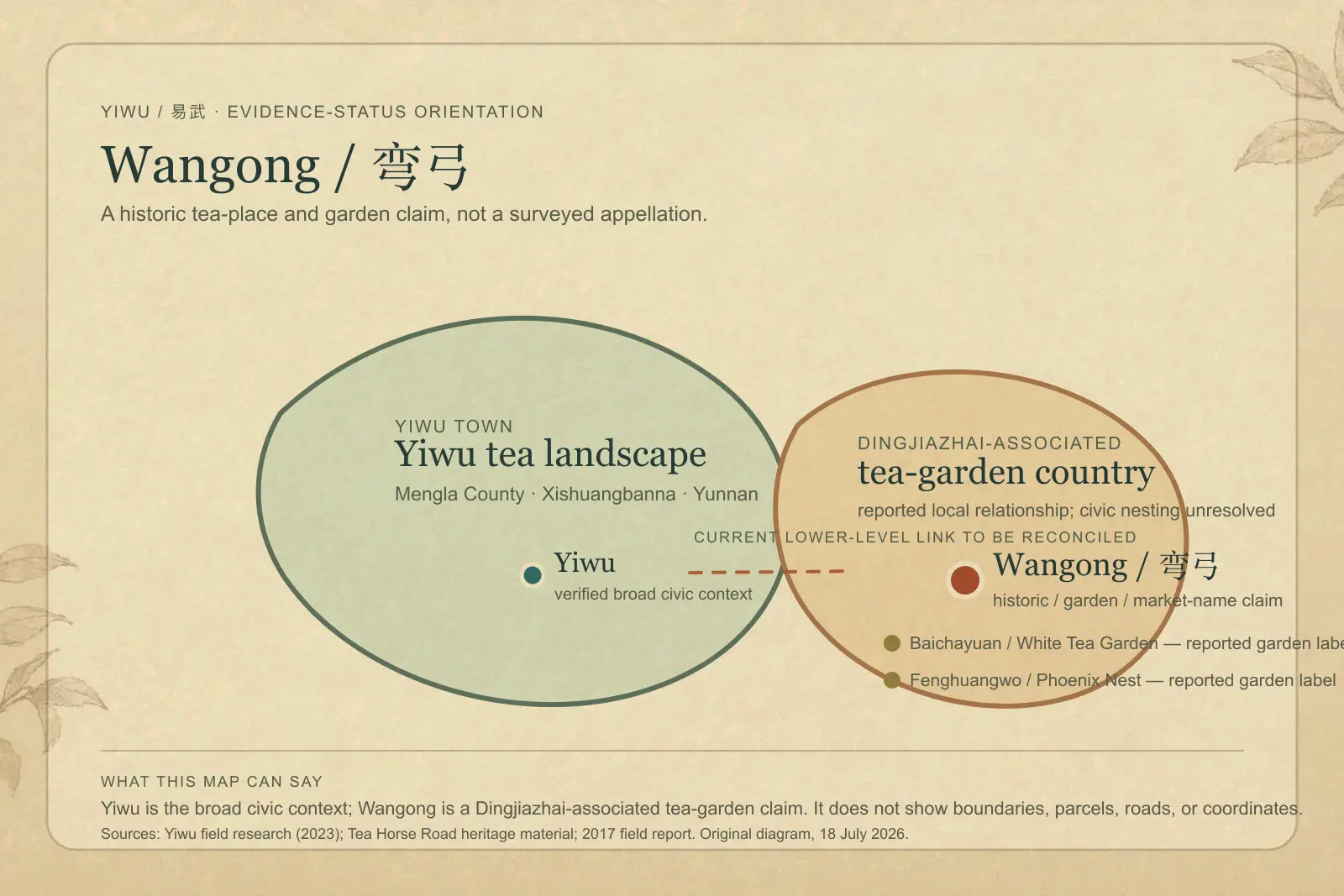
Orientation guide notes and sources
Boundary confidence: No licensed composite map, official Wangong boundary, verified locality-point set, or agreed current administrative nesting was found; the map is an orientation diagram only.
- Journal of Natural Resources, 2023
- State Council Tea Horse Road designation, 2013
- Jiemian tea-area field report, 2017
Why Wangong needs a slower introduction
Wangong (弯弓, Wāngōng) is one of the Yiwu names that can make a tea feel impossibly specific. It is often sold as a rare forest micro-origin, sometimes as a lost tea village, and sometimes as if it were a clean administrative district with a fixed line around it. The evidence supports something more interesting, and less tidy.
Wangong is a historic tea-place name in the wider Yiwu landscape. Tea writing consistently connects the present-day Wangong garden claim with Dingjiazhai, especially the Yao Dingjiazhai community. A 2017 field report says the Wangong gardens it visited were managed and picked by Yao residents of Dingjiazhai Lower Village. Heritage material also places the old Yao Dingjiazhai route within the Tea Horse Road landscape. But the available public sources do not produce a dependable present-day civic chain for Wangong itself, a surveyed garden boundary, or a single definition shared by every seller.
That is not a reason to skip Wangong. It is a reason to drink it like a real place name: with curiosity, some historical imagination, and a few questions for whoever is using it.
How can Wangong tea taste?
The public record is suggestive, not conclusive. Producer and specialist notes often reach for floral fragrance, sweetness, a dense or silky texture, cooling sensation and a firmer, more energetic bitterness than the softest broad Yiwu stereotype. An independent comparison of a claimed Wangong tea with a Mahei tea also found a noticeably different aromatic and textural direction. That gives a drinker a sensible set of things to notice. It does not make a blind-identification kit.
Try tasting in layers:
- Opening aroma: Is it floral, honeyed, fruity, green, herbal or darker? Does it survive after the leaves warm up?
- Structure: Is the early bitterness light, firm, delayed or absent? Does it become drying, or does it resolve into sweetness?
- Texture: Notice density, slipperiness, grip and whether the liquor stays present after the aroma fades.
- Return: huigan is sweetness returning after a sip; shengjin is gathering salivation. Time them rather than treating them as prestige stamps.
- Finish: Cooling and body sensation are worth recording, but they are subjective, dose-sensitive and affected by caffeine, context and expectation.
The confounders are ordinary and powerful: leaf maturity, weather, withering, shaqing (kill-green), rolling, sun-drying, blending, compression and storage. The 2023 Yiwu study documents the broad maocha chain and multiple production arrangements; it does not establish one Wangong method. A sharp tea might reflect young storage or green processing; a soft tea might reflect age, humid storage or blending. A village name cannot settle that.
No matched, multi-producer public sample set was found, so the sensory evidence is partial. Buy a small amount first and compare it beside a disclosed Dingjiazhai-associated tea, a Mahei tea and a broad Yiwu reference from a similar season and storage history.
What kind of place is Wangong?
Evidence snapshot
| English name | Wangong |
| Chinese and pinyin | 弯弓, Wāngōng |
| Common spellings | Wangong, Wan Gong, Wan-gong; 灣弓 appears in some traditional-character material |
| Useful type | Historic tea-place and contemporary garden/market-origin claim; not a verified administrative village name in this review |
| Broad address | Yunnan → Xishuangbanna Dai Autonomous Prefecture → Mengla County → Yiwu Town → Dingjiazhai-associated tea landscape |
| Parent tea name | Yiwu / 易武, one of the Ancient Six Tea Mountains |
| People and local link | Specialist and field reporting connect Wangong garden management with Yao Dingjiazhai, especially a Lower Village reference; current official nesting needs reconciliation |
| Nearby names often bundled with it | Dingjiazhai, Baichayuan / White Tea Garden, Fenghuangwo / Phoenix Nest, Bohetang, Chawangshu |
| Cautious cup shorthand | Floral or high-toned aroma, sweetness, texture, and a firmer edge than broad “soft Yiwu” shorthand, reported tendencies, not an origin test |
| What is not established here | A Wangong boundary, precise elevation, tree ages, ecology measurements, a civic village code, comparable price range, or a unique sensory fingerprint |
| Research confidence | Supported for Yiwu context and Wangong and Dingjiazhai association; partial for current hierarchy, historic-site continuity, garden geography and cup profile |
The cleanest way to understand Wangong is to let the name do more than one job without pretending those jobs are identical.
First, it appears in historical and heritage storytelling around the old Yiwu tea landscape. Tea writers refer to an older Wangong settlement or temple story, and describe a tea route running through the surrounding Dingjiazhai country. The national Tea Horse Road designation does establish the importance of the wider Mengla and Yiwu heritage landscape, including a route described as running from Daqishu toward Yao Dingjiazhai Lower Village. It does not certify a present Wangong tea-garden boundary, verify every local-history detail found in commercial accounts, or turn every modern Wangong cake into a heritage artifact.
Second, Wangong is a garden-area claim. The most useful reported connection is not “Wangong village” but “Wangong gardens managed from Dingjiazhai.” A 2017 on-the-ground tea-area report names Yao Dingjiazhai Lower Village as the community caring for and picking the gardens it identifies as Wangong. Other specialist accounts use Wangong alongside Baichayuan and Fenghuangwo as small, prestige tea places reached through Dingjiazhai. Those reports are meaningful local-market evidence. They are not a cadastral survey.
Third, Wangong is a market term. A wrapper can mean leaf from a named garden area, a broader collection managed through Dingjiazhai, or a blend sold under the best-known nearby name. The smaller the claim, the more the producer should be able to tell you: who picked it, what garden or collecting area is meant, when it was made, and whether other leaf entered the lot.
How should you read the address?
The verified broad chain is straightforward: Yunnan → Xishuangbanna → Mengla County → Yiwu Town. The 2023 peer-reviewed Yiwu study is useful here because it treats Yiwu as a living tea economy rather than a static map label. It records a town-wide mix of household producers, workshops, firms and buyers, and describes an industry that changed rapidly as tea demand returned.
Below Yiwu Town, caution starts to matter. Available reporting connects Wangong to Dingjiazhai, and more specifically to Yao Dingjiazhai / Dingjiazhai Lower Village. But published sources do not agree cleanly about the present administrative committee name around that reference: some field reporting says Mannai, while heritage-oriented reporting ties the Yao Dingjiazhai Lower Village road to Manla. This may reflect source error, changing usage, different Dingjiazhai references, or administrative naming that needs a current local register. It would be irresponsible to solve that disagreement with a confident-looking arrow chain.
For now, use this honest working sequence:
Yiwu Town → Dingjiazhai-associated Yao community / historic-route landscape → Wangong tea-garden claim → household or collecting area → harvest → maocha maker → finished lot → storage.
The missing rung is the point. Wangong is not proven to be a current civic village or an officially delimited tea appellation. A seller who can document a shorter chain is giving you more than a romantic name.
Who manages the gardens behind the name?
Wangong’s contemporary reputation is inseparable from Dingjiazhai. Specialist reports repeatedly describe the Yao Dingjiazhai community as the people who manage, pick or trade leaf associated with the Wangong, Baichayuan and Fenghuangwo areas. Treat that as a link between people, work and landscape, not as a decorative ethnic credential and not as permission to assume every resident shares the same identity or every cake comes from the same gardens.
The wider Yiwu research is helpful again. It describes how the tea revival changed bargaining power, processing choices, land use and household income across the town. In other words, a famous micro-origin is not simply “discovered.” It is kept alive by access paths, family knowledge, seasonal labour, negotiations with buyers, fresh-leaf handling and decisions about whether to sell leaf, maocha or pressed tea. Wangong’s glamour can hide that work. The work is the better story.
Which nearby names belong in the comparison?
| Name | What the current evidence supports | What to ask before treating it as provenance |
|---|---|---|
| Wangong 弯弓 | Historic/local tea-place and premium garden-origin name tied to Dingjiazhai in tea reporting | Does the lot name a household, garden/collection area and maker, or only use the umbrella term? |
| Dingjiazhai 丁家寨 | A real community label in Yiwu tea and Tea Horse Road material; Yao and Han Dingjiazhai references both occur | Which Dingjiazhai, which settlement, and what current committee does the source record use? |
| Baichayuan 白茶园 | A frequently paired garden/market name in specialist accounts | Is it a garden tract, tea style, collection label or a separately documented source? |
| Fenghuangwo 凤凰窝 | Another highly specific market/garden name associated in specialist accounts with the broader Dingjiazhai area | What direct source trail supports the claimed relationship to Wangong? |
| Bohetang 薄荷塘 | A nearby high-profile Yiwu tea-market name in current trade language | Do not silently substitute it for Wangong; a premium neighbourhood is not a provenance chain. |
| Yiwu 易武 | Town, historic trade landscape and broad commercial umbrella | Is the label claiming a town blend, a village, or a narrow garden area? |
The temptation is to arrange all of these as boxes within boxes. The evidence says not to. Some are communities; some are historic or route names; some are garden labels; some have been made powerful by the market. Their relationship may be geographically real without being administratively neat.
What can the available garden evidence explain?
Yiwu is a mountainous, warm and wet southern-Yunnan tea landscape. The peer-reviewed Yiwu study reports town-scale annual rainfall of roughly 1,700 to 2,200 mm and red to latosolic-red soil context. It also discusses how tea cultivation, processing and rural change have evolved together. That is real context for a Wangong conversation.
It is not a Wangong soil analysis. This research found no defensible public source for a garden-specific elevation range, canopy percentage, parcel map, cultivar census, chemical-input record or tree-age survey. You will see exact figures in sales descriptions. Until the underlying field source and its method are visible, treat them as claims about a particular seller’s leaf, not regional facts to copy into a guide.
The same goes for “forest tea.” The available accounts describe difficult, wooded terrain and old tea-garden imagery. That can tell us why fresh-leaf transport and processing are practical concerns. It cannot prove that all Wangong-labelled tea is forest-grown, biodiverse, wild, unsprayed or collected from old trees. Place may shape the raw material; handling and disclosure decide what reaches the cup.
How can processing, season, age and storage change the cup?
At Yiwu scale, raw pu-erh begins as picked leaf and passes through fixation, rolling and sun-drying into maocha. It can then be sorted, blended, steamed and pressed. The producer may be a household, a small workshop or a larger business buying leaf. That diversity is important: it means “Wangong” is not a processing method.
Premium offers are often spring offers, but this review did not find a controlled Wangong spring-versus-autumn comparison. Spring may be a useful field on a lot record, not a synonym for authenticity. Ask for picking date, processing date, pressing date and storage history. If a producer cannot answer, the micro-origin name is doing more work than the provenance.
For aging, compare like with like. A cleanly stored young cake may emphasize aroma and high notes; an older or more humid-stored tea may emphasize wood, herbs, sweetness or cellar influence. Neither state is proof of Wangong. The most interesting question is whether the tea stays balanced once its processing and storage effects stop shouting.
How should you buy and compare Wangong?
Wangong is a perfect place to become pleasantly difficult. Ask:
- Is the claim Wangong garden, Dingjiazhai-sourced, or a broader Yiwu blend named for Wangong?
- What Chinese place name appears on the producer’s source record: 弯弓, 丁家寨, 白茶园, 凤凰窝, or something else?
- Which family or collecting group supplied the leaf, and who made the maocha?
- Was the tea one garden, one household, a village blend or a brokered blend?
- What were the picking, processing, pressing and storage dates?
- What does “old tree,” “forest,” “ancient village” or “national forest” mean in this particular offer, and what can the seller document?
This guide prints no price range. It did not find two dated, comparable Wangong observations matched for season, material, maker, age and storage. A transparent Yiwu tea with a solid lot trail is a better buy than an expensive micro-origin without one.
How should you brew a controlled comparison?
Start with 5 to 6 g per 100 ml and water near 95 to 100°C. For a tightly compressed tea, a quick rinse and a short rest can help. Begin with short infusions, about 5, 7, 10, 15 and 20 seconds, then lengthen slowly. If bitterness gets louder than aroma, shorten the time before lowering the temperature.
For a practical comparison, line up a claimed Wangong lot, a clearly identified Dingjiazhai-associated lot, Mahei and a broad Yiwu tea from a similar harvest year. Blind the labels if possible. Record fragrance, texture, early bitterness, time to sweet return, drying grip and the final satisfying steep. You are not trying to “prove” a mountain with your tongue. You are checking whether the story, the cup and the seller’s disclosure hang together.
Which history should remain separate from sales copy?
| Moment | What it means for Wangong |
|---|---|
| Qing-era Yiwu expansion | Yiwu was a major production, processing and trade center in the Ancient Six. This is the historical stage for Wangong, not proof that every current garden has one documented imperial past. |
| Tea Horse Road heritage | The national designation recognizes the wider route landscape; published material includes a Daqishu-to-Yao Dingjiazhai Lower Village section. It supports regional historical importance, not a surveyed Wangong polygon. |
| Twentieth-century change | Yiwu’s tea economy moved through war, state procurement and later household production arrangements, according to field research. |
| Recent revival | Interest in old-tree and hand-processed leaf raised the stakes for small origin names and turned Dingjiazhai-associated garden labels into high-value market language. |
| Now | Wangong is a meeting point of heritage, family labour, forest/garden management, bargaining and traceability, not a single, timeless flavour. |
Some merchants call Wangong a lost village or a former temple settlement. That may preserve valuable local memory. It needs primary local-history or heritage documentation before this guide can present a precise date, destruction story or population as fact. The best version of the tale will be stronger when it can name its source.
What should you remember?
- Wangong is best treated as a historic and garden-origin tea name, not a currently verified administrative village or fixed surveyed appellation.
- The useful human connection is Dingjiazhai, particularly reported Yao Dingjiazhai management of Wangong gardens.
- Public sources conflict or remain incomplete on the current lower-level administrative nesting; this guide keeps that uncertainty visible.
- Floral sweetness, texture and some grip are reasonable tasting leads, not a fingerprint.
- The most useful Wangong purchase comes with a short, checkable chain from garden or collecting area to maker, lot and storage.
Sources and research limits
This guide uses peer-reviewed Yiwu fieldwork for town-scale climate, historical change and production structure; State Council heritage material for the Tea Horse Road’s national designation; and field/specialist accounts only for the Wangong and Dingjiazhai association and limited sensory discussion. The full research dossier and source log retain source URLs, access date, conflicts and claim confidence.
The original map package is an evidence-status orientation diagram. It uses no borrowed base-map geometry, exact coordinates, road linework, parcel lines or invented Wangong boundary. It is not a full geographic composite. To make stronger claims, this article still needs: a licensed map with authoritative administrative layers and verified locality data; a current reconciliation of the Dingjiazhai civic chain; multi-producer tasting evidence; and comparable, dated market observations. Until then, its map and origin claims remain deliberately limited.
Quick answers
Frequently asked questions
What does the Wangong tea name identify?
A reported historic site and tea-garden locality associated with Dingjiazhai households in the wider Yiwu landscape of Mengla County. Its most useful identity is historic-site name and commercial tea-garden locality, so the name alone does not guarantee a particular garden, tree age or quality level.
What does Wangong tea taste like?
Claimed teas often suggest floral sweetness, dense or silky texture, cooling and firmer bitterness than soft Yiwu stereotypes, but evidence remains partial. Use that profile as a tasting guide, not as proof of origin.
What is Wangong commonly confused with?
Wangong is not a verified current village, all Dingjiazhai tea or a surveyed micro-origin boundary.
What should I ask before buying Wangong tea?
Start with: Which Dingjiazhai households and garden records connect this lot to Wangong, and at what claimed geographic scale? Also ask for the harvest year and season, producer or household, processing details and storage history.