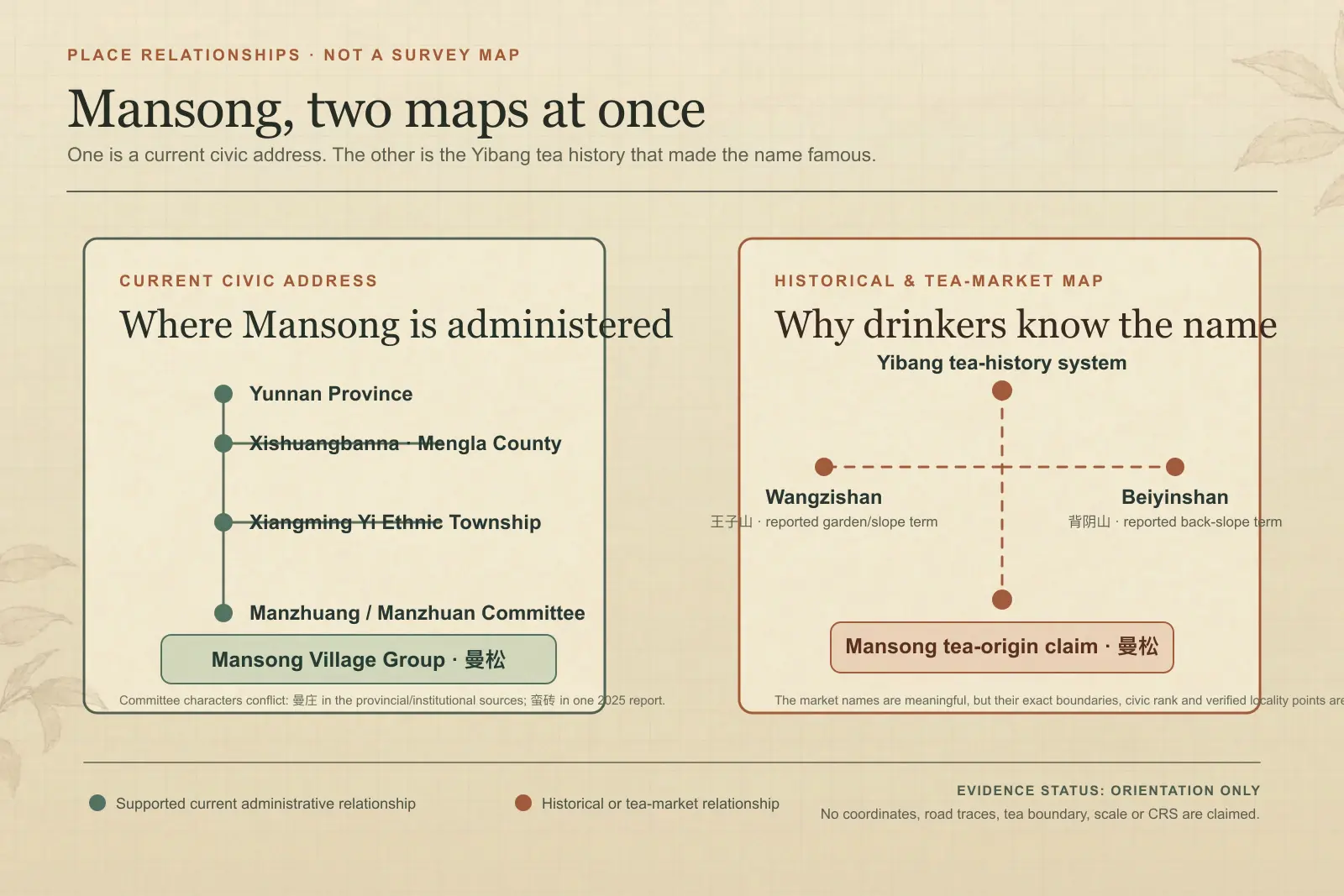
Orientation guide notes and sources
Boundary confidence: Mansong's current village-group parentage is supported, but no licensed garden boundary, authoritative locality-coordinate set, or survey of Wangzishan and back-mountain tea areas was found. This is an orientation diagram, not a geographic composite map.
- DB53/T 1176.13-2023 administrative village codes
- Yunnan Daily 2025 Mansong road-work report
- Yunnan Institute of Tropical Crops 2025 Manzhuang assistance report
- People's Daily Overseas Edition 2022 Yibang stele report
Why Mansong needs two maps
Mansong (曼松, Mànsōng) is the name that makes otherwise sensible pu-erh drinkers forget to ask ordinary questions. It is associated with Qing-era tribute tea, delicate small-leaf material and an extraordinarily narrow, expensive-looking origin. All of that makes it compelling. It also makes it a useful place to slow down.
The first map is current and administrative: Yunnan → Xishuangbanna Dai Autonomous Prefecture → Mengla County → Xiangming Yi Ethnic Township → Manzhuang/Manzhuan Village Committee → Mansong Village Group. The provincial village-code standard uses 曼庄 for the committee. A 2025 Yunnan Daily report writes 蛮砖, while a 2025 Yunnan Institute of Tropical Crops report again uses 曼庄 and lists Mansong among that committee’s village groups. No formal rename notice was found, so this guide retains the character conflict instead of pretending it has vanished.
The second map is historical and commercial. Mansong is inseparable from the Yibang tea story: Qing-era records and later heritage writing place it in the old eastern tea-mountain trade world, and tea sellers still use Yibang as its broadest intelligible neighbourhood. Those two maps overlap, but they are not the same thing. A current civic address answers where a village group is administered. A historical tea name answers why drinkers recognise it.
What Mansong tea may taste like
The public tasting evidence is much less robust than the market confidence. CCTV’s 2014 visit to Mansong includes a tea demonstration framed around sweet entry, low bitterness and persistent throat sensation. Sellers commonly use fragrance, honey, sweetness, delicacy and a deep finish. A product description can be useful as a tasting prompt, but it cannot be a blind identity test.
Use the cup as a notebook, not a certificate:
- Aroma: look for flowers, honey, ripe fruit, grain or leaf-sweetness, then check whether the aroma survives after the opening perfume.
- Taste: a tea may enter gently and still develop a firm bitter line later. “Soft” is not synonymous with weak; “bitter” does not disprove a Mansong claim.
- Texture: fine, silky, oily and dense are useful sensations to record. Ask whether the body grows through the middle steeps or vanishes with the first aroma.
- Astringency: grip is separate from flavour. Note dry cheeks, tongue pressure and throat pull rather than hiding all structure under “sweet.”
- Return and finish: huigan is sweetness returning after swallowing; shengjin is gathering salivation. Their timing can be more instructive than the intensity of the first sip.
- Body sensation: calm, warmth, alertness and cha qi are real personal observations, but dose, food, expectation and context all affect them. They are not evidence of village, garden or tree age.
Fresh-leaf maturity, season, resting, fixation, rolling, sun drying, blending, compression and storage all change the session. A green, sharp tea may be a processing problem; an old, soft one may be mostly storage. No ImperfecTea-controlled flight and no matched three-tea/two-producer public comparison were located in this review. The tasting language here is deliberately provisional.
Where does Mansong sit today?
Evidence snapshot
| English name | Mansong |
| Chinese and pinyin | 曼松, Mànsōng |
| Also seen as | Man Song, Mansong Gongcha, Mansong Tribute Tea; older historical writing may use 蔓松 |
| Current civic chain | Yunnan → Xishuangbanna → Mengla County → Xiangming Yi Ethnic Township → Manzhuang/Manzhuan Village Committee → Mansong Village Group |
| Tea-history connection | A prestige sub-origin in the wider historical and market conversation around Yibang |
| Entity type | Current village group plus a much narrower tea-place/garden-origin claim; not a surveyed appellation |
| Names around the claim | Wangzishan / Prince Mountain (王子山) and Beiyinshan / back mountain (背阴山) are reported local or commercial landscape terms, not verified civic units |
| Tea form | Usually sold as raw pu-erh (sheng) |
| Cautious cup shorthand | Sweet-edged, fragrant and fine-textured are recurring reported descriptions; bitterness, grip and stamina still vary by lot |
| Not established here | A garden boundary, coordinates, elevation range, tree census/age, soil profile, production volume, or defensible current price range |
| Research confidence | Supported for current hierarchy and broad Qing trade/tribute association; partial for local ecology, plant identity, sensory profile and narrow garden claims |
It is tempting to put Mansong directly under Yibang, because that is how it travels through tea speech. But recent institutional sources do not do that. They place the Mansong Village Group under Manzhuang/Manzhuan Committee in Xiangming Township. That does not exile Mansong from Yibang’s history. It simply stops a historical tea system from masquerading as today’s local-government chart.
This distinction matters at the buying table. A wrapper can quite reasonably say Mansong, Yibang tea mountain while a producer’s current rural address refers to Manzhuang/Manzhuan. The red flag is not the two names together. The red flag is someone using the confusion to make a vague lot sound more narrowly documented than it is.
| Name | What it is safe to say | What remains open |
|---|---|---|
| Mansong 曼松 | A current village group under Manzhuang/Manzhuan and a famous Yibang-linked tea name | Surveyed tea extent, garden ownership and a complete locality register |
| Yibang 倚邦 | Historic tea mountain, former collection/trade landscape and modern village committee name | It is not Mansong’s present civic parent |
| Wangzishan 王子山 | A narrower Mansong-associated landscape or garden name in public tea usage | Its legal/civic status, border and independently verified point |
| Beiyinshan 背阴山 | A reported Mansong-associated back- or shaded-slope label | Its exact characters, scope, ownership and relation to Wangzishan |
| Manzhuang / Manzhuan | The current committee name family in provincial and institutional sources | Whether 曼庄 and 蛮砖 reflect a rename, variant transcription or editorial inconsistency |
The useful provenance chain is therefore longer than a mountain name:
Mansong Village Group → named household, garden or collecting area → harvest and season → fresh-leaf buyer or maocha maker → pressing batch → storage → cup.
If a seller cannot speak to the middle of that chain, “Mansong” may still be an honest broad description. It is not yet a reason to pay as if you know a particular hillside.
What can the tribute story actually support?
Mansong’s prominence is not a modern invention. Heritage reporting from Yibang describes surviving steles dated 1738, 1848 and 1888. The 1738 text is presented as a notice against coercive low-price purchasing, while the report links the wider Yibang administration to the old six tea mountains and says Mansong tea was procured as tribute. A China Co-operation Times history essay reproduces a Qing-era official instruction concerning the collection of tender tribute tea and delivery through Yibang. Together, those sources support a broad conclusion: Mansong was part of the Qing-era tea economy and became associated with tribute procurement inside the Yibang system.
That is already a good story. It does not need the usual pile of unverified extras. This research did not establish a continuous modern-to-Qing provenance chain, a single emperor’s favourite cake, an annual tribute weight, a fixed “royal garden” boundary, or a dateable tree inventory. The famous phrase gongcha (贡茶, tribute tea) is historically meaningful, but on a present-day wrapper it is still a provenance claim that needs a lot number, maker and source explanation.
Yibang’s importance also came from people and movement, not merely from elite taste. The old street, merchant associations and stone-road accounts describe a working network of growers, carriers, processors, merchants and officials. That context makes a modern Mansong premium easier to understand: small names became valuable because trade made them legible. The price tag is not the history; it is one modern consequence of it.
What remains unresolved about small-leaf material?
Mansong is routinely described as small-leaf tea in a region better known for Yunnan large-leaf populations. The observation is real enough to record, but the explanation is unsettled. People’s Daily Overseas Edition repeats a local account that Sichuan migrants brought small-leaf material during the late Ming to early Qing period. A China Co-operation Times discussion reports a specialist view that the material remains within Yunnan large-leaf populations rather than being the same as Sichuan small-leaf tea.
These claims do not yet add up to a published genetic answer. We do not have the underlying comparative dataset, a current cultivar register, or a field inventory that links one modern product to a defined plant population. Use “small-leaf morphology is reported around Mansong” rather than “Mansong is a certified small-leaf cultivar.” A wet leaf, a short petiole or a romantic origin story cannot authenticate a cake.
What can the available garden evidence explain?
The honest environmental picture begins wide. Mansong lies in Xiangming’s warm, mountainous southern-Yunnan setting. The Yibang committee profile reports monsoonal conditions, and long-term research elsewhere in Mengla County confirms a strongly seasonal rain pattern. That tells us why harvest timing, slope exposure, leaf transport and sun drying matter. It does not give Mansong a measured elevation band, soil chemistry, canopy percentage or private-garden boundary.
No plot-level Mansong soil study or licensed garden survey was found. Claims about purple-red rock, “mineral water,” exact height, centuries-old trees or a unique royal microclimate mostly circulate through trade and travel copy. They might point toward a question worth researching; they are not evidence to convert into a map legend.
The practical terroir lesson is more grounded. A steep or shaded position may influence sun, drainage and leaf timing. Mixed vegetation and different management can influence picking conditions and fresh-leaf handling. Those mechanisms explain why two tea lots bearing the same name can taste unlike each other. They do not allow us to work backwards from a honeyed cup to a specific mountain, tree or soil.
How can processing, season, age and storage change the cup?
Most Mansong presented to specialist drinkers is raw pu-erh. In broad outline, fresh leaf is rested or withered, heat-fixed, rolled and sun-dried into maocha; it may later be sorted, blended, steamed and pressed. That workflow is regional, not a Mansong-only method.
For a tea sold on finesse, small choices can be enormous. Too much oxidation before fixation can make a young tea redder and fruitier. Weak fixation can leave grassy notes; a harsh wok can add smoke or hard bitterness; heavy rolling can exaggerate drying grip. A premium label does not neutralise any of these possibilities.
Ask for season as well as place. Spring has the strongest prestige language, but this review found no controlled Mansong spring-versus-autumn study. Ask when the leaf was picked, when the maocha was made, when the cake was pressed and where it has lived since. Storage can create wood, herbs, cellar tones and softness that are compelling but not a simple expression of fresh Mansong leaf.
How should you buy and compare Mansong?
Mansong is a high-risk place to confuse a beautiful story with a complete record. The useful questions are precise and unglamorous:
- Does this lot claim the Mansong Village Group, Wangzishan, Beiyinshan, a household garden or a broader Yibang sourcing area?
- Which Chinese name appears on the producer’s source record: 曼松, 王子山, 背阴山, 倚邦, 曼庄 or something else?
- Who picked and processed the leaf, and was the maker buying fresh leaf or finished maocha?
- What are the harvest, processing, pressing and storage dates?
- Is the tea one garden, one household, a village blend or a brokered blend?
- What does “gushu,” “tribute,” “royal,” “pure material” or “Prince Mountain” mean in this lot, and what documents support it?
Do not use the most spectacular online quote as a market benchmark. Public Mansong figures mix fresh leaf, maocha and finished cakes; spring and autumn; alleged one-tree material, village blends and broad regional sourcing. One 2019 report describes a drought-era price movement, and the 2014 CCTV feature shows the older scarcity conversation, but neither is a current, comparable market survey. This guide publishes no range.
A transparent broad Yibang tea, a Manzhuang tea, or a clearly identified Yiwu comparison can be the better purchase when the goal is to learn. The most expensive label is not automatically the most informative cup.
How should you brew a controlled comparison?
Start with 5 grams in a 75 to 90 ml porcelain gaiwan and water close to a full boil. Give a tightly compressed sample a quick rinse if needed, then use short early steeps: roughly 5, 7, 10, 15 and 20 seconds. Keep a second session with less leaf if sweetness appears only after a punishing wall of bitterness.
For a useful four-tea flight, compare a traceable Mansong-labelled tea with a broad Yibang spring sheng, a Manzhuang or Manzhuan reference and one contrasting Ancient Six tea such as Manzhuan or Gedeng. Match age and storage as closely as you can. Record aroma persistence, bitterness, drying grip, the moment sweetness returns, texture through the middle steeps and the last satisfying infusion. Blind labels when possible.
The point is not to prove a legend from the cup. It is to discover whether the tea in front of you earns another session.
What should you remember?
- Mansong is a real current village group under Manzhuang/Manzhuan Committee, while its tea-history and market story sits inside the wider Yibang conversation.
- Its Qing tribute association is supported in heritage and historical reporting; precise imperial stories, production figures and “royal garden” borders are not established here.
- Wangzishan and Beiyinshan are meaningful tea names, but not yet mapped civic units or audited garden polygons.
- Fragrance, sweetness and fine texture are good things to look for, not a way to authenticate a lot.
- The best Mansong buying question is still: whose leaf, from which named place, in what season, made by whom, and stored how?
Sources and research limits
Sources were accessed on 18 July 2026. This guide relies first on the provincial administrative-village standard and current institutional reporting for the civic hierarchy; it uses heritage and historical reporting for the Yibang and Mansong tribute connection, and treats product/tasting sources only as limited sensory evidence.
- DB53/T 1176.13-2023: Xishuangbanna administrative village codes, current Xiangming committee context.
- Yunnan Daily: road and livelihood work at Mansong and Yunnan Institute of Tropical Crops: Manzhuang assistance work, recent Mansong village-group parentage.
- People’s Daily Overseas Edition: visiting Yibang’s tea steles and China Co-operation Times: Pu’er tribute-tea history, heritage/history reporting, used with limits.
- Journal of Plant Ecology: long-term climate observations at Menglun, Mengla, county-level monsoon context, not a Mansong weather station.
- CCTV Economic Half-Hour, 2014 Mansong visit and China Co-operation Times, 2019 drought/price report, dated media evidence only; not a current price survey or controlled tasting.
The full dossier and source log record access dates, conflicts, claim confidence and rejected claims. The original map package is an orientation diagram with no borrowed basemap, coordinates, road geometry or tea-boundary polygon. A trustworthy version still needs a licensed geographic composite; verified locality and administrative data; an independent tasting flight; resolved Manzhuang/Manzhuan nomenclature; and market evidence that compares like with like. Until then, its map and origin claims remain deliberately limited.
Quick answers
Frequently asked questions
What does the Mansong tea name identify?
A current village group under Manzhuang Village Committee in Xiangming Township, Mengla County, historically and commercially linked to Yibang. Its most useful identity is current village group, historical tribute origin and prestige micro-region, so the name alone does not guarantee a particular garden, tree age or quality level.
What does Mansong tea taste like?
Claimed teas often suggest fragrance, honeyed sweetness, fine texture and a lingering throat finish, but no matched flight supports a signature. Use that profile as a tasting guide, not as proof of origin.
What is Mansong commonly confused with?
Mansong village group, historical Yibang tribute procurement and modern Prince Mountain garden claims are different layers of provenance.
What should I ask before buying Mansong tea?
Start with: What current Mansong household and garden supplied this lot, and what evidence supports any Prince Mountain claim? Also ask for the harvest year and season, producer or household, processing details and storage history.