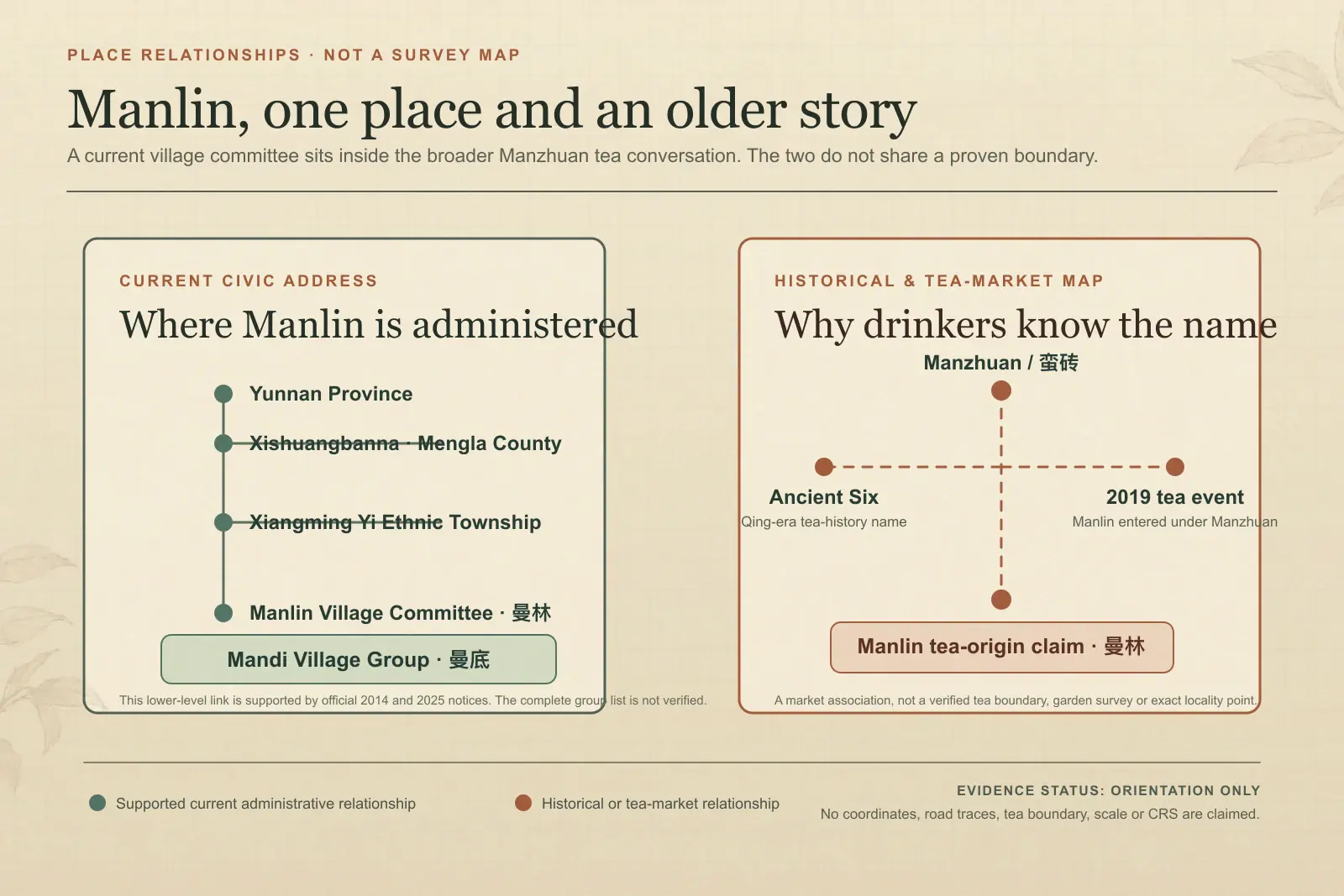
Orientation guide notes and sources
Boundary confidence: Manlin Village Committee and its Xiangming parent are supported by provincial and official records; Manlin's exact natural-village set, tea-garden extent, locality coordinates, and relationship to the historical Manzhuan boundary are not resolved.
- Yunnan provincial village-code standard DB53/T 1176.13-2023
- Yunnan Department of Natural Resources, 2016
- Songjiang District Government, 2025
- Geographical Science, 2022
What is Manlin, and why is it not simply Manzhuan?
Manlin (曼林, Mànlín) is not merely a fancy sub-label on a Manzhuan cake. It is a current village committee in Xiangming Yi Ethnic Township, Mengla County. That is the useful starting point. Tea people often place Manlin inside the older Manzhuan / 蛮砖 story, one of the Ancient Six Tea Mountains; an academic record of a 2019 tea competition listed Manlin Village among Manzhuan entrants. But an old mountain name, a civic committee and a particular garden are three different sizes of claim.
Published Manlin tastings make the name worth chasing: one same-producer comparison found a Manlin tea more slowly building and longer-lived than a broadly labelled Manzhuan tea. It is one taster, not a regional law. A particular cake still needs a village group, household or garden, harvest, maker and storage history. Read “Manlin” as an invitation to ask better questions, not as a guarantee of old trees, forest leaf or a fixed flavor.
What can Manlin tea taste like?
There is enough published experience to make Manlin interesting, but not enough to give it a passport stamp. The most useful evidence is a close, imperfect comparison: MattCha reviewed two 2016 Zheng Si Long teas from the same producer, year and listed price. The broadly labelled Manzhuan tea moved through rainforest wood, cherry, coconut and pastry sweetness, with a sticky texture and little bitterness, then faded earlier. The Manlin tea was described as more gradual, more durable and less harshly building. That is a single public taster using commercially supplied tea, with origin and storage not independently audited. It is a good tasting hypothesis, not a regional average.
Another public record, Tea Log’s note on a 2016 Zheng Si Long Manlin, corroborates that a specifically named Manlin product circulated. It does not provide enough controlled sensory detail to settle a local profile. A local-style account describes fresh Manlin tea as sweet-bitter with a moist, lingering fragrance; it is a vivid visit report, not a blind comparison.
Try the name this way:
- Aroma: look for fruit, flowers, honey, wood or pastry-like notes, then see whether they survive past the first aromatic steeps.
- Taste: separate immediate sweetness from later huigan, the sweetness that returns after swallowing. Do not treat low bitterness as more authentic.
- Texture: compare density and coating after matching leaf weight, water temperature and age. A tea can be fragrant yet thin, or reserved yet persistent.
- Astringency: note fine grip versus coarse drying. Processing, leaf maturity and hard water can change it as much as origin.
- Stamina: the compelling Manlin claim in the public comparison is a slower build. Count the last satisfying infusion rather than rewarding the loudest first cup.
- Body sensation: cooling, warmth and cha qi are subjective, dose-sensitive responses. They are not proof of village, tree age or purity.
The evidence is partial because no controlled, representative Manlin flight was found. A transparent lot may be worth comparing for a sweet-to-structured, gradually building session, but the maker matters at least as much as the place name.
Where does Manlin sit today?
Evidence snapshot
| English name | Manlin |
| Chinese and pinyin | 曼林, Mànlín |
| Common spellings | Manlin, Man Lin, 曼林村, 曼林寨; romanisation varies, but these refer to the same current committee-level name in the evidence reviewed |
| Region family | Manzhuan conversation, Ancient Six Tea Mountains |
| Best-supported address | Yunnan → Xishuangbanna Dai Autonomous Prefecture → Mengla County → Xiangming Yi Ethnic Township → Manlin Village Committee |
| Geographic type | Current village committee and tea-market origin name; not a surveyed mountain appellation |
| Supported lower-level anchor | Mandi Village Group (曼底村民小组) under Manlin Village Committee, documented in official 2014 and 2025 notices |
| Reported, not adopted as a full civic list | Manlin village group, Gaoshan, Mansai, Baodian, Manpei, Choushuihe, Xiaomannai and Changlinggang appear in specialist writing; a current official register was not found |
| Manzhuan relationship | Contemporary tea-cultural and festival evidence links Manlin with Manzhuan; no authoritative tea-boundary polygon establishes that their extents are identical |
| Climate and terrain context | Xiangming is a mountainous, wet southern-Yunnan township. No Manlin garden-level elevation, weather or soil study was verified in this review |
| Harvests and material | Raw pu-erh is the market focus; spring is commonly foregrounded. No committee-level harvest calendar or cultivar inventory was found |
| Cautious cup shorthand | Sweetness, fruit/wood and a gradual, durable structure are plausible things to test for, not a fingerprint |
| Research confidence | Supported for committee hierarchy and a Manzhuan-market connection; partial for locality list, sensory profile and history; unknown for surveyed gardens, tree age and prices |
| Last researched | 18 July 2026 |
The administrative chain is the least romantic and most valuable fact:
Yunnan → Xishuangbanna → Mengla County → Xiangming Yi Ethnic Township → Manlin Village Committee → village group / household / garden → harvest → maocha maker → finished lot → storage.
Yunnan’s 2023 administrative-village code standard lists Manlin alongside Yibang, Anle, Manzhuang and Longgu as one of Xiangming’s five village committees. The spelling matters. Manlin (曼林) and Manzhuang (曼庄) are separate civic units. Manzhuan (蛮砖) is the historical tea-mountain name, often rendered in English close enough to create confusion. A current cake can honestly connect Manlin to Manzhuan without proving that Manlin equals the whole historical mountain.
Two official records make the committee more than a line in a code table. A 2014 Yunnan natural-resources notice identifies Mandi Village Group under Manlin Village Committee. A 2025 government report on a drainage project again names Mandi under Manlin Village Committee. This is strong, limited evidence: it confirms one lower-level address and continuity of the committee name. It does not furnish a complete natural-village register, a tea-garden map or coordinates suitable for a public terroir map.
Why Manlin and Manzhuan get braided together
Manzhuan is a Qing-era tea-mountain name and a modern tea-market umbrella. A 2022 Geographical Science study records Manlin Village among the Manzhuan entries at the 2019 Mengla tea competition. A tea-travel account likewise says that Manlin and Manzhuang committees sit within a cultural-geographic Manzhuan conversation, then records local growers insisting that “Manlin is Manlin.” That tension is illuminating. Tea history groups landscapes; civic government administers them; growers and buyers may use a smaller name to describe the tea they care about.
Use both lines when reading a label. “Manzhuan” can orient you in the Ancient Six. “Manlin” can narrow the question. Neither says which garden, which trees, which season or who made the maocha.
The map here is an orientation diagram, deliberately not a survey. The public sources found for this article establish the civic chain and the tea-history relationship, but do not provide a licensed base map, authoritative garden boundary, verified point set, CRS or scale. It would be worse to draw an exact-looking tea estate from a seller’s route description.
Which narrower localities need recognition?
Manlin’s current committee rank is strong. Its interior is not yet safe to flatten into a tourist-style village list. The table keeps the distinction visible.
| Name | What can be said now | What it does not prove |
|---|---|---|
| Manlin Village Committee 曼林村民委员会 | A current Xiangming village committee in the provincial code standard | A single tea boundary, flavor or garden type |
| Mandi Village Group 曼底村民小组 | Official 2014 land notice and 2025 drainage report place it under Manlin VC | That its land-use record describes tea gardens, or that every Manlin cake comes from Mandi |
| Manlin village group 曼林村民小组 | A collective-economy listing and specialist writing use this lower-level name | Its exact official rank, boundary or relationship to every marketed “Manlin” lot |
| Gaoshan, Mansai, Baodian, Manpei, Choushuihe, Xiaomannai, Changlinggang | Reported in specialist/local tea writing as groups or localities associated with Manlin | Current official spellings, parentage, coordinates, garden boundaries or a shared cup profile |
| Walong / 瓦竜 | Appears in forest-protection reporting in the Xiangming area and in Manzhuan tea-market writing | A confirmed Manlin parent; it remains a separate research question |
This is not pedantry. A vendor can say “Manlin” honestly at committee or village-blend scale. It becomes a narrower provenance claim only when the person can name the Chinese locality, household or garden, harvest date, processor and whether the lot was blended. A large-sounding origin name without that chain can still make a lovely tea; it just should not command evidence-free certainty.
What can the available place evidence explain?
What the regional setting tells us
Xiangming is a rugged, wet township in Mengla’s northern tea country. An administrative geography source describes multiple ethnic communities, complex mountain-and-water terrain and small rivers feeding the Xiaohei River system. That helps explain why roads, access, fresh-leaf logistics and slope-level variation matter. It does not hand us a Manlin garden profile.
Specialist accounts describe forest, slopes and older tea trees around Manlin; one gives an elevation range and tree ages. Those claims are useful leads for future fieldwork, not adopted facts here. The sources do not supply a transparent survey, tree-dating method, representative sample or licensed spatial data. This guide therefore does not claim a Manlin elevation range, old-tree acreage, canopy percentage, soil chemistry, chemical-input status or cultivar.
The sound inference is modest: tea from different parts of a large mountain township can vary because slope, shade, leaf freshness, rain, picking and household processing vary. The unsafe inference is that a tall tree, a red-soil phrase or an expensive label proves flavor or age.
Plant material and human work
Manlin belongs to Yunnan’s broad large-leaf pu-erh context, but no Manlin-specific genetic or cultivar study was located. “Ancient,” “wild,” “ecological” and “forest” are not interchangeable. Tree form is not a dating method; forest adjacency is not a pesticide audit; and a seller’s photo is not a chain of custody.
Fresh leaf becomes tea through labor. Resting, shāqīng (kill-green), rolling and sun-drying determine the maocha; sorting, blending, compression and storage add another layer. The 2020 local visit account describes hand frying, rolling and sun-drying at one household. That is a useful human-scale observation, not evidence of a committee-wide recipe.
How can processing, season, age and storage change the cup?
A transparent Manlin raw pu-erh should be evaluated as a made thing, not as raw geography. In the broad sheng sequence, picked leaf is rested, heat-fixed, rolled and sun-dried into maocha. It may later be sorted, blended, steamed and pressed. A long delay before fixation, uneven wok heat, rough rolling, weak sun-drying or tight compression can change a cup dramatically.
In practice, watch for these possibilities:
- Early grassiness, smoke or scorched bitterness asks a processing question before it asks a village question.
- Immediate softness and red-fruit notes may reflect leaf maturity, oxidation, processing or storage, not necessarily “gentle Manlin.”
- A late dry grip can be leaf, extraction or water. Try a lower ratio before making it a terroir claim.
- Aging can bring wood, herbs and softened bitterness, but it also brings the storage environment. An older cake is not a frozen sample of fresh Manlin.
Spring appears most often in premium Manlin offers, yet this review found no matched spring-versus-autumn set. Treat season as a disclosed condition, not as a hierarchy of virtue. Ask for picking date, processing date, pressing date and storage history.
How should you buy and compare Manlin?
The buyer’s job is to turn a place word into a production story. Ask:
- Does “Manlin” mean the village committee, Manlin village group, a named garden or a broker’s blend?
- Which Chinese characters appear in the source record: 曼林, 曼底, 蛮砖 or something else?
- Who managed the garden and who processed the maocha?
- What are the picking, processing and pressing dates? Is the tea spring, rain-season or autumn material?
- Is it a household lot, a village blend or a wider Manzhuan blend?
- What does “old tree,” “forest” or “wild” mean in this particular offer, and what evidence can the seller provide?
Search both 曼林 and Man Lin. Do not silently substitute 蛮砖 or 曼庄: the names travel together commercially but designate different things in the strongest current civic evidence. This guide does not print a price range. It found no two normalized, dated observations matched for season, material type, maker, storage and form. A well-documented broad Manzhuan tea may be a more rational purchase than a mysterious “Manlin gushu” cake.
For comparisons, try a disclosed Manlin lot beside a broad Manzhuan lot, a Manzhuang/Manqian claim and a transparent Yiwu-area tea. Match age, storage and brewing as closely as possible. Manlin is interesting precisely because it tests how much a narrower name changes the cup once the other variables are held still.
How should you brew a controlled comparison?
Begin around 5 to 6 g per 100 ml, near-boiling water and short steeps: approximately 5, 7, 10, 15 and 20 seconds. If the tea becomes bitter before it becomes expressive, reduce contact time first; lowering water temperature can hide useful aroma and texture. Give tightly compressed leaf a quick rinse and a few minutes to open.
For a three- or four-tea session, use the same leaf weight, water, vessel and timing:
- A Manlin-labelled tea with a maker and harvest disclosed.
- A broad Manzhuan tea of similar age and storage.
- A Manzhuang or Manqian lot with comparable transparency, if available.
- A Yiwu-area reference tea, chosen for contrast rather than rank.
Record aroma persistence, immediate sweetness, bitterness, astringency, texture, the timing of huigan and the last satisfying steep. Blind the labels if you can. The point is not to crown a mountain; it is to discover whether a label is carrying useful information.
How did a current committee enter an older tea story?
Manlin’s story works best when it avoids the usual fantasy of a timeless mountain. Qing and later accounts made the Ancient Six Tea Mountains important to regional production and trade; Manzhuan is one of those names. The 2022 festival study shows that, in 2019, Manlin was still publicly grouped under Manzhuan for tea competition. That is evidence of contemporary cultural-market practice.
The civic record tells a different, equally real story. Manlin Village Committee appears in the current provincial standard. Mandi Village Group appears in a 2014 state land notice and a 2025 drainage-project report. These documents bring the subject back to ordinary public life: collective land, drainage, transport and village administration. They do not tell us which cake is best, but they tell us why a village name is more than a brand.
Tea writing sometimes says that Manlin’s old gardens are uniquely preserved or that its trees are hundreds of years old. The research pass found no published inventory sufficient to carry those claims. We can acknowledge a real tea culture and local skill without turning residents, trees or forest into decorative proof of a premium price.
What should you remember?
- Manlin is a current village committee in Xiangming, Mengla, not just a poetic name on a wrapper.
- It belongs in the modern Manzhuan tea conversation, but its civic extent is not proven to equal the historic mountain boundary.
- Mandi Village Group is a supported lower-level anchor; many other locality names need an official register before they become a definitive hierarchy.
- Sweetness, fruit/wood and a gradual, durable structure are reasonable tasting prompts, not authentication tools.
- The best Manlin label names a narrower source and a maker. The best Manlin session compares it against a transparent Manzhuan peer.
Sources and research limits
This guide uses Yunnan’s provincial administrative-village standard for Manlin’s committee status; Yunnan Department of Natural Resources and a 2025 Shanghai district-government report for the Mandi Village Group connection; and a peer-reviewed Geographical Science article for Manlin’s 2019 Manzhuan tea-competition association. A local governance source is used only for broad Xiangming setting. Specialist product reviews and local visit writing are used only for scoped sensory, processing and locality leads. The local research dossier and source log record full URLs, access dates, conflicts and claim confidence.
The map is an original orientation graphic, not a geographic composite. It uses no copied base map, exact coordinates, inferred roads or tea-boundary polygons. A trustworthy version still needs a licensed Yunnan/Mengla/Xiangming composite, authoritative boundaries, independently verified locality points, a scale, CRS, source/date and uncertainty layer; a current natural-village register; controlled tasting across at least two producers; and normalized dated market observations. Until then, its map and origin claims remain deliberately limited.
Quick answers
Frequently asked questions
What does the Manlin tea name identify?
A current village committee in Xiangming Yi Ethnic Township, Mengla County, commonly placed inside the broader Manzhuan tea conversation. Its most useful identity is current village committee and narrower tea origin, so the name alone does not guarantee a particular garden, tree age or quality level.
What does Manlin tea taste like?
A same-producer comparison suggests a sweet, structured and gradually building session with better stamina than one broad Manzhuan, but evidence remains partial. Use that profile as a tasting guide, not as proof of origin.
What is Manlin commonly confused with?
Manlin is connected to the historical Manzhuan trade landscape but is not simply a synonym for the entire mountain name.
What should I ask before buying Manlin tea?
Start with: Does this tea come from a named Manlin village or committee-wide blend, and who made the maocha? Also ask for the harvest year and season, producer or household, processing details and storage history.