Orientation guide notes and sources
Boundary confidence: administrative hierarchy verified; no surveyed Mahei tea boundary or independently cleared natural-village coordinate set
- DB53/T 1176.13-2023 administrative village codes
- Yang, Yang & Yin (2023) Yiwu fieldwork
- Yunnan official road reporting (2018)
What is Mahei, and why does it demand a second question?
Mahei (麻黑, Máhēi) is one of the names drinkers learn after Yiwu, but it is more useful once you stop treating it as a tiny, perfectly bounded flavour zone. The firm civic anchor is Mahei Village Committee, one of six beneath Yiwu Town in Mengla County. In the tea trade, “Mahei” can then mean the committee, a central settlement, a producer’s buying network, or a narrower lot that someone wants to sound village-specific.
That ambiguity does not make Mahei uninteresting. It makes it a good lesson in how Yiwu actually works. Public tastings of Mahei-labelled raw pu-erh often find fragrance, sweet return and an oily or rounded feel, but also vegetal notes, cocoa-like bitterness, sour processing and storage effects. The historic Tea Horse Road has documented Mahei and Luoshuidong sections, and official reporting places Guafengzhai under the committee. The name points to a real tea landscape. It just does not authenticate a cake by itself.
What Mahei tea can taste like
“Soft and sweet Yiwu” is too broad to help much. Mahei’s public tasting record is more interesting because it refuses to be that simple.
An independent review of a seller-claimed 2018 spring Ma Hei sample found steamed green vegetables, medicinal and grassy notes, plum and malt-like aroma, and no perceived bitterness across many infusions. A comparison of a claimed 2013 Bi Yun Hao Mahei found cherry or berry character, an oily texture and a distinct cocoa-like bitterness. A 2019 Mahei-labelled tea reviewed after Taiwanese-style storage showed savoury/mushroom-like aroma plus real bitterness and astringency; the reviewer also noted that its extra micro-origin name, Dahei Senlin, was not clearly resolved. An older seller-claimed Mahei tasting discussed by MarshalN began sour and awkward, then improved through the session.
Taken together, those are not a regional fingerprint. They are a fair starting hypothesis:
- Aroma: fruit, honey, flowers, malt, herbs, green vegetation, wood or storage tones can all appear. Judge whether the aroma remains after the first quick steeps.
- Taste: a gentle entry may be followed by a bitter edge. A cocoa-like or medicinal bitterness is not incompatible with a Mahei claim, and lack of bitterness proves nothing either.
- Texture: some examples are described as oily, rounded, thick or coating; others are lighter and more vegetal. “Smooth” alone tells you little.
- Astringency: distinguish taste from grip. A tea can be sweet-tasting and still dry the cheeks or throat.
- Sweet return: huigan is sweetness that appears after swallowing. Note its delay and duration rather than assuming it must be present.
- Salivation: shengjin is increased salivation. It is a useful observation, not a laboratory test of place or tree age.
- Body sensation: warmth, calm, focus or “cha qi” are subjective and dose-sensitive. They cannot authenticate a village claim.
The main confounders are not subtle. Harvest maturity, time between picking and heat fixation, wok skill, rolling, sun drying, blending, compression and storage can each change the cup more dramatically than the word on a wrapper. Age adds another layer: an older Mahei-labelled cake may be telling you about storage humidity and compression long before it tells you about fresh leaf.
No ImperfecTea-controlled Mahei flight has been logged, so this profile is supported, not verified. The best next test is three traceable Mahei teas from two producers, tasted beside a broad Yiwu and a nearby named Yiwu locality at comparable age and storage.
Where does Mahei sit inside Yiwu?
Evidence snapshot
| English name | Mahei |
| Chinese and pinyin | 麻黑, Máhēi |
| Common spellings | Mahei, Ma Hei, Yiwu Mahei, Mahei Village; Mahai appears in some English retail copy |
| Region family | Yiwu, within the Ancient Six Tea Mountains |
| Best-supported address | Yunnan → Xishuangbanna Dai Autonomous Prefecture → Mengla County → Yiwu Town → Mahei Village Committee |
| Geographic type | Current village committee and tea-market origin name; the exact rank and extent of the central “Mahei village” tea usage remain unverified |
| Associated locality | Guafengzhai (刮风寨) is officially reported under Mahei Village Committee; its own tea identity is narrower than Mahei |
| Heritage context | Mahei and Luoshuidong road sections are documented within the Yiwu Tea Horse Road landscape; Mahei old tea garden is a named heritage reference |
| Climate and soil context | Yiwu Town is reported as warm and wet, with about 1,700 to 2,200 mm annual rainfall and red/lateritic-red soils; these are town-scale, not Mahei-garden measurements |
| Tea-garden elevation | No defensible representative range found |
| Material and seasons | Raw pu-erh is the visible market form. Spring dominates prestige language; no complete Mahei harvest calendar or cultivar inventory was verified |
| Cautious cup shorthand | Fragrant, sometimes sweet-edged and oily or rounded; bitterness, astringency, vegetal character and storage effects vary sharply by lot |
| Research confidence | Supported for civic hierarchy and historical context; partial for sensory evidence; incomplete for ecology, coordinates, garden inventory and price data |
| Last researched | 18 July 2026 |
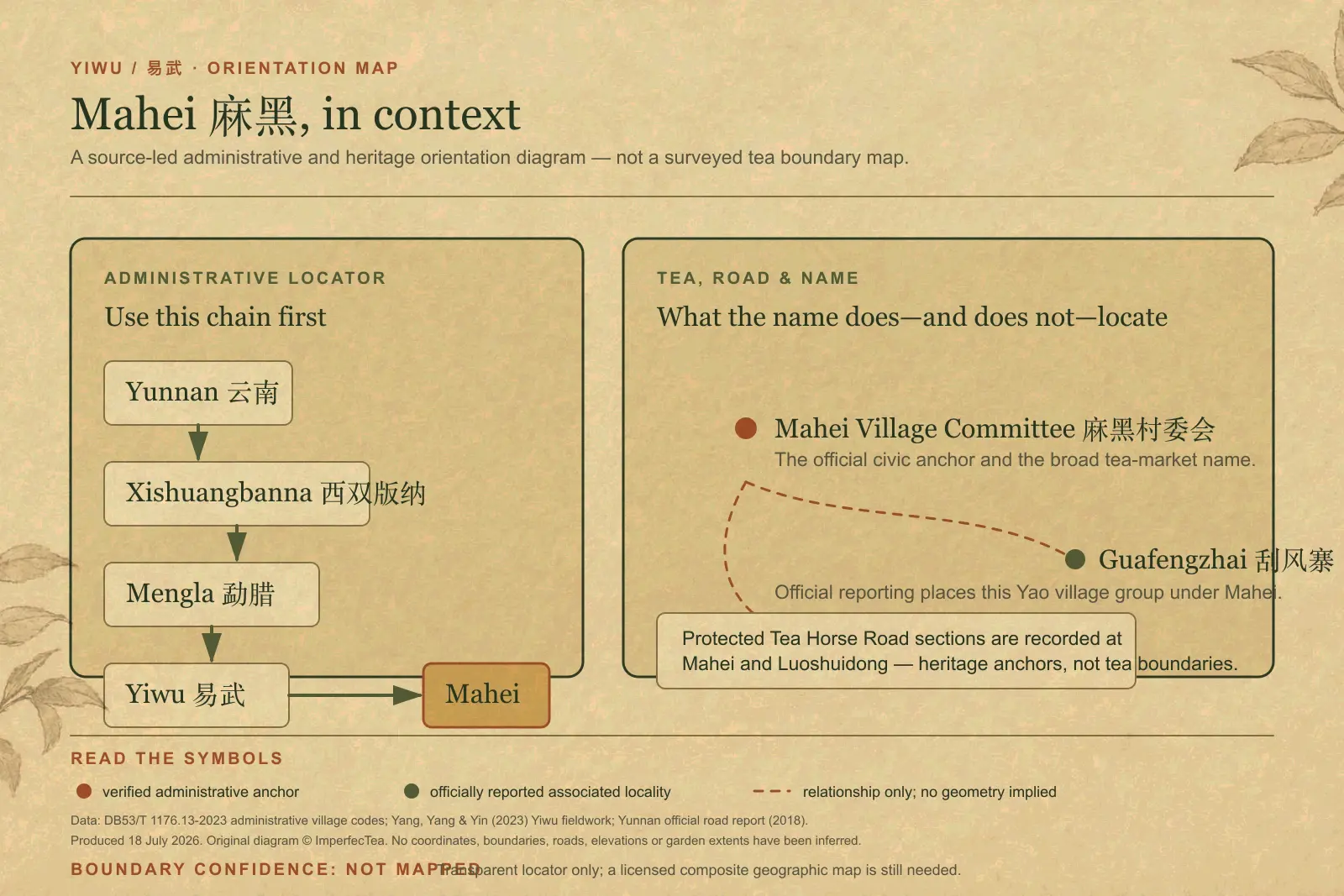
The easiest mistake is grammatical. Tea sellers often say “Mahei village,” and there may indeed be a settlement called Mahei in everyday use. But the current provincial administrative standard identifies Mahei Village Committee (麻黑村民委员会) beneath Yiwu Town. That is the level this guide can verify. It is one of Yiwu’s six current committees, alongside Yiwu, Namatian, Manla, Mannai and Luode.
The next layer is less tidy. A 2018 official report explicitly places Guafengzhai under Mahei Committee, describing it as a Yao village group. Local tea writing attaches more names, Luoshuidong, Manxiu and others, to Mahei at different scales, while a 2020 local profile gives conflicting totals for the committee’s subordinate groups. Those are not small bookkeeping problems. They are why a market label can be true in a broad sense and still be unclear in the narrow sense a buyer imagines.
The map above is deliberately a source-led orientation diagram, not a pretend cadastral map. It shows only what current records support: Mahei under Yiwu, and Guafengzhai as an associated locality. It also marks the historical-road relationship. It does not draw a tea boundary, invent a village pin, or turn a vendor map into survey geometry.
Mahei is inside Yiwu, not a rival mountain
Yiwu is the larger historical and commercial umbrella. Mahei is a narrower name within that landscape. A cake marked Yiwu may be a broad regional blend. A cake marked Mahei is making a more specific sourcing claim, but “more specific” is not the same as “fully traceable.” The useful chain is:
Mengla → Yiwu Town → Mahei Village Committee → named settlement or household → garden/collection area → season → processor → storage.
The first four links are where a serious seller should be able to start. If the conversation jumps directly from “Mahei” to “ancient forest single-tree,” the middle of the chain is missing.
Why does the road history matter?
Yiwu’s tea history is not just a backdrop for romantic wrappers. Merchant houses, processing workshops and routes turned leaf from an upland production area into tea that could circulate across much larger markets. The route system now recognized in the Yiwu Tea Horse Road landscape includes sections identified at Mahei and Luoshuidong, while heritage records also name the Mahei old tea garden. Those anchors make Mahei part of a tangible trade-and-garden history, not merely a modern product category.
There is a popular story that “Mahei” means dusk because caravans from Yiwu arrived there at day’s end. It is a pleasing explanation, and it appears in retail copy. This research did not find an authoritative linguistic study or archival source for it, so it is not presented as history here. That restraint leaves a better story: we do know that road remains, tea gardens and present-day production tie the Mahei name to Yiwu’s working landscape.
Tea remains a contemporary livelihood, not a frozen historical scene. A peer-reviewed study of Yiwu’s tea economy included interviews in Mahei in 2019. A local account credits committee-level garden protection, processing training and quality controls with part of the village’s development; it is useful testimony, but it should not be read as an independently audited impact study. A provincial report separately named Mahei Village in a 2021 demonstration-village programme. The point is practical: roads, rules, tea-making skills and market access are part of what a named-origin tea means.
People are not a flavour note
Guafengzhai’s Yao community is documented by official reporting. Some commercial descriptions call Mahei itself a Han village. Neither source establishes a single identity for every community inside the committee, and no tea profile should turn ethnicity into a shortcut for authenticity. When a seller invokes community or heritage, ask the concrete questions: who manages the garden, who picked the leaf, who made the maocha, and who benefits when the name gains value?
Which narrower names sit inside Mahei?
Mahei is not a neat village-only label. The useful field guide is a set of relationships rather than a definitive boundary map:
| Name | What this review can support | Why it matters in a tea conversation |
|---|---|---|
| Mahei 麻黑 | A current village committee under Yiwu Town, plus a narrower tea-market name used at several scales. | Ask whether a lot is committee-wide, settlement-specific or garden-specific. |
| Guafengzhai 刮风寨 | An officially reported Yao village group under Mahei Village Committee. | Its narrower identity should not be silently broadened into all Mahei tea. |
| Luoshuidong 落水洞 | A named Tea Horse Road section and a familiar Yiwu tea name; its exact current lower-level relationship to Mahei needs a current register. | Treat it as a separate comparison point until the seller explains the nesting. |
| Manxiu 曼秀 | Appears in local tea-market descriptions associated with Mahei, but its civic rank and boundary were not independently confirmed here. | Keep it as a research lead, not as a proven Mahei sub-village. |
This distinction is part of the tasting work. A seller who says “Mahei” should be able to say which row of this table they mean, who bought the leaf, and whether the tea is a single locality or a wider Yiwu blend.
What can the garden evidence explain?
The parent Yiwu study provides useful context but not a village passport. It reports Yiwu Town rainfall around 1,700 to 2,200 mm each year, and identifies red and lateritic-red soils in the town. Those conditions say something about a wet southern-Yunnan tea landscape. They do not establish the elevation, slope, soil chemistry, shade level or garden management of a specific Mahei lot.
No Mahei-specific garden map, plot-level soil study, representative elevation range, cultivar inventory or transparent tree-age register was located in this review. That is why this guide does not turn “forest,” “arbor,” “gushu,” “organic,” or “ancient tree” into blanket facts. They may be accurate descriptions of a particular garden and harvest, but they need garden-level evidence.
What is plausible is more modest. Shade, drainage, exposure, harvest timing and leaf condition can affect how tea develops; so can the work between field and drying rack. A producer’s choice to preserve fresh green character, for instance, may make a tea smell bright while affecting its later trajectory. That is not a flaw in terroir language, it is a reminder to give human processing equal weight.
What the place can tell us, and what it cannot
We can say Mahei sits in Yiwu’s wet, tea-producing highland context and that it has a documented relationship to historical roads and tea gardens. We cannot yet say that a particular soil makes Mahei “mineral,” that a high elevation makes it superior, or that old-looking trunks guarantee depth. The honest version of terroir is a set of conditions and practices to investigate, not a sales story waiting for adjectives.
How can processing, season, age and storage change the cup?
There is no verified Mahei-only processing recipe. The most responsible baseline is to ask how the particular lot was picked, withered, heated, rolled and sun-dried, then to treat storage as a second origin story. A bright, green, floral cup may reflect a light touch at the wok; a sour opening may reflect moisture or rushed processing rather than the mountain; a darker, softer older tea may be telling you more about humidity and compression than fresh Mahei leaf.
Spring material carries the strongest prestige language, but no complete Mahei harvest calendar or controlled season comparison was found. Compare spring and autumn only when the maker, picking standard, storage and processing are disclosed. The name on the wrapper cannot tell you whether bitterness, sweetness or stamina came from season, craft, age or place.
How should you buy and compare Mahei?
The name deserves more than automatic suspicion, but also more than automatic trust. Read the label from broad to narrow and ask the seller to fill in the missing links.
- What scale does “Mahei” mean here, and is the tea a named household or garden lot, a committee blend or a broader Yiwu blend?
- What was the harvest year and season, and who made the maocha?
- Does “old arbor” describe all the leaf, a proportion of it or a loose market category?
- If a tree photograph appears, is it actually linked to this lot?
- For an aged cake, what is the storage and compression history?
- Is there a broad Yiwu or nearby-village tea from the same producer that makes a fair comparison?
Search both 麻黑 and Ma Hei. Treat gushu, forest, single village, organic and pure material as claims that need supporting records rather than as a guarantee. One current 2023 retail cake was listed at US$80 for 100 grams, but that is not a Mahei price range: season, garden type, claimed tree category, storage, maker and traceability all differ too much across products.
For value, a transparent broad Yiwu or explicitly blended Mahei-area tea is often more educational than a costly micro-origin label with no chain of custody. Compare it with a clearly labelled Luoshuidong, Guafengzhai or another Ancient Six mountain only when harvest year, age and storage make the comparison fair.
How should you brew a controlled comparison?
Start with 5 to 6 grams per 100 ml, water around 95 to 100°C, one quick rinse, then short steeps near 5, 7, 10, 15 and 20 seconds. If bitter grip arrives before aroma, shorten the pour before changing temperature. If an older tea seems flat, allow the broken cake to rest and lengthen later infusions gradually.
For a useful four-tea flight, line up:
- a disclosed Mahei raw pu-erh;
- a broad Yiwu tea from the same year;
- a nearby named Yiwu locality with known sourcing;
- a contrasting Ancient Six tea such as Manzhuan or Yibang at similar age.
Keep vessel, water, leaf ratio and timings constant. Record aroma persistence, bitterness, grip, texture, time to sweet return and last satisfying infusion. Blind the labels if possible. The goal is not to guess Mahei perfectly; it is to learn whether the seller’s account of this particular tea makes sense.
What should you remember?
- Mahei is best verified as Mahei Village Committee under Yiwu Town, and as a tea-market name used at more than one scale.
- Guafengzhai is an officially documented locality under the committee; Mahei and Luoshuidong have a recorded Tea Horse Road relationship.
- Public Mahei tastings suggest fragrance, sweet-edged texture and variable bitterness, not one blind-identifiable flavour.
- Tree age, elevation, forest status and micro-origin boundaries still need garden-level evidence.
- Buy Mahei as a transparent provenance question and a tasting comparison, not a guarantee made by a single word.
Sources and research limits
This guide uses Yunnan’s 2023 administrative village-code standard for the civic hierarchy, a peer-reviewed Yiwu field study for town-scale context and Mahei interviews, and official reporting for Guafengzhai’s nesting and present-day civic context. Independent public tasting notes are product-specific and commercial provenance remains a limitation. The local research dossier and source log record source URLs, access dates, claim confidence and conflicts.
The map is an original orientation graphic, not a geographic composite: no point coordinates, tea boundaries, garden polygons, elevations or road geometry have been inferred. A stronger geographic treatment still needs a licensed geographic map, a current lower-level register, locally verified ecology and history, a controlled multi-producer tasting flight, and image permissions. Until then, its map and origin claims remain carefully sourced but limited.
Quick answers
Frequently asked questions
What does the Mahei tea name identify?
A current village committee under Yiwu Town in Mengla County, containing narrower village groups and tea localities including Guafengzhai. Its most useful identity is village committee and broader commercial sourcing name, so the name alone does not guarantee a particular garden, tree age or quality level.
What does Mahei tea taste like?
Claimed teas span fruit, honey, herbs, malt and storage tones, with oily texture and bitterness both possible; the profile is supported, not verified. Use that profile as a tasting guide, not as proof of origin.
What is Mahei commonly confused with?
Mahei committee is not one village, one garden or every narrower origin marketed within its administrative area.
What should I ask before buying Mahei tea?
Start with: Which Mahei village group, household and garden does this lot come from, and what harvest record connects them? Also ask for the harvest year and season, producer or household, processing details and storage history.