Orientation guide notes and sources
Boundary confidence: village-group hierarchy and broad relative location supported; no licensed composite map, surveyed tea boundary, or independently verified coordinate set has been assembled
- Xishuangbanna official publicity, 2024
- DB53/T 1176.13-2023 administrative village codes
- Mengla heritage protection report, 2017
What is Luoshuidong, and why does its water story matter?
Luoshuidong (落水洞, Luòshuǐdòng) is one of the Yiwu names that feels intimate on a wrapper: a particular village, not just a large mountain. That is mostly right, but the useful address comes first. Current public reporting places Luoshuidong Village Group beneath Mahei Village Committee, in Yiwu Town, Mengla County. It is part of the wider Yiwu / Ancient Six landscape, while its own name is a narrower origin claim.
The name is memorable because the village sits beside a karst drainage hollow: rainwater disappears underground rather than pooling. A protected Tea Horse Road section runs through the village, so the story is not only modern tea marketing. Official local accounts describe a fragrant, sweet-edged cup with some bitterness that resolves quickly. Those are good things to taste for, not a fingerprint. Leaf maturity, wok work, blending, compression and storage can all change the result. Treat Luoshuidong as a place with a real civic and historical footing, then ask how close a particular cake comes to that place.
What Luoshuidong tea can taste like
There is not yet a robust independent tasting archive for Luoshuidong. Most detailed sensory descriptions found in this review come from a local official-publicity feature or commercial market writing, so they are reported expectations, not a blind-identification profile. The local 2024 account describes high fragrance, sweetness, a full texture and a little early bitterness/astringency that returns quickly to sweetness and salivation; a companion feature uses orchid and honey fragrance language for spring tea.
Use that as a set of prompts, not promises:
- Aroma: look for lifted floral, honeyed, fruit or green-herb notes; ask whether they persist after the first few fast steeps.
- Taste: a soft entry may still contain a brief bitter edge. Sweetness without structure is not automatically a virtue, and bitterness is not evidence against the name.
- Texture: local writing calls the liquor full and smooth. In practice, notice whether it coats the palate, feels thin, or turns watery early.
- Astringency and return: distinguish grip from bitterness. Huigan is sweetness arriving after swallowing; shengjin is increased salivation. Both are observations, not origin tests.
- Finish and body sensation: a long throat feel is worth recording; warmth, calm or
cha qiremain subjective and dose-sensitive.
The big confounders are normal sheng realities: picking maturity, withering, fixation, rolling, sun drying, blending, compression and storage. A green, sharp tea may be the result of processing; an older, mellow tea may tell you chiefly about storage. No ImperfecTea-controlled Luoshuidong flight has been logged, and no three-product independent set was found. The public sensory section is therefore partial.
Where does Luoshuidong sit inside Yiwu?
Evidence snapshot
| English name | Luoshuidong |
| Chinese and pinyin | 落水洞, Luòshuǐdòng |
| Common spellings | Luoshuidong, Luo Shui Dong, Luoshui Dong; LSD appears as retailer shorthand but is best avoided on a label |
| Region family | Yiwu, in the Ancient Six Tea Mountains |
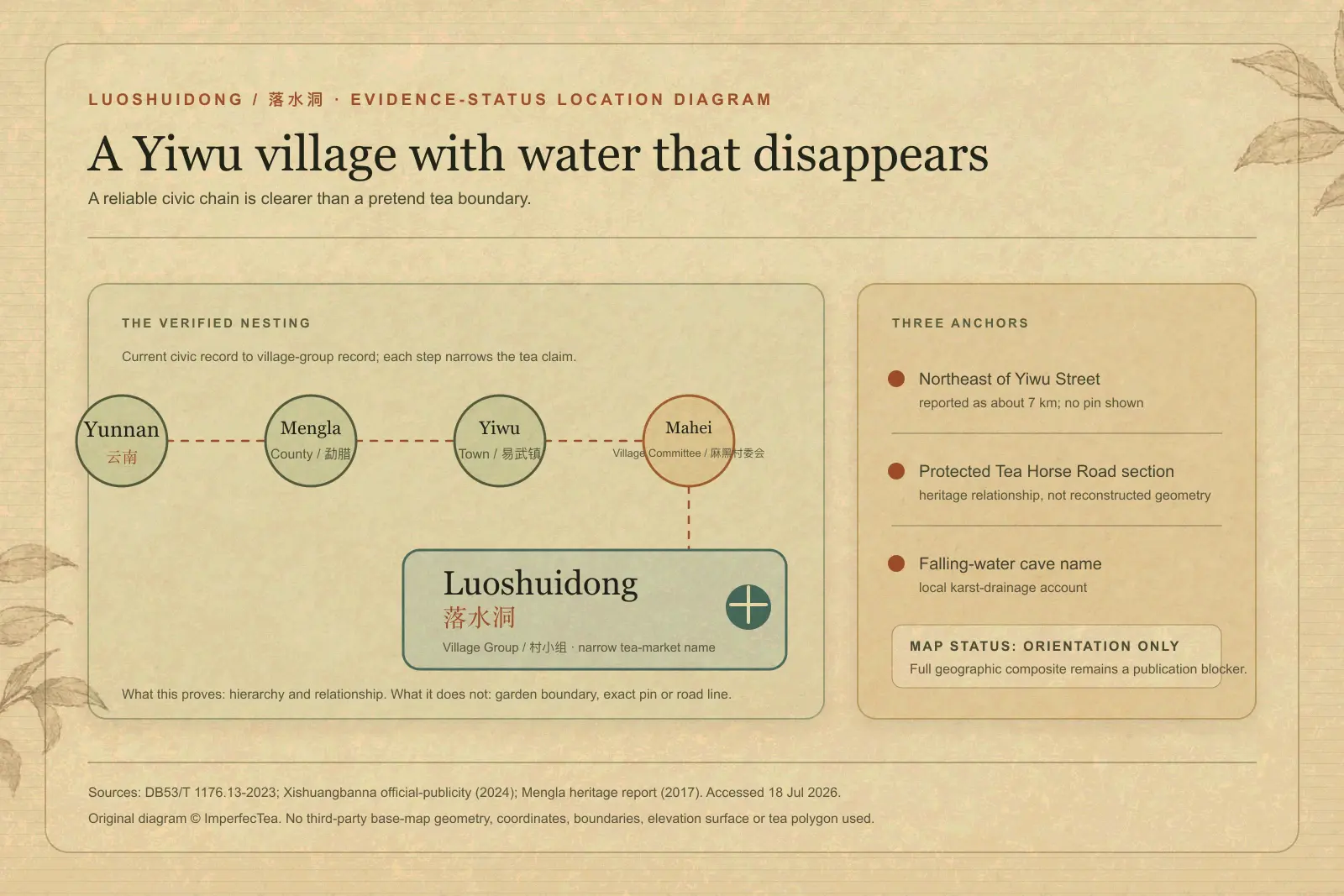
| Best-supported address | Yunnan → Xishuangbanna Dai Autonomous Prefecture → Mengla County → Yiwu Town → Mahei Village Committee → Luoshuidong Village Group |
| Geographic type | Natural-village group and tea-market origin name, rather than a separate administrative mountain |
| What the name means | Literally “falling-water cave.” A local official account links the name to a draining karst hollow and underground water, not to a tea-grade category |
| Relative location | Official 2024 reporting places it on Yiwu Town’s north-eastern side, about 7 km from Yiwu Street; no independently verified point is published here |
| Reported settlement elevation | 1,400 to 1,600 m in a 2024 Xishuangbanna official-publicity feature; no separate, verified tea-garden range |
| Climate and soil context | Wet southern-Yunnan monsoon landscape; village reporting describes nearby karst terrain and forest. Plot-level soil testing was not located |
| Harvest and material | Raw pu-erh dominates the public market. Spring is the most discussed season; no full local harvest calendar or cultivar inventory was verified |
| Cautious cup shorthand | Fragrance, sweetness and a rounded feel are commonly claimed; local reporting also notes a small bitter/astringent lift before a quick return |
| Research confidence | Supported for village-group nesting, heritage and local landscape; partial for sensory evidence; incomplete for garden boundaries, tree ages, ecology and price data |
| Last researched | 18 July 2026 |
The easy version of the hierarchy is Yiwu → Mahei → Luoshuidong. The exact version is more useful: the provincial village-code standard confirms Mahei Village Committee under Yiwu Town; a 2024 Xishuangbanna official-publicity report identifies Luoshuidong as a village group (村小组) in Mahei. That makes Luoshuidong a living local community as well as a tea name.
This matters because the market uses the same words at different scales. “Yiwu” can mean a town, a historical tea landscape, a style, or a broad blend. “Mahei” can describe the committee or a looser sourcing area. “Luoshuidong” is the narrower claim, but it still does not tell us the garden, household, picking date, processor or storage. A convincing provenance chain is:
Yiwu Town → Mahei Village Committee → Luoshuidong Village Group → household / garden → harvest → maocha maker → finished lot → storage.
The map is an original evidence-status location diagram, not a disguised survey. It shows the hierarchy, the heritage connection and the broad relationship to Yiwu. It does not draw a tea boundary, claim an exact village pin, or turn a marketing map into geography.
A village named for water that leaves
The name has a better story than the usual tea superlatives. The local account says Luoshuidong lies among karst formations: surface and groundwater dissolve and cut soluble rock, while collapse and deposits create caves. At the village’s low point, rainwater and runoff enter a drainage cave and leave through an underground river; the cave does not fill, and falling water is said to make little sound. That is the source’s explanation for 落水洞, “falling-water cave.”
It is a local interpretation, not a geological survey. Still, it gives the name a concrete landscape reference. It is more useful than pretending that Luoshuidong is simply a flavour word.
Why does the protected road matter?
Luoshuidong is part of the Yiwu Tea Horse Road story in a specific way. The Tea Horse Road, including the Yiwu material, entered China’s seventh batch of nationally protected cultural relics in 2013. Local Mengla heritage reporting says the Luoshuidong road section is among the protected Yiwu sections, and that the town recorded, photographed and satellite-positioned its surviving route material during survey work. A 2024 local feature says the old road passes through Luoshuidong Village Group and continues along old tea forest.
That does not make every tea sold under the name historically special. It does establish that the village sits in a trade-and-garden landscape whose roads, wells and old processing life are more than a sales-script backdrop.
| Period | What we can responsibly say |
|---|---|
| Qing period | Yiwu became a major production, processing and circulation centre for the Ancient Six; its surviving inscriptions and route remains make that broad role tangible. A village-by-village production history for Luoshuidong still needs archival work. |
| 2013 | The Tea Horse Road was listed among the seventh batch of national key cultural relics; local heritage material identifies the Luoshuidong road section within the Yiwu component. |
| 2017 | Mengla heritage reporting described a town-wide programme of route surveys, documentation and protection. |
| 2024 | Xishuangbanna official-publicity features presented Luoshuidong as a Mahei village group where tea remains a central livelihood and cultural landscape. |
The 2024 feature also reports old wells, a tea-king-tree memorial and a spring-time community observance. Those details belong to local memory. They should not be converted into laboratory proof of tree age, a mandatory ritual for every household, or a guarantee of what is in a cake.
Which nearby names should not be collapsed?
Luoshuidong is often discussed next to Mahei, Guafengzhai, Manxiu and broad Yiwu. Those are not interchangeable labels.
| Name | Supported relationship | How to use it when tasting or buying |
|---|---|---|
| Luoshuidong 落水洞 | Village group beneath Mahei Village Committee; a distinct tea-market origin name and protected road section. | Ask whether the leaf is from the village group, a named garden, or a Mahei-area blend. |
| Mahei 麻黑 | Current village committee under Yiwu Town; also a market name used at several scales. | A Mahei label is broader than a fully disclosed Luoshuidong claim. |
| Guafengzhai 刮风寨 | Officially reported under Mahei Village Committee, but a separate Yao village-group tea identity. | Do not let a seller use “Mahei” to blur a Guafengzhai-specific claim. |
| Manxiu 曼秀 | A Yiwu-area tea name reported in competition and specialist sources; current committee nesting was not verified in this review. | Treat it as a comparison lead, not proof of a shared Luoshuidong terroir. |
| Yiwu 易武 | Town, historical landscape and broad commercial umbrella. | Useful for broad blends; too broad to establish Luoshuidong provenance. |
The key distinction is social as well as geographic. A village group can have its own producers, processing habits and trading relationships. Saying that all leaf nearby must taste the same erases that work. It also makes it easier for a very broad blend to borrow a narrow name.
What can the karst and garden evidence explain?
Elevation and topography
The 1,400 to 1,600 m figure is a reported village-group elevation band, not a surveyed garden range. The local feature describes a low-lying basin surrounded by hills and karst formations. That is a reasonable orientation point; it is not enough to assign any individual lot an altitude or aspect.
Climate and seasonality
Luoshuidong sits in southern Yunnan’s warm, wet monsoon context. Yiwu research reports strong seasonal rain and a tea landscape where fresh-leaf handling matters. The village feature uses cloud, mist and high rainfall to describe local conditions. We did not locate a village weather station, a multi-year temperature record or a crop calendar, so those claims stop at landscape scale.
Soil, drainage and forest
The local account describes karst drainage, cave systems and forest around the village. It does not provide soil analyses. “Mineral” may be a beautiful tasting descriptor, but it cannot be attributed to a particular rock type here. Nor can a forested photo certify that every marketed lot came from forest-grown trees.
Plant material and people
Official publicity calls the local tea an artificial-cultivation large-leaf type in relation to one tree, but no cultivar or landrace inventory for the village group was found. Tree-age claims are common and vary by source; no age-measurement method or register was reviewed. The most concrete human fact is that tea remains a local livelihood and processing craft. That deserves as much attention as terrain when someone calls a tea “Luoshuidong.”
What the place can tell us, and what it cannot
We can say that Luoshuidong is a Mahei village group in a wet, forested, karst-influenced Yiwu landscape with a documented historical road. We cannot honestly say that a cave, an elevation figure, a certain tree age or “forest” status causes a particular flavour in an untraceable cake. Terroir is a working set of conditions plus human choices, not a way to skip provenance.
How can processing, season, age and storage change the cup?
There is no verified Luoshuidong-only maocha recipe. For raw pu-erh, the productive questions are practical: how long did the leaves rest, how was fixation handled, was the leaf rolled hard, how was it sun-dried, and was the final cake blended? A high floral note may reflect careful fresh-leaf handling; a sour opening can reflect moisture or flawed processing rather than village character; an aggressively bitter or smoky cup can be a house style.
Spring has the strongest prestige language in public descriptions, but no controlled spring-versus-autumn comparison or local picking standard was located. Aging is another major variable. A 2010 tea stored in humid conditions and a 2025 fresh cake can both read “Luoshuidong” yet have almost nothing useful to say to one another in the cup. Compare age, storage and processing before comparing place.
How should you buy and compare Luoshuidong?
Luoshuidong is precise enough to invite a premium, so it is worth asking precise questions.
- Does the maker mean the Luoshuidong Village Group, a named garden, or a wider Mahei collection area?
- Is the cake single-origin, a village blend, or a Yiwu blend made in a Luoshuidong style?
- Who bought the fresh leaf and who made the maocha? Is that information lot-specific?
- What are the harvest year and season, picking standard, pressing date and storage history?
- If “ancient tree,” “forest” or “single garden” appears, what records link those words to this batch?
- Can the seller offer a broad Yiwu or Mahei tea made in the same year for comparison?
Search both 落水洞 and Luo Shui Dong. Treat elevation, tree age, tea-king-tree photographs and gushu as claims requiring evidence. This pass does not publish a price range: it found no two truly comparable, current observations matched for season, material, maker, age and storage. A transparent Mahei-area or broad Yiwu tea can be a better-value lesson than an expensive micro-origin name with no chain of custody.
How should you brew a controlled comparison?
Start with 5 to 6 g per 100 ml, water around 95 to 100°C, one quick rinse and short steeps around 5, 7, 10, 15 and 20 seconds. Reduce contact time before lowering temperature if bitterness runs ahead of aroma. If a compressed cake seems flat, let broken pieces rest and lengthen the later steeps slowly.
For a useful four-tea comparison, brew a disclosed Luoshuidong, a Mahei lot, a broad Yiwu tea from the same season, and a contrasting Ancient Six tea such as Yibang or Manzhuan at comparable age. Keep water, vessel and dose constant. Write down aroma persistence, bitterness, astringent grip, texture, time to sweet return and the last satisfying infusion. Blind the labels if you can. The goal is to test a sourcing story, not to pass a geography exam by taste.
What should you remember?
- Luoshuidong is best understood as a village group under Mahei Village Committee, within Yiwu Town, not as a stand-alone mountain.
- Its disappearing-water karst name and protected Tea Horse Road section give it a tangible landscape and trade history.
- Fragrant, sweet-edged, rounded tea with a quickly resolving bitter lift is a reported expectation, not a guarantee or authentication test.
- Garden boundary, tree-age, cultivar, ecology and price claims need lot-level evidence.
- It is most rewarding for drinkers who enjoy comparing a narrow Yiwu name against a transparent Mahei or broader Yiwu reference.
Sources and research limits
This guide uses the provincial administrative-village code standard for Mahei’s current civic position; Xishuangbanna official-publicity reporting for Luoshuidong’s village-group nesting, local name explanation and reported landscape; and Mengla heritage reporting for protected-road context. The local research dossier and source log record URLs, access dates, conflicts and claim confidence.
The map is an original evidence-status orientation graphic, not the required full geographic composite. It uses no borrowed base-map geometry, coordinates, tea polygons or inferred road linework. A stronger geographic treatment still needs a licensed 3:2 composite map with a Yunnan locator, authoritative administrative layers, independently verified locality points, source/date/CRS information and an explicit uncertainty layer; a controlled tasting flight; a natural-village and garden register; and current comparable market observations. Until then, its map and origin claims remain deliberately limited.
Quick answers
Frequently asked questions
What does the Luoshuidong tea name identify?
A village group under Mahei Village Committee in Yiwu Town, Mengla County, eastern Xishuangbanna. Its most useful identity is natural village group and named Yiwu tea origin, so the name alone does not guarantee a particular garden, tree age or quality level.
What does Luoshuidong tea taste like?
Claimed teas often suggest floral-fruit sweetness, rounded texture and moderate grip, but sparse unmatched samples make processing, season and storage stronger explanations than a fingerprint. Use that profile as a tasting guide, not as proof of origin.
What is Luoshuidong commonly confused with?
Luoshuidong village group is narrower than Mahei committee and Yiwu, but its name still does not identify a garden, household or lot.
What should I ask before buying Luoshuidong tea?
Start with: Which Luoshuidong household or garden supplied this lot, and who processed its maocha in this named season? Also ask for the harvest year and season, producer or household, processing details and storage history.