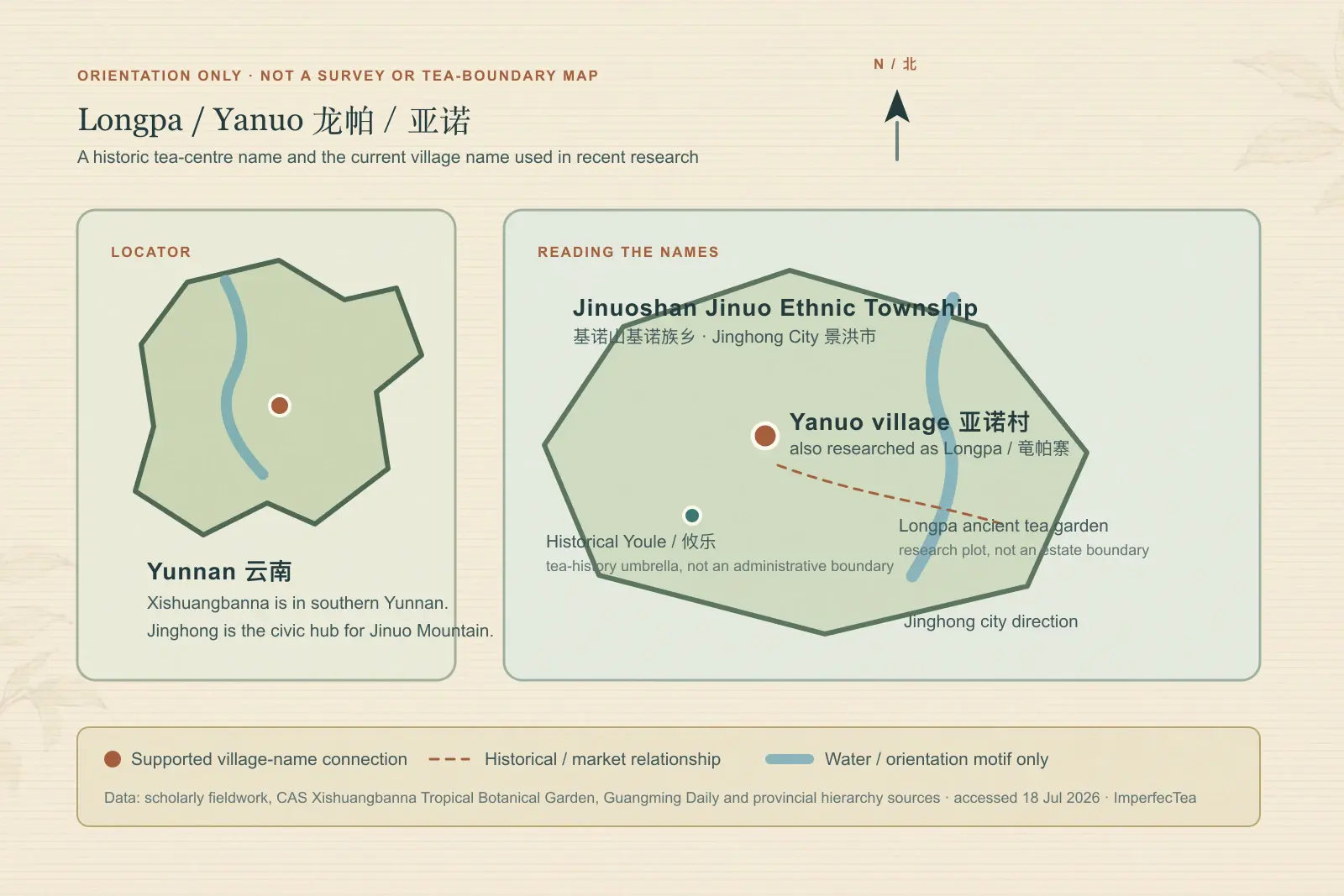
Orientation guide notes and sources
Boundary confidence: The Longpa–Yanuo name relationship and township location are supported by scholarly, institutional and research sources. The illustration is an orientation diagram, not a licensed boundary map: it does not assert a village boundary, garden boundary or surveyed tea-market extent.
- Hubei University ethnographic interview/profile
- Chinese Academy of Sciences Xishuangbanna Tropical Botanical Garden
- Guangming Daily
- Yunnan provincial village-code standard DB53/T 1176.13-2023
What is Longpa, and why does the name Yanuo matter?
Longpa (龙帕, Lóngpà) is one of the names that makes the historical Youle mountain feel suddenly alive. A long-running Jinuo ethnographic account identifies Longpa Village as the official Yanuo Village (亚诺村, Yànuò). Chinese Academy of Sciences work independently places the Longpa ancient-tea garden at Yanuo, in Jinuoshan Jinuo Ethnic Township outside Jinghong. That gives a tea drinker something unusually useful: Longpa is not simply a romantic synonym for all of Youle.
It is still not a magic provenance stamp. Longpa has been described as a Qing-era tea centre, a Jinuo community with a well-known longhouse history, a village associated with a sizeable old-tea landscape, and a name used on finished cakes. Those are related claims, but they sit at different scales. A transparent Longpa tea should still name the harvest, maker, material and storage. One documented 2006 Longpa cake showed stone fruit, flowers, wood, medium oily body and drying grip; that is a promising cup to compare, not a fixed regional personality.
What can Longpa tea taste like?
Longpa has better product-specific tasting evidence than most small village names, though it is still one main public sample rather than a regional flight. TeaDB’s 2016 Wistaria mini-report tasted a 2006 Wistaria Longpa (Youle) cake. The taster described stone fruit, flowers and leather in the aroma; medium, oily liquor; wood alongside fruit and floral notes; and a drying astringency that required careful brewing. The tea felt more youthful than older comparison teas in that report. It is an experienced specialist account, but the maker’s sourcing, original processing and all storage conditions remain outside independent verification.
This is how to use that evidence in a session:
- Aroma: look for stone fruit, flowers, wood or leather, but write down whether they persist after the first dramatic steeps.
- Taste: separate bitterness from the later returning sweetness known as huigan. A tea can be sweet and still have a firm, useful bitter edge.
- Texture: the cited cake was oily rather than simply thick. Compare coating and persistence at the same dose before calling one tea “better.”
- Astringency: Longpa’s clearest published clue is drying grip. It may come from leaf maturity, processing or water as readily as village origin.
- Finish and body feeling: TeaDB noted modest extension toward the back of the mouth and a light subjective qi response. Treat bodily effects as individual and dose-sensitive, not as provenance evidence.
The wider Youle record is a warning against turning that list into a recipe. Public tastings from the broader mountain range through fruit, flowers, grain, sweetness, bitterness, cooling and storage-led notes. The sensible working hypothesis is aromatic, structured and capable of a drying return, not “Longpa always tastes like stone fruit.” A proper regional profile would need at least three teas from two producers, brewed side by side with known harvest and storage.
Where does Longpa sit inside Jinuo Mountain?
Evidence snapshot
| Reader-facing name | Longpa |
| Chinese and pinyin | 龙帕 / 竜帕寨, Lóngpà; current official village name reported as 亚诺村, Yànuò |
| Common spellings | Longpa, Long Pa, Longpa Village, Yanuo, Ya Nuo, Youle Longpa |
| Region family | Historical Youle / modern Jinuo Mountain, Ancient Six Tea Mountains |
| Best-supported civic address | Yunnan → Xishuangbanna Dai Autonomous Prefecture → Jinghong City → Jinuoshan Jinuo Ethnic Township → Yanuo Village |
| Geographic type | Living village name, historic tea-centre name, and tea-market origin label; not a defined mountain appellation |
| Parent relationship | Longpa belongs to the modern Jinuo Mountain landscape; Youle is the historical tea-history umbrella, not a current village boundary |
| Supported garden anchor | A 2024 peer-reviewed field experiment identifies Longpa ancient tea garden at Yanuo, with large-leaf Camellia assamica and interplanted shade trees |
| Research-site detail | The experiment reports one study location at 21°59′05″N, 101°05′07″E and 1,150 m. It is a sampled garden site, not a village centroid or a universal Longpa elevation. |
| Community context | Jinuo community; a researcher who worked there for years identifies Longpa/Yanuo with a once-important longhouse tradition |
| Tea style, cautiously | One aged named cake: stone fruit, floral and leather/wood, medium oily texture and drying astringency. Wider Youle samples range much more widely. |
| Price | Not published: no comparable current, normalised Longpa market observations were found |
| Map status | Orientation diagram only; no reusable official village or tea-garden geometry was located |
| Research confidence | Supported for the Longpa and Yanuo relationship and research-site location; partial for tea profile and history; unknown for village boundary, full garden inventory, tree-age distribution and current prices |
| Last researched | 18 July 2026 |
The most helpful discovery in this review is a correction to the older parent guide. Longpa is not merely an unresolved historical label. A Hubei University profile of the ethnographer who studied Jinuo communities for years says directly that the village he knew as Longpa was officially called Yanuo Village. A 2019 Chinese Academy of Sciences report then names “Yanuo Village, Jinuo Township, Jinghong” as the location of Longpa ancient tea garden. A 2024 peer-reviewed microbiology paper repeats the same Yanuo and Longpa connection while describing an experimental tea-garden plot.
That yields a cautious hierarchy:
Yunnan → Xishuangbanna → Jinghong City → Jinuoshan Jinuo Ethnic Township → Yanuo Village / historic Longpa → household or cooperative → garden → harvest → maocha maker → finished lot → storage.
The provincial village-code standard is the controlling source for the township’s seven village committees, but it does not publish a natural-village directory that resolves Yanuo’s committee parent. So this article does not invent one. “Official name” in the ethnographic source establishes a current village identity; it does not tell us whether Yanuo is a natural village, village group, administrative village, or current committee in the code-standard sense.
Youle, Jinuo and Longpa are overlapping, not interchangeable
Youle (攸乐) is the old Chinese tea-history name found in the Ancient Six Mountain story. Jinuo Mountain (基诺山) is the modern landscape and ethnic-township name. Longpa / Yanuo narrows the conversation to a village. A tea labelled only “Youle” may be a township blend; one labelled Longpa should be able to offer a more specific chain of custody. Neither name, by itself, demonstrates that leaf is old-tree, forest-grown, organic, or from the research garden.
The National Ethnic Affairs Commission says the Qing-era Longpa/竜帕 settlement was a tea field and a tea-making centre frequented by merchants and caravan traders. That is enough to explain why the name carries weight. It is not enough to turn every modern retail story about tribute tea, exact output, or a Qing estate boundary into fact.
Which living place anchors the historical tea name?
Longpa is a good case for keeping people in the frame. The Hubei scholar’s account describes the village’s large family longhouse system: related households once lived in one extended house, with separate hearths marking smaller family units. The account says that form had broken up by the 1980s. This is a specific observation about social history, not a decorative proof that tea is more authentic.
Current reporting shows tea as a live local livelihood rather than just a historical souvenir. Guangming Daily reported a 2021 Yanuo “Laobola” tea-cultural gathering, describing ritual attention to tea trees and village-scale organising around the tea economy. The article reported village figures for tea gardens and trees; this guide does not repeat them as a hard inventory because reporting definitions, garden classes and calendar years need a direct local register to be comparable. What it does support is simpler and more useful: Yanuo/Longpa is a contemporary tea-growing community, and tea is tied to community events, cooperative activity and local livelihood.
The garden is real; the promotional boundary is not
There is unusually strong ecological evidence for one Longpa garden site. CAS Xishuangbanna Tropical Botanical Garden reported an epiphytic-orchid research trial at Longpa ancient tea garden in Yanuo. The later peer-reviewed experiment identifies the location, altitude of the experimental plot, large-leaf tea material and interplanted shade trees. This is good evidence for a garden with mixed structure; it is not a survey of all Longpa gardens, a licence to call every Longpa cake “forest tea,” or a method for estimating each tree’s age.
The broader GeoDOI research case on Jinuo/Youle tea is valuable context but appears to use “Youle Village” for its study area. It should not silently be treated as a clean synonym for Yanuo without the dataset’s own detailed metadata. Different institutions, local names and market names may be describing overlapping places at different scales.
What can the garden evidence explain?
The experimental garden’s large-leaf tea and shade-tree mix make a plausible ecological conversation. Shade, moisture, leaf development and harvest conditions can all affect the raw material. The finished cup is then profoundly shaped by leaf selection, transport time, heat-fixation, rolling, sun-drying, sorting, blending, compression and storage. A smooth cake is not automatic evidence of an old tree; a harsh one is not evidence that the village is inferior.
We can say that a verified Longpa research plot at Yanuo sits in a tea garden with large-leaf material and shade trees. We cannot, from that one experiment, assign a village-wide soil profile, rainfall total, slope, forest percentage, cultivar inventory or flavour mechanism. The site altitude belongs to the research plot only. We also cannot turn vendor estimates of hundreds-of-year-old trees into a measured village age distribution.
How can processing, season, age and storage change the cup?
Longpa is usually discussed in the market as raw pu-erh. The raw sequence is familiar: freshly picked leaves are rested, heated to arrest most enzymatic change, rolled, sun-dried into maocha, then perhaps sorted, blended, steamed and compressed. Each stage can preserve a bright aromatic quality or blur it with smoke, excessive greenness, rough astringency or storage character.
The 2006 Wistaria Longpa is useful precisely because it was not a fresh spring sample. Its continuing youthful bite after years of age tells us something about that cake’s material, processing and storage together, not about a universal Longpa ageing curve. If you buy a young Longpa tea, ask whether it is spring or another season, who processed it, whether it is a single-village lot or a broader Youle blend, and what changed between maocha and cake.
How should you buy and compare Longpa?
Longpa is a more specific claim than broad Youle, but it still needs evidence. Ask a seller:
- Do you mean Yanuo Village, and which Chinese characters appear in the producer record?
- Is the leaf from one household/garden, a Yanuo village blend, or a broader Jinuo/Youle blend?
- What harvest and processing year is it, and who made the maocha?
- Does “ancient tree,” “forest,” “organic” or “single village” have a dated document or lot record behind it?
- Where and how has the cake been stored?
Do not infer Longpa from a generic Youle wrapper, and do not assume that a cooperative name proves every batch is village-pure. The best current value comparison is not a price table, there is no defensible one yet, but a tasting flight: one declared Longpa/Yanuo lot, one transparent broader Youle/Jinuo tea, and one Yiwu or Yibang tea of similar age. Buy the tea that stays coherent after the fourth steep, not the label that arrives with the grandest legend.
How should you brew a controlled comparison?
Start with 5 to 6 g per 100 ml in a small porcelain gaiwan, water just off boil, and brief early infusions. If drying grip dominates, reduce leaf before dropping temperature; lowering both at once makes it hard to learn what changed. Keep notes at steep 1, 4 and 8 for aroma, mouthfeel, bitterness, drying, returning sweetness and stamina.
For a fair comparison, hold water, vessel, dose and timing steady. Put Longpa beside a broader Youle/Jinuo tea and a documented Yiwu or Yibang sample. The question is not whether you can identify “the Longpa note.” It is whether the declared source produces a repeatable difference once leaf quality, processing and storage are visible.
Which history still matters to Longpa tea?
Longpa appears in the Qing-era tea story because merchants and caravans came to buy tea and the settlement was remembered as a making centre. The larger historical structure matters too: Qing reform established a Youle office in 1729, and later historical writing preserved Youle’s place in the Six Mountains. The office was short-lived, and modern Jinuo Mountain is not frozen in that administrative moment.
The Jinuo people are the community most closely associated with the mountain. Jinuo is the community self-name; Youle is an older Chinese rendering. Origin stories connecting tea and Zhuge Liang are living traditions, not archaeological proof of a two-thousand-year-old garden. The better story is not “ancient people, ancient trees, therefore rare tea.” It is a living village whose tea knowledge, work and local institutions still matter to what reaches a cup.
What should you remember?
- Longpa is best understood as historic Longpa / current Yanuo Village, inside Jinuo Mountain’s modern township, not as a synonym for all of Youle.
- The name has real tea history and living community context, but the Qing tea-centre story does not draw a modern estate boundary.
- One research garden at Yanuo is unusually well documented for large-leaf tea and shade trees; it does not describe every garden or authenticate every cake.
- Published Longpa sensory evidence suggests aromatic structure and drying grip, but it comes mainly from one aged commercial tea and should be tested, not recited.
- A good Longpa label gives the route from Yanuo to lot. Ask for maker, season, garden or household, processing and storage before paying for age or rarity.
Sources and research limits
All sources were accessed 18 July 2026. The article separates a current village identity from historical and market uses of the name.
- Hubei University profile/interview on Jinuo research, states that Longpa Village’s official name is Yanuo Village and records the longhouse observation.
- CAS Xishuangbanna Tropical Botanical Garden: Longpa ancient-tea-garden orchid work, independently places Longpa ancient tea garden at Yanuo, Jinuo Township.
- Peer-reviewed field experiment at Longpa ancient tea garden, source for the sampled plot’s coordinates, elevation, large-leaf tea and shade-tree context; it is not a village survey.
- Guangming Daily: Yanuo tea-cultural gathering, contemporary community and tea-livelihood context.
- National Ethnic Affairs Commission: Jinuo customs and livelihood, historical Longpa tea-centre claim; broader historical synthesis, not a primary Qing record.
- TeaDB: 2006 Wistaria Longpa tasting, one specialist tasting account; product-specific and not independently provenance-audited.
- Yunnan provincial village-code standard DB53/T 1176.13-2023, controlling township/committee context; it does not identify Yanuo’s committee parent.
Map note: the map is an original ImperfecTea orientation diagram based on the sources above. No official reusable village-boundary geometry, tea-garden boundary, full lower-level register or cleared base-map layer was found, so no precise boundary, scale bar or estate polygon is claimed. It is not yet a fully sourced composite map.
Open research questions: confirm Yanuo’s current committee parent and administrative rank; obtain licensed civic/garden geometry; locate a current garden survey and full village register; build a multi-producer tasting set with documented harvest and storage; and collect comparable, dated prices.
Quick answers
Frequently asked questions
What does the Longpa tea name identify?
Longpa, also called Yanuo, is a current Jinuo village within Jinuoshan Jinuo Ethnic Township, Jinghong City, Xishuangbanna. Its most useful identity is current village and historical Youle tea centre, so the name alone does not guarantee a particular garden, tree age or quality level.
What does Longpa tea taste like?
One aged commercial cake suggests stone fruit, flowers, oily texture and drying grip; that single sample cannot define fresh Longpa or authenticate origin. Use that profile as a tasting guide, not as proof of origin.
What is Longpa commonly confused with?
Longpa or Yanuo village is not the whole of Jinuo Mountain, historical Youle or every tea marketed with the old Longpa name.
What should I ask before buying Longpa tea?
Start with: Does this lot trace to present-day Yanuo households and a named harvest, maker and garden rather than only historical Longpa? Also ask for the harvest year and season, producer or household, processing details and storage history.