Orientation guide notes and sources
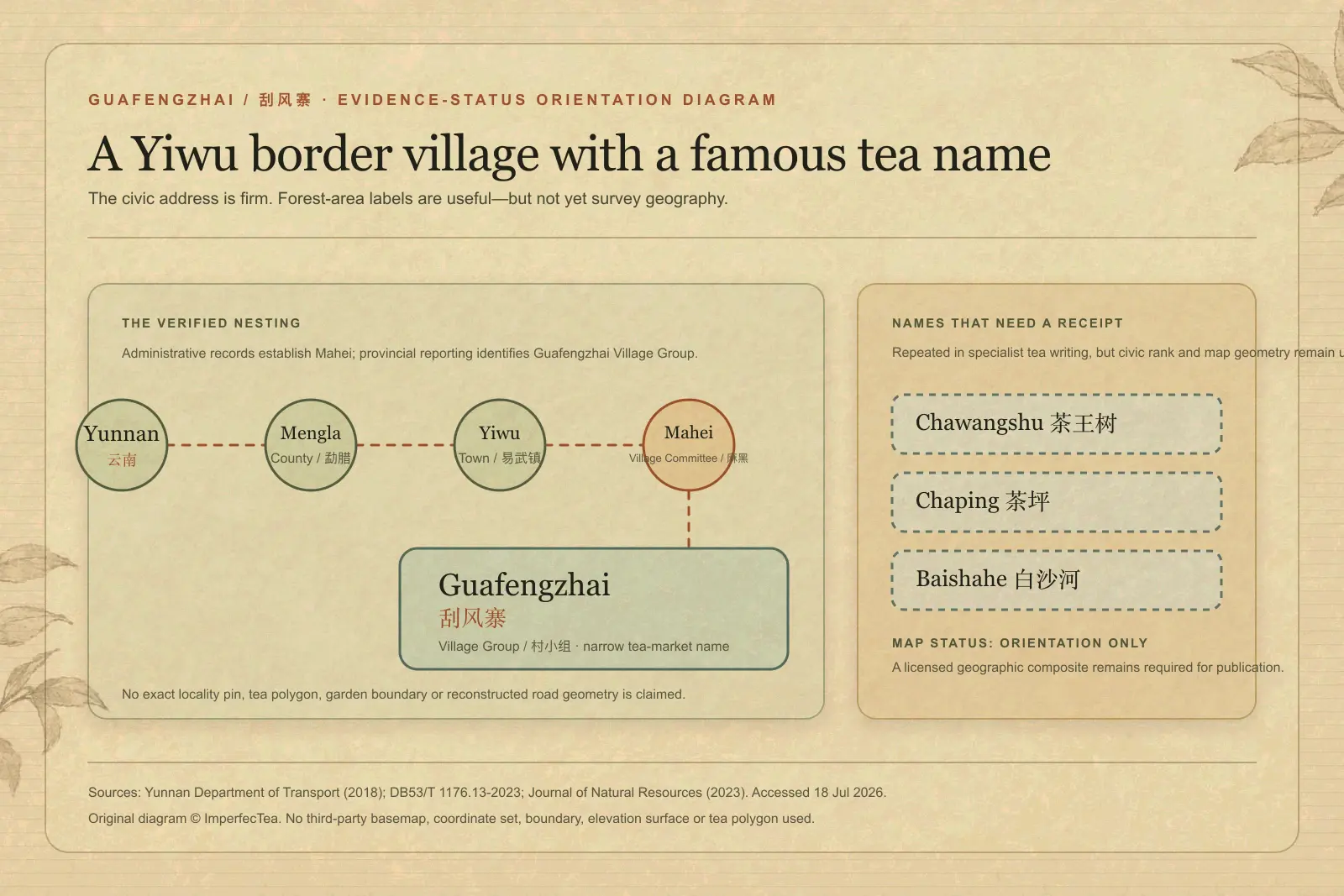
Boundary confidence: Mahei committee and Guafengzhai village-group relationship supported; no licensed composite map, surveyed tea boundary, or independently verified locality-point set has been assembled
- Yunnan Department of Transport, 2018
- DB53/T 1176.13-2023 administrative village codes
- Journal of Natural Resources, 2023
What is Guafengzhai, and what does the label leave out?
Guafengzhai (刮风寨, Guāfēngzhài) is one of the most charged names in Yiwu tea: a border-side Yao community, a tea-market origin and, on many wrappers, a promise of rare forest leaf. The address is more grounded than the hype. Public provincial reporting places Guafengzhai Village Group under Mahei Village Committee in Yiwu Town, Mengla County, close to the Laos border. That makes it a narrower name than Mahei and much narrower than Yiwu, but it still does not identify a garden, household, harvest or maker.
Representative Guafengzhai claims tend to lean toward fragrance, sweetness and texture, sometimes with a firmer edge than the softest Yiwu stereotype. That is a sensible tasting question, not a fingerprint. The village’s modern prominence also has a real human story: road access, tea processing, forest/garden protection and a Yao community’s changing livelihood. Start there. Then ask what a particular cake actually contains.
What can Guafengzhai tea taste like?
The responsible answer is a little less cinematic than the sales copy. Slow Food’s Ark of Taste describes a sweet, fragrant Guafengzhai Yiwu pu-erh. A 2018 independent note on a seller-claimed Guafengzhai tea called the experience calm but powerful; specialist visit accounts describe the practical difficulty of carrying and processing leaf from remote forest-side areas. Together they support a hypothesis of aroma, sweetness and serious texture. They do not establish a blind-tasting signature.
Try this structure instead:
- Aroma: notice flowers, honey, ripe fruit, herbs or darker forest-like notes, then ask whether they remain after the opening steeps.
- Taste: sweetness may arrive early, but a stronger Guafengzhai lot can also carry bitterness or a dry edge. Neither outcome proves or disproves the name.
- Texture: look for density, coating and how long the liquor stays present once the headline aroma fades.
- Return: huigan is sweetness returning after the sip; shengjin is building salivation. Record their timing rather than using them as a luxury-origin test.
- Finish and body sensation: cooling, warmth, calm or
cha qiare subjective, dose-sensitive observations. They are not geographic evidence.
The confounders are ordinary but important: picking maturity, withering, fixation, rolling, sun-drying, blending, pressing and storage. A green, sharp tea may have been poorly finished; an old, soft tea may chiefly show its storage. No ImperfecTea flight and no sufficiently matched public three-tea set were located. The sensory profile is therefore partial.
Where does Guafengzhai sit inside Yiwu?
Evidence snapshot
| English name | Guafengzhai |
| Chinese and pinyin | 刮风寨, Guāfēngzhài |
| Common spellings | Guafengzhai, Gua Feng Zhai, GuaFengZhai; GFZ is trader shorthand, not a useful provenance statement |
| Region family | Yiwu, Ancient Six Tea Mountains |
| Best-supported address | Yunnan → Xishuangbanna Dai Autonomous Prefecture → Mengla County → Yiwu Town → Mahei Village Committee → Guafengzhai Village Group |
| Geographic type | Village group/community and tea-market origin name, not an independently surveyed mountain appellation |
| Relative location | Provincial reporting places it about 32 km from Yiwu Town government, near the border between China and Laos; no coordinate is published here |
| Climate context | Warm, wet southern-Yunnan monsoon setting. Yiwu-wide research reports 1,700 to 2,200 mm annual rainfall and red/latosolic-red soils; this is not a garden-level measurement |
| Harvests and material | Raw pu-erh is the dominant market form. Spring commands the most attention; no local harvest calendar or cultivar inventory was verified |
| Key names to untangle | Mahei, Chawangshu, Chaping, Baishahe; the latter three are repeatedly used as forest/garden names, not verified civic subdivisions |
| Cautious cup shorthand | Fragrant, sweet-leaning, textured; occasionally more grip than a broad Yiwu cliché suggests |
| Research confidence | Supported for civic nesting, community and broad Yiwu context; partial for named garden geography, sensory profile, ecology, tree age and price |
| Last researched | 18 July 2026 |
The useful chain is Yiwu → Mahei → Guafengzhai. The provincial village-code standard lists Mahei among Yiwu Town’s current villages. A 2018 Yunnan provincial transport report then identifies Guafengzhai as a village group in Mahei Village Committee and describes it as a Yao-concentrated community. It is a living settlement first, not a boutique product descriptor.
That distinction saves a lot of confusion at the tea table. “Yiwu” can mean a modern town, a historic tea landscape or a broad commercial blend. “Mahei” is a current committee and a market name used at more than one scale. “Guafengzhai” is the narrower village-group claim. But even that claim leaves the details that matter untouched: leaf from which household or garden, picked in which season, made by whom, blended or not, and stored where?
Yiwu Town → Mahei Village Committee → Guafengzhai Village Group → household / garden → harvest → maocha maker → finished lot → storage.
The map included here is deliberately an evidence-status orientation diagram. It is not pretending to be a land survey. Public sources found for this guide verify the administrative nesting and broad border-side setting, but not a licensed coordinate set, a tea-boundary polygon, garden parcels or named forest-area boundaries. Those absences matter more than a handsome but false-precision map.
A border community with a tea economy
The provincial transport report is unusually useful because it puts tea in social context. It describes Guafengzhai as a Yao community that had been difficult to reach before road improvements, then connects road access to tea selling, small-scale processing, household income and locally stated goals of protecting old tea gardens and forest. It reports 123 households and 668 people at the time of reporting, with tea becoming a major source of cash income. Those are dated report figures, not timeless demographic facts, but they make the point: the famous name grew with infrastructure, labour and local decisions.
It also reports roughly 600 mu of old tea trees and “hundreds of years” age language. Preserve the source, not the marketing shortcut. There is no independent plot survey or documented dating method in this review, so this guide will not turn that report into a precise garden area, a certified average age or a guarantee that every Guafengzhai-labelled cake contains old-tree leaf.
Which forest names should a buyer recognize?
Chawangshu (茶王树), Chaping (茶坪), and Baishahe (白沙河) are repeatedly attached to Guafengzhai in specialist tea writing. They are commonly presented as remote forest/garden collecting areas, and one field account describes them as the source areas for particular producer lots. That can be valuable information, if a seller can show its chain of custody. It is not enough evidence to call all three villages, assign them boundaries or place them at exact points on a public map.
| Name | What is supported | What still needs asking |
|---|---|---|
| Guafengzhai 刮风寨 | A Mahei village group and Yao community; also a narrow, high-profile tea label | Which household, garden or collection area does this lot claim? |
| Mahei 麻黑 | Current village committee under Yiwu Town and a broader market origin | Is the tea simply Mahei-area leaf or Guafengzhai-specific leaf? |
| Chawangshu 茶王树 | A commonly used Guafengzhai-linked market/garden name in specialist sources | Does it mean a particular stand, route, household convention or a broad marketing label? |
| Chaping 茶坪 | A specialist-reported Guafengzhai-linked forest/garden area | What map/source and producer relationship support the claim? |
| Baishahe 白沙河 | Another specialist-reported Guafengzhai-linked forest/garden area | Is the name a watercourse, collection area, settlement term or blend designation? |
| Yiwu 易武 | Town, historic trade landscape and broad sourcing umbrella | Is the wrapper making a town-level or village-level claim? |
This is why “more specific” is not always “more proven.” A good Guafengzhai tea can be honest about being a village blend. A less convincing one can borrow the name of a named forest tract without saying how the leaf got from forest to cake.
What can the forest-side landscape plausibly explain?
Rain, soil and forest, at the scale we actually know
A peer-reviewed Yiwu study gives useful town-scale context: the town sits in a mountainous, wet southern-Yunnan setting, with annual rainfall reported at 1,700 to 2,200 mm and mainly red and latosolic-red soils. It also documents rapid change in the tea economy and interviews in Mahei. That helps explain why fresh-leaf handling, rain-season timing and access to processing matter. It does not give Guafengzhai a soil test, a garden elevation band, a canopy percentage or a unique microclimate.
The government road report and Slow Food description both associate the community with old tea gardens, forest and the Laos border. That may shape access, management choices and harvest logistics. It does not demonstrate that all marketed leaf is forest-grown, chemical-free, biodiverse or of a particular age. A photo of a tall tree cannot settle any of those questions.
Plant material and human management
Guafengzhai sits inside Yiwu’s Yunnan large-leaf pu-erh context. But a leaf label still needs more than a regional genus/species shorthand. Picking standard, pruning, shade, harvest pressure, worker skill and the freshness of leaf before fixation can all alter the cup. The Yiwu study describes several production arrangements, from farmers selling fresh leaf or basic maocha, to small processors, larger firms and direct-selling households. That is a useful antidote to the idea that a village name automatically describes one processing style.
What the place can tell us, and what it cannot
We can say that Guafengzhai is a Mahei village group in the Yiwu tea landscape, with a documented Yao community and border-side forest/garden context. We can reasonably expect season, topography, management and fresh-leaf handling to vary across lots. We cannot claim a precise elevation, tree age, soil-flavour mechanism, garden boundary or chemical-input status for an undisclosed cake. Terroir is a chain of conditions and decisions, not a shortcut around provenance.
How can processing, season, age and storage change the cup?
At Yiwu scale, raw pu-erh begins with picking and moves through shāqīng (kill-green/fixation), rolling and sun-drying into maocha; it may later be sorted, blended, steamed and pressed. The peer-reviewed Yiwu study documents that sequence and a mixture of household, small-factory and larger-enterprise organisation. No source in this review establishes a single Guafengzhai-only recipe.
That is good news for tasting because it leaves room for questions. Too much resting or oxidation before fixation can make young tea redder, softer or prematurely fruity. Weak fixation may leave grassy greenness; scorched fixation can bring smoke or hard bitterness; rough rolling can amplify grip. A remote forest setting may make fresh-leaf logistics harder, but it does not make every producer’s wok work the same.
Spring is the season most often attached to premium Guafengzhai offers. The present research does not support a controlled spring-versus-autumn comparison, and it will not call one season intrinsically authentic. Aging adds another layer: a cleanly stored young cake may foreground aroma and texture, while a humid-stored older cake may show wood, herbs or cellar effects. Compare age and storage before deciding you are comparing villages.
How should you buy and compare Guafengzhai?
Guafengzhai is famous enough to earn a premium and vague enough to be borrowed. Ask these questions before accepting a narrow claim:
- Does the name mean the Guafengzhai Village Group, a named forest/garden area, or a broader Mahei/Yiwu collection?
- Which Chinese name is on the producer’s source record: 刮风寨, 茶王树, 茶坪, 白沙河, or something else?
- Who owned or managed the source garden, and who made the maocha?
- What are the picking date, season, processing date, pressing date and storage history?
- Is the tea one household/garden, a village blend or a brokered blend? What evidence supports that distinction?
- If “old tree,” “wild,” “forest” or “border tea” appears, what does the maker mean and what can they document?
Search both 刮风寨 and Gua Feng Zhai. Do not confuse GFZ shorthand with disclosure. This guide intentionally prints no price range: it found no two dated, comparable products matched for season, material, maker, age and storage. A transparent Mahei or broad Yiwu tea may teach more than an expensive micro-origin claim with no lot trail.
How should you brew a controlled comparison?
Start around 5 to 6 g per 100 ml, use water close to 95 to 100°C, give tightly compressed tea a quick rinse, and begin with short steeps: roughly 5, 7, 10, 15 and 20 seconds. Shorten contact time before lowering temperature when bitterness outruns aroma. If a tea seems dull, let broken pieces rest and extend later steeps rather than forcing the opening.
For a fair four-tea flight, compare a disclosed Guafengzhai lot with a Mahei lot, a broad Yiwu tea from the same season and a contrasting Ancient Six tea such as Yibang or Manzhuan. Match age and storage as closely as possible. Record aroma persistence, texture, bitterness, drying grip, time to sweet return and the last satisfying infusion. Blind labels when you can. The point is to test a sourcing claim, not to turn a village name into a pass/fail geography quiz.
How did access and community decisions shape the tea?
| Period | What it changes in the story |
|---|---|
| Qing to Republican trade era | Yiwu became a major production, processing and trade centre in the Ancient Six. This is the wider landscape behind the village name, not proof of a specific Guafengzhai estate history. |
| Late twentieth century | Yiwu’s private trade and production changed through war, procurement systems and later household control of tea trees, as documented in Yiwu field research. |
| 1990s onward | Demand for hand-processed and old-tree material helped rebuild Yiwu’s prestige and reconfigured village-origin pricing. |
| Road-development period | Provincial reporting links Guafengzhai’s improved access with tea commerce, processing, forest/garden protection and livelihood change. |
| Today | The village is not frozen in a caravan past: tea is tied to households, buyers, infrastructure, conservation claims and high-stakes provenance. |
The National Tea Horse Road designation is important Yiwu context, but no village-specific protected route geometry is published in this guide. The people who pick, process, negotiate and protect land deserve more attention than a vague “ancient forest” mood board.
What should you remember?
- Guafengzhai is best understood as a Yao village group under Mahei Village Committee, inside Yiwu Town.
- It is a real community with a border-side tea economy, not just a premium wrapper term.
- Fragrance, sweetness and texture are sensible things to look for, but they are reported tendencies rather than an origin test.
- Chawangshu, Chaping and Baishahe need source-by-source explanation; do not assume each is a civic village or a precisely bounded garden.
- It will reward drinkers who enjoy comparing a narrow, documented Yiwu claim against transparent Mahei and broad Yiwu references.
Sources and research limits
This guide uses the current provincial administrative-village code standard for Mahei’s civic position, the 2018 Yunnan Department of Transport report for Guafengzhai’s village-group nesting and community/road context, and peer-reviewed Yiwu research for town-scale climate, industry, processing and historical context. Slow Food and independent specialist tasting/field accounts are used only for scoped sensory and named-area discussion. The local research dossier and source log keep URLs, access dates, conflicts and claim confidence visible.
The original map package is an orientation graphic, not the required full geographic composite. It uses no borrowed base-map geometry, exact coordinates, inferred road lines or tea-boundary polygons. A stronger version still needs a licensed composite map with Yunnan and Mengla/Yiwu orientation, authoritative boundaries, independently verified locality points, source/date/CRS information, scale and an explicit uncertainty layer; a controlled tasting flight; reconciliation of named forest/garden labels; and dated comparable market observations. Until then, its map and origin claims remain deliberately limited.
Quick answers
Frequently asked questions
What does the Guafengzhai tea name identify?
A village group under Mahei Village Committee in Yiwu Town, Mengla County, near China's border with Laos. Its most useful identity is natural village group with narrower forest tea localities, so the name alone does not guarantee a particular garden, tree age or quality level.
What does Guafengzhai tea taste like?
Claimed samples often point toward fragrance, sweetness, dense texture and sometimes firm bitterness; no matched multi-producer flight establishes a village fingerprint. Use that profile as a tasting guide, not as proof of origin.
What is Guafengzhai commonly confused with?
Guafengzhai village, Mahei committee, and the tea-market names Chawangshu, Chaping and Baishahe are different geographic scales.
What should I ask before buying Guafengzhai tea?
Start with: Is this a Guafengzhai village blend or a named forest-area lot, and which households and harvest records support that claim? Also ask for the harvest year and season, producer or household, processing details and storage history.