Orientation guide notes and sources
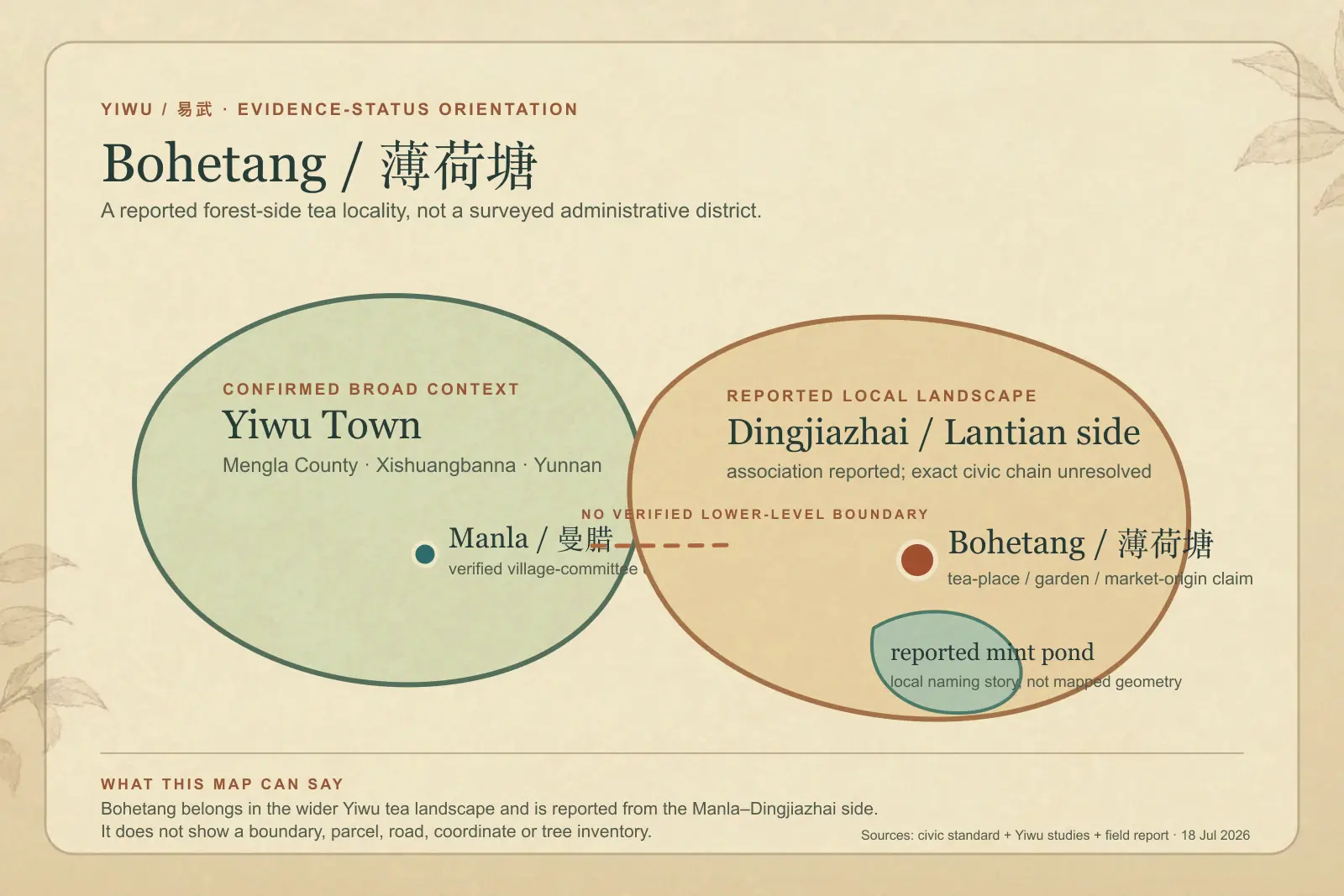
Boundary confidence: The Yiwu Town and Manla Village Committee context is supported, but Bohetang's civic rank, mapped extent, garden boundary and verified locality coordinates remain unresolved. This is an orientation diagram, not a geographic composite map.
- DB53/T 1176.13-2023 administrative village codes
- Journal of Natural Resources, 2023
- Yunnan Daily field report, 2023
What is Bohetang, and why is its evidence unusually narrow?
Bohetang (薄荷塘, Bòhétáng) is one of the most expensive-sounding names in Yiwu tea. It is commonly offered as rare, tall-tree, forest-grown material with a cold, floral sweetness. The more useful starting point is less dramatic: Bohetang is a tea-place and garden-origin claim in the wider Yiwu landscape, not a currently verified township, village committee or surveyed appellation.
A 2023 Yunnan Daily field report describes Bohetang as a local mountain name reached through the Manla and Dingjiazhai side of Yiwu, separated by a ridge from Wangong. It tells a local explanation for the name: a small pond where mint grew beside a stream. That is a fine piece of place memory, but the report does not supply a cadastral boundary, a public coordinate set, an official lower-level village code or a complete list of gardens. The name can be real, tiny and important without behaving like an administrative district.
That distinction is the key to drinking Bohetang well. Treat the name as an invitation to ask about a garden, household, harvest and maker, not as a substitute for those answers.
What can Bohetang tea taste like?
The public notes agree on a few useful questions, not a fingerprint. A 2023 product-specific tasting report describes flowers, green plant sweetness, a light bitterness/astringency, a smooth texture, quick sweet return and a cooling mouth sensation. A 2024 specialist seller’s Bohetang identifies floral aroma, thickness and a darker-toned Yiwu direction. The 2023 Yunnan Daily field account calls the local cup floral, honeyed and rounded. These sources are neither blind nor matched, and all depend on a claimed source. Together they justify a partial profile: fragrance, sweetness, texture, some bitterness and a cooling impression are things to look for.
Taste them in separate lanes:
- Aroma: Is it floral, green, honeyed, fruity or darker? Notice whether it survives after the first showy steeps.
- Taste and bitterness: Does bitterness arrive early, remain light, or build later? “Not bitter” is not a quality guarantee, and bitter does not disprove the name.
- Texture: Look for density, coating, grip and whether the liquor remains present once aroma fades.
- Sweet return and salivation: Huí gān is sweetness returning after a sip; shēng jīn is gathering salivation. Note timing, not just intensity.
- Finish: Cooling, throat comfort and body sensation are subjective and dose-sensitive. They should stay in your notebook, not become proof of a garden.
The confounders are more powerful than the wrapper: picking maturity, weather, resting before fixation, shāqīng (kill-green), rolling, sun-drying, blending, compression and storage can all move the cup. No controlled multi-producer set was found. A claimed Bohetang sample can teach you something; it cannot authenticate the next one by resemblance.
What kind of place is Bohetang?
Evidence snapshot
| English name | Bohetang / Mint Pond |
| Chinese and pinyin | 薄荷塘, Bòhétáng |
| Common spellings | Bohetang, Bo He Tang, Bo-he-tang, Mint Pond; 薄荷糖 is a different Chinese phrase (“mint candy”), not this tea name |
| Region family | Yiwu, Ancient Six Tea Mountains |
| Best-supported broad address | Yunnan → Xishuangbanna Dai Autonomous Prefecture → Mengla County → Yiwu Town |
| Reported local relationship | Tea reporting places it in the Wangong / Dingjiazhai and Manla-side forest landscape. Its exact current civic nesting is not independently confirmed in this review. |
| Geographic type | Forest-side tea-place, garden-area and market-origin claim; not a verified administrative village |
| Name history | A 2023 field account attributes the name to mint growing around a small pond beside a spring/stream. This is local reporting, not a surveyed toponymic record. |
| Climate context | Warm, wet southern-Yunnan monsoon setting. Yiwu-wide research reports roughly 1,700 to 2,200 mm annual rainfall and red/latosolic-red soils; this is not a Bohetang garden measurement. |
| Material and tea style | Usually sold as raw pu-erh (sheng) from small, high-value old-tree or “high-pole” categories; category definitions and tree ages vary by seller. |
| Cautious cup shorthand | Floral/green aroma, sweetness, a cooling impression and a dense, sometimes darker-toned Yiwu structure are recurring reported descriptions, not an origin test. |
| What is not established here | Boundary, coordinates, elevation, tree inventory/age, garden ownership, ecology measurements, production volume, civic rank, or a defensible price range. |
| Research confidence | Supported for Yiwu context and Bohetang’s contemporary market/locality use; partial for exact lower hierarchy, physical geography, sensory profile and all tree/garden claims. |
Bohetang is easiest to understand when we stop forcing it into one box.
It is first a locality name: the Yunnan Daily account calls it “the name of this area’s mountain” (这一带山头的名称) and recounts the pond-and-mint explanation. In the same account it lies across a ridge from Wangong and is reached from a Yao community around Lantian/Dingjiazhai. That establishes a reported local relationship, not a fixed boundary.
It is also a garden claim. Market language often narrows the name further: “core area,” “first class,” “second class,” “high pole,” or a named household’s trees. Those may be meaningful distinctions within one producer’s sourcing system. Without a disclosed map, picking record and maker, they are not universal grades. In particular, “high pole” describes a growth form or commercial category in a seller’s language; it is not a botanical passport and does not by itself establish tree age, wild status or quality.
Finally, it is a premium market term. The 2022 geography study of the Yiwu tea-competition economy explains why this happens: buyers increasingly search down the chain from province to town to village, then to ever smaller named places; festivals, firms, growers and drinkers all participate in making those scales valuable. Bohetang’s price aura is part of that story. It should make a buyer more curious, not more credulous.
How should you read the address?
The firm part of the address is Yunnan → Xishuangbanna → Mengla County → Yiwu Town. The provincial village-code standard confirms Yiwu Town’s current committees, including Manla Village Committee. Heritage material for the Tea Horse Road also places the route to Yao Dingjiazhai Lower Village in Manla Village. These are useful anchors for the reported Bohetang direction.
Below that, the public record thins out. Specialist maps and sellers variously fold Bohetang into Dingjiazhai, Wangong, Lantian, Manla, a national-forest tract, or a separate “core area.” The sources reviewed here do not establish those terms as equivalent. Nor did they produce an official natural-village register that names Bohetang, a surveyed tea-garden boundary, or a licensed point set that we could safely plot.
Use the following as a working provenance chain, not a civic address:
Yiwu Town → reported Manla / Dingjiazhai-side tea landscape → Bohetang locality or garden claim → household or collecting group → harvest → maocha maker → finished lot → storage.
That middle step is exactly where a good seller should slow down. “Yiwu Bohetang” may be honest shorthand, but it is not complete provenance.
Names that should not be quietly collapsed
| Name | What the evidence supports | What to ask |
|---|---|---|
| Bohetang 薄荷塘 | A highly valued Yiwu tea-place / garden-origin label; a 2023 field account describes a local mint-pond naming story | What garden, household or collection area does the lot actually claim? |
| Wangong 弯弓 | A separate historic/local tea-place and garden claim associated in reporting with Dingjiazhai | Is the tea Wangong, Bohetang, a nearby garden, or a blend using one name as shorthand? |
| Dingjiazhai 丁家寨 | Community label used in Yiwu tea and heritage material; Yao and Han Dingjiazhai references both occur | Which settlement and current village committee does the producer mean? |
| Manla 曼腊 | A current Yiwu Town village committee and Tea Horse Road context | Does the seller mean the civic committee, a historical Mansa association, or a broad tea landscape? |
| Yiwu 易武 | Town, historic production/trade landscape and broad sourcing umbrella | Is the wrapper claiming broad Yiwu leaf or a traceable micro-origin? |
Search both 易武 / Yiwu and the exact Chinese micro-origin name. Romanised labels are not a stable substitute for the Chinese source record.
What can the available landscape evidence explain?
Yiwu is a warm, mountainous, wet southern-Yunnan tea landscape. Peer-reviewed fieldwork reports town-scale rainfall of roughly 1,700 to 2,200 mm and red/latosolic-red soils, alongside a tea economy spanning households, small workshops, firms and buyers. This helps explain why rain, access, fresh-leaf movement and processing organisation matter.
It does not provide a Bohetang soil profile, elevation band, canopy percentage, cultivar census, pesticide record or tree-age survey. The Yunnan Daily field story describes a wooded, steep approach and local old-tree language. It is valuable testimony about how people experience the landscape. It is not a forestry inventory. Exact figures for tree counts, age, elevation or “national forest core” status should remain seller-specific until the underlying survey, jurisdiction and method are visible.
What the place can tell us, and what it cannot
We can say that Bohetang is marketed from the forest-side Yiwu landscape and that remoteness can affect leaf handling, labour and access. We can say rain, season, garden management and processing plausibly contribute to variation. We cannot say a particular floral note comes from a particular soil, that tall trees automatically make better tea, or that every Bohetang label represents one ecology. Terroir is a chain of conditions and choices, not a luxury seal.
How can processing, season, age and storage change the cup?
At Yiwu scale, raw pu-erh begins with picking, moves through fixation, rolling and sun-drying into maocha, then may be sorted, blended, steamed and pressed. The Yiwu research documents multiple production arrangements; Bohetang is not a processing style.
This matters especially for a name sold on finesse. Slow handling before fixation can push a young tea toward redder, fruitier notes. Weak fixation may leave grassy green character; harsh fixation can give smoke or hard bitterness; rough rolling can make a tea feel more astringent. A producer can make a lovely Bohetang-inspired cup in several ways. None of them turns the processing result into geographic evidence.
Spring is prominent in premium listings, but this review found no controlled Bohetang spring-versus-autumn comparison. Ask for picking date, maocha-making date, pressing date and storage history. Compare like with like: young dry-stored tea may foreground fragrance and grip; older or humid-stored tea may foreground wood, herbs or cellar character. Storage deserves as much attention as the mountain name.
How should you buy and compare Bohetang?
Ask these questions before paying for a narrow claim:
- Does “Bohetang” mean a named garden, a household collection, a wider forest-side buying area, or a blend sold under the best-known name?
- What Chinese source record accompanies the lot: 薄荷塘, 弯弓, 丁家寨, 曼腊, or something more specific?
- Who managed or collected the leaf, and who made the maocha?
- Is it one garden, one household, a village blend or a brokered blend?
- What do “old tree,” “high pole,” “wild” and “forest” mean in this product, and can the seller show a record rather than a slogan?
- What are the picking, processing, pressing and storage dates?
This guide intentionally gives no price range. Public asking prices mix fresh leaf, maocha and finished cakes; spring and autumn; one-tree, household, “high pole,” big-tree and mixed lots. Without at least two dated, comparable observations, a number makes the mystery look more precise than it is. For a calmer and usually cheaper learning comparison, try a transparent Mahei or broad Yiwu lot from the same maker and storage style, then a Manzhuan or Yibang tea to test how much of your preference is Yiwu aroma and how much is the Bohetang story.
How should you brew a controlled comparison?
Start with 5 to 6 g per 100 ml, water near 95 to 100°C, and short infusions: around 5, 7, 10, 15 and 20 seconds. If tightly compressed, give the tea a quick rinse and a few minutes to open. Shorten time before lowering temperature when bitterness gets louder than aroma.
For a four-tea flight, compare a disclosed Bohetang lot with a named Wangong or Dingjiazhai-associated lot, a Mahei lot and a broad Yiwu tea. Match year and storage where possible. Write down aroma persistence, early bitterness, astringency, thickness, time to sweet return, cooling impression and the last satisfying infusion. Blind the labels if you can. The aim is not to “prove” Bohetang by taste; it is to learn what the producer’s claim changes in a fair comparison.
How did this tiny name become commercially huge?
| Moment | Why it matters |
|---|---|
| Qing-era Yiwu trade expansion | Yiwu became an important production, processing and merchant landscape in the Ancient Six. This is the wider stage, not evidence that every modern garden has a documented tribute story. |
| Tea Horse Road heritage recognition | National and local heritage material anchors routes through the Yiwu-Manla/Dingjiazhai landscape. It does not create a Bohetang appellation. |
| Tea revival and competition culture | Scholarship on Yiwu’s tea festival shows how named villages and smaller origins became more legible, and more valuable, to markets. |
| Current premium micro-origin trade | Bohetang now functions as one of Yiwu’s trophy labels, making traceability, household credit and exact lot description more important than ever. |
The local mint-pond story is worth keeping because it explains why the name feels so specific. It should stay credited as local field reporting, rather than being inflated into a fully documented settlement history.
What should you remember?
- Bohetang is a tiny Yiwu tea-place and garden-origin claim, not a confirmed administrative village or surveyed appellation.
- A local field account links the name to a mint-bordered pond and places it in the reported Wangong/Dingjiazhai and Manla-side landscape; the exact civic nesting still needs a current local register.
- Floral fragrance, sweetness, texture, light-to-firm bitterness and a cooling impression are useful tasting prompts, not authentication tools.
- Tree counts, tree age, “high pole,” forest status, core-area boundaries and price headlines all need lot-specific evidence.
- Bohetang is most rewarding when it comes with a chain of people and dates, not just a very expensive name.
Sources and research limits
This guide uses the provincial administrative-village code standard for the Yiwu/Manla civic context; peer-reviewed Yiwu studies for town-scale environment, production organisation and market-scale history; national/local heritage sources for Tea Horse Road context; and a Yunnan Daily field report for the reported Bohetang naming and landscape relationship. Product-specific tasting reports are used only as scoped sensory evidence. URLs, access date, conflicts, claim confidence, map status and tasting limits are recorded in the accompanying dossier and source log.
The map package is an original evidence-status orientation diagram. It deliberately does not invent coordinates, a boundary, road geometry or a garden polygon. It is not a full geographic map. A controlled tasting flight, a verified lower-level administrative register, a garden survey, and comparable dated market observations are also missing, so the guide keeps those claims narrow.
Quick answers
Frequently asked questions
What does the Bohetang tea name identify?
A reported forest-side tea area tied to Manla and Dingjiazhai within Yiwu Town, Mengla County, eastern Xishuangbanna. Its most useful identity is reported forest tea area and commercial micro-origin, so the name alone does not guarantee a particular garden, tree age or quality level.
What does Bohetang tea taste like?
Claimed lots often suggest floral or honeyed aroma, rounded texture, light bitterness and quick sweet return, but no controlled multi-producer tasting set supports a fingerprint. Use that profile as a tasting guide, not as proof of origin.
What is Bohetang commonly confused with?
Bohetang is not a verified administrative village, a surveyed garden polygon or all tea sourced through Dingjiazhai.
What should I ask before buying Bohetang tea?
Start with: Can you trace this lot in Chinese from Yiwu through Manla or Dingjiazhai to a household, garden and harvest? Also ask for the harvest year and season, producer or household, processing details and storage history.