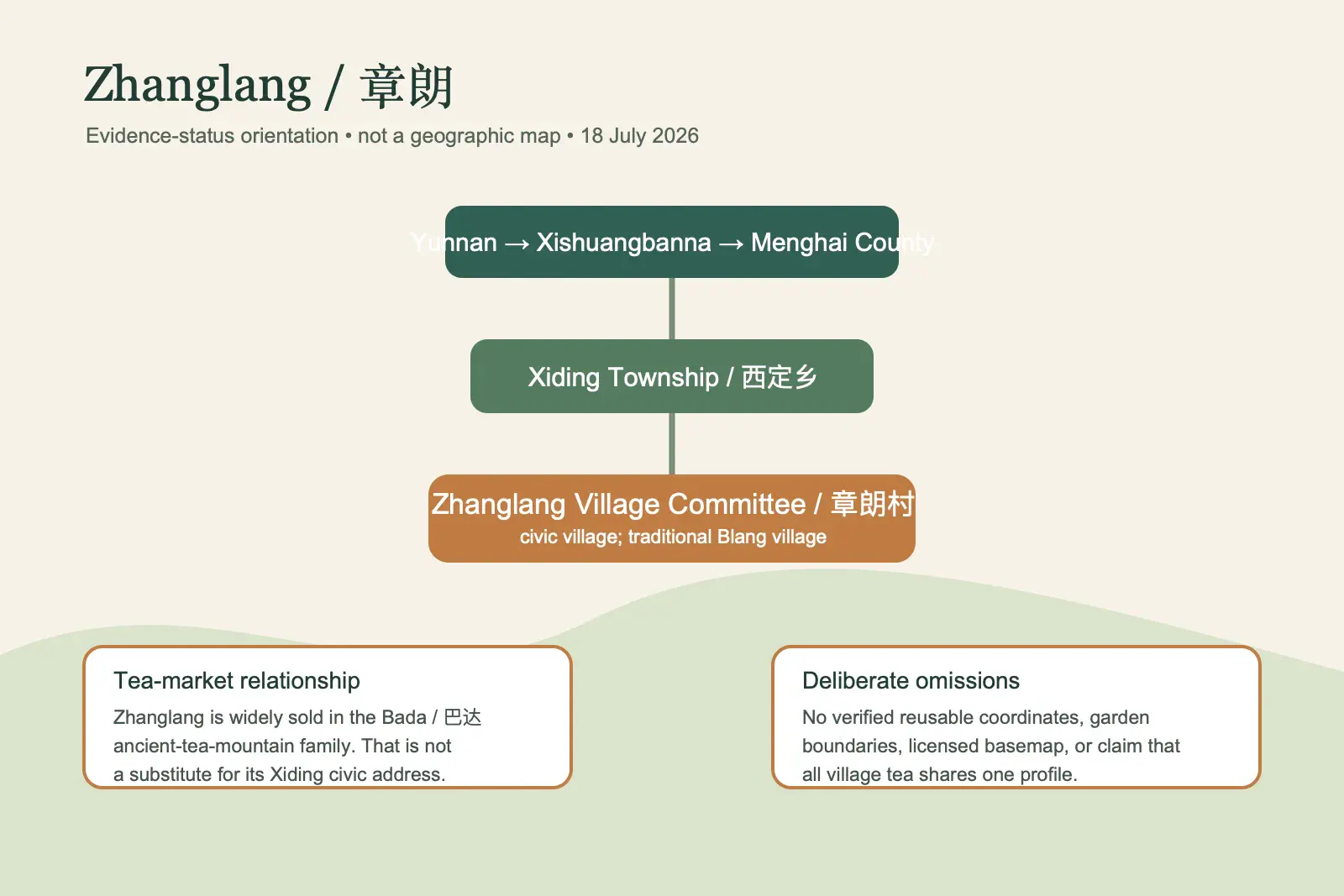
Place relationship diagram notes and sources
Diagram status: Zhanglang's county and Xiding Township affiliation, village status, and Bada market relationship are supported. No reusable authoritative village coordinate, surveyed garden boundary, or licensed composite geometry was obtained; this original diagram is not to scale.
- Yunnan provincial reporting on Zhanglang Village
- Menghai County Media Centre reporting on Bada Ancient Tea Mountain
- Menghai township-level sun-dried tea study
What can Zhanglang taste like beyond the Bada umbrella?
Zhanglang (章朗, Zhānglǎng) is a Blang village in Xiding Township, Menghai County, and a meaningful name in the Bada ancient-tea-mountain market family. Those descriptions answer different questions. The first is a civic location; the second is the commercial and tea-geographic umbrella under which Zhanglang leaf is often discussed. Neither makes Zhanglang a township, a surveyed tea garden, a uniform grade, or a guarantee of “ancient-tree” material.
Public reporting documents a tea-growing village with a Blang cultural institution and extensive tea land. It even gives village-wide figures for registered organic tea gardens and counted old tea trees. Those are collective records, not proof that an individual cake is organic, old-tree, forest-grown, or made from one named plot. When you shop, ask which part of Zhanglang supplied the leaf, what season and material it represents, who processed it, and whether the lot was kept separate.
Finding it on the map
Keep the civic map and tea map separate
Zhanglang’s administrative backbone is Xiding Township → Zhanglang Village, in Menghai County, Xishuangbanna. Provincial heritage material lists “Menghai County, Xiding Township, Zhanglang Village” among traditional villages. Contemporary county media likewise calls Xiding’s Zhanglang Village a Bada ancient-tea-mountain development site. This supports the parent relationship used in this guide: Zhanglang is a Bada child in the tea-guide hierarchy, while Xiding remains the civic township.
That distinction matters because market descriptions may say “Bada Zhanglang,” “Zhanglang Mountain,” or simply “Bada.” They can be useful provenance clues, but none identifies a particular household, garden or boundary. Nor does a village name settle whether leaf came from an old tea tree, a younger garden, a blend, or another nearby site marketed under a familiar name.
The map above is deliberately an original orientation diagram, not a navigation map. This pass did not establish a reusable source-and-CRS-verified point, licensed base map, surveyed Zhanglang tea-garden geometry, or an authorized market-boundary polygon. It uses no copied map, satellite image, coordinate or traced boundary. A pin and contour lines would imply a precision the evidence does not yet supply.
What might show up in the cup
Evidence at the township scale, not a village signature
The strongest controlled sensory evidence located during this review is broader than Zhanglang. A 2023 study compared sun-dried green tea from seven Menghai townships using sensory review, electronic-nose work and GC-MS; it described Xiding samples as qingxiang (a “clear” or fresh-green aroma category) and found measurable differences among township samples. That is useful context for a carefully defined production sample. It does not establish what every Zhanglang garden tastes like, nor does it tell us how a seller’s kill-green, compression or storage will present in a finished raw pu-erh cake.
No documented ImperfecTea Zhanglang session or independent, multi-producer Zhanglang flight meeting this guide’s sensory threshold was located. Vendor accounts commonly describe Bada/Zhanglang tea as strong, bitter, sweet-returning or forest-like, but those are seller-facing impressions and should not become a village fact. Use them as hypotheses to test, not label promises.
When tasting a transparently declared Zhanglang lot, record separately:
- Aroma: warm-leaf, lid and empty-cup notes; do not convert one floral, green, woody or smoky note into a regional rule.
- Structure: bitterness, astringent drying, sweetness and huigan are different observations.
- Texture and finish: note coating, salivation (shengjin), throat feel and the last flavorful steep without treating “energy” as objective place data.
- Variation: compare same-season lots with declared garden scope, processor and storage before crediting a difference to the village.
High heat, smoke, oxidation before kill-green, leaf maturity, blending, compression and warehouse conditions can all reshape a cup. Tasting can test a well documented lot; it cannot repair weak provenance.
Which village, tea-landscape and community relationships matter?
A living Blang village
Zhanglang is repeatedly described in public reporting as a long-established Blang village, with a Blang ecological museum created in 2006, a temple, tea trees and continuing tea-related livelihoods. The 2024 village report says cultural preservation is comparatively complete and discusses residents’ own work in ecological protection. A 2025 Menghai County Media Centre article places it in the Bada ancient-tea-mountain integration programme and describes tea tourism, homestays and village participation in the current local economy.
That context should be treated as living community history, not decorative proof of purity. Being Blang, visiting the museum, or using an old-village image does not verify that a tea is village-separated, ancient-tree or organically certified. It does explain why Zhanglang’s tea name is bound up with farming, cultural institutions and conservation questions rather than only with a tasting descriptor.
Field voices: management is not a single village recipe
A later Chinese field report, republishing China Environment News, gives this picture more practical texture. It quotes Zhanglang resident Yan Zhangwang (岩章往) on separate spring and autumn picking from his household’s old and ecological tea gardens, with summer used principally to let trees recover. It also records community-conservation worker Shen Dingfang (申顶芳) describing scattered gardens and the local distinction among old-tree, large-tree and terrace material; the report says households make maocha by hand while several primary-processing workshops operate in the village. These are useful, named observations about household practice and the village’s processing economy, not a controlled inventory of every garden or processor.
The same report describes weeding with cattle, insect boards, forest protection and weather pressure as reported local practice. It should not be read as proof that every Zhanglang tea is pesticide-free, hand-made, forest-grown or climate-resilient. The value of this evidence is that it gives a buyer better questions: which material class, which household or workshop, which season, and what actually happened after picking?
What the village-wide numbers do and do not prove
The 2024 report gives unusually concrete village-wide figures: 14,981 mu of tea gardens; 4,699.5 mu said to be certified organic; and more than 8,000 old tea trees in forests around the village. It also says the village conducted an old-tree survey, built an archive, QR-tagged trees with trunk diameter above 20 cm, and placed protection rules in village regulations in 2020.
These statements are valuable landscape and governance evidence, with limits. The report does not publish plot polygons, a garden-by-garden organic certificate, tree ages, harvest volumes, a random sampling method, or a chain of custody for retail tea. “Old tea tree” in a village inventory also cannot be silently exchanged for a specific age or for a commercial gushu claim. A buyer should ask which garden and which certification, not assume the village figure travels with every wrapper. A separate field account also makes clear that old-tree, large-tree and terrace material are locally discussed as different classes; a seller should name the class rather than use “Zhanglang” as if it settled the question.
Which geographic facts separate current village from older tea region?
| Reader-facing name | Zhanglang |
| Chinese and pinyin | 章朗; Zhānglǎng |
| Common variants | Zhang Lang; Zhanglang Village; Zhanglang Ancient Village; 章朗村; 章朗寨; 章朗古寨 |
| Geographic type | Village / village committee and traditional Blang village; not a tea grade |
| Current civic path | Yunnan → Xishuangbanna Dai Autonomous Prefecture → Menghai County → Xiding Township → Zhanglang Village |
| Parent tea name | Bada / 巴达 (bada) |
| Tea-market relationship | Zhanglang is a named Bada ancient-tea-mountain provenance in trade language; Bada is not its civic township name |
| Community context | Reporting describes a long-established Blang village, an ecological museum and a Buddhist temple; culture is not lot authentication |
| Documented tea-land context | A 2024 report states 14,981 mu of village tea gardens, 4,699.5 mu organically certified, and 8,000+ old tea trees nearby; scope is village-wide reporting |
| Flavor shorthand | No supported Zhanglang sensory fingerprint; a township-level Xiding study is context, not a village tasting guarantee |
| Confidence | Supported for name, civic nesting, Bada relationship and broad village tea context; incomplete for map geometry, plot ecology, independent tasting and comparable prices |
| Last researched | 19 July 2026 |
Terroir: useful context, insufficient causation
Zhanglang’s Bada association and Xiding location make it reasonable to discuss a forest-and-tea landscape in broad terms. Reporting refers to forest around the village and to tea gardens as part of present-day conservation and tourism. It does not provide a representative Zhanglang garden dataset for slope, aspect, rainfall, soil chemistry, shade percentage, cultivar/landrace composition, inputs, planting density, yield or individual-tree age.
This absence changes the language we can use. Forest cover, moisture, leaf maturity and management may influence raw material, but “forest minerals make the taste mineral” and “higher land makes better tea” are not evidence-based conclusions. The 2023 township comparison supports only that samples can differ at the township scale under its stated method; it does not identify a Zhanglang terroir mechanism. Garden-level records and repeatable tasting would make any such explanation more testable.
How do processing, seasons and aging change the leaf?
Public material supports that tea picking, processing demonstrations and tea sales are part of Zhanglang’s contemporary economy. It does not identify one mandatory Zhanglang processing style. For raw pu-erh, ask who handled withering, kill-green, rolling and sun-drying; whether leaf was blended before pressing; and how the cake was stored. These choices may alter green aromas, bitterness, fragrance and drying sensation enough to mimic a place difference.
Do not infer a village harvest calendar from a tourism programme. Spring, rain-season and autumn material can differ, as can picking standard and weather. Aging can make tea seem sweeter, woodier, thinner or more settled, but it cannot retrospectively establish that the leaf came from Zhanglang.
Which history and current pressures explain the tea?
| Period | What it supports |
|---|---|
| 2006 | Public reporting says a Blang ecological museum was established in Zhanglang. |
| 2013 | Provincial heritage material lists Zhanglang Village, Xiding Township in the second batch of China’s traditional villages. |
| 2020 to 2024 | A 2024 report describes village tree-inventory/protection measures and tea-industry branding; it is evidence of local programmes, not lot certification. |
| 2025 | Menghai County Media Centre reporting describes Zhanglang as a Bada ancient-tea-mountain development site, with tea, tourism and local employment intertwined. |
The same name that helps a village sell tea can attract tourism and label broadening. That is not an accusation about any particular producer; it is a reason to distinguish cultural recognition, a collective brand and a traceable tea lot.
Shopping with clear eyes
On a wrapper, 章朗 is more specific than “Bada,” but it remains incomplete. “Zhanglang ancient village,” “Bada old-tree,” “ecological,” “organic,” “forest tea,” “gushu/ancient tree” and “Menghai Zhanglang tea” are separate claims. One does not prove the others.
Ask a seller:
- Does Zhanglang identify the village committee, a natural village, a named garden, or a blend?
- Which household or garden supplied the leaf, and was it kept separate through processing and pressing?
- What are harvest date, season, picking standard, processor, pressing date and storage history?
- If “organic” is stated, which garden and certificate apply? If “old tree” is stated, what method supports it?
- Is Bada a geographic origin, a blend style or a marketing family on this product?
No current Zhanglang price band is printed here. A copied government-plan passage reports a historical programme narrative in which village ancient-tree tea rose from ¥500/kg in 2015 to ¥3,000/kg at the plan’s then-current reference point, but it does not specify season, material class, transaction type or a current date. It is therefore historical context, not a 2026 price quote or a usable market range. This pass did not locate two current, comparable observations with matching form, unit, season, material claim and transaction context. A one-off listing is not a market price. A transparent Bada or Xiding tea may be a safer purchase than an expensive Zhanglang label with no source trail.
Brew it and compare notes
Start with 5 to 6 g per 100 ml in porcelain, near-boiling water and quick early infusions. Keep water, vessel and timing stable. Note dry leaf, warm leaf, liquor, empty cup, bitterness, astringency, sweetness, salivation, texture and finish separately.
For a small flight, compare a transparently declared Zhanglang lot with a declared Bada lot and a Xiding tea from a similar season and storage condition. Taste blind first; then compare provenance records. If a young tea is harsh, shorten contact time before altering water temperature and dose. The goal is to learn whether documentation corresponds with a repeatable cup, not to reproduce a legend.
What should you remember over your next cup?
- Zhanglang / 章朗 is a village in Xiding Township, Menghai County; it is not a civic unit called Bada.
- Bada is the appropriate parent in a tea-market hierarchy, while Xiding is the relevant administrative township.
- Village-wide tea-land and old-tree reporting gives important context, but does not authenticate a retail lot or establish tree age.
- A township-scale study supplies only Xiding-level aroma context; Zhanglang-specific sensory and garden evidence are not yet sufficient.
- Buy declared garden scope, season, processing, certification basis and storage evidence, not a village name alone.
Where this guide comes from
Research completed and sources accessed 19 July 2026. The civic and cultural framing rests primarily on Yunnan reporting on Zhanglang, provincial traditional-village material, and Menghai County Media Centre reporting on Bada. The China Environment News field account is used only for its named village and community-practitioner observations; its source chain and narrative scope do not authenticate products. The Menghai township aroma study is explicitly limited to its township samples and does not become a Zhanglang taste signature.
The map is ImperfecTea-original SVG plus rasterisation. It uses no third-party map, image, coordinate or geometry and is not a composite geographic map. The dossier records source access, scope conflicts, map rights, sensory limitations and the missing price evidence. No ImperfecTea Zhanglang tasting, reusable map geometry, plot-level ecology study or normalized Zhanglang price pair was located.
Quick answers
Frequently asked questions
What does the Zhanglang tea name identify?
A current village committee in Xiding Hani and Bulang Ethnic Township, Menghai County, and the clearest civic anchor for the older Bada tea region. Its most useful identity is village committee, traditional Blang village and commercial origin, so the name alone does not guarantee a particular garden, tree age or quality level.
What does Zhanglang tea taste like?
No village fingerprint is supported; available lots range through floral sweetness, spice, citrus, green vegetables, resin and variable bitterness, texture and sweet return. Use that profile as a tasting guide, not as proof of origin.
What is Zhanglang commonly confused with?
Zhanglang is a current village inside Bada's historical and market geography, not proof that all Bada tea comes from Zhanglang.
What should I ask before buying Zhanglang tea?
Start with: Which Zhanglang household, garden and season supplied this lot? Also ask for the harvest year and season, producer or household, processing details and storage history.