Place relationship diagram notes and sources
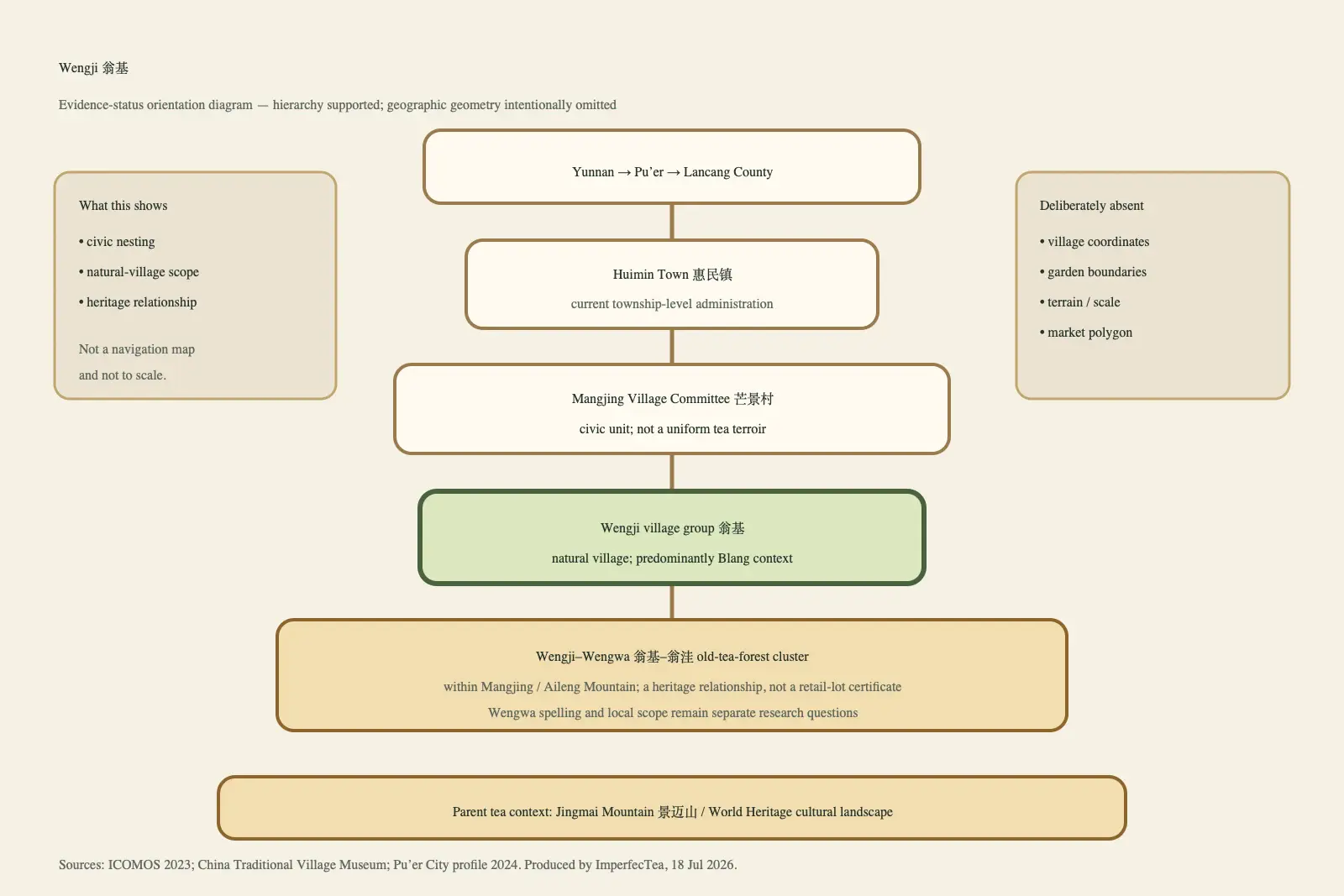
Diagram status: Wengji's natural-village status, civic nesting, and Wengji-Wengwa heritage-cluster relationship are supported. No reusable authoritative village point, surveyed garden boundary, or licensed composite geometry was obtained; this original diagram is not to scale.
- ICOMOS evaluation of World Heritage property 1665
- China Traditional Village Museum record 53082810403
- Pu'er City 2024 village profile
What can Wengji taste like without borrowing heritage as proof?
Wengji (翁基, Wēngjī) is a named natural village, often called Wengji old village or Wengji Blang village, in the Mangjing-side landscape of Jingmai Mountain. It is not a township, a statutory tea grade, or a synonym for the whole mountain. The strongest current record places it under Mangjing Village Committee in Huimin Town, Lancang Lahu Autonomous County, Pu’er; heritage material places Wengji and Wengwa (翁基-翁洼) together as one old-tea-forest cluster within the Mangjing/Aileng Mountain unit of UNESCO’s Jingmai cultural landscape.
That combination makes Wengji a meaningful provenance clue. It does not authenticate an “ancient-tree” cake, establish a single garden, or guarantee the floral, honeyed, bitter, or cooling profile sometimes sold under Jingmai’s name. Wengji also has a well documented Blang community context and traditional-village record. That history deserves care, but it is not a romance seal for retail tea. Ask which Wengji household or garden supplied the leaf, which season it came from, who processed it, and what records follow the tea to the cake.
Finding it on the map
Keep four maps apart
The administrative backbone is straightforward: Huimin Town → Mangjing Village Committee → Wengji village group. The China Traditional Village Museum describes Wengji as a ziran cun (natural village), and a 2024 Pu’er City profile likewise says it belongs to Mangjing Village and lies about three kilometres from the village committee. This is a more precise statement than calling Wengji “Mangjing Village,” yet it still says nothing by itself about a tea garden or lot.
A second map is the heritage landscape. ICOMOS identifies Mangjing Mountain (Aileng Mountain) as the southern mountain unit and names Wengji and Wengwa as one of its two old-tea-forest clusters. The other links Mangjing Shangzhai, Xiazhai, and Manghong. Wengji is therefore related to those three villages through a mountain-scale cultural landscape, but is not their alternate spelling and should not be silently sold as one of them. The wider parent, Jingmai Mountain, includes both Mangjing-side and Jingmai-side village/forest systems; commercial “Jingmai” can be broader again.
The public map is deliberately an original hierarchy diagram, not a navigation map. This pass did not establish a reusable village coordinate with source and CRS, a licensed basemap, surveyed Wengji tea-garden geometry, or reusable authorized heritage polygons. It uses no copied map, photo, coordinate or traced boundary. A crisp pin or polygon would create false precision; a trustworthy composite map will require documented data rights and separate symbols for civic, natural-village, heritage and tea-market scopes.
What might show up in the cup
A nearby evidence point, not a village signature
There is better Wengji-specific material evidence than for several nearby names, but not enough for a reader-facing taste guarantee. A peer-reviewed Yunnan Agricultural University study picked one-bud/two-leaf material from a named Wengji tea garden in the 2022 spring season, made all seven village samples as sun-dried green tea under one stated protocol, and had five certified senior tea tasters assess them under GB/T 23776-2018. In that narrow experiment, the Wengji sample’s aroma and taste scores were 92.8 and 91.4, respectively; the authors group it with samples described as clean/persistent in aroma and rich with returning sweetness. That is useful, transparent sensory evidence for that processed sample, not a Wengji retail-cake tasting flight, a finding for every garden, or a promise about a seller’s processing and storage.
No documented ImperfecTea Wengji session or multi-producer Wengji set meeting the guide’s sensory threshold was available. A 2026 aroma study of samples described as Jingmai ancient-arbor Pu’er and broader Jingmai tasting records make floral, honeyed, citrus-like, resinous, bitter or returning-sweet impressions reasonable things to watch for, but not promises. A commercial 2025 “Jingmai Wengji” listing is evidence about one seller’s claimed lot and its notes, not independent evidence of a Wengji norm.
Taste a transparently declared lot in separate dimensions:
- Aroma: record floral, honey, fruit, herb, smoke and storage notes before assigning them to village.
- Taste and structure: distinguish bitterness in the liquor from astringent drying; then note whether huigan (returning sweetness) actually develops.
- Texture and finish: observe coating, salivation (shengjin), throat feel and the last flavorful steep independently. A warming or energising response is subjective, not a measured Wengji trait.
- Variation: compare same-season lots with garden, processor and storage disclosed. A good cup supports that lot, not a fixed village fingerprint.
Smoke, over-heating, oxidation before kill-green, leaf grade, compression and storage can reshape aroma and grip enough to impersonate a place difference. Wengji is best treated as a provenance question that tasting can test, not replace.
Which village, forest and community relationships matter?
Wengji 翁基
Wengji is the subject of this guide: a natural village under Mangjing Village Committee. The Traditional Village Museum describes it as a typical Blang ancient village and records its traditional-village designation in 2013. The 2024 municipal profile gives a 2021 year-end population of 341, predominantly Blang, and says the settlement extends along a ridge at roughly 1,350 metres. Those data characterize a settlement record; they should not be repurposed as garden altitude, a household census today, or a claim about every resident.
UNESCO’s nomination-image record calls it “Blang People’s Village in Wengji,” with attribution and a no-derivatives condition for the photograph. We use neither that image nor any derivative. It corroborates the public cultural context, while the village record and local reporting show that tea, visitor economy and conservation are contemporary work, not frozen folklore. Community identity never proves a cake’s origin or ownership.
Chinese field reporting adds a more granular, but still attributed, view of that work. In a 2024 interview, Wengji tea-shop owner Er Bing (而丙) said she had learned to pick, make and sell tea with her parents before returning to the village to run tea and visitor businesses; she described tea production and sales as her household’s main income at the time of interview. That is a named household account, not a census of Wengji practice or proof that its tea was made in any one way. It does show why a buyer should ask about the household and maker rather than treating a heritage label as the production record.
Wengwa / 翁洼
Wengwa appears in English heritage material paired with Wengji; contemporary Chinese reporting calls the traditional village 翁洼. The spelling connection is supported at cluster level, but the precise romanisation and local administrative detail should remain a separate research question. It is not safe to treat Wengwa as a brand synonym, a garden within Wengji, or a way to widen an unverified Wengji claim.
The parent and close comparisons
For a focused Jingmai flight, compare a declared Wengji lot with one transparent Wengwa lot and one Mangjing Shangzhai/Xiazhai/Manghong-cluster lot, keeping harvest year and storage as close as possible. Then compare a broader Jingmai tea to test whether the narrower label adds information. The purpose is not to rank Blang villages; it is to find out whether provenance documentation survives processing and commerce.
Which geographic facts separate village, forest cluster and market name?
| Reader-facing name | Wengji |
| Chinese and pinyin | 翁基, Wēngjī |
| Common variants | Weng Ji; Wengji Village; Wengji Old Village / Laozhai; 翁基寨; 翁基老寨 |
| Geographic type | Natural village / village group and traditional Blang village; not an administrative village or a tea grade |
| Current civic path | Yunnan → Pu’er City → Lancang Lahu Autonomous County → Huimin Town → Mangjing Village Committee → Wengji village group |
| Parent tea name | Jingmai Mountain / 景迈山 (jingmai) |
| Heritage relationship | Wengji and Wengwa is one named old-tea-forest cluster in Mangjing/Aileng Mountain, within World Heritage property 1665 |
| Community context | Wengji is recorded as a predominantly Blang natural village; sources also describe it as a traditional Blang village |
| Settlement setting | A 2024 municipal profile places the village on the northern end of the Mangjing/Aileng range at about 1,350 m; this is not a tea-garden elevation range |
| Tea material / price | Old-tea-forest context is documented at landscape scale; no lot-level tree-age evidence or comparable dated Wengji price pair was found |
| Flavor shorthand | No supported Wengji fingerprint; broader Jingmai evidence is only a tasting hypothesis |
| Confidence | Supported for identity, nesting, heritage and community context; incomplete for map geometry, garden ecology, sensory profile and price |
| Last researched | 18 July 2026 |
Terroir: a managed landscape, not a flavor machine
ICOMOS and UNESCO document a cultural landscape connecting forest, tea, and villages, in which Wengji’s cluster sits. The wider property is reported around 1,250 to 1,500 metres in a subtropical mountain-monsoon setting; Wengji’s settlement profile says about 1,350 metres. The difference between those statements matters: neither is a measured garden range. The municipal source’s ridge description supports a settlement-setting note, not a slope/aspect model for leaf.
At property scale, official accounts describe a vertical forest system and longstanding tea cultivation/management by Blang and Dai communities. Those are robust reasons to discuss ecological context. This pass did not locate a representative Wengji garden study for soil, rain, shade percentage, plant population, slope, aspect, planting density, inputs, harvest volume or individual-tree age. The seven-village study’s ancient-tree sample label is limited to its defined samples and is not a certificate for retail material.
What the place can tell us, and what it cannot
Canopy, moisture, leaf maturity, plant population and management may affect raw material. They do not establish that “forest minerals” cause a taste, that higher land is automatically better, or that Wengji has one flavor. The defensible connection is conditional: an exact garden and processing record makes a terroir interpretation more testable; a broad Wengji wrapper leaves several variables unresolved.
How do processing, season and storage change the leaf?
The Jingmai landscape record describes hand-picking and tea making as household knowledge, and the Wengji field interview above confirms that picking, making and selling remain connected in at least one named household. Broader raw-pu’er processing commonly includes withering, kill-green, rolling and sun-drying before later blending or compression. Neither source establishes a universal Wengji house style. One official landscape account mentions spring, summer and autumn picking; later reporting stresses spring/autumn picking and summer rest. Their geographic scopes are not reconciled for Wengji, so no local harvest calendar is asserted here.
Ask whether the leaf was separated at harvest, who did kill-green and drying, whether it was blended, when it was pressed, and how it was stored. An aggressively hot kill-green can mute fragrance; smoke or delayed heating can be mistaken for “village character”; humid storage can overwrite fresh-leaf differences. Aging may make a tea seem sweeter, woodier or thinner, but it cannot retrospectively establish its address.
Which history and community context explain the tea?
| Date | What it supports |
|---|---|
| 2013 | Wengji entered the second batch of China’s traditional villages, according to the Traditional Village Museum record. |
| 2023 | UNESCO inscribed the Cultural Landscape of Old Tea Forests of the Jingmai Mountain in Pu’er under criteria (iii) and (v). |
| 2024 profile | Pu’er’s municipal village record describes Wengji’s civic affiliation, predominantly Blang population context, ridge setting and traditional-built environment; separate field reporting records a named young tea producer’s tea-and-visitor business. |
The inscription recognizes a living land-use system, not a product certification. Tourism, village repair, tea sales and conservation create both opportunity and pressure: a celebrated name can support livelihoods while increasing incentives to broaden the label. Treat cultural context as part of understanding stewardship, not as marketing proof.
Shopping with clear eyes
On a wrapper, 翁基 is narrower than “Jingmai” but still incomplete. “Wengji old village,” “Blang village,” “old tea forest,” “gushu/ancient tree,” “ecological,” “heritage” and “Aileng” each make different claims. None proves the others.
Ask a seller:
- Does Wengji mean the natural village, the Wengji and Wengwa cluster, a named garden, or a blend?
- Which household or garden supplied the leaf, and was it kept separate through processing?
- What are harvest date, season, picking standard, processor and pressing date?
- What method supports any tree-age, organic or heritage-zone assertion?
- What storage history and provenance record can be shown?
No Wengji price range appears here. I found no two dated observations with comparable form, unit, season, material claim and transaction context. A one-off asking price is not a market. A transparent broad Jingmai tea may offer better value than an expensive Wengji label with no chain of custody.
Brew it and compare notes
Start with 5 to 6 g per 100 ml in porcelain, near-boiling water, and quick early infusions. Keep water, vessel and timing stable. Smell dry leaf, warm leaf, lid and empty cup; record aroma, bitterness, astringency, sweetness, salivation, texture, finish and stamina separately.
For a four-tea flight, use a declared Wengji lot, a Wengwa lot, a Mangjing-cluster lot, and a broader Jingmai tea from similar harvest/storage conditions. Taste blind first, then reveal source records. If a young tea is harsh, reduce contact time before changing several variables. The goal is a repeatable comparison, not an inherited flavor legend.
What should you remember over your next cup?
- Wengji is a natural village under Mangjing Village Committee, not a broad administrative unit or ready-made tea grade.
- Its documented heritage relationship is the Wengji and Wengwa old-tea-forest cluster within the Mangjing/Aileng Mountain side of Jingmai.
- A predominantly Blang community and traditional-village context are well supported, but they never authenticate a retail lot.
- One standardized seven-village study supports material variation, not a universal Wengji cup profile; map, ecology and price evidence remain incomplete.
- Buy exact garden, season, separation, maker and storage evidence, not just 翁基 on a wrapper.
Where this guide comes from
Research updated 19 July 2026. The hierarchy and cluster relationship rest chiefly on the ICOMOS evaluation, UNESCO property 1665, the China Traditional Village Museum record and a Pu’er City 2024 village profile. The seven-village Jingmai study supplies a standardized Wengji-garden sample and trained-panel result, but is limited to its defined ancient-tree samples and processing. A named 2024 Wengji household interview contributes contemporary local production-and-livelihood context, not a generalized sensory claim. Wider Jingmai sensory material is deliberately not promoted to a Wengji signature.
The original map uses no third-party map, image, coordinate or geometry and is an orientation diagram rather than a geographic map. No controlled tasting set, garden-level Wengji ecology survey, validated tree-age method, reusable map geometry or normalized price pair was found.
Quick answers
Frequently asked questions
What does the Wengji tea name identify?
A Blang natural village under Mangjing Village Committee, Huimin Town, Lancang County, within the Jingmai Mountain World Heritage landscape. Its most useful identity is blang natural village and narrow commercial origin, so the name alone does not guarantee a particular garden, tree age or quality level.
What does Wengji tea taste like?
No Wengji-only fingerprint is supported; broader Jingmai samples make floral, honeyed or citrus notes useful prompts, not authentication, with grip and sweetness varying. Use that profile as a tasting guide, not as proof of origin.
What is Wengji commonly confused with?
Wengji village, Wengwa village, their shared forest cluster, Mangjing committee and broad Jingmai tea are different provenance scales.
What should I ask before buying Wengji tea?
Start with: Which Wengji garden and household supplied this lot, and who made it? Also ask for the harvest year and season, producer or household, processing details and storage history.