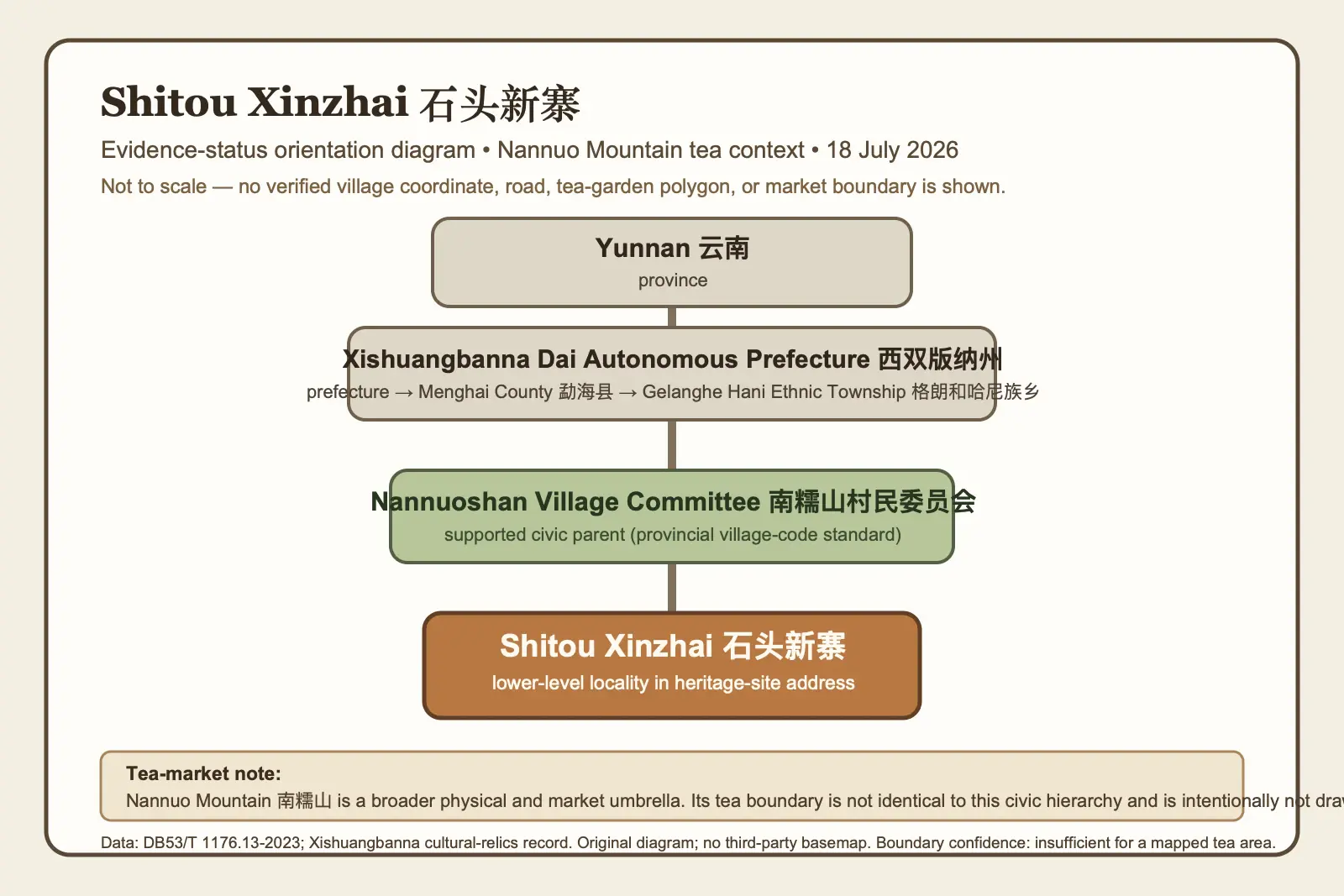
Place relationship diagram notes and sources
Diagram status: The civic hierarchy and heritage-site address are supported. No licensed base map, surveyed locality coordinate, or authoritative Shitou Xinzhai tea-garden boundary was found; the diagram is not to scale.
- Yunnan provincial village-code standard DB53/T 1176.13-2023
- Xishuangbanna cultural-relics record
- Yunnan Academy of Agricultural Sciences Tea Research Institute chronology
What can Shitou Xinzhai taste like beyond its factory history?
Shitou Xinzhai (石头新寨, Shítou Xīnzhài) is a lower-level village locality on Nannuo Mountain, Menghai County, best supported not by a standardized flavor claim but by a remarkably specific historical anchor: the protected former Nannuo tea-factory site is recorded at Gelanghe Hani Ethnic Township → Nannuoshan Village Committee → Shitou Xinzhai. That makes it a real place in the Nannuo story, not simply a romantic label for a cake.
In 1938 to 1940, the provincial Sipu tea experimental project associated with Bai Mengyu brought mechanized tea work to this part of Nannuo. The surviving site helps explain how village-grown leaf, public investment, machinery and local labor met before the modern Menghai factory system took its familiar form. It does not establish a separate Shitou Xinzhai flavor, a precise garden boundary, or the provenance of every tea sold as “Shitouzhai.” Treat the name as a prompt for a better sourcing conversation.
Finding it on the map
The map above is deliberately an evidence-status orientation diagram, not a conventional locator map. It shows the supported nesting from Yunnan to Shitou Xinzhai and the relationship between the civic address and the wider Nannuo tea name. It does not place an exact pin, trace a road, calculate distance or draw a tea boundary because this review did not find a licensed base layer plus an independently verified locality coordinate and surveyed tea-area extent.
That restraint is useful. A village entrance pin cannot represent every garden linked to a household; a factory ruin cannot stand in for a village center; and a vendor’s shaded mountain outline is not an appellation boundary. Trustworthy cartography still needs a licensed Yunnan/Menghai/Gelanghe composite, sourceable boundaries, independently checked locality points, a stated coordinate reference system, scale and a clear uncertainty layer. Until then, the honest map says what the sources establish, and no more.
What can tea called Shitou Xinzhai taste like?
The answer is currently: we do not know well enough to print a regional fingerprint. This research found no controlled tasting set and no group of independent, clearly provenance-scoped tasting reports for Shitou Xinzhai. Broad Nannuo tasting accounts are useful for learning what to observe, fragrance, bitterness, drying grip, texture, returning sweetness and stamina, but they cannot be silently reassigned to a smaller village.
Chinese tea-community evidence gives a little more texture without solving that problem. Houyue’s 2019 Nannuo overview lists 石头新寨 among Nannuo old-tree-tea settlements; it describes the wider Nannuo/石头寨 market conversation in terms of green-to-honeyed aroma, a soft entry, modest bitterness, lingering astringency and returning sweetness. This is a producer’s regional account, not a Shitou Xinzhai tasting flight, and the shorter 石头寨 label may cover more than this settlement. Treat it as a set of questions to test against a disclosed lot, not as a certified village profile.
That does not make a transparent Shitou Xinzhai tea uninteresting. It simply changes the method. Taste the individual lot, then record what may travel with it:
- Aroma: note flowers, fruit, herbs, green vegetation, wood, smoke or storage notes after the rinse and again in later cups.
- Taste and grip: record bitterness separately from astringency. Bitterness is a taste; astringency is the drying or gripping sensation.
- Texture: distinguish watery, coating, oily, chalky and dense. “Smooth” alone hides too much.
- Sweet return: huigan is sweetness that appears or returns after swallowing. Time it rather than treating it as a village certificate.
- Salivation and finish: shengjin is salivation; throat feel, cooling and aroma persistence may be worth noting, but remain subjective sensory observations.
- Stamina: count the last satisfying infusion with real aroma, texture and finish, not merely pale liquid.
- Body sensation: warmth, calm, stimulation or cooling are personal, dose-sensitive reports, not evidence of origin, tree age or purity.
If several transparent lots eventually show a repeatable pattern, that will be a reason to revise this section. At present, the responsible shorthand is: a named Shitou Xinzhai lot must earn its profile in the cup; Nannuo’s reputation cannot do that work for it.
Which geographic facts separate the village from the factory site?
| English name | Shitou Xinzhai |
| Chinese and pinyin | 石头新寨, Shítou Xīnzhài |
| Common spellings | Shitou Xinzhai, Shi Tou Xin Zhai, 石头新寨; shorter 石头寨 / Shitouzhai occurs in heritage and market writing but can be too broad to prove the same lower-level place |
| Region family | Nannuo Mountain, commonly grouped among the New Six Tea Mountains |
| Best-supported address | Yunnan → Xishuangbanna Dai Autonomous Prefecture → Menghai County → Gelanghe Hani Ethnic Township → Nannuoshan Village Committee → Shitou Xinzhai |
| Geographic type | Lower-level village locality / settlement name and tea-market origin term; Chinese field reporting treats it as a zhai (village settlement), but no current cadastral boundary was located |
| Defining landmark | Former Nannuo tea-factory site (南糯山茶厂旧址), recorded as a modern historical site at Shitou Xinzhai |
| Tea-market relationship | A narrow locality inside the broad Nannuo umbrella. “Shitouzhai” alone does not identify a garden, household, harvest or processor. |
| Tea-garden elevation, climate and soils | A 2020 Chinese field report describes the settlement at about 1,690 m and tea trees growing among abundant stones. This is a visit observation, not a garden survey or a range for every plot. |
| Material and harvest | Raw pu-erh and maocha are the relevant market context; spring is frequently foregrounded commercially, but no village-level harvest calendar was found. |
| Cautious cup shorthand | Chinese tea-community writing places Shitou Xinzhai within Nannuo’s old-tree-garden conversation, but it does not provide a matched, traceable tasting set. Evaluate a named lot by its own sensory evidence rather than borrowing a fixed “Nannuo” profile. |
| Map status | Original evidence-status orientation diagram only; no coordinates, scale or tea boundary are claimed. |
| Research confidence | Supported for upper hierarchy and heritage-site relationship; partial for factory chronology; unknown for village ecology, garden census, specific sensory profile and normalized pricing. |
| Last researched | 18 July 2026 |
How should the Shitou Xinzhai name be read?
The least glamorous fact is the one that protects a buyer from a misleading label. Yunnan’s 2023 administrative-village code standard establishes Nannuoshan Village Committee (南糯山村民委员会) under Gelanghe Hani Ethnic Township (格朗和哈尼族乡) in Menghai County. A Xishuangbanna cultural-relics listing gives the next useful layer for the former Nannuo tea factory: Gelanghe Township, Nannuoshan Village Committee, Shitou Xinzhai. Together, they support this working chain:
Yunnan → Xishuangbanna → Menghai → Gelanghe → Nannuoshan Village Committee → Shitou Xinzhai → household/garden → harvest → maocha maker → finished lot → storage.
The standard itself stops at the village-committee level. The heritage listing is strong evidence that Shitou Xinzhai is a real lower-level locality, but it is not a current natural-village gazetteer, land survey or garden map. A 2020 Chinese tea-community field account by Dao Ge and Wang Lei also visits it as the fourth zhai on their Nannuo route, says it was separated from Shitouzhai in 1940, and records later offshoot settlements. That is useful local naming history, not an administrative determination: its sponsor, source trail and village testimony are visible, but it is not a government register. That boundary matters: it would be wrong to turn either record into a precise village polygon or a complete list of households.
Nannuo is the umbrella; Shitou Xinzhai is the narrower question
Nannuo Mountain / 南糯山 is a physical, cultural and tea-market umbrella. Labels may honestly use Nannuo for material pooled across more than one locality. Shitou Xinzhai is a more specific place word, and therefore asks for a more specific chain of custody. It is a neighbor in the Nannuoshan committee context to names such as Guniangzhai and Banpo localities; it is not a synonym for Nannuo, Pasha, or every place called Shitouzhai in tea trade prose.
The shortened name is especially risky. Historical accounts often call the factory location Shitouzhai (石头寨), while the heritage record uses Shitou Xinzhai (石头新寨). The relationship is plausible and contextually supported, but a commercial “Shitouzhai” label should still show Chinese characters, a current parent unit and a producer’s source record. A name that is geographically close is not automatically a civic match.
Village context, gardens and terroir
What the locality evidence establishes
Shitou Xinzhai has two solid roles in the record. First, it is a lower-level place beneath the Nannuoshan committee in the address of a protected historical site. Second, it sits in the Nannuo tea landscape, where Hani communities continue to farm, process tea, host visitors and negotiate a growing named-origin economy. These are meaningful facts about people and place.
They do not yet yield a defensible village matrix of garden elevation, aspect, canopy, soil, tree age, cultivar, plot size, inputs or production volume. The Dao Ge/Wang Lei visit offers a useful but narrow ground-level observation: its authors photographed tea trees growing among stones, described a settlement panorama at about 1,690 m, and reported a thick humus layer in their own soil sample. Their later language about “rock tea,” tree age and a possible yellow soil is interpretive; without laboratory work, plot locations or replication, we do not turn it into a soil type, a garden elevation range or an age claim. It does, however, make the specific question of stony, mixed tree-and-rock garden sites worth asking a grower rather than treating the locality as blank on the ground.
Public travel and commercial pages attach precise elevations, ancient-tree ages and flavor claims to Nannuo localities, but no representative Shitou Xinzhai survey with methods was located. We therefore do not repeat a peak height as tea-garden altitude, infer tree age from trunk size, or call a forest-edge photograph an agroforestry audit.
Plant material and human work
Nannuoshan appears in research on Yunnan large-leaf tea populations, which supplies broad regional context rather than a Shitou Xinzhai genetic identity. A retail lot cannot be genetically authenticated from a mountain name alone. Similarly, “qiaomu,” “old arbor,” “ancient tree,” “wild” and “ecological” are not interchangeable. Each is a claim about a particular garden or material stream and needs a producer explanation.
Fresh leaf becomes maocha through choices people make: resting, heat fixation (shaqing), rolling and sun-drying. Sorting, blending, steaming, compression and storage then add further variables. Delayed fixation may increase oxidation; excessive heat can flatten or scorch aroma; rough rolling and damp drying can change texture and later storage behavior. A smoky, green, thin or aggressively bitter cup may therefore be a processing question before it is a village question.
What the place can tell us, and what it cannot
We can say that Nannuo’s different slopes, garden histories, fresh-leaf logistics and household processing conditions plausibly create variation. Shade, drainage, weather and harvesting conditions may affect leaf growth and handling. We cannot say which one causes a particular Shitou Xinzhai flavor without plot-level measurements and comparable teas. Nor can we claim that higher elevation is automatically better, that soil makes a “mineral” taste, or that a protected factory site proves exceptional surrounding leaf.
How do processing, season and storage change the leaf?
Most tea sold under a narrow Nannuo locality is raw pu-erh: leaf is rested, heat-fixed, rolled and sun-dried into maocha, then may be sorted, blended, steamed and pressed. For Shitou Xinzhai, no current village-wide processing study was found. The historical factory is evidence that mechanized production existed on the mountain; it is not evidence that every contemporary household makes tea in one inherited style.
Ask a seller whether the lot was bought as fresh leaf or maocha, who did the heat fixation, whether it was blended before pressing, and where it was stored. Spring, rain-season and autumn leaf can differ, but no matched Shitou Xinzhai set supports a seasonal rule here. An older cake adds storage to the equation: wood, herbs, softened bitterness and darker sweetness may come from time and environment as much as original leaf. A storage history is therefore as important as a village name.
How did the factory give the village its clearest tea history?
Shitou Xinzhai’s historical importance is unusually concrete. A chronology published in connection with the Yunnan Academy of Agricultural Sciences Tea Research Institute says that in 1938 the provincial government assigned Bai Mengyu (白孟愚, also rendered Bai Yaoming) to prepare the Yunnan Sipu-area tea experimental station. It records a tea factory established at Nannuo’s Shitouzhai in January 1940, with six British-made machines, collecting material and producing machine-made black tea that year. Other historical accounts say construction began in April 1938 and the plant was completed in January 1940. They agree on the larger point but not every institutional title or milestone.
A short, conflict-aware timeline
- 1938: provincial support and Bai Mengyu’s experimental-tea work are consistently reported; some accounts call this the start of construction at Shitouzhai.
- 1940: the Tea Research Institute chronology records a factory at Shitouzhai, imported machinery and machine-made black tea; other accounts describe completion in January.
- Later twentieth century: the site survives as a reminder of experimental and mechanized production on a mountain where village cultivation continued.
- Current heritage record: the former Nannuo tea-factory site is listed at Shitou Xinzhai under Nannuoshan Village Committee.
It is tempting to call this simply the “first” factory. That superlative needs a defined scope and a stronger documentary comparison across Yunnan factories. The supported, more useful claim is narrower: the site is an early, historically significant example of provincial experimental and mechanized tea production in Nannuo’s tea landscape. It links technology, finance, local leaf and local labor without erasing the village cultivation that made the experiment possible.
Shopping with clear eyes: turn a name into a record
Read a label from broad to narrow: Menghai → Gelanghe → Nannuoshan → Shitou Xinzhai → household or cooperative → garden → season → processing → storage. A broad Nannuo blend can be honest if it says so. A Shitou Xinzhai claim is narrower and should provide more.
Ask:
- Which Chinese characters does the producer use, 石头新寨 or the broader 石头寨, and what current parent unit do they mean?
- Is the tea from one household, several gardens, a village blend or a broader Nannuo purchase?
- Who picked the leaf and who carried out shaqing, rolling and sun-drying?
- What year and season were the leaves picked, and when was the tea pressed?
- What evidence supports any “old tree,” exact elevation, forest or single-garden wording?
- Where has the tea been stored since pressing, and did the seller buy fresh leaf, maocha or a finished cake?
No price range is printed here. The additional Chinese market material found during this review either uses the broader 石头寨 name or reports another settlement (for example, 2020 prices for Shitou Laozhai), so it cannot be reassigned to Shitou Xinzhai. I still could not find two dated observations normalized by form, season, tree/garden claim, maker and storage. A transparent broad Nannuo tea can be a better value than an undocumented Shitou Xinzhai premium. For a comparison, choose a transparent broad Nannuo blend, a documented Banpo or Guniangzhai lot, and a Pasha tea from the same township; match year, storage and brewing before drawing conclusions.
Brew it and compare notes
Use 5 g in a 75 to 90 ml porcelain gaiwan, water just off the boil and short steeps of roughly 5, 7, 10, 15 and 20 seconds. A quick rinse can help tightly compressed tea open. If an early brew is harsh, reduce contact time before lowering temperature; cooler water can hide aroma and texture as well as bitterness.
For a four-tea flight, hold leaf weight, vessel, water and timing constant:
- A Shitou Xinzhai-labelled tea with maker, harvest and processing details;
- A transparent broad Nannuo tea of similar age and storage;
- A documented Banpo Laozhai or Guniangzhai lot, if obtainable;
- A Pasha reference tea from Gelanghe for a same-township comparison.
Blind the labels if possible. Note aroma persistence, immediate sweetness, bitterness, astringency, texture, huigan and the last satisfying steep. The goal is not to prove that Shitou Xinzhai has a predetermined taste. It is to find out whether the narrower name adds repeatable information once other variables are disclosed.
What should you remember over your next cup?
- Shitou Xinzhai is a supported lower-level locality beneath Nannuoshan Village Committee, not a synonym for all of Nannuo.
- Its clearest tea significance is the protected former Nannuo tea-factory site, tied to early experimental and mechanized production.
- “Shitouzhai” can be too broad; look for 石头新寨, a parent unit, a household or garden, harvest and maker.
- No reliable Shitou Xinzhai flavor fingerprint, garden-elevation range or price band was found. Let a documented lot speak for itself.
- It best suits historically curious drinkers who enjoy comparing provenance claims rather than collecting a prestige name.
Where this guide comes from
Sources were accessed 18 July 2026. The provincial village-code standard supports the civic chain through Nannuoshan Village Committee. The heritage record supports the factory site’s Shitou Xinzhai address. The Tea Research Institute chronology and historical reporting support the 1938 to 1940 factory narrative, while preserving conflicts over establishment, construction and completion dates. This second pass adds two Chinese tea-community sources: Dao Ge and Wang Lei’s sponsored but named 2020 on-foot account, used for attributed settlement and observed garden context, and Houyue’s 2019 regional producer guide, used only as broad Nannuo/石头寨 sensory context. Neither turns into a village boundary, laboratory ecology study or Shitou Xinzhai tasting certificate.
The map is an original, not-to-scale orientation diagram with no copied base map, coordinates, implied roads or tea-boundary geometry. No controlled tasting set, representative ecological survey, licensed mapping dataset or normalized price series was found.
Quick answers
Frequently asked questions
What does the Shitou Xinzhai tea name identify?
A lower-level village locality beneath Nannuoshan Village Committee in Gelanghe Hani Ethnic Township, Menghai County, supported by heritage-site reporting. Its most useful identity is lower-level village locality and tea-market origin, so the name alone does not guarantee a particular garden, tree age or quality level.
What does Shitou Xinzhai tea taste like?
No village fingerprint is supported; declared teas may reflect broader Nannuo florals, sweetness, bitterness or grip, while processing and storage can dominate the cup. Use that profile as a tasting guide, not as proof of origin.
What is Shitou Xinzhai commonly confused with?
Shitou Xinzhai is a supported narrow locality, while Shitouzhai can be broader and the factory site is not a garden boundary.
What should I ask before buying Shitou Xinzhai tea?
Start with: Which Shitou Xinzhai garden, households and maker are documented for this lot? Also ask for the harvest year and season, producer or household, processing details and storage history.