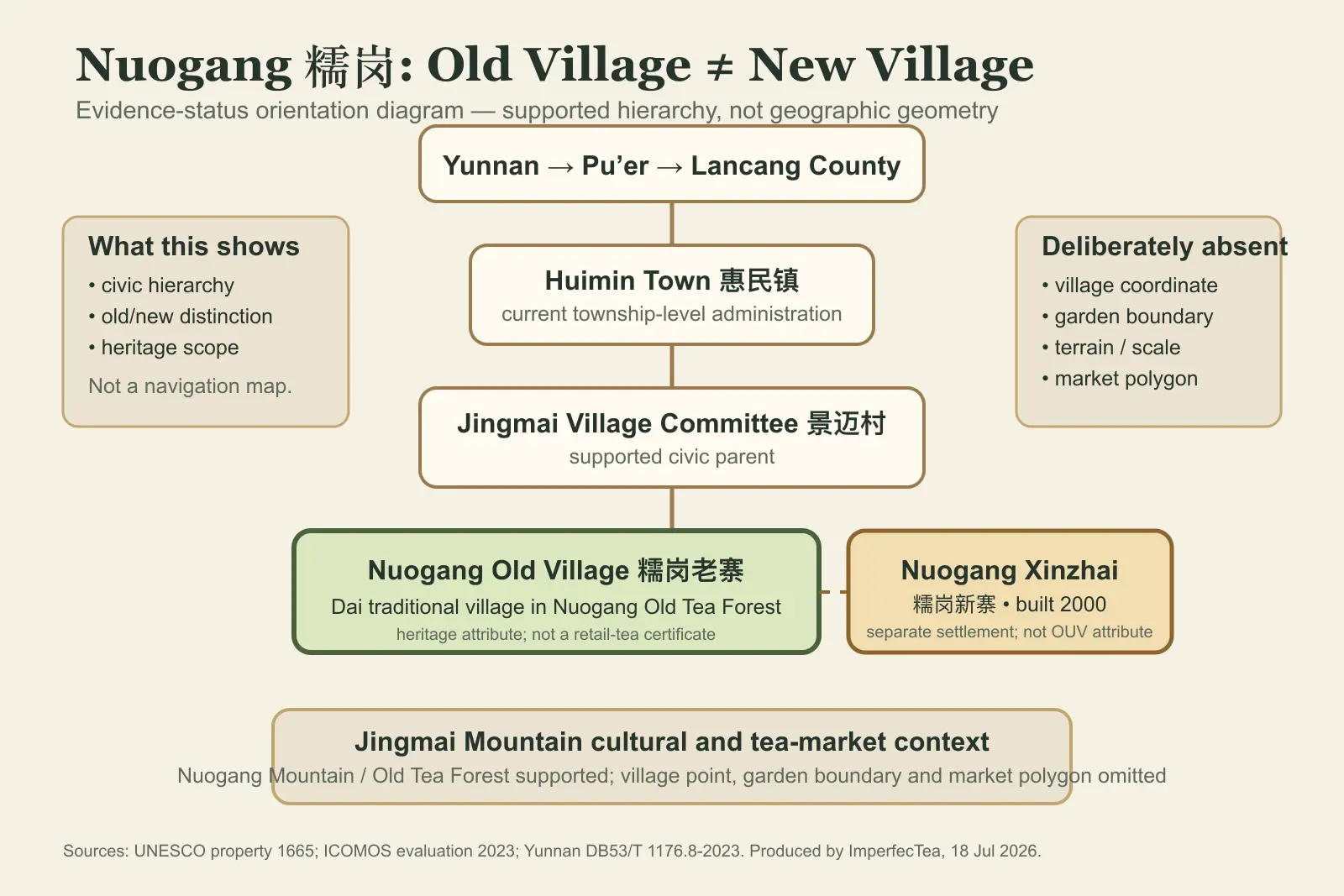
Place relationship diagram notes and sources
Diagram status: The administrative path and the distinction between Nuogang Old Village and Nuogang Xinzhai are supported by ICOMOS and local institutional reporting. No reusable authoritative village or tea-garden geometry was secured; this original diagram is not to scale.
- UNESCO World Heritage property 1665 and ICOMOS evaluation
- Yunnan DB53/T 1176.8-2023 administrative-village standard
- Yunnan/People's Daily local reporting
What can Nuogang taste like, and which village is meant?
Nuogang Old Village (糯岗老寨, Nuògǎng Lǎozhài) is the Dai traditional village located with the Nuogang Old Tea Forest on Nuogang Mountain, within Jingmai Mountain’s 2023 World Heritage cultural landscape. It is a real, named place in the tea landscape, not merely a dealer’s fantasy label. Its commonly shortened market name, Nuogang, is nevertheless too broad to authenticate a cake by itself.
The first buying caveat is unusually important here. Nuogang Xinzhai (糯岗新寨) is a separate Dai settlement, built in 2000 to protect the older village from development. Heritage documents distinguish it from Nuogang Laozhai: Xinzhai lies inside the inscribed property but is not an attribute of Outstanding Universal Value. Neither “old village,” “World Heritage,” nor “ancient tree” on a wrapper identifies a household garden, season, processing chain or blend. Treat Nuogang as a precise question to investigate, not a flavor guarantee.
Finding it on the map
One short name, several different places and claims
The supported civic backbone is Huimin Town → Jingmai Village Committee in Lancang Lahu Autonomous County, Pu’er City. ICOMOS places the Dai Nuogang traditional village in the Nuogang Old Tea Forest on Nuogang Mountain, the northwest geomorphological unit of the heritage landscape. The World Heritage property is larger than the village: it includes five old-tea-forest clusters, nine traditional villages and three protective partition forests. One of those protective forests is named Jingmai and Nuogang; it should not be mistaken for a tea garden or a village boundary.
Nuogang Xinzhai requires its own line on the map of ideas. ICOMOS says the new village was built in 2000 to protect Nuogang Laozhai from development, and says it is not a heritage attribute. That is a conservation and settlement-history distinction, not a quality ranking. A seller may use “Nuogang” without saying which settlement, forest, household or garden is meant; the evidence seen here does not establish a statutory tea-market boundary for either village.
The public image is therefore an original evidence-status orientation diagram, not a terrain map. It intentionally omits an unverified coordinate, a property polygon, village boundary, road trace and garden outline. Those omissions make it unsuitable for navigation, but more honest than a crisp, vendor-derived boundary. The property is 7,167.89 hectares with an 11,927.85-hectare buffer, yet neither figure is a Nuogang tea-growing area or a retail-origin definition.
What might show up in the cup
A Jingmai hypothesis, not a Nuogang signature
No documented ImperfecTea Nuogang tasting session or multi-producer Nuogang flight meeting this guide’s minimum basis was available during this review. A commercial listing can describe a tea it sells, but its “orchid,” “wild forest,” “honey” or “300-year tree” language is not independent evidence that every Nuogang lot tastes that way. We therefore do not publish a numeric bitterness scale, a fixed cha qi (subjective body/energy experience) claim, or a village fingerprint.
The wider Jingmai record is still useful as a question set. A 2026 aroma study of samples described as Jingmai ancient-arbor pu’er identified aroma-active compounds including linalool, beta-ionone and methyl salicylate; it does not identify Nuogang or authenticate a cake. Specialist records for different Jingmai lots often mention flowers, honey, citrus or fruit, alongside changing bitterness, astringency and returning sweetness. In a transparently sourced Nuogang sample, those are things to notice, not promises delivered by the name.
- Aroma: distinguish floral, honeyed, citrus, herb, smoke and storage notes before deciding they are “Jingmai.”
- Taste and bitterness: record bitter taste separately from huigan, the sweetness that returns after swallowing.
- Texture and astringency: thickness, silkiness and mouth-drying grip are different sensations; follow both through the middle steeps.
- Salivation, finish and stamina: shengjin (salivation), throat finish and the last flavorful steep can be useful observations, but none proves geography.
- Variation: harvest season, leaf maturity, kill-green, sun-drying, blending, compression and storage can easily outweigh a broad village label.
Which old-village and new-village distinctions matter?
Nuogang Old Village 糯岗老寨
Nuogang Old Village is the subject of this guide. Official and local reporting calls it a Dai traditional village under Jingmai Village Committee and records its setting in a small mountain basin with a water feature. ICOMOS’s stronger, heritage-scale wording places it in the Nuogang Old Tea Forest on Nuogang Mountain. Local accounts do not give one settled translation of the name: one renders it as “where deer drink water,” while a 2023 Yunnan feature gives a different Dai-language reading, “gold falls into a pond.” Both are reported local explanations, not a verified linguistic conclusion or a tasting descriptor.
The older village is an attribute of the World Heritage cultural landscape. That supports its identity and conservation context; it does not identify leaf from a particular plot. Local reporting describes tea and tourism as current livelihoods, and traditional Dai built form as a significant part of the place. Avoid converting that cultural reality into a claim that every resident produces tea, every tea is forest-grown, or every seller using the name buys locally.
Nuogang Xinzhai 糯岗新寨
Nuogang Xinzhai is not an alternate name for the old village. The ICOMOS evaluation states that this Dai new village, with 277 residents in the nomination material, was built in 2000 to protect Nuogang Laozhai from development. It remains inside the nominated/inscribed property but is not counted among the property’s attributes of Outstanding Universal Value. A fieldwork-based architectural source likewise excludes Nuogang Xinzhai from its traditional-village/national-protection discussion. This distinction should appear on a seller invoice or source record where relevant; it should never be papered over by the word “Nuogang.”
The parent: Jingmai Mountain 景迈山
Jingmai Mountain is the right parent tea name but is not a homogeneous estate. ICOMOS describes Nuogang, Jingmai Dazhai, Manggeng, Mengben, Mangjing Shangzhai, Mangjing Xiazhai, Manghong, Wengji and Wengwa as traditional-village attributes across different forest clusters. Compare a declared Nuogang tea with a disclosed broader Jingmai lot before comparing it with a different mountain: this tests the narrow village claim without pretending that a heritage map supplies a sensory map.
Which geographic facts separate old village, new village and forest?
| Reader-facing name | Nuogang Old Village |
| Chinese and pinyin | 糯岗老寨, Nuògǎng Lǎozhài |
| Search/wrapper variants | Nuogang, Nuogang Laozhai, Nuogan, Nuogang Ancient Village; 糯岗 / 糯干古寨 |
| Name and entity type | A Dai traditional/natural village; not a statutory tea grade or a defined retail appellation |
| Current civic path | Yunnan → Pu’er City → Lancang Lahu Autonomous County → Huimin Town → Jingmai Village Committee |
| Parent tea name | Jingmai Mountain / 景迈山 (jingmai) |
| Important distinction | Nuogang Old Village is the heritage attribute; Nuogang Xinzhai is a separate settlement built in 2000 |
| Heritage / forest context | Nuogang Old Tea Forest on Nuogang Mountain; one of five old-tea-forest clusters in the property |
| Map status | Original hierarchy diagram only; no surveyed village point or reusable garden boundary used |
| Elevation / climate | Property-wide context: roughly 1,250 to 1,500 m, subtropical mountain-monsoon conditions; no Nuogang garden range verified |
| Flavor shorthand | No supported Nuogang fingerprint; broader Jingmai examples often report floral, honeyed or citrus-like notes but vary materially |
| Price | Not published: no two comparable dated, normalized Nuogang observations found |
| Confidence / date | Supported for identity, civic path, old/new-village distinction and landscape context; incomplete for lot provenance, mapping and village-specific tasting. Researched 18 July 2026. |
What might shape the cup
UNESCO and ICOMOS document a managed cultural landscape in which old tea groves, forests, plantations and villages are connected through long-lived Blang and Dai land use. ICOMOS reports a property-wide elevation band of about 1,250 to 1,500 metres and a subtropical mountain-monsoon setting. Its description of protective forests and the old-tea-forest system gives a credible environmental context for Nuogang. It does not give us a representative Nuogang garden elevation, slope/aspect series, soil analysis, rainfall record, cultivar survey, shade measurement, input record or tree-age method.
Shade, moisture, leaf maturity and farm management may influence the material a producer receives; processing then decides much of what reaches the cup. Chinese field reporting provides lived context rather than a plot study: it describes households in the heritage area maintaining tea gardens and inheriting tea-making, and profiles a Nuogang tea maker, Yan Lie (岩烈), who makes tea by day and has sought formal tea-evaluation training. That supports the reality of contemporary local tea work; it does not establish a Nuogang-wide processing style, garden protocol, or sensory result. The claim that a particular soil creates “minerality,” that higher tea is automatically better, or that an old-looking tree is superior cannot be made from the available record. The property’s old-tea-forest surveys conducted in 2021 are a promising conservation baseline, but this review did not locate a reusable Nuogang plot dataset.
What the place can tell us, and what it cannot
We can say Nuogang Old Village is tied to a documented old-tea-forest cultural landscape and is separated from Jingmai and Mangjing zones by named protective forests. We can say that ecological management and community knowledge are part of the landscape context. We cannot assign a soil, altitude, tree age, biodiversity measure or cup profile to an unidentified Nuogang cake. The evidence supports a careful source conversation, not terroir mythology.
How do processing, season and storage change the leaf?
Raw pu’er normally moves through withering, heating to curb enzymatic change, rolling and sun-drying into maocha; later sorting, blending, steaming, compression and storage may alter it again. ICOMOS notes hand-picking in spring, summer and autumn at the property scale, while a 2025 provincial report stresses spring/autumn picking and summer rest. These statements may describe different scopes or practices, so neither becomes a universal Nuogang calendar here.
Ask whether maocha from Nuogang was kept separate, who performed the kill-green and sun-drying, whether it was blended, and when it was pressed. Smoke, over-aggressive heating, delayed heating, excess oxidation and storage can change aroma, bitterness and texture enough to masquerade as village character. Older tea may become woodier, sweeter or drier because of storage rather than Nuogang.
Which history and community context explain the tea?
The 2023 inscription recognized a living cultural landscape shaped by Blang and Dai peoples over more than a millennium; it did not freeze the villages in time or create a retail tea certification. The old/new Nuogang distinction is a concrete recent history: the new village was created in 2000 to shield the older settlement from development pressure. The ICOMOS evaluation also flags tourism development and climate change as risks to landscape integrity.
Local reporting describes ongoing repairs, water-landscape work, tea making and tourism in Nuogang. A 2026 Yunnan Daily report places tea seller Xiān Jīn (仙金) at an intersection in 糯干古寨; that name is an unresolved local search lead, not a confirmed synonym for Nuogang Old Village. The report records her account of a family tea forest and factory: her father began making tea in 2003 and the family later moved from door-to-door selling toward direct and livestream sales. A People’s Daily feature separately profiles Nuogang resident Yan Lie, who makes tea and sells online. These are named, on-the-ground accounts of household-scale tea work and changing routes to market, not independent verification of a particular cake, a village-wide factory structure, or a sensory profile. Read them as present-day choices by a community, rather than a scenic backdrop for premium marketing. Heritage membership can explain conservation priorities; it does not prove that an individual cake comes from a protected forest.
Shopping with clear eyes
Look for 糯岗老寨, Nuogang Laozhai, Nuogang Old Village or simply Nuogang, then ask what the shortened name actually means. If the seller means Xinzhai, request that it be said. If the seller means a broader Jingmai blend, that is not necessarily bad tea, but it is not the same claim.
Ask six practical questions:
- Is the claimed source Nuogang Old Village, Nuogang Xinzhai, the Nuogang old tea forest, or broader Jingmai?
- Which household, garden or buying station supplied the leaf, and was it kept separate?
- What were harvest date, season and picking standard?
- Who performed kill-green and drying; where were blending and compression done?
- What does “old tree,” “arbor,” “forest” or “heritage” mean for this lot, and what record supports it?
- When was it pressed, and what is its storage history?
No Nuogang price range is printed because two comparable dated observations, same unit, form, season, claimed material and transaction context, were not found. A single asking price is not a market. When answers are vague, a well-documented broader Jingmai tea is usually a more defensible purchase than an expensive village story.
Brew it and compare notes
Start with 5 to 6 g per 100 ml in a gaiwan or small pot, water near boiling and short early infusions. Keep leaf ratio, water and timing fixed. If young sheng becomes sharply bitter, shorten contact before changing the temperature; if aroma is quiet, lengthen later steeps rather than reading low fragrance as weak leaf.
Build a three-tea flight: a transparently declared Nuogang Old Village lot, a broader Jingmai lot with clear sourcing, and a named Jingmai neighbour or another mountain matched as closely as possible for harvest year and storage. Taste blind first, then read the source records. Note aroma, bitter taste, astringency, texture, huigan, shengjin, finish and stamina. The point is to see whether the narrow origin claim predicts anything beyond producer and processing.
What should you remember over your next cup?
- Nuogang Old Village (糯岗老寨) is a documented Dai traditional village under Jingmai Village Committee in Huimin Town, Lancang.
- Nuogang Xinzhai is separate: ICOMOS says it was built in 2000 to protect the old village and is not a heritage attribute.
- Nuogang sits with the Nuogang Old Tea Forest on Nuogang Mountain, inside, but not synonymous with, the broader Jingmai Mountain tea and heritage landscape.
- Heritage, old-tree and village words on a wrapper do not prove garden, season, processing, storage or purity.
- This guide keeps its claims narrow because a legitimate composite map, village-scale tasting/ecology evidence and normalized pricing are still missing.
Where this guide comes from
Research was completed 19 July 2026. The identity, old/new-village distinction, Nuogang Mountain/Old Tea Forest relationship, property composition, physical setting and conservation context rest principally on the ICOMOS evaluation, read with UNESCO property 1665 and the World Heritage Committee decision. The current administrative backbone is supported by the Yunnan administrative-village standard. Named Chinese local accounts add household tea-work and direct-market context, and a 2023 Yunnan feature exposes a conflicting local name explanation; neither is used to authenticate tea, fix a garden boundary, or assign a village flavor.
The map is an ImperfecTea-original SVG and rasterization, with no third-party basemap, photo, coordinates or copied geometry. It is a hierarchy/evidence-status diagram, not the required composite geographic map. No ImperfecTea Nuogang tasting set, village-specific multi-producer sensory record, representative garden ecology dataset, individual-tree age methodology, reusable village/garden geometry, or two normalized dated price observations was found. The companion dossier retains source, conflict, claim-confidence, map and tasting notes.
Quick answers
Frequently asked questions
What does the Nuogang tea name identify?
Nuogang Old Village lies under Jingmai Village Committee in Huimin Town, Lancang County, within Jingmai Mountain's World Heritage cultural landscape. Its most useful identity is traditional old village and narrow commercial origin, so the name alone does not guarantee a particular garden, tree age or quality level.
What does Nuogang tea taste like?
No Nuogang-only profile is supported; broader Jingmai evidence suggests floral, honeyed or citrus notes with variable grip, but transparent lot provenance must lead. Use that profile as a tasting guide, not as proof of origin.
What is Nuogang commonly confused with?
Nuogang Laozhai and Nuogang Xinzhai are separate settlements, and an unspecified Nuogang label does not prove old-village leaf.
What should I ask before buying Nuogang tea?
Start with: Does this Nuogang lot come from the old village or new village, and which garden? Also ask for the harvest year and season, producer or household, processing details and storage history.