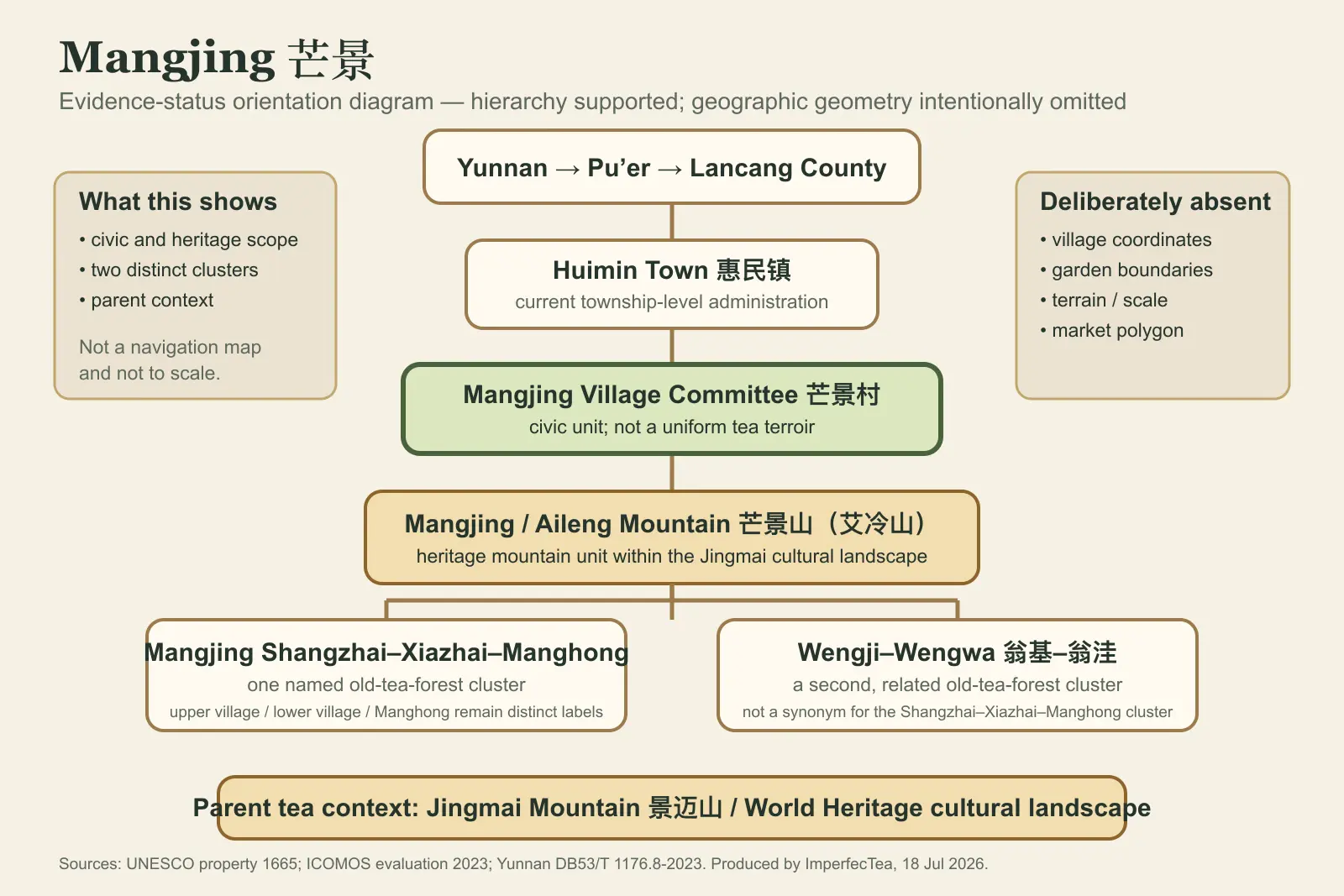
Place relationship diagram notes and sources
Diagram status: The civic and heritage hierarchy is supported. No reusable authoritative geometry, independently verified village coordinate, or surveyed tea-garden boundary was obtained; this original diagram is not to scale.
- UNESCO World Heritage property 1665 and ICOMOS evaluation
- Yunnan DB53/T 1176.8-2023 administrative-village standard
- Journal of Qujing Normal University (2022), Mangjing Shangzhai Blang field study
What might Mangjing taste like, and why is no fingerprint supported?
Mangjing (芒景, Mángjǐng) is one of Jingmai Mountain’s most useful names, and one of its easiest to overstate. In today’s administration it is a village committee under Huimin Town, Lancang Lahu Autonomous County. In heritage material, Mangjing Mountain, also called Aileng Mountain, is a southern mountain unit of the 2023 UNESCO cultural landscape. In tea conversation, the same word can be used for leaf from an upper or lower village, a broader old-forest area, or an imprecise Jingmai-facing product name.
The landscape has a well-supported Blang community context and two named old-tea-forest clusters on the Mangjing side. That is meaningful provenance context, not a certificate for a cake’s tree age, garden, processing or taste. Broader Jingmai teas often invite floral and honeyed expectations; this review found no sufficiently independent, Mangjing-specific tasting set to turn that expectation into a Mangjing fingerprint. Buy the exact village, garden, season and maker before buying the romance of the mountain.
Finding it on the map
One word, several legitimate scopes
The reliable civic backbone is Huimin Town → Mangjing Village Committee, within Lancang Lahu Autonomous County, Pu’er City. The provincial administrative-village standard supports the committee level, but it should not be read as a tea-garden register. A committee is not automatically one uniform terroir or one household supply chain.
ICOMOS calls the southern heritage mountain unit Mangjing Mountain (Aileng Mountain). It identifies two separate old-tea-forest clusters there: one linking Mangjing Shangzhai, Xiazhai, and Manghong, and the other linking Wengji and Wengwa. The first connects Mangjing Upper Village, Lower Village and Manghong; the second connects Wengji and Wengwa. This guide’s narrow working subject is the Mangjing-named village cluster, while Wengji and Wengwa remain distinct named localities rather than synonyms for Shangzhai or Xiazhai.
All of those sit beneath the reader-facing parent Jingmai Mountain. Yet the UNESCO property, its buffer zone, Mangjing committee, Mangjing Mountain and retail “Jingmai/Mangjing” usage are overlapping maps, not interchangeable ones. The property totals 7,167.89 hectares with an 11,927.85-hectare buffer, but membership of a heritage landscape does not authenticate a retail lot.
Why the map is deliberately modest
The public diagram is ImperfecTea-original and shows hierarchy only. It does not use a basemap, image, coordinate, property polygon or traced map geometry. UNESCO nomination maps and property materials are valuable research records, but this review did not establish an open licence for reproducing or deriving their cartography. Nor did it locate an independently verified, reusable Mangjing village point or garden boundary. The diagram is therefore not to scale and not for navigation. A trustworthy composite map still needs licensed base data, authorized heritage geometry, clear committee/natural-village symbols and documented attribution.
What might show up in the cup
A Jingmai clue, not a Mangjing guarantee
There is no recorded ImperfecTea Mangjing session and no multi-producer retail tasting set in this review. That makes it unsafe to promise a fixed balance of orchid, bitterness, thickness, cooling or cha qi, the latter is a personal body/energy impression, not a measured origin trait.
There is, however, better village-level evidence than a generic Jingmai stereotype. A 2024 Yunnan Agricultural University study made standardised sun-dried maocha from one-bud/two-leaf material taken from seven Jingmai village tea gardens, including Mangjing Shangzhai and Mangjing Xiazhai. It found measurable differences among the samples. In its aroma screen, Xiazhai was the exception in which the study did not detect the flower-aroma type; that result belongs to the study’s material and method, not every Xiazhai tea or a rule for Mangjing. It is useful precisely because it says that the two villages should not be flattened into one flavour label.
Wider Jingmai evidence gives a cautious starting point. A 2026 aroma study of samples described as Jingmai ancient-arbor pu-erh found aroma-active compounds including linalool, beta-ionone and methyl salicylate, but it does not identify Mangjing retail tea or represent every village. Separate specialist and community records for broader Jingmai samples recur around flowers, honey, citrus, resin, bitterness, drying and returning sweetness. Those reports make floral, honeyed or citrus-like aromatics worth looking for in a transparent Mangjing lot; they do not prove the lot came from Mangjing.
Taste the claim and the cup separately:
- Aroma: record floral, honey, fruit, herb, smoke or storage notes before assigning an origin story.
- Structure: distinguish bitterness in the liquor from astringent mouth-drying, then watch whether sweetness returns after swallowing.
- Texture and finish: note body, coating, salivation and throat finish through later steeps; these can be changed sharply by leaf grade, processing and storage.
- Variation: compare same-season lots with garden and processing disclosed. A pleasant result is evidence about those lots, not proof that Mangjing has one permanent profile.
Which Mangjing villages narrow the claim?
Mangjing Shangzhai 芒景上寨
Shangzhai means upper village. It is a named traditional village within the old tea forest linking Mangjing Shangzhai, Xiazhai, and Manghong in the ICOMOS evaluation. A peer-reviewed 2022 field study specifically concerns the Blang mother tongue in Mangjing Shangzhai and reports strong local language vitality in its research setting. That is sound context for people and place; it neither assigns every resident an identity nor authenticates tea sold with the village name.
Mangjing Xiazhai 芒景下寨
Xiazhai means lower village. ICOMOS places it with Shangzhai and Manghong in the same named forest cluster. It is not a spelling variant of Shangzhai and should not be collapsed into a vendor’s generic “Mangjing” claim. The 2024 seven-village study included a Xiazhai garden sample, but that is a standardised research sample, not a substitute for a documented retail lot, elevation, garden boundary, tree-age survey or independent tasting flight.
Manghong 芒洪
Manghong is the third traditional village named in the cluster linking Shangzhai, Xiazhai, and Manghong. A cluster name establishes a heritage-landscape relationship, not identical gardens or cup profiles. A producer who says “Mangjing” should be asked whether the leaf is from Shangzhai, Xiazhai, Manghong, another Mangjing-committee locality, or a blend.
Wengji and Wengwa: related, but not interchangeable
Wengji and Wengwa is the other Mangjing Mountain old-tea-forest cluster. It belongs in orientation and comparison, but it is a different cluster from the three-village Mangjing one. The public record supports Wengji’s affiliation with Mangjing Village and a predominantly Blang community context; that does not license relabelling all Wengji or Wengwa tea as Shangzhai/Xiazhai, or vice versa. Compare transparent lots rather than treating the whole mountain unit as one estate.
Which geographic facts separate committee, villages and mountain?
| Reader-facing name | Mangjing |
| Chinese and pinyin | 芒景, Mángjǐng |
| Common variants | Mang Jing; Mangjing Village; Mangjing Mountain; Aileng Mountain / 艾冷山; Mangjing Shangzhai / 芒景上寨; Mangjing Xiazhai / 芒景下寨 |
| Geographic type | Village committee, mountain unit and tea-market shorthand; this guide uses a village-cluster scope and keeps those meanings separate |
| Current civic path | Yunnan → Pu’er City → Lancang Lahu Autonomous County → Huimin Town → Mangjing Village Committee |
| Parent tea name | Jingmai Mountain / 景迈山 (jingmai) |
| Heritage relationship | The Mangjing-side mountain unit is within World Heritage property 1665; its two old-tea-forest clusters include three named villages in one cluster and Wengji and Wengwa in another |
| Named cluster for this guide | Old tea forest linking Mangjing Shangzhai, Xiazhai, and Manghong; do not silently merge it with Wengji and Wengwa |
| Community context | Mangjing Shangzhai is documented in a field study as a Blang community; the heritage landscape includes Blang and Dai communities |
| Elevation / climate | ICOMOS reports about 1,250 to 1,500 m and a subtropical mountain-monsoon setting for the property, not a verified Mangjing garden range |
| Material and price | Old-tea-forest and ecological claims remain lot-specific; no comparable dated price pair found for publication |
| Flavor shorthand | Standardised research samples distinguish Shangzhai and Xiazhai; they do not establish a retail Mangjing fingerprint |
| Confidence | Supported for hierarchy, heritage role and community context; incomplete for map geometry, garden-level ecology, sensory profile and pricing |
| Last researched | 19 July 2026 |
What might shape the cup
The strongest environmental evidence is at landscape scale. UNESCO and ICOMOS describe a living system connecting forest, tea, and villages, while the national forestry account describes a vertical vegetation structure in which tea commonly occupies the shrub layer. ICOMOS reports the heritage property at about 1,250 to 1,500 metres in a subtropical mountain-monsoon setting. These conditions make a real ecological context for Mangjing; they are not a plot-by-plot Mangjing data set.
No representative Mangjing study was found for garden elevation, slope, aspect, soil texture or chemistry, rainfall, shade percentage, cultivar, planting density, inputs or a methodologically established tree-age distribution. The 2024 quality study supplies controlled maocha comparison, not field ecology, and cannot tell us which garden condition caused a result. The forestry account suggests aromatic companion plants contribute flavour; without a controlled Mangjing leaf study, that is an institutional descriptive assertion rather than a causal explanation for a cup. We do not convert it into “forest minerals” or a guaranteed fragrance.
The useful inference is conditional: canopy, moisture, leaf maturity, plant population and human management may affect the material a maker receives. They do not establish that a particular cake is forest-grown, ancient-tree, organic or better. The reader’s best test is still a documented lot and a comparison designed to hold season, maker and storage as steady as possible.
How do processing, season and storage change the leaf?
Raw pu-erh leaves are generally withered, heated to curb enzymatic change, rolled and sun-dried as maocha before possible sorting, blending, steaming and compression. That is process orientation, not a claimed Mangjing house style. Local reporting provides a more useful, but still bounded, production picture: Mangjing’s 2015 village-level tea rules were agreed in meetings that included Shangzhai and Xiazhai, restricting outside fresh leaf/dry tea and prohibited inputs. A 2024 provincial profile attributes to local tea-culture bearer Nan Kang advocacy for limited pruning, avoiding indiscriminate fertiliser/pesticide use, and planting crops compatible with the tea forest. Those are reported local governance and stewardship practices, not proof that every household, garden or cake follows them.
ICOMOS records spring, summer and autumn hand-picking in the property context; a later provincial account emphasizes spring/autumn picking with summer rest. Their scopes are not reconciled for these three villages, so this guide does not turn either into a local calendar.
Ask whether leaf was kept separate through processing, whether it was blended before pressing, who performed the kill-green and drying, and where the finished tea was stored. Smoke, excessive heat, oxidation before heating, compression and humid or dry storage can all change aroma and structure enough to impersonate a village difference. Aging may bring sweeter, woodier or drier impressions, but it can also obscure the fresh-leaf story.
Which history and community context explain the tea?
UNESCO inscribed the Cultural Landscape of Old Tea Forests of the Jingmai Mountain in Pu’er in 2023 under criteria (iii) and (v). Its value is a living land-use system shaped by Blang and Dai communities, not a premium badge. Mangjing Shangzhai’s Blang language study, local village rules, and current reporting on Mangjing Village’s tea, cultural and visitor economy place people in the present rather than treating them as scenery for a wrapper.
The community context matters because stewardship, language, ceremony, farming and tourism are ongoing social work. It should not be mined to imply that every household has the same practice, that heritage fixes ownership, or that ethnicity predicts a tea’s flavour. Heritage-area development and tourism also create practical pressures: more visibility can bring income and conservation resources while intensifying incentives to sell an attractive name. Traceability remains the bridge between cultural landscape and an honest retail claim.
Shopping with clear eyes
Look for the Chinese label: 芒景 alone is broad; 芒景上寨, 芒景下寨 and 芒洪 are narrower but still do not establish a single garden. “Aileng,” “old tea forest,” “ancient tree,” “ecological,” “World Heritage” and “Jingmai” each describe different things, if they are true at all.
Ask a seller:
- Is the claim Mangjing committee, Mangjing Mountain, Shangzhai, Xiazhai, Manghong, Wengji/Wengwa, or a blend?
- Which household, forest or garden supplied the leaf, and was material kept separate?
- What were harvest date, season, picking standard and processing location?
- What evidence supports any old-tree, arbor, organic or heritage-zone claim?
- When was the tea pressed and how has it been stored?
No price range appears because this review did not find two dated, comparable observations with the same unit, form, season, material claim and transaction context. A lone seller listing is an asking price, not a Mangjing market. When documentation is thin, a well-described broad Jingmai tea can be a more useful purchase than an expensive village label.
Brew it and compare notes
Start with 5 to 6 g per 100 ml in porcelain, water near boiling and quick early infusions. Keep leaf ratio, water, vessel and timing stable. Smell dry leaf, warm leaf, lid and empty cup; record bitterness, astringency, returning sweetness, salivation, texture, finish and stamina separately.
For a useful flight, try one declared Mangjing-cluster lot, one transparent Wengji or Wengwa lot, and one broader Jingmai tea from the same harvest year and comparable storage. Taste blind first, then compare records. If a young tea is punishingly bitter, shorten contact before changing variables. The exercise is not a contest between villages, it tests whether a narrower label adds information beyond processing and seller language.
What should you remember over your next cup?
- Mangjing is a current village committee, a heritage mountain-unit name and a tea-market shorthand; the scope must be stated.
- Mangjing Shangzhai, Xiazhai and Manghong form one named old-tea-forest cluster; Wengji and Wengwa is another, related cluster.
- Mangjing Shangzhai has documented Blang community context, but community identity and World Heritage status do not authenticate a tea.
- A property-wide ecological setting is supported; Mangjing garden geometry, lot-level tree ages and village-specific sensory profile are not.
- Ask for exact village/garden, harvest, separation, processing and storage before treating Mangjing as provenance.
Where this guide comes from
Research was refreshed 19 July 2026. The identity, cluster names, property composition and scope distinctions rest chiefly on the ICOMOS evaluation, UNESCO property 1665 and the World Heritage Committee decision. The present administrative backbone comes from the Yunnan administrative-village standard. The 2022 Mangjing Shangzhai Blang-language field study is specific to community context, not tea provenance. A 2024 Yunnan Agricultural University study compares standardised Shangzhai and Xiazhai samples; it does not authenticate retail tea. Local village tea rules and a Nan Kang profile add attributed, Chinese-language stewardship context. Wider Jingmai context comes from a 2026 aroma study and clearly limited tasting records.
The original map uses no third-party basemap, photograph, coordinate or copied property geometry; it is an orientation diagram, not a geographic map. No multi-producer Mangjing tasting set, garden-level ecological survey, individual-tree age method or normalized price pair was found.
Quick answers
Frequently asked questions
What does the Mangjing tea name identify?
Mangjing Village Committee in Huimin Town, Lancang County, covering several Blang villages and forest clusters within the Jingmai Mountain heritage landscape. Its most useful identity is village committee, village cluster and market shorthand, so the name alone does not guarantee a particular garden, tree age or quality level.
What does Mangjing tea taste like?
Standardized research samples separated Shangzhai and Xiazhai chemically, but no retail Mangjing fingerprint is supported; broader Jingmai florals and sweetness remain hypotheses to test. Use that profile as a tasting guide, not as proof of origin.
What is Mangjing commonly confused with?
Mangjing committee, Mangjing mountain unit, its named villages and a broad Jingmai blend are different geographic and sourcing claims.
What should I ask before buying Mangjing tea?
Start with: Which Mangjing village, forest or garden supplied this lot? Also ask for the harvest year and season, producer or household, processing details and storage history.