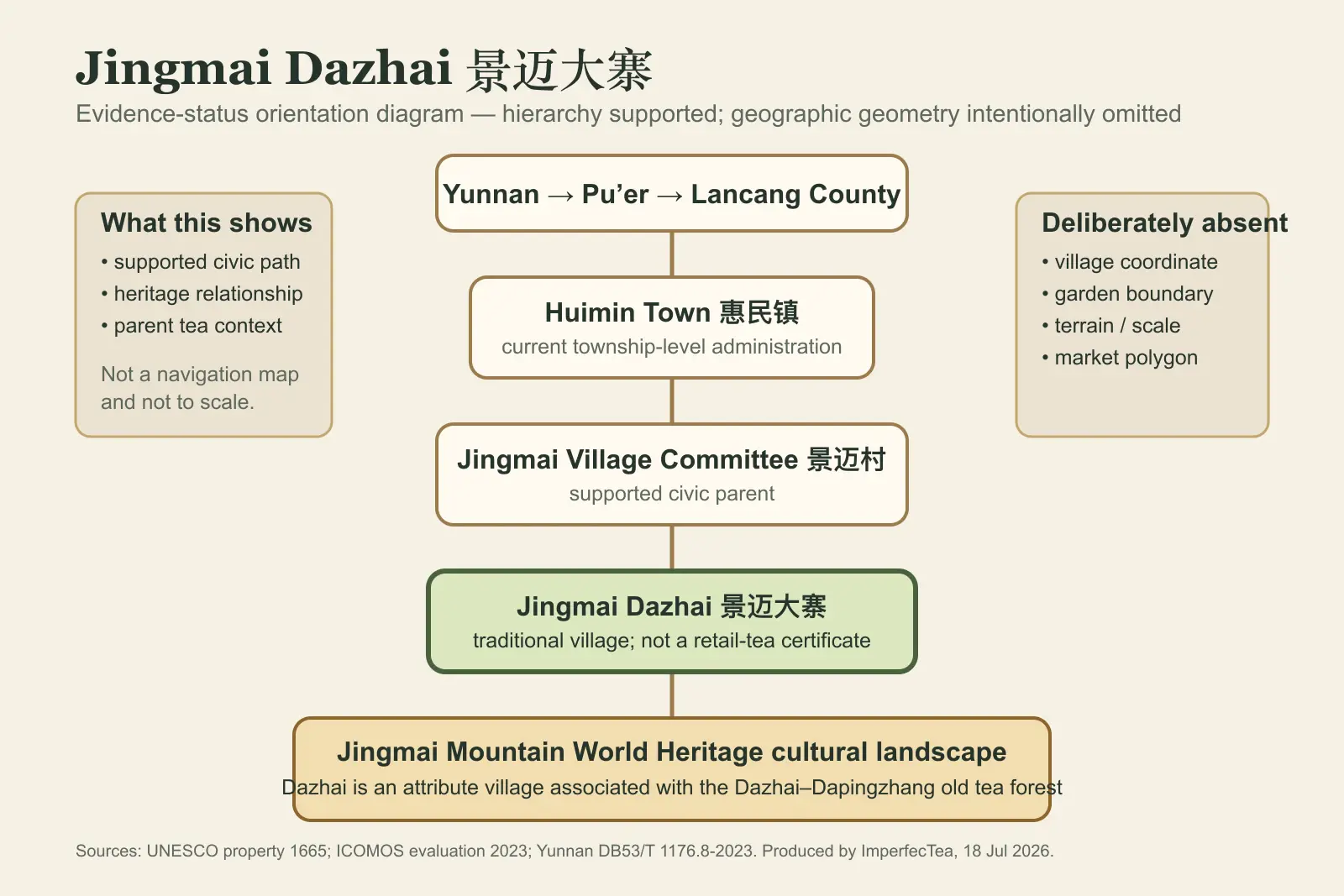
Place relationship diagram notes and sources
Diagram status: The administrative path and Jingmai Dazhai's status as a named World Heritage traditional village are supported. No reusable authoritative geometry or independently verified village/garden coordinate was obtained for this pass; the original diagram is not to scale.
- UNESCO World Heritage property 1665 and ICOMOS evaluation
- Yunnan DB53/T 1176.8-2023 administrative-village standard
What can Jingmai Dazhai taste like without turning heritage into proof?
Jingmai Dazhai (景迈大寨, Jǐngmài Dàzhài) is one of the named traditional villages in UNESCO’s 2023 Cultural Landscape of Old Tea Forests of the Jingmai Mountain in Pu’er. Its associated old-tea-forest cluster is called Jingmai Dazhai and Dapingzhang in the ICOMOS evaluation. That makes it an unusually well documented place in the Jingmai story: a village, forest and community land-use system inside a defined heritage property.
It does not make every tea sold as “Jingmai Dazhai” authenticated, ancient-tree, organic, single-garden, or uniformly floral. The World Heritage inscription recognizes a cultural landscape and its living management, not individual cakes. Nor is “Jingmai” a precise retail appellation: sellers can mean the mountain, the UNESCO property, its buffer, a village committee, a forest, or a broader market blend. A useful Dazhai label should therefore lead to questions about garden, household, season, processing and storage, not stop the conversation.
Finding it on the map
A village inside several overlapping maps
The reliable administrative backbone is Huimin Town → Jingmai Village Committee in Lancang Lahu Autonomous County, Pu’er City. The provincial administrative-village standard supports that current upper path. UNESCO and ICOMOS then identify Jingmai Dazhai as a traditional village inside the World Heritage property, alongside its Dapingzhang old-tea-forest area. The village is therefore not simply a poetic merchant invention.
But those true statements have different boundaries. The inscribed property is 7,167.89 hectares, with an 11,927.85-hectare buffer; it contains five old-tea-forest clusters, nine traditional villages and three protective partition forests. Those fixed heritage zones are not the same thing as the Jingmai Village Committee, the broader municipal protection landscape, or every tea sold under Jingmai’s name. The public map here is deliberately an original evidence-status diagram rather than a faux terrain map. This pass did not locate reusable authoritative property geometry, a licensed base map, an independently verified Dazhai coordinate, or a surveyed Dazhai tea-garden boundary. It is not to scale and should not be used for navigation.
That restraint matters. A pin on a village does not identify every family’s garden, while a crisp polygon copied from a seller’s map would imply a precision that the evidence does not support. Until an authorized map package can be assembled, the hierarchy itself is the honest orientation tool: Dazhai is narrower than Jingmai Mountain, and heritage-property membership is narrower than a broad Jingmai market claim.
What might show up in the cup
A Jingmai clue, not a Dazhai guarantee
No documented ImperfecTea Dazhai tasting session, and no multi-producer Dazhai set meeting the guide’s minimum evidence basis, was available during this review. It would be false precision to announce a fixed Dazhai profile for bitterness, body, orchid aroma or cha qi (a subjective body/energy experience). A vendor’s cup note is evidence about that lot, not automatically the village.
The wider Jingmai evidence supplies a careful starting hypothesis. A 2026 aroma study of samples described as Jingmai ancient-arbor Pu’er found aroma-active compounds including linalool, beta-ionone and methyl salicylate; it does not establish the origin of a retail cake or represent every Jingmai village. Independent and specialist tasting records for different Jingmai lots repeatedly mention flowers, honey, citrus or fruit, alongside variable bitterness, astringency and returning sweetness. Those recurrences make floral-to-honeyed aromatics worth looking for in a transparently sourced Dazhai tea, but they do not authenticate it.
There is now one useful attributed local-market observation, rather than an independent profile: tea writer Ke Feng’s producer-hosted note for Yunque Manor’s own 2022 spring Dazhai cake describes orchid and honey aromas, a little initial astringency, and a strong sweet return across many infusions. The same source identifies the exact product, season, 200 g format and asking price. That specificity makes it a helpful lot record and a concrete prompt for a side-by-side tasting; its producer affiliation means it must not be averaged into a Dazhai fingerprint or market price.
Taste a declared Dazhai tea in separate dimensions:
- Aroma: floral, honeyed, citrus, herbaceous, woody, smoky or storage-derived notes. Record them before and after the rinse.
- Taste and bitterness: note bitterness in the liquid separately from sweetness returning after swallowing. Does it clear, or does the cup simply become thin?
- Texture and astringency: silky, oily, coarse or watery texture is not the same as mouth-drying grip; watch both through later infusions.
- Huigan and shengjin: returning sweetness and salivation may be pleasurable but do not prove a village address.
- Finish, stamina and body sensation: record throat finish and the last flavorful infusion. Warming, cooling or stimulation remains personal experience, not geographic evidence.
Young raw pu-erh is especially vulnerable to non-place variables. Smoke, scorched leaf, excessive greenness, oxidation before heating, compression and storage can alter aroma, bitterness and apparent body enough to be mistaken for terroir.
Which village and forest relationships matter?
Jingmai Dazhai 景迈大寨
In Chinese, 大寨 means “large village” or “main stockaded village”; it is a descriptive village name, not a grade. ICOMOS lists Jingmai Dazhai among the nine traditional villages that carry the property’s heritage attributes and pairs it with the Dapingzhang old tea forest. The latter should not be inflated into a tenth village or silently treated as a product brand. The community identified for this Jingmai-side village in the evaluation is Dai; that cultural context deserves respect, but it is not a certificate of tea purity or ownership for any particular seller.
The property’s land-use system helps explain why a simple village-name profile is inadequate. Old tea forests, protective forests, tea plantations, village sites and water/field uses form a managed landscape. An individual purchase can still be a household collection, an ecological-garden tea, a blend from several places, or leaf processed elsewhere. A precise Dazhai claim needs the chain of custody to be equally precise.
The parent: Jingmai Mountain 景迈山
Jingmai Mountain is the correct parent tea name, but it is not a single homogeneous estate. The heritage property includes Dazhai, Manggeng, Mengben, Nuogang, Mangjing Shangzhai, Mangjing Xiazhai, Manghong, Wengji and Wengwa among its traditional-village attributes. Five forest clusters and both Dai and Blang community contexts sit within that landscape. Commercial “Jingmai” can be still broader. A Dazhai label is therefore a narrower claim than a Jingmai label, yet it still needs garden and production evidence before it becomes a single-origin claim.
Comparisons that do not flatten the mountain
Compare a declared Dazhai tea first with a transparently sourced broader Jingmai tea, then with a named Mangjing-side or Wengji lot disclosed to the same standard. This makes the source record part of the tasting rather than treating heritage villages as fixed flavor categories. For an outside comparison, choose one raw tea from another documented mountain and match harvest year, storage and brewing as closely as possible. The aim is to notice variation, not to turn one vendor’s ranking into a geographic law.
Which geographic facts separate village, forest and heritage property?
| Reader-facing name | Jingmai Dazhai |
| Chinese and pinyin | 景迈大寨, Jǐngmài Dàzhài |
| Wrapper/search spellings | Jingmai Da Zhai, Jingmai Dazhai Village; traditional 景邁大寨 |
| Geographic type | Traditional village and associated old-tea-forest cluster, not a statutory tea grade |
| Current civic path | Yunnan → Pu’er City → Lancang Lahu Autonomous County → Huimin Town → Jingmai Village Committee |
| Parent tea name | Jingmai Mountain / 景迈山, a cultural-landscape and tea-market umbrella |
| Heritage relationship | One of nine traditional villages identified as attributes of World Heritage property 1665 |
| Associated forest | Jingmai Dazhai and Dapingzhang old tea forest; Dapingzhang is a forest area, not an additional village |
| Map status | Original hierarchy diagram only; no surveyed village/garden point or reusable property geometry used |
| Elevation / climate | The heritage property is reported at about 1,250 to 1,500 m with subtropical mountain-monsoon conditions; no Dazhai garden range was verified |
| Plant material / tree ages | Old-tea-forest system documented at landscape scale; no individual Dazhai lot or tree-age claim is established here |
| Flavor shorthand | No supported village fingerprint; broader Jingmai samples often report floral, honey or citrus-like notes but vary materially |
| Price | Not published: no pair of comparable, dated, normalized Dazhai observations found |
| Confidence | Supported for identity, civic path, heritage role and landscape context; incomplete for lot provenance, map geometry and village-specific tasting |
| Last researched | 18 July 2026 |
Terroir: a managed forest, not a flavor machine
UNESCO describes the landscape as an organically evolved production system developed by Blang and Dai peoples over more than a millennium, with old tea groves, plantations, forests and traditional villages. ICOMOS reports a property-wide elevation range of roughly 1,250 to 1,500 metres and a subtropical mountain-monsoon setting. Its account of understorey cultivation and complementary land use supports a meaningful ecological context for Dazhai.
The limits matter just as much. I found no published representative Dazhai plot series for garden elevation, slope, aspect, rainfall, soil texture/chemistry, shade, cultivar, planting density or inputs. Nor does the landscape’s reported old-tree population establish the age of a leaf in a cake. “Ancient,” “arbor,” “ecological” and “organic” are different claims, each requiring lot-level evidence or certification where relevant.
The sensible mechanism is conditional: shade, moisture, plant population, leaf maturity and human care may influence leaf growth and the raw material available to a maker. They do not by themselves prove that soil creates a mineral taste, that higher is better, or that every old tree tastes superior. Forest management and household knowledge are part of place, but they cannot be reverse-engineered from an attractive wrapper.
What the place can tell us, and what it cannot
We can say Dazhai belongs to a documented old-tea-forest cultural landscape and has a supported relationship to the Jingmai Dazhai and Dapingzhang cluster. We can say forest, old tea groves, villages and community governance are interdependent at the property scale. We cannot isolate a Dazhai soil, altitude, tree age or community identity as the cause of a particular cup without plot-level and lot-level evidence.
How do processing, season and storage change the leaf?
For raw pu-erh, fresh leaves are typically withered, heated to curb enzymatic change, rolled and sun-dried into maocha; they may later be sorted, blended, steamed and compressed. ICOMOS records spring, summer and autumn hand-picking in the property context, while a 2025 provincial report emphasizes spring/autumn picking with summer rest. These are not necessarily contradictory, but their exact scope has not been clarified for Dazhai; they should not be converted into a universal village harvest calendar.
Ask who processed the leaf, whether it was blended, when it was pressed and how it was stored. Slow or uneven heating can bring redder/oxidized notes; overly hard heating can mute fragrance; smoke and damp drying can travel into the cup. A tea stored for years may gain woodier, sweeter or drier notes that reveal more about storage than its village. Good processing can make a transparent Dazhai lot easier to compare; it cannot manufacture provenance.
Which history and community context explain the tea?
The 2023 inscription is the key recent date, but it represents a much longer living landscape rather than an end point. The ICOMOS evaluation links the system’s understorey tea cultivation traditions to Blang communities and later Dai participation, and frames community governance and Tea Ancestor belief as part of landscape management. These are cultural and historical accounts at landscape scale, not evidence that every household follows identical practices or that spirituality proves a retail tea’s origin.
Heritage protection also sits beside current pressures. UNESCO notes risks from development and tourism; official contemporary reporting describes monitoring, care teams, cooperatives, visitors, hospitality and evolving livelihoods. Dazhai should be read as a community where people manage land and make economic decisions in the present, not as a museum backdrop for premium pricing.
The local work behind that landscape is more specific than a heritage label suggests. A Farmers’ Daily report names a Jingmai Dazhai resident, Yuegong, and describes post-spring-pick work in her family’s old tea forest: clearing vines, removing moss or other growth on bark, and pruning dead branches. A separate field-reporting project records Dazhai grower Dao Yanhong describing weeding and branch work without fertilizer or pesticides, and the spring sequence of checking picked leaf, withering it and beginning processing later in the day. These are reported household practices, not a certification that every garden uses the same method; they are nevertheless better evidence of lived management than generic “ancient-tree” marketing.
Shopping with clear eyes
Look for 景迈大寨, Jingmai Dazhai or Jingmai Da Zhai. Spacing and romanization do not establish provenance. “World Heritage” on a package likewise does not certify the leaf, tree age or garden location. A responsible seller should be able to answer:
- Which household, forest or garden supplied the leaf, and is it inside the claimed village context?
- What are the harvest date, season and picking standard?
- Was maocha kept separate from buying through processing, compression and packing, or blended?
- Who performed the kill-green and sun-drying, and where?
- What exactly is meant by old tree, arbor or ecological, and what evidence supports it?
- When was it pressed, and how has it been stored?
No price range is given here because two comparable dated observations, same unit, form, season, claimed material and transaction context, were not found. A single premium dealer listing is an asking price, not a Dazhai market. If the answers above are vague, a well documented broad Jingmai tea may be better value than an expensive village name. That is an evidence decision, not a judgment on Dazhai.
Brew it and compare notes
Start with 5 to 6 g per 100 ml in a gaiwan or small pot, water close to boiling and short early infusions. Keep water, vessel, leaf ratio and timing stable across a flight. If a young raw tea turns punishingly bitter, shorten contact before changing water temperature; if aroma is quiet, lengthen later infusions rather than assuming weak leaf.
Try three teas: a transparently declared Jingmai Dazhai lot, a broad Jingmai tea with clear sourcing, and one named Jingmai village or external mountain tea with comparable harvest and storage disclosure. Taste once with labels hidden, then read the source records. Note aroma, bitterness, astringency, texture, huigan, finish and stamina. The exercise tests whether the narrow claim predicts something beyond the maker and lot.
What should you remember over your next cup?
- Jingmai Dazhai (景迈大寨) is a documented traditional village under Jingmai Village Committee in Huimin Town, Lancang.
- It is one of the nine traditional-village attributes in Jingmai Mountain’s World Heritage property and is associated with the Jingmai Dazhai and Dapingzhang old tea forest.
- The World Heritage landscape, the administrative village, and a commercial Jingmai/Dazhai label are overlapping but non-identical scopes.
- No verified Dazhai garden boundary, reusable map geometry, village-specific tasting set or normalized price series was found in this review.
- The best buying tool is a traceability conversation covering garden, household, harvest, processing, blending and storage.
Where this guide comes from
Research was completed 18 July 2026. The primary basis for the identity, village/forest pairing, property composition, physical setting and cultural-landscape distinction is the ICOMOS evaluation, read alongside UNESCO property 1665 and the World Heritage Committee decision. The current civic path is supported by the Yunnan administrative-village standard. The 2026 Jingmai aroma study and limited specialist tasting records are context for a wider Jingmai hypothesis, not a Dazhai authentication test.
This second pass also records three Chinese-language sources at their appropriate weight: a named Dazhai household-practice account in Farmers’ Daily; a field-reporting project with named Dazhai growers in Red Star News’ COP15 feature; and Ke Feng’s Yunque Manor product note. The first two improve reported lived-practice context. The latter is a clearly producer-affiliated, dated lot claim, useful for a stated sample, never for verifying geography, tree age or a general price range.
The original map uses no third-party basemap, photo, coordinates or copied property geometry, and is an orientation diagram rather than a geographic map. No Dazhai-specific multi-producer tasting set, plot-level ecology survey, individual-tree age method or normalized price observations were found.
Quick answers
Frequently asked questions
What does the Jingmai Dazhai tea name identify?
A traditional village under Jingmai Village Committee, Huimin Town, Lancang County, within the Jingmai Mountain World Heritage cultural landscape. Its most useful identity is traditional village and associated old-tea-forest cluster, so the name alone does not guarantee a particular garden, tree age or quality level.
What does Jingmai Dazhai tea taste like?
Broader Jingmai evidence suggests flowers, honey or citrus with variable bitterness and sweet return; no independent multi-producer set supports a Dazhai-only fingerprint. Use that profile as a tasting guide, not as proof of origin.
What is Jingmai Dazhai commonly confused with?
Jingmai Dazhai village, Dapingzhang forest, the UNESCO property and a broad Jingmai market label are not the same provenance claim.
What should I ask before buying Jingmai Dazhai tea?
Start with: Which Dazhai garden, household, season and maker produced this lot? Also ask for the harvest year and season, producer or household, processing details and storage history.