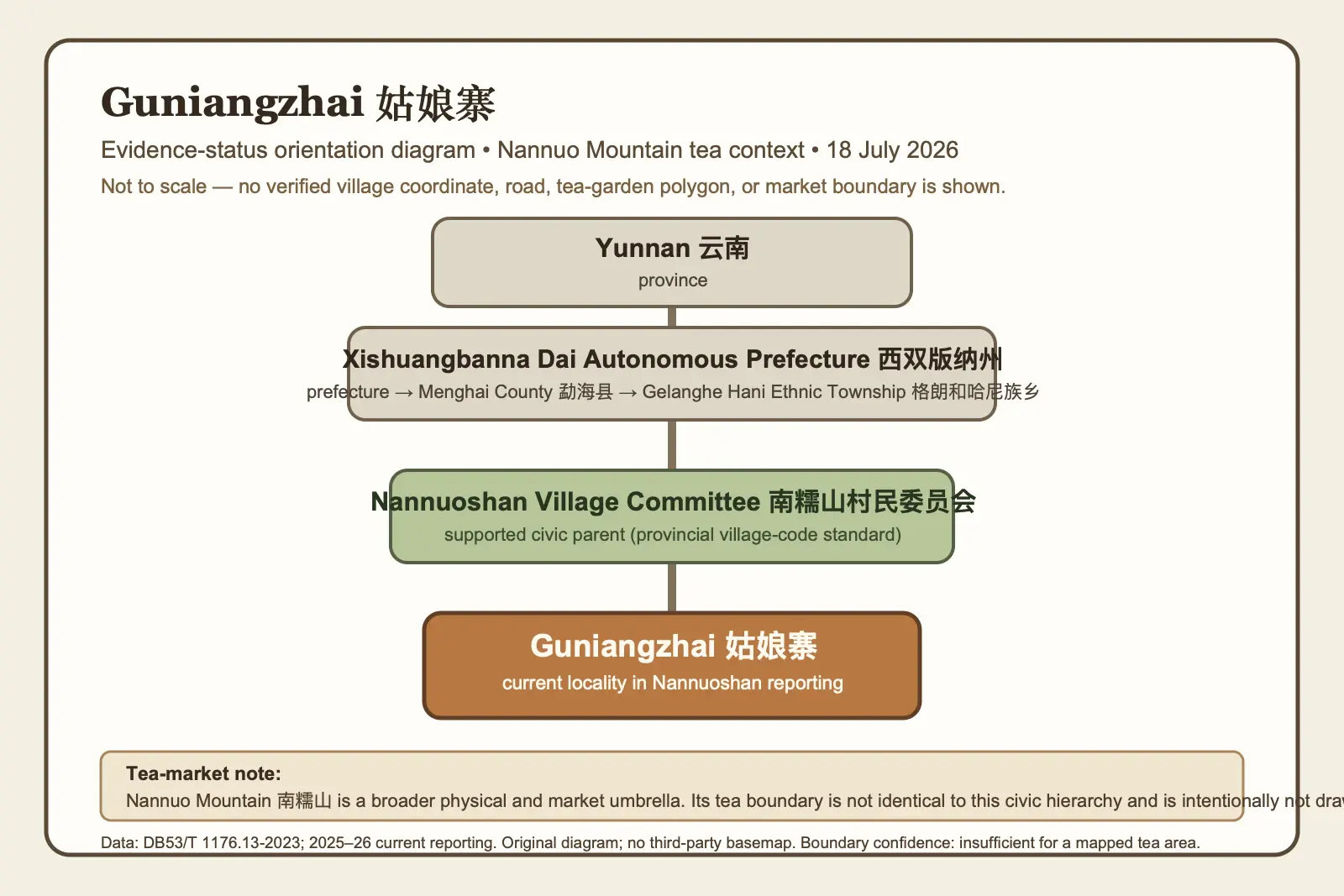
Place relationship diagram notes and sources
Diagram status: The hierarchy through Nannuoshan Village Committee and the current Guniangzhai locality are supported. No licensed base map, surveyed locality coordinate, or authoritative Guniangzhai tea-garden boundary was found; the diagram is not to scale.
- Yunnan provincial village-code standard DB53/T 1176.13-2023
- Yunnan/Xishuangbanna reporting (2025)
- Songjiang District People's Government reporting (2025–26)
What can Guniangzhai taste like, and what remains unverified?
Guniangzhai (姑娘寨, Gūniángzhài) is a real, current village locality in the Nannuo Mountain conversation, not a generic romantic name printed on a cake. The clearest administrative path runs through Gelanghe Hani Ethnic Township → Nannuoshan Village Committee in Menghai County, while current provincial and local-government reporting specifically places activity in Guniangzhai. Tea, visitors and small hospitality businesses are part of that present-day setting.
That is meaningful, but it is not a finished terroir claim. The evidence located during this review does not establish a surveyed Guniangzhai tea boundary, public coordinate, representative garden elevation, cultivar inventory, tree-age method, or a controlled set of village-specific tastings. A seller may use the village name accurately, broadly, aspirationally, or without enough chain-of-custody detail for a buyer to tell. The useful lesson is to treat Guniangzhai as a narrower Nannuo locality worth asking about, not as a guaranteed floral, ancient-tree, or single-garden style.
Finding it on the map
Start with the hierarchy, not a pin
The provincial administrative-village standard gives the dependable backbone: Menghai County → Gelanghe Hani Ethnic Township → Nannuoshan Village Committee. It does not list every natural village or tea garden. A 2025 Xishuangbanna report and 2025 to 2026 Songjiang government reporting then place Guniangzhai within the current Nannuo Mountain village setting. Together, those sources support the parent relationship used here.
They do not license a more precise map. No independently verified coordinate with provenance, current lower-level boundary, declared coordinate system, or public tea-garden polygon was found. The diagram above is consequently not a locator map: it is an original, not-to-scale evidence-status graphic. It makes one important distinction visible. Nannuo Mountain is a larger physical, cultural and tea-market umbrella; the civic hierarchy is a separate thing; and Guniangzhai is a narrower locality inside that context. None of those labels automatically traces the edge of a tea lot.
This restraint is useful to buyers. A map pin at a homestead would not locate all gardens associated with it. A hard outline copied from a merchant graphic would falsely suggest a surveyed appellation. Until reliable geometry is available, it is more honest to say what the sources establish than to make an attractive but misleading terrain map.
What might show up in the cup
The responsible answer is: not yet a Guniangzhai profile
No documented ImperfecTea session, and no multi-producer Guniangzhai tasting set that meets the guide’s minimum basis, was found in this review. The page therefore does not convert a reseller’s notes into village character. Claims such as honey aroma, a thick texture, strong astringency, rapid huigan (returning sweetness), or a particular “cha qi” should be read as observations about a named product unless the producer, season, garden/material, brewing and storage are disclosed.
The broader Nannuo record is still a good reason to taste carefully. TeaDB’s month-long 2014 exercise included commercial teas sold as Nannuo, Banpo Laozhai and Bama. The samples varied from fragrant and sweet-edged to bitter, drying, thin or forceful. It was not a controlled geographic study: years, makers, storage and commercial provenance differed. Its value here is negative as well as positive, it shows why one cannot lift “soft Nannuo” and paste it onto Guniangzhai.
For a genuinely declared Guniangzhai tea, record these dimensions instead of looking for confirmation of a canned story:
- Aroma: flowers, honey, fruit, vegetation, roast or storage notes, before and after the rinse.
- Taste: separate bitterness from sweetness in the liquid; note whether bitterness clears or merely weakens as the brew thins.
- Texture: watery, silky, oily, dense or rough; check whether body survives after the aroma fades.
- Astringency: mouth-drying grip is not the same as bitterness and may accumulate later in the session.
- Huigan and shengjin: distinguish returning sweetness from salivation; neither proves origin.
- Finish and stamina: note what remains after swallowing and the last infusion with meaningful aroma, texture and finish.
- Body sensation: warmth, cooling or stimulation are personal reports, not geographic evidence.
This is a more demanding way to taste, but it turns an uncertain label into useful evidence for your own comparison notebook.
Which Nannuo comparisons make Guniangzhai useful?
Guniangzhai 姑娘寨
The village name is normally romanized Guniangzhai; spacing it as Guniang Zhai is a search or wrapper variation rather than a different confirmed place. Literally, the characters can be glossed as “young woman/girl” (姑娘) and “stockaded settlement/village” (寨). A secondary historical profile reports an oral account that calls it an earlier “Old Village” and links the later name to a woman called Api Yule. A 2023 Chinese tea-community profile repeats the same broad Hani-settlement and Api Yule story. That agreement makes the story worth recording as local oral history, but neither source establishes a date, a primary narrator, or an official etymology. It belongs in the “reported” column, not in a package of sales certainty.
The stronger contemporary evidence is practical. A 2025 provincial report describes Guniangzhai amid tea gardens and visitors, and government reporting from 2025 to 2026 records village improvement and tea/forest/cultural-tourism activity. Tea is therefore part of the locality’s living economy, not merely historical scenery. That does not make every family a tea producer, every garden old, or every product a single-village lot.
The parent: Nannuo Mountain 南糯山
Nannuo is the right comparison frame because it is the broader mountain and tea-market umbrella that contextualizes a Guniangzhai claim. It contains multiple settlements, garden histories and production decisions. Banpo Laozhai, Shitou Xinzhai and Guniangzhai are well-supported locality anchors in current research; other names circulate with less certain present-day rank. A Nannuo blend, a Guniangzhai household lot and a single-garden lot make progressively narrower claims. The label should become more specific only when the evidence does.
Relevant neighbors: compare claims before profiles
Pasha and Bulang are useful nearby tea-market comparison names, but neither is a synonym for Nannuo and their own internal hierarchies need to be read on their own terms. Since no defensible Guniangzhai sensory record exists, it would be false precision to rank its bitterness or sweetness against either. A better flight is one transparent broad Nannuo tea, one clearly documented Guniangzhai tea if available, and one Pasha or Bulang tea with equal harvest/storage disclosure. The exercise tests labels and maker decisions, not a fantasy of fixed mountain flavors.
Which geographic facts keep Guniangzhai inside Nannuo?
| Reader-facing name | Guniangzhai |
| Chinese and pinyin | 姑娘寨, Gūniángzhài |
| Common spellings | Guniang Zhai, Gu Niang Zhai, Guniang Village |
| Region family | Commonly grouped with the New Six Tea Mountains; a tea-market/history convention rather than a statutory appellation |
| Current civic path | Yunnan → Xishuangbanna Dai Autonomous Prefecture → Menghai County → Gelanghe Hani Ethnic Township → Nannuoshan Village Committee |
| Geographic type | Current village locality in Nannuo reporting; exact controlled natural-village rank remains unverified |
| Parent tea name | Nannuo Mountain / 南糯山, a broader mountain and market umbrella |
| Map status | Original hierarchy diagram only; no verified coordinate, licensed base map, or tea-area boundary |
| Tea-garden elevation | Not established by a representative village garden survey |
| Climate / ecology | No representative Guniangzhai series or plot survey found |
| Plant material / tree ages | Not established at village level; retail claims require lot-level evidence |
| Harvests and processing | Tea activity is current; a village-wide harvest calendar or processing style was not verified |
| Flavor shorthand | Not published as a village fingerprint; broad Nannuo examples vary materially |
| Price | Not published: two comparable, dated, normalized observations were not found |
| Confidence | Supported for upper hierarchy and current locality context; incomplete for terroir and provenance |
| Last researched | 18 July 2026 |
What might shape the cup
Measured information versus a plausible mechanism
Tea gardens around Nannuo are repeatedly described in current reporting, and tea/forest tourism is part of Guniangzhai’s contemporary story. That supports a lived landscape, not a quantified environmental profile. No representative Guniangzhai garden dataset was located for elevation, slope, aspect, rainfall, humidity, soil texture, soil chemistry, canopy, watershed, cultivar, planting density or inputs. The article therefore deliberately gives no borrowed number from a Nannuo summit, road sign or vendor page.
It is reasonable to say that slope position, shade, rainfall timing, drainage, plant population and human management can affect leaf growth and therefore a cup. Those are mechanisms, not proof that a Guniangzhai tea must be sweeter, more mineral, more fragrant or more powerful. “Ancient tree” requires the same caution: a large tree, a local oral history or an expensive wrapper is not a transparent age method, and a village label does not show whether material was kept separate.
What local tea writers report, and what that can support
Chinese tea-community writing gives a more textured account than the official reports, but it must stay attributed. A 2023 profile published under the byline 大嘴吃天下 describes tea gardens, bamboo-tube tea hospitality, and a cup with honey-like aroma, initial bitterness/astringency and a lasting return sweetness. A specialist producer’s Nannuo overview likewise lists 姑娘寨 among the Nannuo settlements it regards as notable for old-tree tea. These are useful leads for a buyer and a reason to ask a producer what they mean by “姑娘寨,” not independent proof that every garden shares the same age, acreage, elevation, or flavor.
In other words, “honey aroma,” “full body,” or “quick huigan” can be recorded as a named Chinese tea-community writer’s product-facing observation. They cannot yet become the site’s village fingerprint. If you buy a tea with those descriptors, compare it against the declared season, material, processing and storage, and write down whether the cup actually bears them out.
Human work is part of place
Fresh leaf is not finished tea. Time between picking and heating, wok load, kill-green heat, rolling, sun-drying, sorting, blending and compression can reshape bitterness, aroma and durability. Delayed heating can produce redder/oxidized notes; excessive heat can flatten aroma; smoky or damp drying can later be mistaken for regional character. Storage adds another layer. A cake’s village name cannot reverse-engineer those decisions.
Gelanghe is a Hani ethnic township, and contemporary reports show local people participating in tea and visitor economies. That identity deserves accurate, present-tense description, not use as a romantic proof of purity, a fixed taste, or an ownership claim.
What the place can tell us, and what it cannot
We can say Guniangzhai sits in a tea-active Nannuo locality where landscape, agriculture and visitor activity meet. We can plausibly expect individual gardens and processing choices to vary. We cannot isolate soil, elevation, forest cover, genetics or tree age as causes of a particular Guniangzhai flavor, because the necessary plot and tasting evidence has not been published here.
How do processing, season and storage change the leaf?
Raw pu-erh is the relevant processing context for this guide. In general, picked leaf is rested, heated to arrest most enzymatic change, rolled and sun-dried into maocha; it may later be sorted, blended, steamed and compressed. That workflow is explanatory context, not a verified Guniangzhai house style.
Ask whether the tea is spring, rain-season or autumn material and whether it is a single garden, household collection or blend. Ask who processed it, when it was pressed, and how it was stored. A very green, smoky, sour, aggressively bitter or prematurely flat cup may reflect processing, compression or storage as much as origin. Older tea compounds the problem: time and storage can create roundness, woodiness or dryness that cannot reliably recover a village address.
Which history and community context explain the tea?
The 2019 secondary village-history account presents Guniangzhai as a founding/older-settlement point in a network of later Nannuo village histories. Treat that as reported oral-history material rather than a dated administrative fact. What is better supported is the current chapter: official reporting describes investment in a 2024 village revitalization project and the growth of tea-linked tourism, hosting and cultural activity through 2025 to 2026.
That contemporary change matters for tea. Roads, visitor demand, accommodation and direct sales can improve opportunity while also changing how land, labor and local names are marketed. Buyers should see a village name as connected to residents and businesses making choices now, not as a sealed historical essence.
Shopping with clear eyes
Look for 姑娘寨, Guniangzhai, Guniang Zhai, or Gu Niang Zhai on a wrapper. The spelling change alone does not prove or disprove anything. Because the name is narrower than Nannuo but lacks a published surveyed tea boundary, request a description that matches the premium:
- Who supplied the leaf and which garden or household is claimed?
- What was the harvest date and season?
- Was material separated from purchase through maocha, compression and packaging?
- Who processed it, and was it blended with other gardens or villages?
- What tree/garden claim is being made, and how was age or garden status assessed?
- When was the cake pressed, and what is the storage history?
No current price band is given here. Two comparable, dated observations, same unit, product form, season, claimed material and transaction context, were not found. A single dealer’s price is an asking price, not a village market. If the answer to the sourcing questions is vague, a transparently sourced broad Nannuo tea is often the better value than a costly Guniangzhai label. That is not a verdict on the village; it is a verdict on evidence.
Brew it and compare notes
Start with 5 to 6 g per 100 ml in a small gaiwan or pot, near-boiling water, a brief rinse only if the tea needs it, and short first infusions. Keep one variable at a time: use the same water, vessel, leaf ratio and timing across the flight. If bitterness becomes punishing, reduce contact time before lowering temperature; if aroma seems muted, lengthen later steeps rather than assuming weak material.
Try a three-tea flight: a transparent Guniangzhai declaration, a transparent broad Nannuo tea, and a declared Pasha or Bulang tea. Record labels before tasting, then hide them for a second pass. Compare aroma, bitterness, astringency, texture, returning sweetness, finish and stamina. Afterward, compare the sourcing information. The point is not to crown a winner; it is to learn whether the narrow name predicts anything beyond the maker and lot.
What should you remember over your next cup?
- Guniangzhai (姑娘寨) is a supported current locality under the Nannuoshan Village Committee context in Gelanghe, Menghai.
- Nannuo is the broader mountain and tea-market umbrella; a Guniangzhai label is a narrower claim, not a surveyed appellation.
- No verified village coordinate, map boundary, garden survey, tree-age method, tasting set or normalized price range was found.
- The most useful buying tool is a chain-of-custody conversation: garden, household, harvest, processing, blend and storage.
- This guide suits readers who prefer honest uncertainty to a polished but unsupported flavor legend.
Where this guide comes from
Research was completed 18 July 2026. The hierarchy through Nannuoshan Village Committee is based on the Yunnan provincial village-code standard. Current Guniangzhai context is corroborated by Yunnan/Xishuangbanna reporting, Songjiang’s 2025 report, and its 2026 project report. The name story comes only from a secondary historical profile and remains reported. A Chinese tea-community profile adds attributed local-history and tasting language, while a specialist producer’s Nannuo overview supports only the limited point that Guniangzhai is a recognized tea-community name. Broad Nannuo variation is illustrated, not proven for this village, by TeaDB’s 2014 tasting report.
The original map uses no third-party basemap, photo, coordinates or copied geometry. It is a hierarchy diagram rather than a geographic map. No verified point, licensed boundary, village-specific multi-producer tasting set, environmental survey, tree-age method or normalized price observations were found.
Quick answers
Frequently asked questions
What does the Guniangzhai tea name identify?
A current village locality beneath Nannuoshan Village Committee in Gelanghe Hani Ethnic Township, Menghai County; its exact controlled natural-village rank remains unverified. Its most useful identity is village locality and narrow commercial origin, so the name alone does not guarantee a particular garden, tree age or quality level.
What does Guniangzhai tea taste like?
No village fingerprint is supported; broader Nannuo teas can be floral, sweet, bitter, drying or textured, so a Guniangzhai lot needs disclosed sample provenance. Use that profile as a tasting guide, not as proof of origin.
What is Guniangzhai commonly confused with?
Guniangzhai is one locality within Nannuoshan, not a synonym for the whole mountain or proof of a seller's garden claim.
What should I ask before buying Guniangzhai tea?
Start with: Who made this Guniangzhai lot, from which garden and season? Also ask for the harvest year and season, producer or household, processing details and storage history.