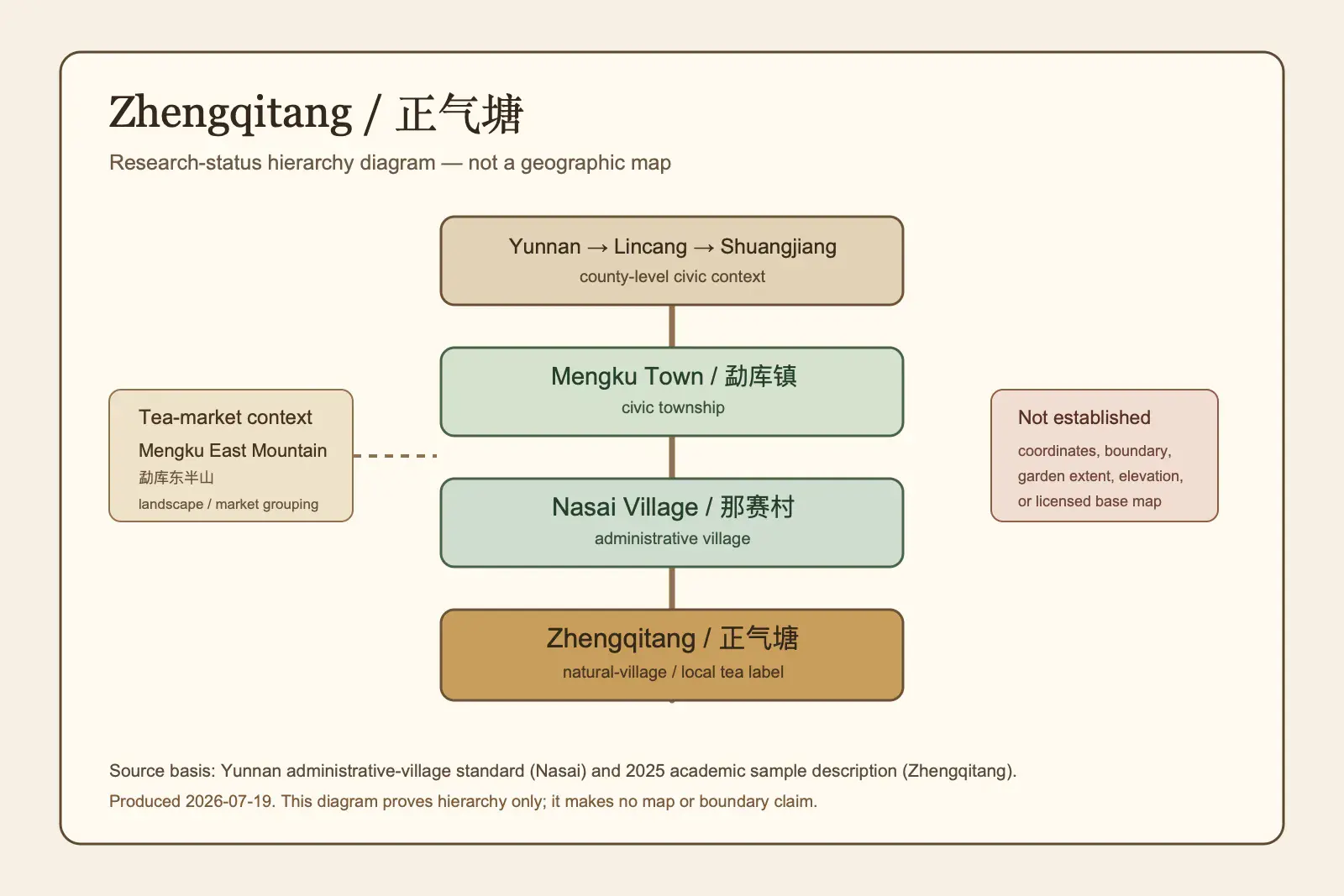
Place relationship diagram notes and sources
Diagram status: Not publication-grade: this first-pass orientation diagram deliberately contains no geographic geometry, coordinates, or boundary claim.
- ImperfecTea first-pass research-status diagram; no reusable geographic-data licence established
What might Zhengqitang tea taste like, and why does its nesting matter?
Zhengqitang (正气塘, Zhèngqìtáng) is a small tea name with a fairly precise address inside Nasai Village (那赛村, Nàsài Village), Mengku Town, Shuangjiang County, Lincang, Yunnan. Sellers often group it with Mengku East Mountain / East Half-Mountain (勐库东半山). That phrase describes a landscape and market area, not an extra civic level between the town and village. A 2025 tea-science paper identifies Zhengqitang as a natural village under the Nasai Village Committee, while Yunnan’s administrative-village standard places Nasai Village under Mengku Town.
Named lots report floral aroma, sweetness, salivation and returning sweetness followed by a bitter or drying edge that clears. These unmatched community accounts support a lot-level tasting hypothesis, not a universal village profile or the nickname “Little Bingdao.”
Think of the names as nested cups. Zhengqitang is a narrower claim than Nasai, while “East Mountain” can be broader than either. Community writers sometimes call Zhengqitang “Little Bingdao,” but that is a market comparison, not an address or a promise about the cup. We have enough evidence for careful orientation and a few attributed tasting observations. We do not yet have a licensed map, a verified garden roster, a tree-age census, a current price range or one universal Zhengqitang flavour profile.
Where is Zhengqitang, and what kind of place is it?
The image above is deliberately a research-status hierarchy diagram, not a geographic map. It does not place Zhengqitang at a coordinate, draw Nasai Village’s boundary, show a road, assign elevation, or imply a tea-garden polygon. Such specificity would need lawful base data, independently checked settlement anchors, a coordinate reference system, a scale and north arrow, bilingual labels, and a visible distinction between an administrative village and a commercial tea area. Those conditions are not established here.
The usable orientation is a hierarchy, not a pseudo-precise pin. The provincial standard lists 那赛村 under 勐库镇. The 2025 paper’s sample description nests 正气塘自然村 under Nasai Village Committee. Mengku East Mountain is a useful site parent because tea people compare the eastern side of Mengku with the western side, but it is not an official district and should never replace Nasai in a civic address.
Search characters as well as Latin spellings. Zhengqitang is sometimes rendered Zheng Qi Tang; Nasai as Na Sai. Do not silently merge it with Najiao / 那蕉 (often 那焦 in commerce), Banuo / 坝糯, Baka / 坝卡, or Bingdao’s five-village cluster. The “Little Bingdao” nickname is a seller/community comparison, not evidence that Zhengqitang belongs to Bingdao or is a substitute by definition.
What to look for in a Zhengqitang cup
The source set supports reported lot descriptions, not a regional law. A 2019 Gu Cha Ju / 网茶会习茶社 note on a 2017 Zhengqitang raw cake reports fresh floral aroma, sweetness, returning sweetness (huigan) and salivation (shengjin), with a later bitter/astringent edge that cleared quickly. A 2022 读茗人 account describes a mailed 2019 sample as floral, sweet and balanced, with a modest drying note and changes through later infusions. A 2024 tea-community account by 老闪的茶 puts Nasai and Zhengqitang in an East-Mountain conversation and explicitly frames its impressions as the writer’s own drinking.
Those accounts are useful because the product, writer and limits can be named. They are not blind, matched or multi-producer; tree claims and storage vary; and none proves that another Zhengqitang tea will taste floral, sweet, thick, cooling or low in bitterness. “Little Bingdao” is particularly unsuitable as a flavour guarantee: it compresses two market stories into one label.
Use an origin claim as a tasting-record prompt:
| Dimension | A useful note |
|---|---|
| Aroma | Record warm-lid, leaf and cooled-cup aroma separately. Floral or honey language belongs to the actual lot unless replicated under comparable conditions. |
| Taste and grip | Note the timing of bitterness and astringency, and whether they clear. Separate a clean grip from rough extraction or poor processing. |
| Sweet return / salivation | Mark when huigan and shengjin arrive rather than treating either as an identity badge. |
| Texture and stamina | Record body, coating and late-steep behaviour, then compare only teas with similar harvest, storage and brewing. |
| Subjective feeling | Cha qi is a personal report, not a measurable village property. |
| Provenance | Keep characters, Nasai/Zhengqitang claim, garden or household, season, maker, material class, blend status, pressing and storage together. |
For a fair flight, use a documented Zhengqitang tea, a Nasai-labelled lot whose natural-village scope is disclosed, a nearby Najiao or Banuo tea, and a broad Mengku control. Keep water, vessel, dose and timing fixed; blind the labels if possible. The result is more useful as a test of supplier specificity than as proof that a village must taste one way.
How does Zhengqitang fit inside Nasai?
The cleanest working model has two layers:
| Name | What it can reasonably mean | What it does not prove |
|---|---|---|
| 那赛村 / Nasai Village | Administrative village under Mengku Town | One natural village, household, garden or processing batch |
| 正气塘 / Zhengqitang | A natural village under Nasai Village Committee and a narrower tea-market label | A civic peer of Nasai, Bingdao membership, or a verified plantation boundary |
| 勐库东半山 / Mengku East Mountain | East-side landscape and tea-market orientation | A statutory administrative area or homogeneous tea profile |
| 小冰岛 / “Little Bingdao” | Community/vendor comparison used in market language | Geographic inclusion in Bingdao, identical sensory character, price or authenticity |
This distinction also helps with product descriptions. “Nasai Zhengqitang” may be a helpful two-level origin statement if the maker can say whether it is a single natural-village lot or a Nasai-area blend. “East Mountain Zhengqitang” is less informative until the actual village and material are documented. A single place word cannot establish tree age, old-tree status, organic practice, cultivar, harvest season, household or garden.
Which local conditions can we connect to the cup?
Chinese tea-community and producer-oriented pieces repeatedly associate Zhengqitang/Nasai with 藤条茶 (téngtiáo chá, vine-pruned tea). This is a management and picking/pruning pattern: it is not a cultivar, age class, organic certificate, or a guarantee that every tea under the label was managed that way. The same sources describe old or ancient trees and large gardens, but they provide neither a consistent boundary nor a measurement method. Those claims remain reported, not verified facts for this guide.
The 2025 paper is useful in a different, narrow way. It used Zhengqitang-origin sun-dried maocha in a standardized ripe-Pu-erh fermentation comparison. That supports the locality relationship and shows that material carrying this origin can enter ripe processing research. It does not prove a raw-tea tasting profile, garden ecology, individual-tree age or an aging forecast: the experiment changed the material through fermentation and was not a Zhengqitang landscape survey.
No source retrieved for this pass establishes a reliable Zhengqitang settlement or garden elevation, soil profile, weather series, forest-cover measure, slope/aspect record, cultivar census, garden boundary, production total, household roster, or tree-age audit. Avoid explanations such as “high elevation makes it sweet” or “minerals make it cooling” unless a future garden-level study and traceable tea provide the missing link.
Where the evidence stops
We can say that Zhengqitang is a specific locality nested within Nasai and commonly marketed in Mengku’s east-side conversation. We can report that named tea writers connect particular lots with floral aroma, sweetness, texture or a clearing grip. We cannot separate those observations from season, picking, processing, material class, age, storage and the writer’s brewing choices. The right conclusion is not that terroir does nothing; it is that the present source set cannot quantify its share.
How can processing, season and storage change the result?
Zhengqitang sources do not establish a uniform raw-tea house style. For sheng Pu-erh, fresh leaf is rested or withered, kill-greened (shāqīng, 杀青), rolled and sun-dried into maocha. It can then be sorted, rested, blended or kept separate, compressed and stored. A smoky, grassy, sour, red-leaf or sharply drying cup may therefore be a processing or storage story rather than a Nasai/Zhengqitang one.
Ask whether a tea is spring, rain-season or autumn material; whether it is a household/garden lot or a broader Nasai blend; and whether it was pressed immediately or later. The 2025 study confirms ripe-Pu-erh experimental use, not a village-wide ripe tradition. No longitudinal Zhengqitang aging study was located. A village name is not an aging guarantee.
How did people and trade shape the Zhengqitang name?
The available first-pass sources establish a present-day tea label and its civic nesting, not a full documented settlement or production timeline. Community accounts can preserve local naming and market comparison, but they do not settle dates, land tenure, garden history or a single cultural story for every household. Those questions remain for a future field-led pass.
How did the market story shape what buyers must ask?
Buy the smallest claim that the seller can document:
- Mengku may be broad regional/material language.
- East Mountain may be a market-side or blend-family term.
- Nasai is an administrative-village claim.
- Zhengqitang is a narrower natural-village/locality claim.
- Household, garden, harvest, maker, maocha separation, pressing and storage are narrower again.
Ask for Chinese characters, the claimed level (Nasai or Zhengqitang), natural-village/garden or household if known, harvest season, material category, processor, blend status, pressing date and storage. Treat “Little Bingdao,” “ancient tree,” “ecological,” “wild” and a high asking price as questions to verify, not provenance records.
No two dated, like-for-like Zhengqitang price observations were located, so this guide publishes no range. Fresh leaf, loose maocha and finished cakes are not the same market; tree claim, season, producer, pressing year and storage all change the comparison. An attributed single seller or farmer price should remain an individual observation until matched with another dated equivalent.
How should you compare Zhengqitang at the tea table?
Start with 7 g per 100 ml in porcelain at 95-100 °C. Keep early steeps quick and record the first point at which bitterness, grip, sweetness and aroma appear. If a young tea turns sharply drying, shorten time before lowering temperature; that helps separate extraction from a persistent late-steep quality.
For a four-tea comparison, use one documented Zhengqitang, one transparent Nasai lot, one Najiao or Banuo reference and one broad Mengku tea. Keep water, dose, vessel and timing fixed. Write down the stated origin depth beside the sensory notes. If the identity record is vague, that uncertainty is part of the result.
What should you remember?
- Zhengqitang / 正气塘 is a natural-village/local tea label under Nasai Village / 那赛村, not an administrative peer of Nasai.
- Mengku East Mountain is a useful landscape-and-market parent, not a government tier or flavour law.
- Named Chinese community tastings describe particular Zhengqitang lots; they do not establish a universal profile.
- “Little Bingdao” is market language, not civic geography or authentication.
- Better buying starts with characters, level of claim, garden/household, season, processor, blend status and storage, not a romantic wrapper phrase.
Sources and research limits
All sources were accessed 19 July 2026. Detailed claim confidence, working translations, conflicts and next-pass tasks are in the accompanying dossier and source log.
- Yunnan DB53/T 1176.9-2023 administrative village and community code standard - official civic placement of Nasai Village under Mengku Town.
- Yang Sirun et al., “Quality Characteristics of Pu-erh Ripe Tea in Lincang Tea Area” (2025) - academic sample description identifies Zhengqitang as a natural village under Nasai Village Committee; limited to standardized ripe processing.
- 荣瑞祥, “How to distinguish Najiao and Zhengqitang tea” (2021) - named tea-specialist comparison and reported local hierarchy; used at reporting level.
- 网茶会习茶社 via 古茶居, “Zhengqitang tasting” (2019) - attributable product-specific tasting, not a regional profile.
- 读茗人, “Zhengqitang evaluation” (2022) - attributable sample note, not independent market evidence.
- 老闪的茶, “Nasai ancient-tree tea” (2024), republished by Baidu Health - Chinese tea-community reporting; personal tasting and price image are not treated as a market range.
Evidence limits: The illustration is deliberately non-geographic. No licensed composite map, controlled multi-producer Zhengqitang tasting series, garden-ecology audit, method-backed tree-age evidence or normalized current price pair was found.
Quick answers
Frequently asked questions
What does the Zhengqitang tea name identify?
Zhengqitang is a natural village under Nasai Village, Mengku Town, Shuangjiang County, Lincang, Yunnan. Its most useful identity is natural village and tea-origin label, so the name alone does not guarantee a particular garden, tree age or quality level.
What does Zhengqitang tea taste like?
Named lots report floral aroma, sweetness, salivation and returning sweetness with a later clearing grip; unmatched community accounts do not establish a village law. Use that profile as a tasting guide, not as proof of origin.
What is Zhengqitang commonly confused with?
Zhengqitang is nested under Nasai and marketed within Mengku East; it is not part of Bingdao despite the nickname 'Little Bingdao.'
What should I ask before buying Zhengqitang tea?
Start with: Is this a single Zhengqitang lot or a broader Nasai blend, and which garden, season and maker support the claim? Also ask for the harvest year and season, producer or household, processing details and storage history.