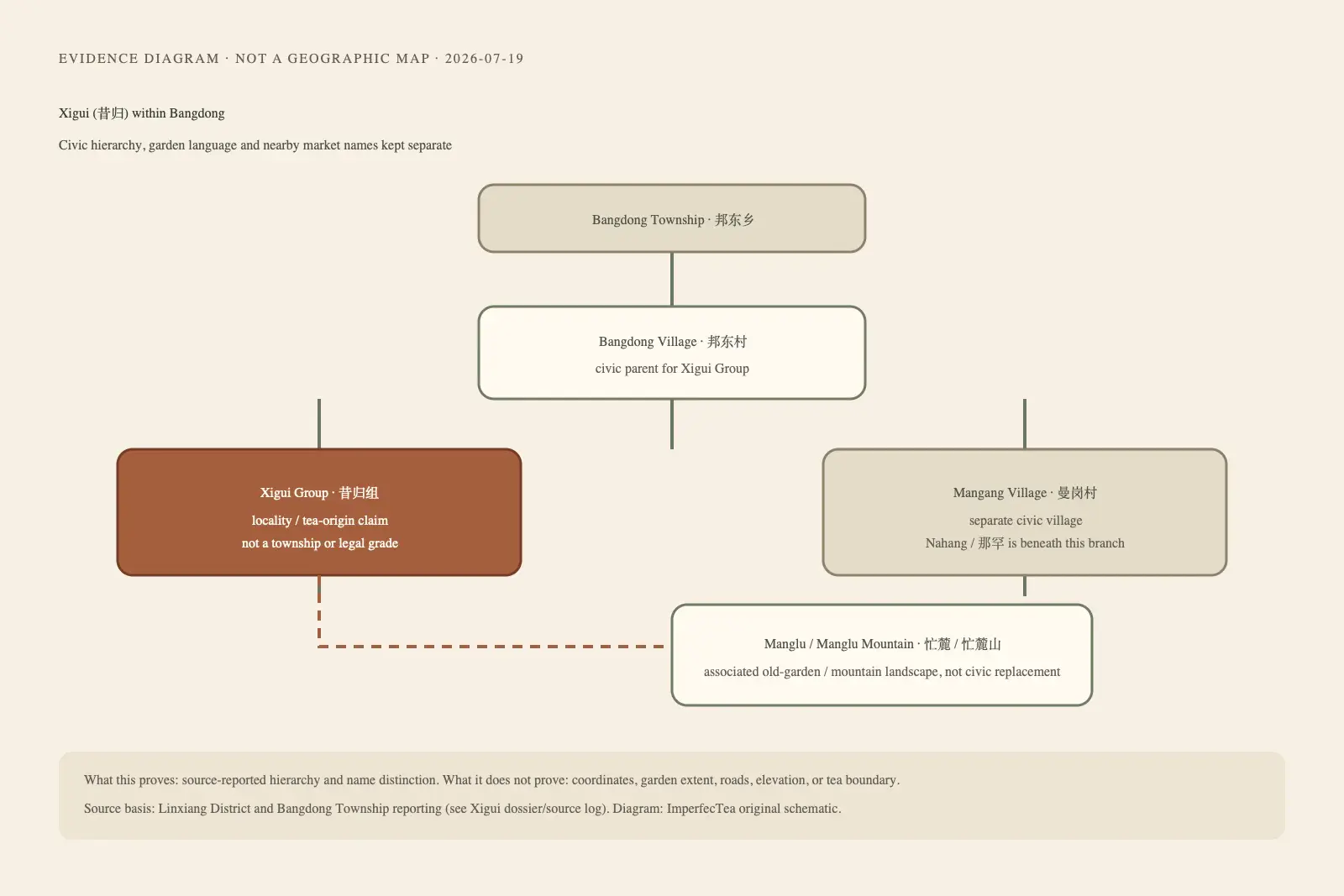
Place relationship diagram notes and sources
Diagram status: Not publication-grade: this evidence diagram deliberately does not assert coordinates, boundaries, routes, or garden geometry.
- Linxiang District and Bangdong Township government sources listed in the dossier; schematic prepared 2026-07-19
What might Xigui tea taste like, and why does scale matter?
Xigui (昔归, Xīguī) is one of those tea names that gets asked to do too many jobs. It is not a township, a legal grade or another word for every tea from Bangdong. Current government usage places Xigui Group (昔归组) inside Bangdong Village (邦东村), Bangdong Township, Linxiang District, Lincang, Yunnan. Tea drinkers also meet the name alongside Manglu / Manglu Mountain (忙麓 / 忙麓山). The two travel together in shops, but they are not the same thing. Xigui is the local settlement and origin claim, Manglu is the associated old-garden and mountain landscape, and Bangdong is the wider township and market family.
Named drinking accounts report orchid fragrance, soft sweetness, bitterness that clears, salivation and returning sweetness. They are unmatched, provenance-limited samples, so use that arc as a comparison hypothesis rather than an authenticity test.
That makes a difference when somebody passes you a cake. Xigui has major name recognition and a real conservation record, but a “Bangdong” wrapper or an old-tree photograph cannot prove Xigui origin. Chinese institutional and field reporting documents a busy local tea economy and protected gardens. It does not give us a public trail for every lot, one tree-age census or a flavour that the name can guarantee.
Where is Xigui, and what kind of place is it?
The image above is a hierarchy evidence diagram, not a map. It intentionally avoids point coordinates, administrative polygons, road lines and tea-boundary geometry because this pass did not secure reusable base data and independently verified locality positioning. It demonstrates the relationships a label needs to preserve: Bangdong Township contains Bangdong Village and separate Mangang Village; Xigui Group is under the former; Manglu is a related garden landscape.
A publishable replacement needs a Yunnan locator, Linxiang/Bangdong detail panel, licensed boundary and terrain data, a scale, north cue, legend, date, data credit, and an explicit soft distinction between civic units and commercial tea areas. Until then, do not derive a travel route, elevation, exact garden location or origin boundary from the illustration.
Where do Xigui, Manglu and Bangdong diverge?
Xigui Group 昔归组 and Bangdong Village 邦东村
The clearest current evidence is administrative rather than romantic. Bangdong Township’s 2026 budget names projects in Bangdong Village’s Xigui area and a Bangdong Village Xigui Group processing/visitor infrastructure context. Earlier township reporting likewise records an agricultural-industry investigation at “Bangdong Township, Bangdong Village, Xigui Group.” This supports the civic nesting used here. It does not establish that every grower, tea garden or merchant using “Xigui” lies in one surveyed polygon.
The market label is much tighter than “Bangdong,” yet still needs more detail. A serious seller should be able to say whether leaf is from Xigui Group, a named Manglu garden or a wider village blend; which season; who made the maocha; and whether the cake was blended, pressed and stored elsewhere. “Bangdong Xigui” may be a useful broad description, but it is not the same claim as a documented single garden.
Manglu / Manglu Mountain 忙麓 / 忙麓山
Manglu is the old-garden landscape most closely associated with Xigui. A Linxiang government reply records Bangdong Xigui (Manglu) old tea garden, 600 mu and Xiaoguangshan old tea garden, 176 mu, on the city’s first old-garden protection list. The 600-mu figure belongs to the stated protected garden scope. It must not be expanded into the acreage of every tea marketed as Xigui, and it cannot date every plant or authenticate a finished cake.
The same sources make protection more concrete than a seller’s adjective: the district reported individual-tree protective tags and infrastructure intended to manage access. That matters because a People’s Daily Overseas Edition field report recorded growers’ concern about visitors plucking new ancient-tree leaves. Conservation reporting is evidence of pressure and management, not a sensory explanation for every cup.
Mangang 曼岗 and Nahang 那罕
Mangang is a separate administrative village in Bangdong Township. Nahang (那罕; often romanized Nahan) is a locality/group under Mangang in the parent Bangdong research. Tea sellers sometimes place Xigui, Nahang and Mangang in one “Bangdong” comparison, which is sensible at township scale, but does not make them aliases. Nor should Mangang (曼岗) be confused with Manglu (忙麓): close English spellings conceal different Chinese names, different parentage and different marketing claims.
What to look for in a Xigui cup
The responsible answer is a tasting pattern, not a promise. A named Chinese tea-community account from Nanmingjiaren describes young Xigui as orchid-fragrant with a soft sweetness and contrasts it with its own older Xigui sample; a separate producer/community source uses a similarly familiar vocabulary of fragrance, bitterness, salivation and returning sweetness. These are useful, attributable experience reports. They do not amount to blind testing, independent provenance verification or a universal Xigui sensory law.
Use the reported vocabulary as a structured checklist:
| Dimension | What to test |
|---|---|
| Aroma | Separate warmed-lid, leaf and cooled-cup notes. “Orchid” is a reported descriptor, not an authentication test. |
| Taste structure | Note first bitterness, sweetness, umami and whether the bitterness clears or accumulates. |
| Return | Record huigan (returning sweetness) separately from shengjin (salivation). |
| Texture / finish | Track coating, dryness, throat feel and late-steep stamina; bodily “qi” impressions are subjective. |
| Variation | Keep season, maker, garden claim, processing, compression and storage attached to each note. |
The locality’s fame creates a trap: generic phrases such as “rock rhyme,” cooling, orchid fragrance or very long aftertaste can be copied across unrelated lots. A harsh green edge can be an aggressive kill-green; smoke, sourness and red-leaf tones may reveal handling or drying rather than place. Conversely, a soft sweet tea is not automatically “true Xigui.” Until samples from multiple disclosed producers are compared under matched conditions, this guide treats the profile as reported market-and-drinking evidence rather than proven regional chemistry.
Which local conditions can we connect to the cup?
Xigui’s Lancang-side setting and Manglu’s garden landscape are meaningful orientation. The sources reviewed describe protection, steep local terrain and a working relationship between gardens, visitors and roads. They do not give a publicly reproducible Xigui-wide soil analysis, temperature/rainfall series, verified garden-elevation range, cultivar census or current forest-cover measurement. Those absences are more useful than a decorative number.
“Rock rhyme” (yanyun) should be treated as a sensory and market phrase. It is not proof that geology passes unchanged into flavour. Nor does a protected old garden prove organic management, uniform shade, zero inputs or a common age for all trees. A future field pass should obtain a licensed map, named garden records, sampling methods and farmer/processor interviews before making stronger ecological claims.
Where the evidence stops
We can say Xigui is a Bangdong Village locality linked with the Manglu garden landscape and a documented protected-garden scope. We can report that local accounts associate some Xigui teas with fragrance, bitterness and sweet return. We cannot responsibly attribute a fixed aroma, minerality, tree age, elevation or price to all leaf sold under the name.
How can processing, season and storage change the result?
Xigui is typically encountered as sun-dried raw-Pu-erh material, but that common route leaves decisive variables open: plucking standard, wither time, kill-green heat, rolling, sun drying, sorting, blending, compression and storage. Township programmes that support processing and branding show an active contemporary industry; they do not establish one Xigui house style.
Ask for harvest season rather than accepting “spring” as a quality certificate. Compare like with like. A hard, brisk young tea can reflect leaf, weather or processing; a stored cake can hide or create traits consumers then attribute to its village. There is no adequate public Xigui sample series here to promise an aging curve.
How should you buy past Xigui’s market story?
The strongest history in this pass is the contemporary history of protection and brand pressure. A 2019 national field report documented concern over visitor picking; Linxiang and Bangdong sources describe protective listing, individual-tree tags, tea-tourism infrastructure and a processing park in Xigui Group. In 2019, a township report gave a 2017 average Xigui tea figure of ¥2,327.10/kg and 14.5 tonnes. It is a dated local official statistic with an unclear product-definition/comparability basis, not a current price or price range. No pair of current like-for-like observations was secured, so this guide publishes no current price band.
Read labels from broad to narrow:
- 邦东 / Bangdong: township or broad trade-area claim.
- 邦东村 / Bangdong Village: civic parent of Xigui Group.
- 昔归 / Xigui: the narrower local origin/market claim discussed here.
- 忙麓 / Manglu: associated mountain/garden landscape, not a civic substitute.
- 曼岗 / Mangang and 那罕 / Nahang: separate Bangdong names, not Xigui synonyms.
Ask which group/garden supplied the leaf, whether it is a single garden or blend, harvest season, who processed the maocha, pressing date, storage, and what documents connect those answers to the cake. A premium, a QR code, a tree photograph or a Manglu story is not a chain of custody. A transparent Bangdong or Nahang tea can be a better buy than an unverifiable “pure Xigui gushu” claim.
How should you compare Xigui at the tea table?
Start with 7 g per 100 ml in porcelain, 95-100 °C water and short early infusions. Keep ratio, water and timing fixed. If a fresh tea is aggressively bitter, shorten early steeps; if it is tightly compressed, allow a rest after breaking and extend later rounds.
For a useful Bangdong flight, compare a disclosed Xigui lot with a named Nahang/Mangang lot, a broader Bangdong control and one traceable Lincang neighbour. Blind the labels where practical. Record origin specificity, season, maker and storage beside aroma, bitterness, astringency, salivation, return and finish. That tests the Xigui story more honestly than a price hierarchy.
What should you remember?
- Xigui (昔归) is a group/locality under Bangdong Village, Bangdong Township; it is not synonymous with the whole township.
- Manglu (忙麓) is the associated old-garden/mountain landscape; Mangang (曼岗) is a separate administrative village.
- The 600-mu protected-garden figure has a defined conservation scope and does not authenticate every Xigui-labelled tea.
- Fragrance, bitterness, salivation and sweet return are reported tasting cues, not proof of origin.
- Buy the documentation: group/garden, season, maker, processing, pressing and storage, not the prestige word alone.
Sources and research limits
All web sources accessed 19 July 2026.
- Linxiang District industry-services reply (2020) - Xigui/Manglu 600-mu and Xiaoguangshan 176-mu protected-garden scopes; conservation/project context.
- Bangdong Township tea-industry investigation report (2019) - Bangdong Village, Xigui Group hierarchy; dated 2017 local output/average-price statistic with limited comparability.
- Bangdong Township 2026 budget - current Bangdong Village Xigui-area and Xigui-group project usage.
- Lincang commerce-bureau report - protected Xigui/Manglu and Xiaoguangshan garden total; brand/traceability context.
- People’s Daily Overseas Edition field report (2019) - growers’ reported concern about visitor picking and local conservation pressure.
- Nanmingjiaren tea-community tasting article (2025) - attributed, product/time-specific sensory language; not independent provenance verification.
- Media report on Xigui cultural naming and processing heritage (2023) - reports historical names 蛮鹿/锡规 and calls 昔归团茶制作技艺 a provincial intangible-heritage item; useful cultural reporting, not a village register.
Evidence limits: The Xigui asset is a source-attributed hierarchy diagram, not a licensed composite map, and it claims no coordinates or boundaries. No controlled multi-producer tasting set or current comparable price range was found.
Quick answers
Frequently asked questions
What does the Xigui tea name identify?
Xigui is a village group inside Bangdong Village, Bangdong Township, Linxiang District, Lincang, Yunnan. Its most useful identity is village group and prestige tea-origin label, so the name alone does not guarantee a particular garden, tree age or quality level.
What does Xigui tea taste like?
Named accounts report orchid fragrance, soft sweetness, bitterness, salivation and returning sweetness; sparse unmatched samples cannot make those traits an authentication rule. Use that profile as a tasting guide, not as proof of origin.
What is Xigui commonly confused with?
Xigui group, Manglu Mountain, Bangdong Village and Bangdong Township are connected but distinct geographic and market scopes.
What should I ask before buying Xigui tea?
Start with: Which Xigui or Manglu garden, season, household and processor can be connected to this lot? Also ask for the harvest year and season, producer or household, processing details and storage history.