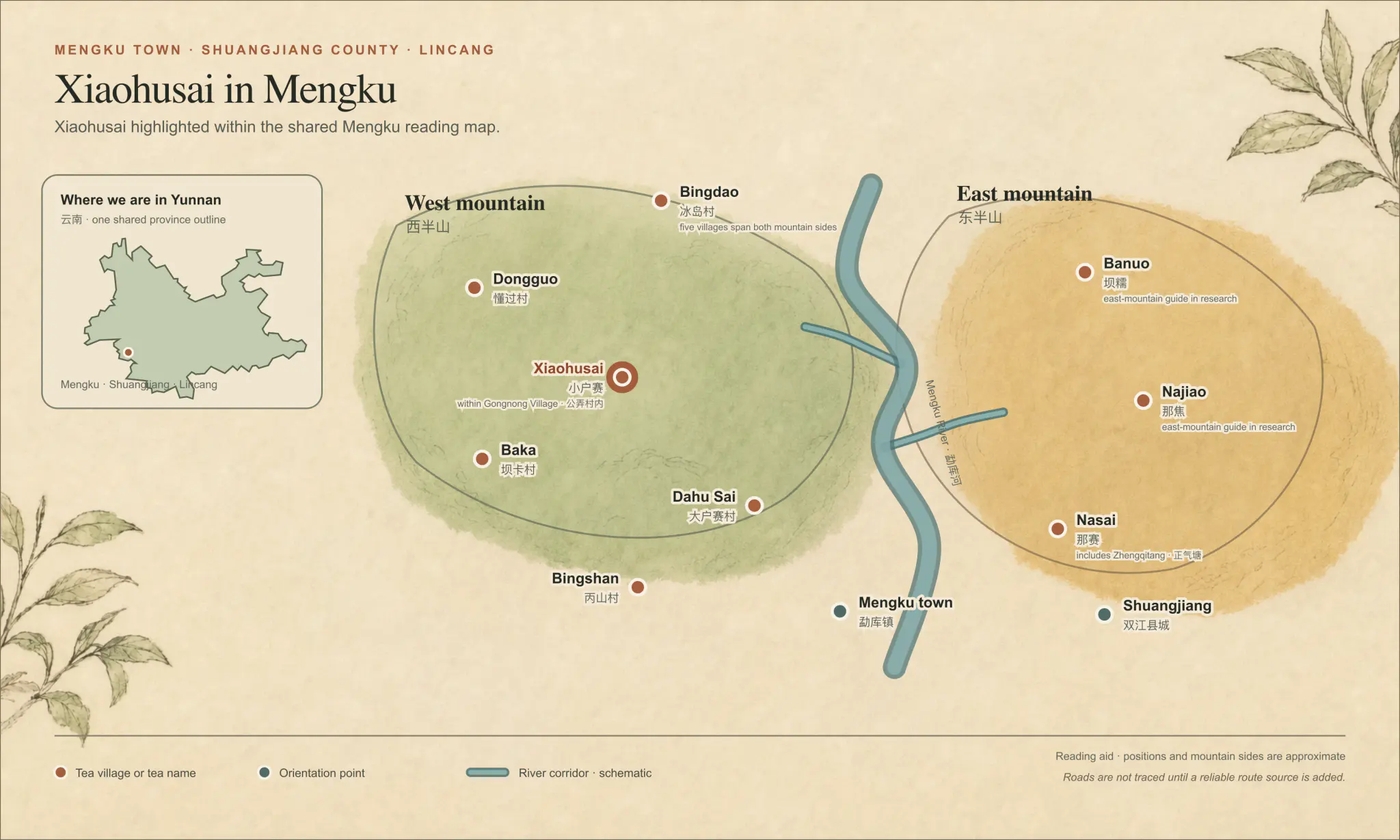
Orientation guide notes and sources
Boundary confidence: Not publication-grade: existing locality positions and geographic shapes have no licensed, verified data basis in this pass.
- ImperfecTea legacy orientation illustration; no external geographic-data licence established in this pass
What might Xiaohusai tea taste like, and why is it not Bingdao?
Xiaohusai (小户赛, Xiǎohùsài) often gets introduced as Sai Bingdao (赛冰岛), or “rival to Bingdao.” That nickname tells you how sellers position the tea, not where the leaf came from or how good it is. Xiaohusai is a tea-famous natural-village locality under Gongnong Village (公弄村) in Mengku Town, Shuangjiang County, Lincang, Yunnan. The broader Mengku West Mountain (勐库西半山) phrase is another market shortcut. Neither term is a civic address, a legal quality grade or proof of a particular garden.
Controlled three-season samples were described as full or intense with returning sweetness. Flowers, honey, salivation and thick texture remain useful prompts for a known lot, but the same study found season effects and did not turn those traits into proof of Xiaohusai origin.
The Chinese reporting offers a more grounded story. Institutional sources call it Xiaohusai Natural Village and record spring-harvest work. A local Lincang Daily report documents Lahu tea practice and livestream training there. A long-running tea-community field account says the market name covers three nearby settlements: Yizhai, Liangzizhai and Wazizhai. No current official roster was found to confirm their administrative rank, so that detail stays open. A useful label should still go beyond “Xiaohusai”: which settlement or garden, which season, who made the maocha, and what chain follows it?
Where is Xiaohusai, and what kind of place is it?
The image above is an orientation illustration, not a verified geographic composite. Its marker positions, river course, mountain-side shapes and labels were not traced to reusable authoritative locality geometry in this pass. Do not read it as a coordinate source, road map, administrative boundary or Xiaohusai tea polygon. A reliable replacement still needs licensed provincial/county/township data, independently verified locality positions, a locator inset and detail panel, scale, north indication, legend, date, data credit and an uncertainty note.
The hierarchy is clearer than the cartography. The Yunnan administrative-village coding standard places Gongnong Village under Mengku Town; it does not make Xiaohusai an administrative village. A 2024 Workers’ Daily field report and a 2026 Lincang Daily report both use “Xiaohusai Natural Village, Gongnong Village.” For tea drinkers, West Mountain is still helpful: it points toward the western/Bangma-side Mengku conversation and distinguishes an origin story from east-side names. It should not replace Gongnong on a serious provenance record.
The older site guide at guides/xiaohusai is retained as research context. This canonical guide treats its stronger claims as leads to verify rather than inherited facts.
Which settlements may sit behind the Xiaohusai name?
Xiaohusai Natural Village 小户赛自然村
Public reporting supports this as the locality name used within Gongnong Village. It also gives a contemporary view of work rather than a frozen “ancient tea village” picture. In April 2024, Workers’ Daily reported Xiaohusai party-branch member Tie Zhapo (铁扎迫) coordinating labour as spring picking and primary processing needed more hands. That is evidence of a particular season’s labour arrangement, not a production statistic or a claim that all households process identically.
In January 2026, Lincang Daily reported that 43 growers in Xiaohusai Natural Village attended short-video and livestream training alongside training in Lahu bamboo-roasted tea and chestnut-tree-roasted tea practice. This is valuable local context: people are growers, processors and sellers adapting their work. It does not mean that every Xiaohusai sheng was bamboo- or chestnut-roasted; a retail lot needs its own production disclosure.
Yizhai, Liangzizhai and Wazizhai
The most detailed available Chinese tea-community field account, published by Houyue Ancient-tree Tea, describes three adjacent settlements: Yizhai (以寨), presented as a Han settlement; and Liangzizhai (梁子寨) and Wazizhai (洼子寨), presented as Lahu settlements. It says the two latter names carry much of the old-garden reputation. This is useful, specific field reporting and a much better way to ask a seller a follow-up question than repeating “Xiaohusai” as if it were one garden.
But it is not an official village register, a land survey or an independent tree-age study. The guide therefore calls these reported component settlements, not separate administrative villages. It also does not equate them automatically with the “inner” or “outer” group terms sometimes found in market and local reporting. Until a current roster resolves those relationships, a product claim such as “Liangzi old tree” should remain a producer claim unless it comes with farm, garden and batch evidence.
West Mountain, Daxueshan and Bingdao
“West Mountain” places Xiaohusai in a familiar Mengku tea-market family; it is not a civic parent. “Daxueshan” is broader still and often brings in protected wild-tea and high-mountain imagery. Nearby mountain or conservation claims must not migrate onto cultivated Xiaohusai leaf simply because the names travel together. And Sai Bingdao is a nickname, not a synonym: Bingdao has its own village-scale and market-scope complications. The comparison is an invitation to taste, not a guarantee of cooling sweetness, price or pedigree.
What to look for in a Xiaohusai cup
The strongest available evidence is more modest and more useful than a generic floral sales pitch. Wang Xinyu and colleagues’ 2023 peer-reviewed comparison sampled sun-dried teas from four Shuangjiang origins across spring, summer and autumn. The Xiaohusai samples were described as 浓强回甘: full or intense, with returning sweetness. The study also found that season and origin both significantly affected the samples.
That supports a starting hypothesis, not a flavour law. It does not prove that every commercial Xiaohusai cake will be full, sweet-returning or even correctly sourced. It does not settle which of the reported settlements supplied the sample, and it cannot remove the effects of picking standard, weather, kill-green, rolling, sun drying, blending, compression or storage.
Use trade descriptions such as flowers, honey, bitterness, salivation, and thick texture as a tasting checklist rather than a promise:
| Dimension | What to observe |
|---|---|
| Aroma | Separate warmed-lid, leaf and cooled-cup notes; record floral, honeyed, herbal, fruity, smoke or green notes rather than calling all perfume “Xiaohusai.” |
| Structure | Note when bitterness and astringency arrive, where they sit, and whether they clear or accumulate. |
| Return / salivation | Record huigan (returning sweetness) separately from shengjin (salivation). |
| Texture / finish | Track coating, dryness, throat feel and late-steep stamina. Body sensations are subjective reports. |
| Variation | Log settlement/garden claim, season, maker, processing, pressing and storage alongside the cup. |
A hard green edge may reflect incomplete kill-green; smoke can reflect heat management; sourness can come from difficult handling or drying. None independently identifies Xiaohusai. Conversely, a soft floral cup is not a certificate of Bingdao-like pedigree. The 2023 study’s season result is especially worth remembering when a seller presents one spring cake as the entire place.
Which local conditions can we connect to the cup?
Chinese community accounts frequently describe forest, streams, high elevation and preserved old gardens around Xiaohusai. They may be good leads for a future field visit, but this pass did not secure a current, method-backed garden-elevation range, soil study, climate series, garden map, cultivar census or tree-age inventory. Repeated claims of “largest,” “best preserved,” “hundreds of years,” or a fixed number of ancient trees are therefore excluded here.
Mengku large-leaf tea is a real regional plant and industry context, and sun-dried maocha is the common raw-pu-erh route encountered in the market. Those facts still do not authenticate an “arbor,” “ancient-tree,” “wild,” or single-village claim. The nearby Daxueshan wild-tea landscape is conservation and regional context, not evidence that a Xiaohusai cake contains wild leaf.
Where the evidence stops
We can place Xiaohusai under Gongnong, recognise a reported three-settlement tea cluster, and use the controlled study to say that its samples differed by season and origin. We cannot responsibly give every Xiaohusai garden one elevation, soil, forest condition, tree age or sensory signature. Origin belongs in the tasting log; it should not be the conclusion before the tea is brewed.
How can processing, season and storage change the result?
The same restraint applies to processing and aging. Season, kill-green, drying, rolling, blending, compression and storage can all reshape a tea more quickly than a broad Xiaohusai label can explain it. The available sources do not establish a house processing style or an aging trajectory for transparently separated Xiaohusai lots.
What does the “rival to Bingdao” nickname fail to prove?
Tea is a current livelihood, not a backdrop. Minsheng Weekly reported tea as the main household business in Xiaohusai/Gongnong, while the 2024 and 2026 reports above describe harvest labour and new selling/training practices. A tea-community article also preserves local Lahu history around the place. Its detailed chronology is best read as attributed local narrative, not a documented settlement history with every date settled.
Market attention makes precision more important. The official 2024 enforcement notice records 786 Xiaohusai-labelled raw-pu-erh cakes in a case involving unauthorised use of another factory’s name and production licence. It does not say that the leaf was necessarily false. What it does show is why producer identity and documentation matter alongside a place name.
Read a wrapper from broad to narrow:
- Mengku / 勐库: town, cultivar and broad market association.
- West Mountain / 西半山: physical-side and market shorthand.
- Gongnong / 公弄村: administrative-village parent.
- Xiaohusai / 小户赛: natural-village/locality and market-cluster claim.
- Yizhai, Liangzi, Wazi, household, garden, tree category: more specific claims requiring more specific evidence.
Ask which Chinese settlement or garden the leaf came from; whether it is a single garden, village blend or broader Mengku blend; harvest season; who processed the maocha; pressing date; storage; and what record links those answers to the cake. Do not infer authenticity from “Sai Bingdao,” a tree-age adjective, a high mountain photograph or a generic certificate.
No two dated, like-for-like price observations were found, so this guide publishes no price range. Fresh leaf, maocha and aged finished cakes are different products. A transparent Gongnong/Mengku lot can be a more useful purchase than an expensive “pure Xiaohusai gushu” claim with no chain of custody.
How should you compare Xiaohusai at the tea table?
Begin with 7 g per 100 ml in porcelain, 95-100 °C water and short early infusions. Keep ratio, water and timing fixed when comparing. If a fresh tea turns hard or bitter, reduce temperature slightly and shorten the first rounds; if a compressed tea seems closed, rest the broken cake and extend later infusions.
For a useful flight, compare a Xiaohusai-labelled tea with disclosed season and maker against a traceable Bingdao-area tea, a Dahu Sai or Dongguo tea, and a broader Mengku control. Blind the labels where possible. Record provenance confidence beside aroma, bitterness, astringency, salivation, return, texture and late-steep stamina. That is a better test of the “rival to Bingdao” nickname than accepting it on the wrapper.
What should you remember?
- Xiaohusai (小户赛) is a natural-village/locality under Gongnong Village, Mengku Town; West Mountain is tea-market/landscape context, not civic hierarchy.
- Yizhai, Liangzizhai and Wazizhai are reported component settlements, not aliases to use interchangeably without a source trail.
- A controlled 2023 study supports full/intense returning sweetness in its Xiaohusai samples, while showing that season matters too.
- Lahu tea practices and contemporary grower training are documented locally, but they do not describe every retail lot.
- The best buying question is not “is it Sai Bingdao?” but “which place, which season, which maker, and what evidence follows this tea?”
Sources and research limits
All web sources accessed 19 July 2026.
- Yunnan administrative-village coding standard DB53/T 1176.9-2023 - Gongnong’s administrative status under Mengku Town; it does not list Xiaohusai as an administrative village.
- Lincang Agriculture and Rural Affairs Bureau (2024) - Gongnong/Xiaohusai relationship in tea-industry context.
- Workers’ Daily field report (2024) - Xiaohusai Natural Village labour context and named party-branch source.
- Lincang Daily (2026) - named Xiaohusai training and reported Lahu roasting practices.
- People’s Daily, Minsheng Weekly (2024) - household tea-livelihood context.
- Shuangjiang market-regulation enforcement notice (2024) - producer-identity/licence case involving 786 Xiaohusai-labelled cakes; not a leaf-origin finding.
- Houyue Ancient-tree Tea field account (2019) - reported three-settlement naming and local distinctions; community/producer evidence, not an official roster or survey.
- Ai Pu Cha local tea article - Chinese tea-community Daxueshan/West-Mountain and local-history context, attributed rather than treated as documentary history.
- Wang Xinyu et al. (2023), Journal of Food Safety & Quality - sampled Shuangjiang origin-and-season comparison; not a universal commercial profile.
A note on what is still missing: The existing SVG/PNG/WebP is a legacy orientation illustration. It has no reusable geographic-data licence or verified locality geometry, so it is not a composite map. We located no controlled ImperfecTea Xiaohusai tasting, independent commercial tasting series across several producers or defensible dated price range. Those gaps stay visible beside the useful evidence.
Quick answers
Frequently asked questions
What does the Xiaohusai tea name identify?
Xiaohusai is a tea-famous natural-village locality under Gongnong Village, Mengku Town, Shuangjiang County, Lincang. Its most useful identity is natural-village cluster and tea-origin label, so the name alone does not guarantee a particular garden, tree age or quality level.
What does Xiaohusai tea taste like?
Controlled samples were full or intense with returning sweetness; flowers, honey, salivation and thick texture remain useful prompts whose balance changes by season and process. Use that profile as a tasting guide, not as proof of origin.
What is Xiaohusai commonly confused with?
Xiaohusai is under Gongnong Village; it is not Bingdao, and Mengku West is only a broader market and landscape grouping.
What should I ask before buying Xiaohusai tea?
Start with: Which reported settlement or garden supplied this Xiaohusai lot, in what season, and who made the maocha? Also ask for the harvest year and season, producer or household, processing details and storage history.