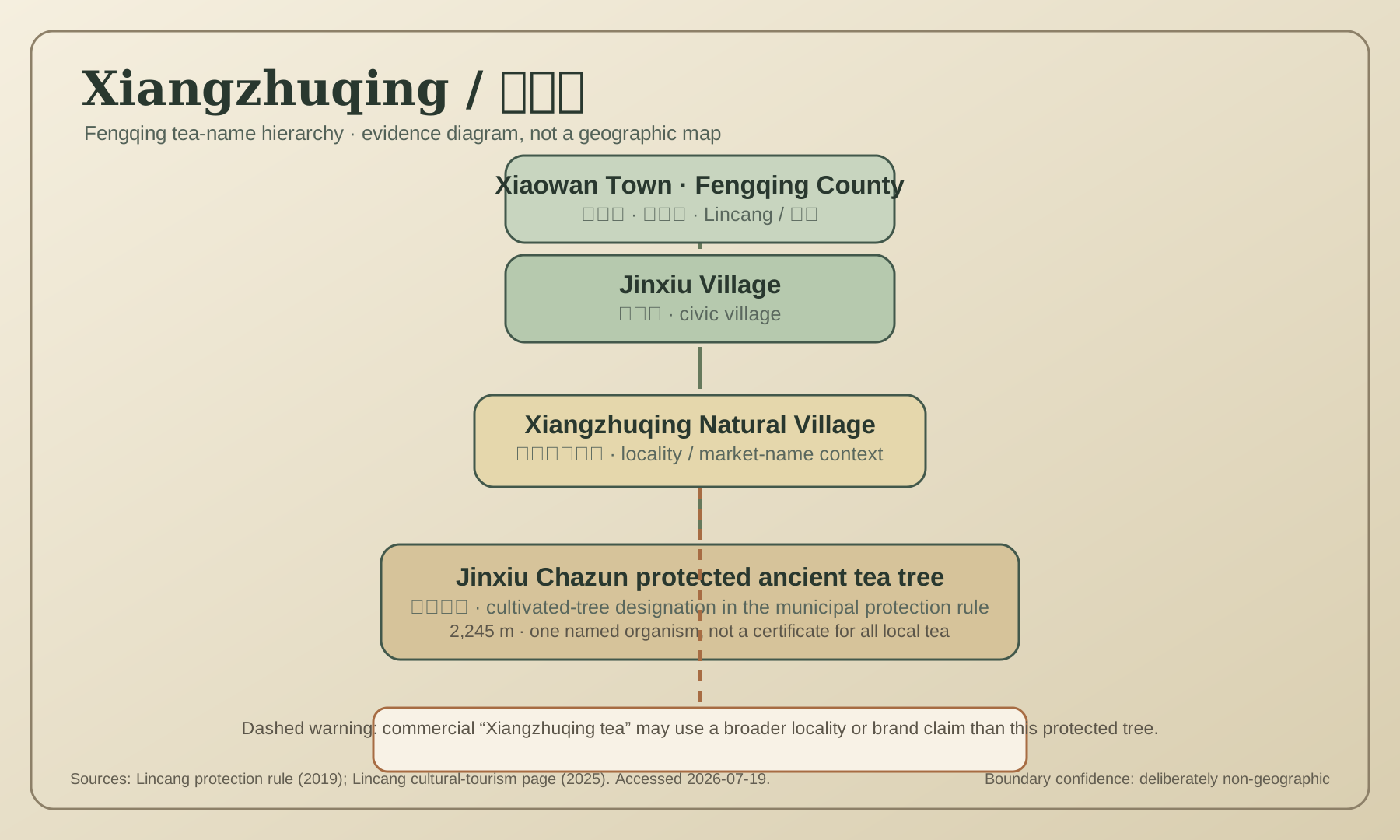
Place relationship diagram notes and sources
Diagram status: Not publication-grade: this evidence diagram deliberately does not draw an inferred village, garden, or market boundary.
- Lincang City protection rules and cultural-tourism page listed in the dossier; schematic prepared 2026-07-19
What might Xiangzhuqing tea taste like, and what does the landmark prove?
Xiangzhuqing (香竹箐, Xiāngzhúqìng) is a natural-village name in Jinxiu Village (锦秀村), Xiaowan Town (小湾镇), Fengqing County (凤庆县), Lincang, Yunnan. It is also home to the protected cultivated ancient tea tree officially called Jinxiu Chazun (锦绣茶尊), widely known as Jinxiu Chawang or “Jinxiu Tea King.” Here is the useful split: the landmark tree is unusually well documented, while the wider tea label is not. A municipal rule names one tree, one coordinate, a 3-km² protection area and an annual protective spring picking. It does not certify every tea sold as “Xiangzhuqing,” draw a complete garden boundary or give all local leaf one repeatable taste.
One producer describes its own tea as highly aromatic, full and sweet, with little bitterness or astringency and a cool throat. That is a product-level hypothesis: no independent multi-producer series makes it a village profile or connects an anonymous cake to the protected tree.
Many drinkers know Fengqing through Dianhong black tea. The county’s large-leaf material can also become sun-dried raw Pu-erh style tea, green tea or other products, so processing matters as much as the place name. Fengqing black tea is not Pu-erh simply because it came from Fengqing. A Xiangzhuqing wrapper also cannot prove that the leaf came from the landmark tree or even the protected area. This is a fascinating place to talk about provenance, conservation and marketing over a pot of tea. It is not permission to repeat a generic “3,200-year-old tea” story.
Where is Xiangzhuqing, and what kind of place is it?
The image above is an evidence diagram, not a geographic map. It preserves the chain that the municipal rule actually names: Xiaowan Town → Jinxiu Village → Xiangzhuqing Natural Village → the Jinxiu Chazun tree. It also separates that protected object from the broader commercial phrase “Xiangzhuqing tea.” It does not draw a village polygon, a tea-garden polygon, a road, a seller’s supply area, or an inferred route from the tree to a cake.
The 2019 Lincang rule gives an exact tree coordinate and defines a 3-km² protection area, with a 200-m-diameter core around the tree. Those are conservation controls for the named tree and its ecological environment. They are not a geographical indication specification for all Xiangzhuqing tea. A publishable replacement needs licensed base data, a Yunnan/Fengqing locator, verified village and garden localities, scale, north cue, bilingual labels, and an explicit distinction between the conservation boundary and any tea-market claim.
Where do the village, landmark tree and market label diverge?
Xiangzhuqing Natural Village / 香竹箐自然村
This is the terminal locality in the municipal protection text. It sits in Jinxiu Village, Xiaowan Town. It is the appropriate location name when describing the tree’s site. The current research did not obtain a complete official settlement roster, garden parcel map, household producer list, or a public record tying every local tea garden to the word Xiangzhuqing. That gap matters: “from Xiangzhuqing” could mean a locality claim, a nearby-source claim, a brand name, or loose Fengqing origin language.
Jinxiu Chazun / 锦绣茶尊
Jinxiu Chazun is the protected individual ancient tea tree. The protection rules call it an artificially cultivated ancient tea tree (人工栽培古茶树), give its location and measurements, and put its ownership under the state through Fengqing County’s exercise of rights. The county must conduct one protective spring picking each year to maintain its conservation objectives. That is far stronger than a vendor legend, but it remains a fact about one protected organism, not a denomination for a general harvest.
“Xiangzhuqing tea” / 香竹箐茶
This is the trade-facing use. A company profile for Yunnan Chunming Tea lists “Xiangzhuqing” among its trademarks across Pu-erh, green and black tea. That alone shows why the name needs careful reading: product category, supplier and processing can vary even when a label repeats the same locality. Treat the brand/product description as manufacturer evidence, not as independent proof of every Xiangzhuqing cup.
What to look for in a Xiangzhuqing cup
No independent, controlled tasting series comparing several Xiangzhuqing producers was found. The usable sensory evidence is a producer description: Yunnan Chunming’s “Xiangzhuqing ancient-tree tea” copy reports high, forceful aroma; a rich, full palate; very low bitterness/astringency; sweetness; and a cooling sensation in the throat. That may be a helpful prompt for tasting that product. It does not establish a fixed local profile, prove leaf came from the protected tree, or let a buyer authenticate an anonymous cake by taste.
Use a transparent sample to test rather than to confirm origin:
| Dimension | What to watch for |
|---|---|
| Aroma | Separate dry leaf, warmed-lid and cooled-cup aroma. Record whether an aromatic claim persists after the first steep. |
| Structure | Note bitterness and astringency separately, their timing, and whether water temperature or leaf ratio is driving them. |
| Sweetness | Mark immediate sweetness separately from huigan (returning sweetness) and shengjin (salivation). |
| Texture / finish | Record body, dryness, throat feel and late-steep stamina without treating a physical reaction as origin evidence. |
| Provenance | Keep Chinese place name, season, garden/household claim, material, process, compression date and storage with every note. |
The safest language is therefore: a named producer describes its own product in this way; representative local material may vary; and raw versus black-tea processing will change the sensory result substantially. Smoke, sourness, a hard-green taste or a soft aged profile can arise from processing and storage before they identify a mountain.
Which garden and ancient-tree claims are supported?
The protected-tree evidence is unusually precise. The municipal rule fixes the tree at 2,245 m, identifies a 3-km² protection area, and defines a 200-m-diameter core. It calls for ecological repair, forest-cover improvement, erosion control, and a weather observation point. These are management intentions and conservation facts, not a measured climate record or proof that every surrounding garden is forest-grown.
The widest repeated age claim is “more than 3,200 years.” Fengqing County’s overview and Lincang’s tourism page repeat it; the Yunnan forestry bureau likewise reports that experts estimated the tree at over 3,200 years. But the materials found in this pass do not explain the estimation method, sample preparation, uncertainty range or whether the number is directly measured. Because a living tea tree cannot be casually ring-counted without harm, a reputable age claim needs method and uncertainty. Here, present the number as an official/expert-attributed estimate, not an exact biological birthday, and never as an age for a seller’s entire garden.
There is a real classification conflict. The governing protection rule calls this individual tree cultivated. A 2024 Chinese encyclopedia entry labels “Xiangzhuqing big tea tree” wild and locates it at 1,980 m, contradicting the municipal rule’s 2,245 m and cultivated designation. The article follows the local protection authority for this specific landmark and logs the encyclopedia claim as unresolved/conflicting rather than blending the two. The broader county certainly contains both wild and cultivated ancient tea resources, but that does not license changing this named tree’s status.
No defensible Xiangzhuqing-wide soil analysis, forest-cover survey, garden elevation range, planting-density record, cultivar census, input record or tree-by-tree age audit was located. Do not say altitude makes the tea better, soil creates a mineral flavour, or a very large trunk proves a numeric age.
How can processing turn the same leaf into a different tea?
Fengqing’s most famous tea story is Dianhong. Provincial agriculture reporting describes the county as the historic birthplace of Dianhong and credits Feng Shaoqiu’s work there in the late 1930s. That history is useful context, but it should not be turned into a product category mistake. Black tea is processed through oxidation; raw Pu-erh style tea depends on a different path including kill-green and sun-drying. The same local large-leaf material can enter different categories, so “Fengqing large leaf” or “Xiangzhuqing” does not tell a buyer whether the tea is Dianhong, a green tea, a raw Pu-erh cake, or a blend.
For a raw tea, ask about harvest season, picking standard, withering, kill-green, rolling, sun-drying, maocha blending, compression and storage. For black tea, ask about withering, rolling, oxidation and drying. The protection rule’s single annual spring protective picking is a stewardship practice for one tree; it must not be used to imply that all Xiangzhuqing tea is spring-picked or that the protected tree provides commercial-scale production.
What does a Xiangzhuqing wrapper fail to prove?
Xiangzhuqing’s landmark has become a cultural and conservation reference point, including a city-listed AAA scenic site. The resulting fame makes language on wrappers especially slippery. “Tea king,” “ancient tree,” “Xiangzhuqing,” “Jinxiu,” and “Fengqing” can point to different levels: an individual protected tree, its natural village, a brand, a county, or an aspirational style. None alone is a chain of custody.
Read a label from broad to narrow:
- 凤庆 / Fengqing: county and major Dianhong context; not a Xiangzhuqing location guarantee.
- 小湾镇 / Xiaowan Town; 锦秀村 / Jinxiu Village: increasingly specific civic claims.
- 香竹箐自然村 / Xiangzhuqing Natural Village: a locality claim; request the garden/household and harvest record.
- 锦绣茶尊 / Jinxiu Chazun: a protected individual tree name; request extraordinary evidence if a commercial tea claims its leaf.
- 古树 / ancient tree: needs a garden, tree/stand definition, age basis, producer and lot trail.
No two dated, like-for-like price observations were found, so there is no current price band here. A branded product’s description is not a village-market price; a pilgrimage-market asking price is not proof of provenance. A buyer should request Chinese place names, harvest season, garden/household, picking and process details, whether the tea is single-source or blended, pressing date, storage history and any verifiable producer record. An honestly documented Fengqing tea is more useful than a dramatic Xiangzhuqing claim with no traceability.
How should you compare Xiangzhuqing at the tea table?
For a raw, openly sourced Xiangzhuqing-labelled tea, begin with 7 g per 100 ml porcelain gaiwan, 95-100 °C water and short early infusions. Hold ratio, temperature and timing constant. If a young tea is sharp, shorten early steeps before lowering temperature; if it is tightly compressed, rest the leaf and lengthen later infusions. For black tea, lower the temperature or shorten contact as needed so oxidation-derived sweetness and tannin are not obscured by over-extraction.
Build a Fengqing flight by process, not hype: compare a transparent Xiangzhuqing-labelled raw lot with a clearly labelled Fengqing Dianhong and another documented Fengqing raw tea. Record aroma, bitterness/astringency, texture, return, finish, and stamina. Then separately score provenance disclosure. This avoids pretending that either “Dianhong” or “ancient tree” is a complete sensory category.
What should you remember?
- Xiangzhuqing is a natural village in Jinxiu Village, Xiaowan Town, Fengqing; its famous landmark is one named protected cultivated ancient tea tree.
- The official 3,200-plus-year figure is an attributed estimate whose method was not obtained. It is not a general garden age or a product certificate.
- Fengqing is a Dianhong centre, but its local leaf can also be processed into raw Pu-erh-style tea, green tea or blends. The product category must be stated.
- A producer’s high-aroma, rich, sweet/cooling sensory copy is useful only for that producer’s product, not as a universal regional profile.
- Buy the most specific, documented lot, not the broadest “tea king” narrative.
Sources and research limits
All sources accessed 19 July 2026.
- Lincang City, Implementation Measures for Protecting the Jinxiu Chazun Ancient Tea Tree (2019) - primary municipal protection rule: civic nesting, coordinates, elevation, cultivated status, dimensions, protection area and annual protective picking.
- Lincang Culture and Tourism Bureau, Jinxiu Chazun Scenic Area (2025) - official tourism page confirming location and repeating the 3,200-plus-year estimate; treated as attributable, not methodological age evidence.
- Yunnan Forestry and Grassland Bureau, CCTV’s Chinese Ancient Trees visits Lincang (2014) - institutional report on experts’ estimated age and landmark measurements.
- Fengqing County People’s Government, Fengqing overview (2024) - county-level Fengqing geography, 13 townships and repeated landmark age claim.
- Yunnan Agriculture and Rural Affairs Department, Fengqing Dianhong: from a cup of tea to a 10-billion-yuan industry (2026) - official current context for Fengqing/Dianhong history and industry; not Xiangzhuqing garden evidence.
- Yunnan Chunming Tea, Xiangzhuqing product/company sheet - manufacturer/producer information on trademarked product categories and product-specific sensory claims only.
- Da Zhen Pu-erh, Fengqing tea region: ancient tea proliferates (2020) - Chinese specialist/community overview used for contextual leads only; it is not used for hard Xiangzhuqing measurements.
A note on what is still missing: The SVG/PNG/WebP package shows hierarchy rather than licensed geographic boundaries. We found no independent tasting across several producers, garden-wide ecology study, reproducible tree-age method, current normalized price pair or complete locality and garden matrix. Those gaps stay visible, especially around the famous tree story.
Quick answers
Frequently asked questions
What does the Xiangzhuqing tea name identify?
Xiangzhuqing is a natural village in Jinxiu Village, Xiaowan Town, Fengqing County, Lincang, Yunnan. Its most useful identity is natural village, protected-tree landscape and market label, so the name alone does not guarantee a particular garden, tree age or quality level.
What does Xiangzhuqing tea taste like?
One producer reports high aroma, full body, sweetness, little bitterness or astringency and a cool throat; no independent series shows that pattern is representative. Use that profile as a tasting guide, not as proof of origin.
What is Xiangzhuqing commonly confused with?
The protected Jinxiu Chazun tree, its protection area, Xiangzhuqing village tea and Fengqing county tea are not interchangeable claims.
What should I ask before buying Xiangzhuqing tea?
Start with: Does this tea claim the landmark tree, its protection area or broader Xiangzhuqing leaf, and what documents connect the lot? Also ask for the harvest year and season, producer or household, processing details and storage history.