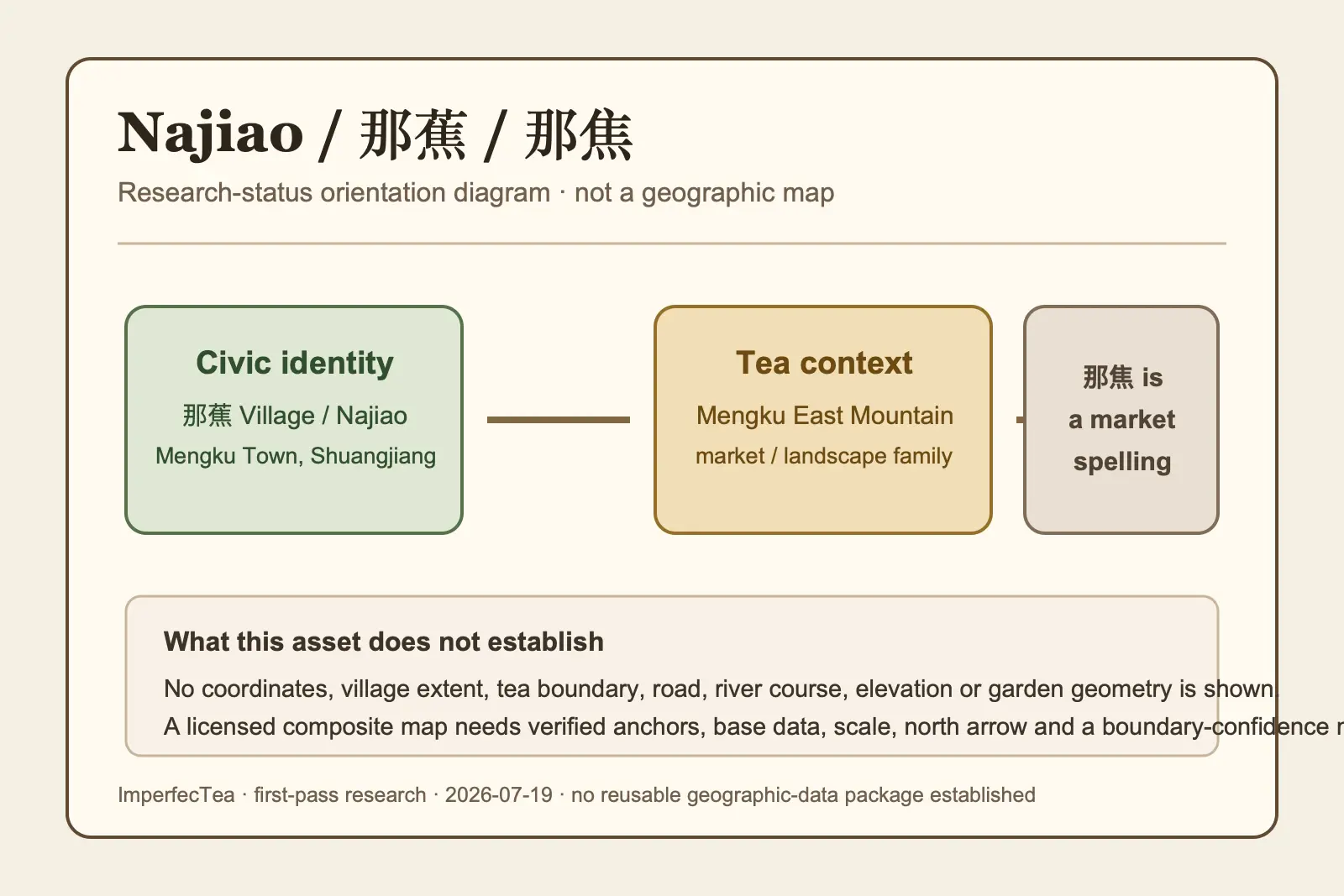
Place relationship diagram notes and sources
Diagram status: Not publication-grade: this first-pass orientation diagram deliberately contains no geographic geometry, coordinates, or boundary claim.
- ImperfecTea first-pass research-status diagram; no reusable geographic-data licence established
What might Najiao tea taste like, and why does the spelling matter?
Najiao looks simple in English until you see the Chinese. The current official village name is 那蕉村 (Nàjiāo Village), while many tea listings write the second character as 那焦. That other spelling is common enough to try in a search box, but Yunnan’s administrative-village coding standard does not use it. Neither does the Najiao village party secretary quoted in provincial agriculture reporting.
Sparse specialist reports suggest testing each disclosed lot for aroma, the timing of bitterness and astringency, coating texture and sweet return. No blind multi-producer comparison yet shows that those observations belong to Najiao rather than its season, maker or brewing.
The village sits in Mengku Town, Shuangjiang County, Lincang, Yunnan. Tea drinkers usually find it under Mengku East Mountain / East Half-Mountain (勐库东半山). That phrase points to a landscape and market area, not another civic rung between town and village. A cake sold as “East Mountain” can be much broader than Najiao. Even a cake sold as “Najiao” still needs a season, garden or household, producer, process and blend record.
There is useful local reporting, especially on vine-pruned tea and village-level management. There is not yet a licensed map, a current natural-village roster, tested garden ecology, a traceable tasting set across several producers or a comparable price series. That is enough to enjoy the place as a real lead without turning its name into a promise.
Where is Najiao, and what kind of place is it?
The image above is deliberately a research-status orientation diagram, not a map. It does not claim Najiao’s exact location, road, ridge, river, elevation, village extent, tea-garden boundary or market boundary. A credible composite map would need a reusable base layer, checked coordinates and coordinate reference system, independent settlement anchors, a north arrow, scale, bilingual labels, a licence statement, and a clear separation between the administrative village and the tea-market expression “East Mountain.” Those ingredients were not established in this first pass.
The safe mental model is simpler. The province’s coding standard lists 那蕉村 under 勐库镇. Tea writers place Najiao in the east-side Mengku conversation alongside Banuo and Nasai, and a 2024 independent tea-community series calls it one of the villages discussed as East Half-Mountain. That supports an orientation and a buyer’s search strategy; it does not draw a statutory East-Mountain polygon or establish that all tea sold under that broader name came from Najiao.
Name discipline is practical here. Search 那蕉 for civic records, then 那焦 for commercial and community tea writing. Do not silently merge Najiao with Nasai / 那赛, Banuo / 坝糯, Baka / 坝卡, or any other Mengku place with a familiar-sounding Latin name. A supplier who cannot give Chinese characters and a village level has not made a useful origin claim.
What to look for in a Najiao cup
The source set does not support a universal Najiao profile. The useful sensory material is reporting-level evidence: a named Chinese tea-community writer, 老闪的茶, includes 那蕉 among the East-Mountain villages and discusses the area’s vine-pruned tea, while other specialist retail/community pages use phrases such as bitterness, returning sweetness or a more substantial middle for specific lots. These can help a drinker frame questions, but they are not blind, matched, multi-producer tastings and they do not prove a cup will taste that way.
Use a Najiao label as the beginning of a tasting record:
| Dimension | What to note |
|---|---|
| Aroma | Write down warmed-lid, leaf and cooled-cup aroma separately. A floral, sugar, herb or fruit association belongs to a lot unless it is repeatedly shown in matched evidence. |
| Bitterness / sweetness | Note when bitterness appears and whether sweetness returns after swallowing. Do not confuse a soft extraction with a place signature. |
| Texture | Record coating, weight and late-steep persistence in the tea actually being drunk. |
| Astringency | Separate a clean brief grip from drying driven by hard brewing, immature leaf or rough processing. |
| Subjective feeling | Cha qi is an individual report, not a measured property of a village. |
| Provenance | Record the characters, village/natural-village claim, harvest, garden/tree category, maker, pressing date, storage and blend status. |
The most revealing comparison is a controlled small flight: a traceable Najiao tea, Banuo, Nasai or Zhengqitang, and one broader Mengku reference. Hold water, ratio, temperature and timing steady. Blind the labels when practical. The aim is not to prove that neighboring villages must taste different; it is to see whether the seller’s origin claim survives season and processing controls.
Which Najiao village and garden claims are supported?
The strongest local source is not a romantic origin legend. In a 2022 report hosted by Yunnan’s Department of Agriculture and Rural Affairs, Dong Mingfu (董明富) is identified as the party branch secretary and village committee director of Mengku Town’s Najiao Village. He describes implementation of the ancient-tea-tree protection regulation, improvement of older gardens, scientific organic/ecological garden management, and vine-pruned tea as part of a village livelihood story. The article says that more standardised management and organic ecological cultivation raised the reported value of its tea over roughly a decade.
That is useful, direct, named reporting about a local official describing contemporary management and livelihood. It is not a garden census, certification register for every farm, tree-age audit, or a guarantee about a retailer’s product. The same source reports a change from a very low historic local price to a much higher figure; it is a village speaker’s retrospective, not a current price benchmark, and this guide does not turn it into one.
Vine-pruned tea merits the same restraint. In local usage, 藤条茶 describes a management pattern: growers retain an extending top/shoot and regulate lateral growth through pruning and plucking. It is not a botanical variety, proof that a tea is old-tree material, proof of organic status, or proof that a tea came from Najiao. The 2024 tea-community account is useful because it puts Najiao in an East-Mountain vine-pruned-tea conversation. Its own estimates of tree ages and planting history are an enthusiast’s observations, not a method-backed inventory; they are not repeated here as hard facts.
No source in this pass establishes a current natural-village roster beneath Najiao Village, a reliable village-wide elevation range, soil or climate series, forest-cover measurement, cultivar census, garden boundary, production total, input audit or individual-tree age survey. Those absences matter. It would be false precision to explain a particular Najiao cake with a numerical elevation or “mineral soil” claim that has not been documented for its garden.
The civic name and the shop name do different jobs
| Label | What it can reasonably mean | What it does not establish |
|---|---|---|
| 勐库 / Mengku | Town and broad tea-region/cultivar context | One village or one garden |
| 东半山 / East Half-Mountain | Landscape and tea-market grouping used to compare the east side of Mengku | A government administrative unit or a single-source lot |
| 那蕉村 / Najiao Village | The administrative-village claim in the official standard | Natural-village, household or garden identity |
| 那焦 / Najiao | Common commercial spelling/search term | A different civic village, by itself |
| Garden, household, season, maker | A potentially more precise provenance claim | Accuracy without records that connect it to the tea |
How can processing, season and storage change the result?
Najiao sources found here do not establish a uniform processing style. For raw Pu-erh, fresh leaf is withered/rested, kill-greened (shāqīng, 杀青), rolled and sun-dried to maocha; it may then be sorted, rested, blended or kept separate, compressed and stored. Each stage can change aroma, bitterness, texture and drying sensation. A green or grassy cup may reflect light kill-green, smoke may reflect heat management, sourness may reflect difficult withering or drying, and a hard brew can make an otherwise balanced tea feel rough. None should be assigned to Najiao by default.
Ask whether the lot is spring, rain-season or autumn material; whether it was a household/garden lot or a village blend; and whether it was sold loose or pressed later. There is no longitudinal Najiao aging study in the source set. A clean, strong young tea may integrate with time, but the village name alone cannot responsibly promise an aging trajectory.
What does a Najiao wrapper fail to prove?
For buyers, the most important Najiao skill is reading specificity:
- “Mengku” can be a broad regional or material family.
- “East Mountain” can be a broad landscape/market orientation or a blend family.
- “Najiao / 那蕉村” is a narrower village claim.
- Natural village, household, garden, harvest and processor are narrower still, and need correspondingly better documentation.
Ask for the Chinese characters on the farmer or maocha record, the civic village and claimed natural village, whether the tea is all-Najiao or part of an East-Mountain blend, harvest season, pruning/tree category, processor, compression date and storage. The ability to narrate “old-tree vine-pruned East Mountain” does not substitute for those details.
No two dated, like-for-like Najiao price observations were found, so this guide publishes no price band. Fresh leaf, loose maocha and a finished cake are different markets; season, garden, tree claim, pressing year, producer and storage can be more important than the place word. Treat any single asking price as an individual offer until it can be compared with another dated observation of the same material class.
How should you compare Najiao at the tea table?
Start with 7 g per 100 ml in porcelain at 95-100 °C and keep early infusions quick. For a very sharp young tea, shorten the early steeps before changing temperature. That makes it easier to tell high extraction from the tea’s later behaviour.
For a three- or four-tea flight, include a documented Najiao, Banuo or Nasai/Zhengqitang, and a transparent broader Mengku reference. Keep water, vessel, ratio and timings fixed. Record bitterness, astringency, return sweetness (huigan), salivation (shengjin), texture and late-steep stamina, but record provenance confidence too. A flight becomes useful when it tests the completeness of an origin story, not when it rewards the most famous name.
What should you remember?
- The official name is Najiao / 那蕉; 那焦 is a widespread tea-market spelling variant worth searching, not a substitute civic identity.
- Najiao Village is under Mengku Town. Mengku East Mountain is its market/landscape parent, not an administrative tier.
- Named provincial reporting supports a real local discussion of ecological management and vine-pruned tea, but it does not authenticate arbitrary retail tea.
- No current natural-village roster, licensed composite map, garden ecology study, independent multi-producer tasting set or comparable price pair was found.
- A useful Najiao label should come with characters, village level, garden/household, season, maker and blend information.
Sources and research limits
All sources accessed 19 July 2026.
- Yunnan administrative-village coding standard DB53/T 1176.9-2023 - official civic spelling and hierarchy.
- Yunnan Department of Agriculture and Rural Affairs / People’s Daily Online Yunnan, “Tea fragrance on Shuangjiang’s road to rural revitalisation” (2022) - named Najiao village-leader account of management and livelihood.
- 老闪的茶, “Nasai ancient-tree tea” (2024), republished by Baidu Health - Chinese tea-community contextual reporting that names Najiao in the East-Mountain village conversation; used only at reporting level.
- Yunnan.cn, “Vine-pruned tea: a horticultural wonder” (2022) - contextual explanation of vine-pruned-tea management in nearby Banuo, not a Najiao census.
- Xiao Chunlei, “Dianqing and Dianhong,” Fujian Literature / China Writers Association site (2023) - regional tea-history context only, not a Najiao geographical or sensory source.
Evidence limits: The illustration is deliberately non-geographic. No licensed composite map, controlled multi-producer Najiao tasting series, garden-ecology audit or normalized current price pair was found.
Quick answers
Frequently asked questions
What does the Najiao tea name identify?
Najiao is an administrative village in Mengku Town, Shuangjiang County, Lincang, Yunnan. Its most useful identity is administrative village and tea-origin label, so the name alone does not guarantee a particular garden, tree age or quality level.
What does Najiao tea taste like?
Sparse reports suggest testing aroma, bitterness, astringency, texture and sweet return, but no blind multi-producer comparison supports a universal Najiao profile. Use that profile as a tasting guide, not as proof of origin.
What is Najiao commonly confused with?
Official Najiao 那蕉, commercial 那焦 and the broader Mengku East label are related search terms, not equal origin evidence.
What should I ask before buying Najiao tea?
Start with: Which Chinese spelling, smaller locality, season, garden or household, and maker does this Najiao lot claim? Also ask for the harvest year and season, producer or household, processing details and storage history.