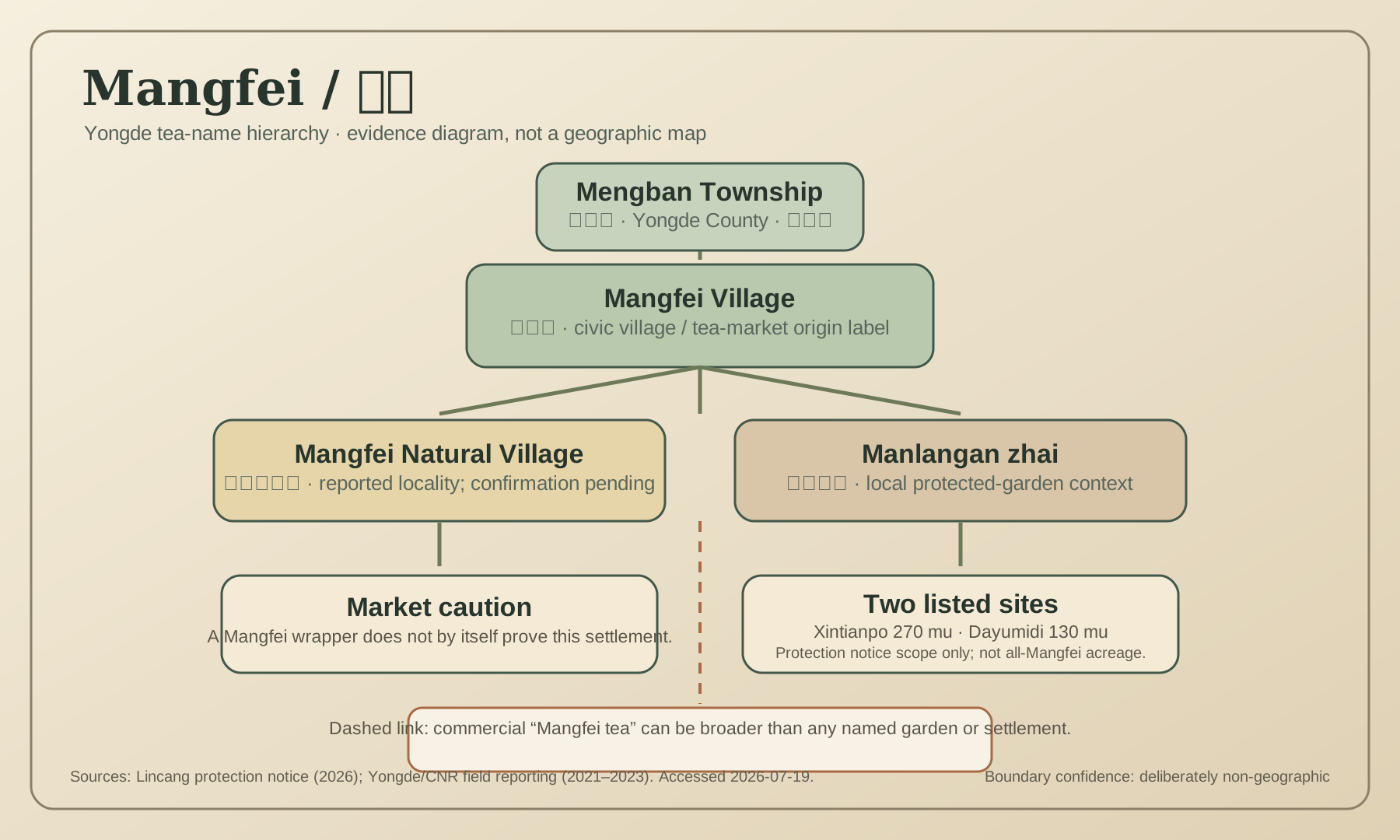
Place relationship diagram notes and sources
Diagram status: Not publication-grade: this evidence diagram deliberately asserts no coordinates, routes, boundaries or garden geometry.
- Yongde and Lincang government sources listed in the dossier; schematic prepared 2026-07-19
What might Mangfei tea taste like, and why does provenance matter?
Mangfei (忙肺, Mángfèi) is both a real village-level origin and a name with plenty of pull in the raw Pu-erh market. Mangfei Village (忙肺村) is the civic unit in Mengban Township (勐板乡), Yongde County, Lincang, Yunnan. A Chinese tea-community account also reports a narrower Mangfei Natural Village (忙肺自然村) locality, although independent confirmation remains open. Shops can use “Mangfei tea” more broadly, so a wrapper needs to tell you which meaning it has in mind.
Named commercial lots report floral and honey aroma, body, bitterness or astringency followed by sweet return. Those are prompts for a disclosed lot, not a multi-producer village profile, and smoke, sourness or a hard-green edge should trigger processing questions first.
The local reporting gives us a good, grounded picture. Mangfei Village has a working tea economy, several natural-village contexts, old-garden protection entries and processing households. There is even a local effort to stop outside leaf from being sold under the Mangfei name. What we do not have is just as important: no public record following every lot, no common tree-age audit, no controlled tasting series across multiple producers, and no single garden boundary that can authenticate every cake. Mangfei is worth sharing as a documented Yongde origin, not as a magic promise that every “old-tree” tea will taste alike.
Where is Mangfei, and what kind of place is it?
The image above is a hierarchy evidence diagram, not a publishable map. It intentionally does not place Mangfei at an exact point or draw a village, tea-market or old-garden polygon. Lincang’s protection notice gives coordinates and boundaries for individual Manlangan sites, but that is not permission to invent a complete Mangfei tea boundary or locate every natural village. It preserves the supported civic relation Mengban Township → Mangfei Village, the protected Manlangan garden context, and a clearly marked Mangfei Natural Village link that is reported but not independently confirmed.
A replacement needs licensed locality/boundary data, a Yunnan locator and Yongde/Mengban detail panel, a scale, north cue, legend, production date and bilingual labels. It should depict protection-site boundaries only when the licence and coordinate treatment are checked, and should render the commercial “Mangfei tea” area as uncertain rather than a precise polygon.
Which places can the Mangfei name include?
Mangfei Village 忙肺村
The county and municipal sources consistently put Mangfei Village under Mengban Township, Yongde County. This is the right civic address for the tea-origin name. A 2023 Yunnan Daily/CNR field report describes tea picking and first processing in the Mangfei Village core area, including named processing-house operators. It reports that the village organized a tea association/union with local processing households and checkpoints intended to keep outside leaf from entering the Mangfei supply chain. That is meaningful contemporary evidence of local concern for origin integrity. It is not a government certificate that every retail “Mangfei” tea is genuine.
Mangfei Natural Village 忙肺自然村
Mangfei Natural Village is reported as a narrower locality in a Chinese tea-community field account. Institutional sources do not independently establish that terminal civic link, so it should not be mistaken for the whole village committee or used as an authentication claim without an official local roster.
Manlangan / 曼兰干寨 and other local names
The 2026 Lincang protection notice lists two named old-tea-garden sites in Mangfei Village’s Manlangan zhai (曼兰干寨): Xintianpo / 新田坡 (270 mu) and Dayumidi / 大玉米地 (130 mu), each with specified adjoining land and coordinates. This is strong evidence for those particular protected resource sites. It is deliberately narrower than “Mangfei ancient tea garden,” and it does not identify individual trees, certify every household’s leaf or establish flavour differences.
Named field reporting also places Jianshan Natural Village (尖山自然村) in Mangfei Village’s present tea economy. Community reporting additionally names Dashuitang / 大水塘 and local market divisions, but only Jianshan and Manlangan have adequate current corroboration. Do not treat a community-reported “upper/middle/lower” flavor hierarchy as an official classification.
What to look for in a Mangfei cup
There is no adequate independent multi-producer Mangfei tasting series in the sources located for this pass. The available descriptions are nevertheless useful if they retain their provenance. China Tea’s 2024 Ming Shan Mangfei product sheet describes its own spring-material cake as clear, high floral-and-honey fragrance, substantial taste, sweetness, a smooth texture and lingering cup aroma. A Chinese tea-community field account reports local/producer vocabulary around fragrance, body, bitterness/astringency and sweet return, and compares internal areas. Neither is a blind tasting; both are product or community reports, not a chemistry result.
Use them as prompts rather than promises:
| Dimension | What to record |
|---|---|
| Aroma | Distinguish dry leaf, warmed-lid and cooled-cup aroma. “Flower” or “honey” is a reported descriptor, not proof of origin. |
| Structure | Note arrival and persistence of bitterness/astringency rather than calling it “strong” in isolation. |
| Return | Record huigan (returning sweetness) separately from shengjin (salivation). |
| Texture / finish | Separate coating, dryness, throat feel and late-steep stamina; bodily reactions remain subjective. |
| Provenance | Keep characters, natural village/garden claim, season, processor, compression and storage attached to each note. |
A smoky, sour or hard-green cup may reflect kill-green, withering, drying or storage before it says anything about Mangfei. Likewise, a sweet, soft cup is not proof that a tea came from Mangfei Village, Manlangan or an old tree. Current official concern about outside leaf entering the local market is a practical reason to demand lot information.
Which local conditions can we connect to the cup?
The strongest physical evidence is site-specific. Yongde’s 2021 official field writing says the Mangfei ancient-garden landscape is above 1,500 metres and describes a three-kilometre tea-garden walkway, while the Lincang notice identifies the two Manlangan protected sites and their precise adjacent land. This supports a high-elevation old-garden landscape and discrete protected areas, not a village-wide elevation range, aspect map or uniform forest cover.
The 2023 CNR/Yunnan Daily report calls Mangfei a source of Mangfei large-leaf tea and reports that a provincial tea-germplasm survey in 1980 named/reviewed it as an excellent population variety. This is useful historical cultivar context, but it cannot identify leaf in a cake, determine a tree’s age, or show that every garden has the same genetic composition. The report gives production figures of more than 5,800 mu of tea area, over 4,100 mu harvestable, roughly 375 tonnes of maocha, and a projected 2023 value. Those numbers describe a village economy at that date. They do not replace garden-level ecology or give a price for raw leaf versus finished tea.
No reproducible soil study, climate series, forest-cover survey, planting-density audit, input record, current cultivar census or method-backed tree-age study was found. Avoid saying that red soil produces a particular flavour, that elevation automatically improves tea, or that “ancient” on a wrapper means one measured age.
Where the evidence stops
We can say that Mangfei is an upland Mengban Village tea landscape with documented protected sites at Manlangan and a local large-leaf population history. We can report producers’ and community writers’ sensory vocabulary as reported experience. We cannot attribute a universal floral aroma, “mineral” taste, age, forest ecology or price to all tea sold under Mangfei.
How can processing, season and storage change the result?
Mangfei tea reaches drinkers in a live local production system rather than a fixed village recipe. The 2023 field report describes village first-processing operations, online sales and an association/union model; a 2025 local report describes consolidation of 142 first-processing sites into a village tea factory/linked supply structure. These reports make processing and aggregation visible, but they do not prove that every household follows the same withering, kill-green, rolling or sun-drying method.
For a raw-Pu-erh lot, record picking standard, season, wither, kill-green, rolling, drying, whether maocha was blended, compression date and storage. Spring and autumn material may differ before processing; an overly sharp young tea may be processing, while a muted older cake may be storage. No reliable Mangfei sample series was found from which to promise an aging trajectory.
What does a Mangfei wrapper fail to prove?
Mangfei’s most useful history is tea’s changing role in village life. The 2023 field report quotes a local processor describing the decline after 2007, subsequent management changes and current efforts to prevent outside tea from being sold as Mangfei. The same article reports a local “party branch + association + cooperative + processing house + farmer + internet” model, with three checkpoints and several natural-village sub-associations. Treat this as attributable local industry reporting, not an independent audit of every transaction.
Read a label from broad to narrow:
- 永德 / Yongde: county and broad regional context.
- 勐板 / Mengban: township parent.
- 忙肺村 / Mangfei Village: civic village claim.
- 忙肺自然村, 尖山, 曼兰干寨: narrower locality/garden claims that need stronger records; the Mangfei Natural Village link is currently reported only.
- 古树 / old tree, 水井头 / Shuijingtou, or a named household: claims needing a method, garden connection and batch trail.
No two dated, comparable price observations were found, so this guide gives no current price band. A ¥800/357 g 2024 China Tea suggested retail price is a single branded finished product, not a Mangfei market price. Ask a seller for the Chinese locality, garden/natural-village claim, season, tree category and its basis, processor, whether the lot was blended, pressing date, storage and any farm/maocha record. A well-documented Yongde tea may be a better purchase than an expensive “Mangfei gushu” claim with no chain of custody.
How should you compare Mangfei at the tea table?
Start with 7 g per 100 ml porcelain gaiwan, 95-100 °C water and short early infusions. Keep ratio, water and timing stable. For a hard young tea, shorten early steeps before lowering temperature; for a tightly compressed cake, rest the broken leaf and extend later infusions.
For a Yongde flight, compare a disclosed Mangfei Village lot with a product specifically claiming Manlangan or Jianshan only if the seller supports it, then a transparent Yongde neighbour such as Meiziqing or Mengma River, plus a broader Yongde control. Blind the labels if practical. Record the evidence level as seriously as aroma, bitterness, texture, salivation, return and stamina.
What should you remember?
- Mangfei / 忙肺 is a Mengban Township administrative village and a tea-market name; a narrower Mangfei Natural Village link is currently reported rather than independently confirmed.
- Manlangan’s two protected old-tea-garden sites are documented, but they do not authenticate every Mangfei-labelled cake.
- Local reporting shows real origin-protection pressure and active processing; it also explains why chain-of-custody questions matter.
- Floral/honey fragrance, body and sweet return are reported product/community observations, not a universal tasting law.
- Buy the most specific disclosed place, season and maker, not the broadest old-tree story.
Sources and research limits
All sources accessed 19 July 2026.
- Lincang City fourth-batch old tea-garden/old tea-tree protection notice - official entries for Mangfei Village, Manlangan Xintianpo and Dayumidi protected sites.
- Yongde County Discipline Inspection Commission, Mangfei ancient-garden walkway field note (2021) - named local government field writing; supports its stated 1,500-m-plus landscape reference, not a universal garden range.
- China National Radio / Yunnan Daily, “Mangfei tea fills local households’ pockets” (2023) - named field reporting on village tea area/output, local large-leaf history and tea economy.
- China National Radio / Yunnan Daily, “A deep-mountain two-hundred-million-yuan industry” (2023) - named processor interviews, local origin-control model and Mangfei Village production context.
- China Tea, Ming Shan Mangfei product sheet (2024) - product-specific origin, brewing and sensory language; not a market-wide tasting finding.
- Ai Pu Cha, “What you may not know about Mangfei” - Chinese tea-community field account used only for reported name/settlement/history and internal-market leads.
- Lijiang Net, local Mangfei tea-industry report (2025) - named local reporting on Jianshan Natural Village and processing-site consolidation; not a provenance audit.
Evidence limits: The illustration shows hierarchy, not geographic boundaries. No external base-map licence or verified geometry supports every locality, and no controlled multi-producer Mangfei tasting set, village-wide elevation range, tree-age method or normalized current price pair was found.
Quick answers
Frequently asked questions
What does the Mangfei tea name identify?
Mangfei Village is a civic unit in Mengban Township, Yongde County, Lincang, Yunnan. Its most useful identity is administrative village and tea-origin label, so the name alone does not guarantee a particular garden, tree age or quality level.
What does Mangfei tea taste like?
Named commercial lots report floral-honey aroma, body, bitterness, astringency and sweet return; without a multi-producer series, treat each dimension as a lot-specific prompt. Use that profile as a tasting guide, not as proof of origin.
What is Mangfei commonly confused with?
Mangfei Village, the reported Mangfei Natural Village, Manlangan sites and broad Yongde tea are different provenance scopes.
What should I ask before buying Mangfei tea?
Start with: Is this leaf from a named Mangfei natural village or protected site, and who processed and tracked the lot? Also ask for the harvest year and season, producer or household, processing details and storage history.