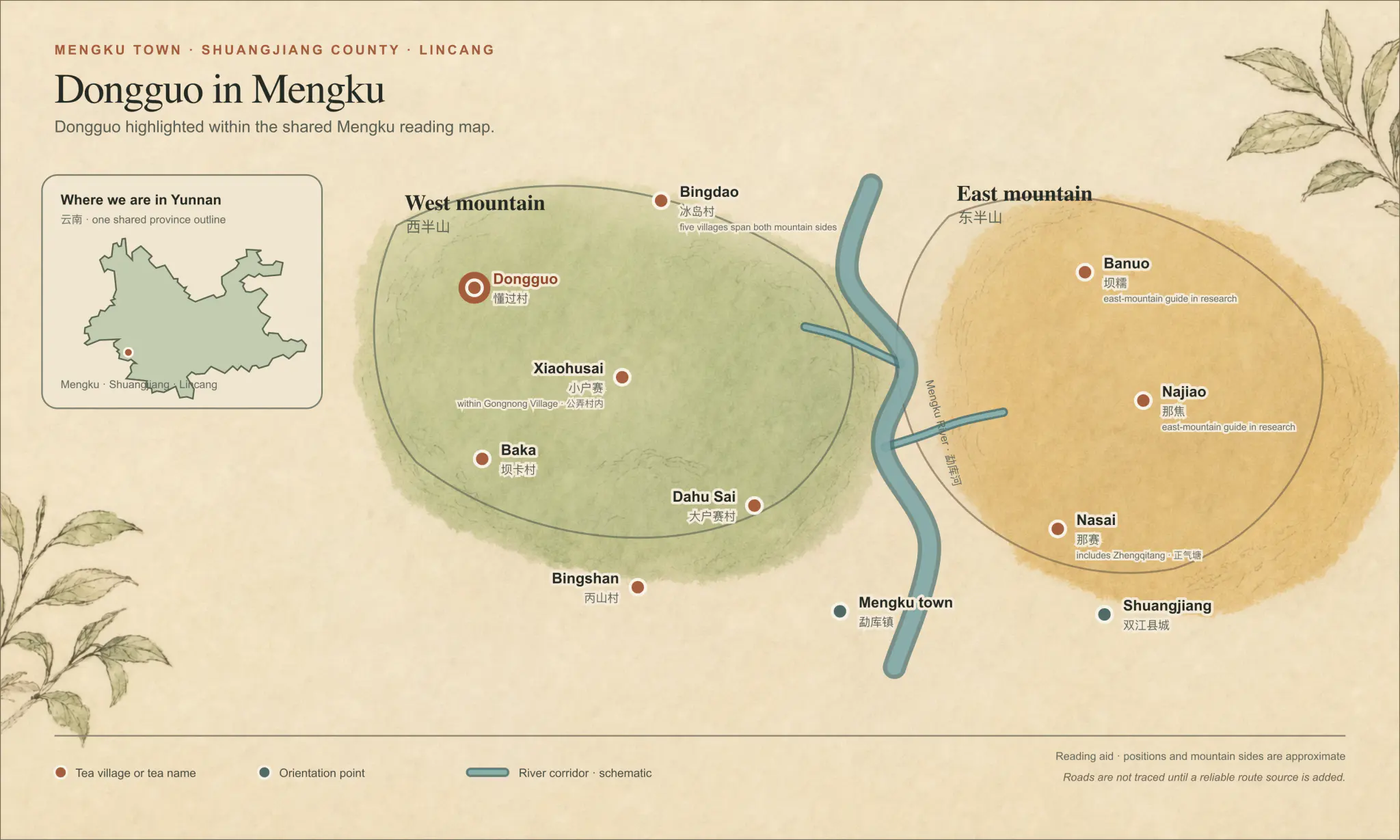
Place relationship diagram notes and sources
Diagram status: No published geographic boundary: this is a non-geographic evidence-status diagram only.
- Yunnan administrative-village coding standard DB53/T 1176.9-2023
- ImperfecTea original hierarchy diagram, 2026-07-18
What might Dongguo tea taste like, and why does it matter?
Dongguo Village (懂过村, Dǒngguò Cūn) is an administrative village in Mengku Town, Shuangjiang County, Lincang, Yunnan. Tea drinkers often find it under Mengku West Mountain (勐库西半山), the shop and landscape shorthand for the Bangma-side country west of the Nanmeng River. It is a useful pointer on the tea map, but it is not Dongguo’s civic parent and it cannot certify what is in your cup.
Then there is Molie (磨烈, sometimes written 慕烈), a smaller locality name commonly sold within Dongguo. Molie is a more specific claim, not a separate township or another name for the entire village. Trade notes often mention perfume, bitterness, salivation and returning sweetness in Dongguo and Molie sheng. Try those as prompts when you taste. The evidence does not include a controlled, independently sourced sensory series, so they cannot be a regional promise. A convincing Dongguo tea should have a Chinese place name, parent village, season, maker and batch trail before the wrapper starts telling you how it ought to taste.
Where is Dongguo, and what kind of place is it?
The supplied visual is an evidence-status diagram, not a geographic map. It records the relationship that can be stated without inventing coordinates: Dongguo Village belongs to Mengku Town, and it is commonly discussed in the West Mountain tea context. It does not establish a Dongguo tea polygon, a precise village point, a road, a riverbank position, or an elevation contour.
The usual west/east frame is still helpful when read carefully. A People’s Daily field report and specialist accounts describe the Nanmeng River as the divider between Ma’an Mountain on the east and Bangma Mountain on the west. A specialist Dongguo field account places the village in the deeper West Mountain area facing the Dahu Sai/Bangma Daxueshan landscape. Those descriptions support broad orientation, not a cadastral boundary. A publishable composite would need reusable authoritative base geometry, independently verified locality locations, a sourced river layer, scale, north arrow and a clear approximate-boundary note.
What to look for in a Dongguo cup
Commercial and specialist descriptions often mention floral or fruit-like aroma, a firm bitter core, salivation (shengjin) and returning sweetness (huigan). They may be useful descriptors for a particular session, but they are not evidence that every Dongguo-labelled tea behaves that way. This research pass found no matched Dongguo/Molie tasting flight from multiple independent producers and no ImperfecTea sample with a verified farm-to-batch provenance trail.
There is one more bounded piece of Chinese-language evidence. Zhang Chunhua and colleagues’ 2025 raw Pu-erh sensory study lists a 2020 Molie old-tree tea with its origin stated as Dongguo Village, Mengku Town, Shuangjiang, among 43 teas used to develop a general descriptive flavour wheel. That makes Molie/Dongguo a documented sample provenance in that study; it does not identify the grower, garden, processing or score of that sample, and it cannot establish a Dongguo-wide profile. It is most useful as a reminder to describe a tea’s aroma, liquor and taste separately rather than turning a market name into a single tasting adjective.
Use the name as a tasting prompt instead:
| Dimension | What to record |
|---|---|
| Aroma | Dry leaf, warmed lid and cooled-pitcher aroma; distinguish flowers, fruit, green notes and smoke. |
| Structure | When bitterness and astringency arrive, where they sit, and how quickly they clear. |
| Salivation / return | Salivation after swallowing and delayed sweetness, separately from initial sweetness. |
| Texture and finish | Coating, dryness, throat feel and late-steep structure; report body sensations as subjective. |
| Variation | Season, leaf maturity, kill-green, rolling, sun drying, compression and storage before assigning a difference to place. |
A hard, smoky or sour cup does not prove Dongguo “strength”; it can be a processing problem. Conversely, a sweet early cup does not prove Molie pedigree. If a seller cannot say whether “Dongguo” is a village blend, a Molie locality lot, or broadly sourced Mengku leaf processed in the area, the origin claim is too large for the price signal it asks you to trust.
Where do Molie and smaller names fit inside Dongguo?
Dongguo Village 懂过村
Yunnan’s administrative-village coding standard lists Dongguo (懂过村) under Mengku Town. This is the stable civic level for a label reading “Dongguo.” It is not synonymous with the entire western side of Mengku, with Bangma Mountain, or with a particular tree category. A 2024 Xinhua report describes tea as central to village livelihoods; it is useful context for a working tea village, not authentication of a cake.
Molie 磨烈
Molie is the smaller market name that most needs a question mark. A 2021 field account says the Dongguo village committee contains Molie alongside Waizhai, Yizhai and Baqishan, and trade writing often divides Molie into upper and lower settlements. This is credible orientation but not an official lower-level register. Treat “Molie” as a narrower claimed locality inside Dongguo, with a correspondingly higher burden of chain-of-custody evidence. The spelling 慕烈 appears in some trade contexts; preserve the seller’s Chinese characters rather than assuming it identifies the same farm or settlement.
Waizhai, Yizhai and Baqishan
The same field account reports Waizhai, Yizhai and Baqishan as Dongguo natural villages, and explains Yizhai in relation to Waizhai. That is useful for reading local names, but no current government natural-village register was obtained in this pass. They should not be given invented map pins, village-wide elevations, flavor profiles or price ladders.
Which local conditions can we connect to the cup?
Elevation, climate and soil
Secondary profiles give village-orientation elevations around 1,700-1,750 metres, but no method-backed, garden-level range was secured here. The research also did not find a Dongguo weather-station series or field-method soil study. A mountain elevation, a red-soil description or a scenic photograph does not explain a cup by itself.
Plants, gardens and management
Mengku large-leaf tea is a real regional cultivar/public-brand context. It does not identify a village, prove that leaf is local, or verify “ancient tree” language. The 2021 field account reports substantial old-tree and large-tree garden claims and an older cultivated plot in Yizhai; these remain reported local/specialist evidence because the pass did not locate a dated inventory with methodology. It would be misleading to convert them into a blanket Dongguo tree-age claim.
Processing and landscape change
The specialist history links Dongguo to seed selection/distribution and to twentieth-century procurement, but it is not a substitute for an archival source. More immediately, fresh leaf can be blended, made into maocha, pressed and stored away from the named village. Overheated kill-green can give scorch; incomplete firing can leave hard greenness; wet or delayed drying can add sourness. Those variables can resemble a dramatic “mountain character” in one session.
Where the evidence stops
We can place Dongguo in Mengku’s civic hierarchy and in the West Mountain market conversation. We cannot yet assign a common garden elevation, soil, forest condition, tree age or sensory profile to all Dongguo or Molie tea. The name is a promising starting address, not a flavour certificate.
How can processing, season and storage change the result?
Most export-facing Dongguo tea is presented as raw pu-erh made from sun-dried maocha. “Raw” still conceals plucking standard, leaf rest, kill-green heat, rolling, drying, sorting, blending and compression. Match harvest season and year before comparing two lots. Research on Shuangjiang sun-dried tea shows that season can matter alongside origin; it does not provide a Dongguo-specific flavor formula.
For a useful comparison, record the place claim separately from production facts: “Dongguo village blend; spring 2026; 7 g/100 ml; producer’s garden claim; pressed date; storage known/unknown.” Repeat a tasting with the same ratio and water before declaring that one lot’s bitterness, fragrance or aging potential belongs to Dongguo. No evidence here supports a universal aging trajectory.
What does a Dongguo or Molie wrapper fail to prove?
Dongguo’s history is worth including because it explains why the village is a tea name, not because it makes every tea historic. The 2021 field account reports Lahu settlement, later Han migration, early state procurement and seed distribution; those are attributed field-history claims pending archival confirmation. The 2024 Xinhua report provides current livelihood context. Together they support a restrained conclusion: tea cultivation and trade have shaped the village over time, while modern origin labels now operate at several scales.
Read a label in this order:
- Mengku / 勐库: town, cultivar or broad brand association.
- West Mountain / 西半山: non-administrative tea-market and landscape shorthand.
- Dongguo / 懂过村: administrative-village claim.
- Molie / 磨烈: reported narrower locality claim inside Dongguo.
- Garden, household, tree category and batch: progressively narrower claims requiring progressively stronger evidence.
Ask a seller which Chinese locality is claimed, whether leaf is one garden or a village blend, harvest season/year, who made the maocha, who pressed it, and where it was stored. Ask what “old tree” means and whether the claim rests on an inventory, farm record or only a sales category. No current price band is published: two dated, comparable observations were not secured, and a fresh-leaf quote, a maocha quote and an aged cake are not interchangeable. A transparent Mengku, Dahu Sai or Xiaohusai comparison lot can teach more than an expensive but vague “Molie ancient tree” label.
How should you compare Dongguo at the tea table?
Start with 7 g per 100 ml in porcelain, 95-100 °C water and short early infusions. Keep ratio, temperature, water and timings fixed. Compare: a clearly described Dongguo village lot; a Molie-claimed lot whose parent, harvest and maker are disclosed; a Dahu Sai or Xiaohusai tea of similar age; and a broad Mengku control. Blind labels if possible. Record provenance confidence alongside aroma, bitterness, astringency, salivation, aftertaste, texture and late-steep structure.
What should you remember?
- Dongguo (懂过村) is an administrative village under Mengku Town; West Mountain is its market/landscape context, not a civic parent.
- Molie (磨烈) is a reported narrower locality within Dongguo, so it needs a more specific origin trail.
- Existing flavor and old-tree descriptions are prompts to test, not verified village-wide facts.
- Processing, season and storage can outweigh a small difference in claimed origin.
- A licensed composite map, a verified natural-village record, independent sensory evidence and comparable price observations would sharpen future comparisons.
Sources and research limits
Sources were accessed 18-19 July 2026; the 2025 sensory-method study was accessed on 19 July.
- Yunnan administrative-village coding standard DB53/T 1176.9-2023 - Dongguo Village listed under Mengku Town.
- Xinhua Yunnan, Dongguo tea-livelihood report (2024) - current village tea-industry context; the page timed out during this pass, so numerical claims are not repeated without checking the original report.
- Pu’er Magazine field account, republished by iPucha (2021) - reported natural-village names, local history and orientation; specialist field account, not an administrative register or audit.
- People’s Daily Overseas Edition field report (2016) - Nanmeng River / Ma’an-east and Bangma-west orientation.
- Shuangjiang tea development plan (2023) - Mengku large-leaf, heritage and traceability policy context.
- Wang Xinyu et al., Shuangjiang sun-dried tea comparison (2023) - origin and season matter in sampled Shuangjiang teas; not a Dongguo profile.
- Zhang Chunhua et al., “Construction and Sensory Characteristics of the Flavor Wheel of Raw Pu-erh Tea” (2025) - a 2020 Molie old-tree sample is listed as originating in Dongguo Village within a 43-sample sensory-method study; it does not publish a Dongguo-wide profile.
Conflicts and unknowns: The official standard verifies Dongguo’s administrative status but not the precise rank of Molie or other reported natural villages. The accessible specialist field account supplies four names but its historical, acreage, age and production figures are not independently audited here. The 2025 sensory study records one Molie sample but not a grower, garden, production method or Dongguo-specific sensory score. No licensed locality geometry, garden-level climate/elevation/soil study, independent multi-producer Dongguo tasting set, verified tree-age inventory or like-for-like current prices was obtained.
What the visuals and tasting cannot tell us yet: The SVG/PNG/WebP package is an original ImperfecTea evidence-status diagram and carries no external geographic-data licence because it is not a geographic composite. Its labels show hierarchy only, and the positions are not verified mapping. No controlled ImperfecTea Dongguo or Molie tasting was available. Treat the diagram as orientation and the tasting language as questions to test, not as proof.
Quick answers
Frequently asked questions
What does the Dongguo tea name identify?
Dongguo is an administrative village in Mengku Town, Shuangjiang County, Lincang, Yunnan. Its most useful identity is administrative village with smaller market localities, so the name alone does not guarantee a particular garden, tree age or quality level.
What does Dongguo tea taste like?
Available lots invite testing perfume, bitterness, astringency, texture and sweet return, but sparse independent evidence makes any universal Dongguo or Molie profile unsafe. Use that profile as a tasting guide, not as proof of origin.
What is Dongguo commonly confused with?
Dongguo, Molie, Waizhai, Yizhai and broad Mengku West labels make claims at different scales.
What should I ask before buying Dongguo tea?
Start with: Does this lot claim Dongguo broadly or a named smaller locality such as Molie, and who made it? Also ask for the harvest year and season, producer or household, processing details and storage history.