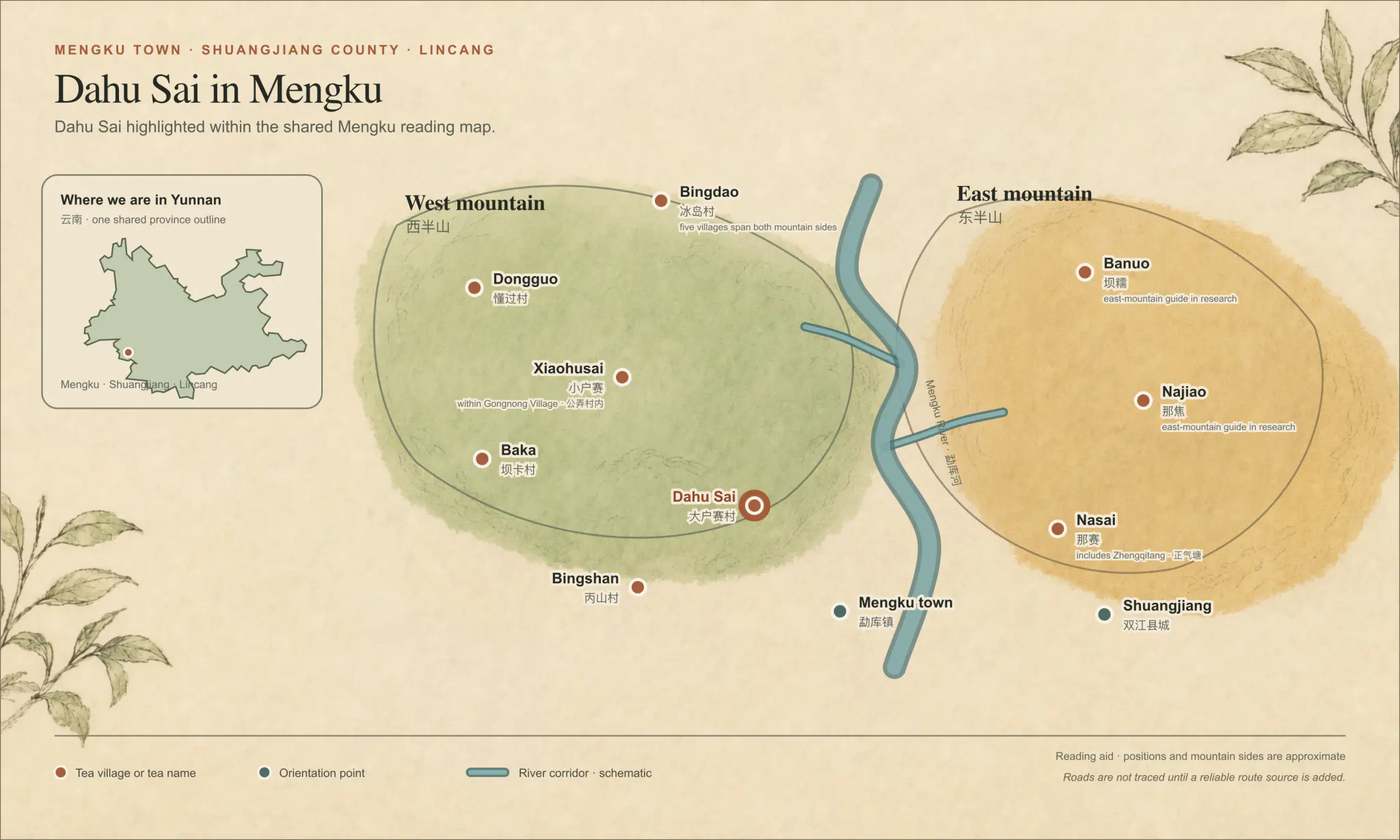
Orientation guide notes and sources
Boundary confidence: Not publication-grade: the existing illustration uses unsupported approximate positions and no licensed locality geometry.
- ImperfecTea existing orientation illustration; no external geographic data license established in this pass
What might Dahu Sai tea taste like, and why does it matter?
Dahu Sai Village (大户赛村, Dàhùsài Cūn) is an administrative village in Mengku Town, Shuangjiang County, Lincang, Yunnan. On tea tables, the shorter Dahu Sai usually appears as a raw pu-erh origin within the looser Mengku West Mountain (勐库西半山) conversation. That phrase helps with market and landscape orientation. It is not the village’s civic parent, and it cannot prove that every cake with the name came from one garden.
The people in the reporting make Dahu Sai easier to picture. A 2021 People’s Daily Online Yunnan report identifies resident Li Zhongwen as village party secretary, a long-serving forest ranger, a tea grower and the operator of a primary-processing workshop. A 2024 Xinhua report names farmer Li Minghua and describes an ancient-tree adoption scheme with a spring-pick, summer-rest and autumn-topping routine for participating trees. These are accounts of named people and programmes. They do not mean every household processes tea the same way or every tree has the same age and management history.
Trade descriptions often suggest a forceful bitter opening, salivation, sweetness on the return and a long finish. Put those ideas in your tasting notes and see what your lot does. They are not a certified village profile. Public reporting confirms that tea matters to the village economy and links Dahu Sai with the Bangma/Daxueshan direction, but it does not provide a shared garden boundary, a tree-age inventory, an elevation range or a sensory guarantee. The useful buyer’s question is simple: which Chinese place, which garden or blend, which season, who made the maocha, and what trail follows it?
Where is Dahu Sai, and what kind of place is it?
The existing visual is an orientation illustration, not a verified composite map. Its approximate marker positions, river course and mountain-side shapes were not traced to a reusable authoritative dataset in this research pass. They must not be read as village coordinates, an administrative boundary, a road map or a Dahu Sai tea polygon. A proper composite still requires licensed Yunnan/county/township base geometry, independently verified localities, sourceable hydrology, a scale, north arrow, legend, production date and an explicit uncertainty treatment.
The hierarchy is clearer than the geometry. The provincial administrative-village standard lists Dahu Sai under Mengku Town. Official and institutional reporting describe travel from the Mengku basin toward Dahu Sai and the Bangma/Daxueshan direction. “West Mountain” organizes tea talk around one side of the Mengku landscape; it is not a village committee, county subdivision or substitute for a field-level address. The legacy site guide, manus/dahu-sai-大户赛-tea-region, is retained as prior research context only.
What to look for in a Dahu Sai cup
Commercial and specialist accounts variously describe Dahu Sai sheng as full, bitter, relatively low in astringency, returning sweet, salivating, floral or honeyed, and persistent. A producer-specific tasting can legitimately report those observations for its own tea. It cannot establish that all Dahu Sai leaf behaves this way, especially when garden, picking standard, season, kill-green, rolling, sun drying, compression and storage are undisclosed.
No controlled, matched multi-producer series with robust village-level provenance was found. Taste the label as a prompt:
| Dimension | Useful note to take |
|---|---|
| Aroma | Separate dry-leaf, warmed-lid and cooled-pitcher aroma; note flowers, fruit, herbs, smoke or green notes. |
| Structure | Record when bitterness and astringency arrive, their location and how quickly they clear. |
| Salivation / return | Record shengjin after swallowing separately from initial sweetness and huigan (returning sweetness). |
| Texture / finish | Note coating, dryness, throat feel and late-steep structure; body sensations are subjective. |
| Variation | Keep origin claim separate from season, leaf grade, processing, compression and storage. |
A scorched note can reflect excessive kill-green; hard greenness can reflect incomplete firing; sourness can reflect delayed or wet drying. None is proof of a dramatic Dahu Sai character. Likewise, a soft sweet start does not independently authenticate a village claim.
Which nearby names should not be confused with Dahu Sai?
Dahu Sai Village 大户赛村
The provincial coding standard is the controlling evidence for the civic name and rank: Dahu Sai Village is under Mengku Town. Public reporting identifies the village as a tea-producing community and treats it as one of the well-known Mengku tea villages. That is enough to describe Dahu Sai as a village origin; it is not enough to state a village-wide old-tree acreage, average garden elevation, precise natural-village list or homogeneous flavor.
There is one nomenclature conflict worth leaving visible. A 2021 Lincang discipline-inspection photo essay calls both Xiaohusai and Dahu Sai “natural villages” when locating Chashan Gully behind them. That is useful, local landscape reporting, but it does not settle whether the report is using settlement language loosely or whether similarly named administrative-village and settlement entities have a more complicated relationship. Until a current township or village-committee roster resolves it, this guide keeps 大户赛村 / Dahu Sai Village as the standard-controlled civic identity and does not invent a subordinate natural-village list.
Mengku West Mountain 勐库西半山
This is not a civic parent. Tea writers use “west half-mountain” for a physical and market-side grouping, commonly contrasted with east-half-mountain names. It can guide a comparison flight, but it should not replace the Chinese village name on a provenance record. A cake described only as “Mengku West Mountain” may be broader than Dahu Sai, blended across sites, or simply using a familiar market signpost.
Daxueshan / Bangma context
Accounts often put Dahu Sai on the approach toward the Bangma Mountain / Mengku Daxueshan landscape and portray it as an entry point for that high-mountain area. That relationship is broad orientation, not permission to call Dahu Sai “Daxueshan,” to assign it the mountain’s summit elevation, or to transfer wild-tea and ancient-tree claims from a reserve to a purchased village lot.
Which local conditions can we connect to the cup?
Elevation, climate and soil
Published trade and travel accounts give various high-elevation descriptions for Dahu Sai, but this pass did not secure a method-backed garden-level range or a source that distinguishes settlement altitude from tea plots. Nor did it find a Dahu Sai weather-station series or field-method soil study. A number repeated in a sales page is not enough to make elevation a flavor mechanism.
Plants, gardens and management
Mengku large-leaf tea is a genuine regional cultivar/public-brand context. It does not identify a household, prove a village origin, or validate “arbor,” “old tree,” “ancient tree” or “wild” language. Some public reports and local accounts use very large ancient-tea figures for Dahu Sai. Without an inventory, sampling method and dating approach, those remain reported claims rather than village-wide facts.
How can processing, season and storage change the result?
Raw pu-erh sold from Dahu Sai is usually described as sun-dried maocha later compressed into cakes. That workflow still leaves many variables: plucking standard, leaf rest, kill-green temperature, rolling, drying weather, sorting, blending, compression and storage. Shuangjiang tea research supports the general caution that harvest season as well as origin affects sampled sun-dried teas; it is not a Dahu Sai flavor formula. No evidence here supports a universal aging promise.
Where the evidence stops
We can place Dahu Sai in Mengku’s civic hierarchy and recognize a broad Bangma/Daxueshan-side market context. We cannot responsibly assign one elevation, soil, forest condition, plant age or taste signature to all Dahu Sai-labelled tea. Place should be one column in a tasting log, not the conclusion before the tea is brewed.
What does a Dahu Sai wrapper fail to prove?
Tea has become an important livelihood story in Dahu Sai. A People’s Daily social-affairs report describes village development through tea-industry arrangements, while a People’s Daily Online Yunnan report describes travel toward the village from the Mengku basin and reports local ancient-tea claims. These are useful current institutional and community context. They are not audits of each farmer’s production, proof of any seller’s tree category, or an authoritative historical chronology.
The local record is most convincing when it remains specific. A People’s Daily field feature reports being offered freshly sun-dried maocha by a tea-farming household while passing through Dahu Sai; this is direct reportage of a visit, not a sensory standard. The newer Xinhua adoption report is useful for how one scheme asks participants to manage enrolled ancient tea trees, but it neither dates those trees nor turns “ancient-tree adoption” into a provenance certificate for a retail cake. These reports support a careful village livelihood and practice account; the cup still needs its own lot-level evidence.
Read an origin label from broad to narrow:
- Mengku / 勐库: town, cultivar and broad market association.
- West Mountain / 西半山: tea-market/physical-side shorthand.
- Dahu Sai / 大户赛村: administrative-village claim.
- Natural village, household, garden and tree category: increasingly specific claims requiring an increasingly specific trail.
Ask the seller for the Chinese locality, whether the leaf is one garden or a village blend, harvest and season, the maocha maker, pressing date, storage history and evidence behind any tree-age claim. Ask whether “Daxueshan” means a location, a blend name or a style. This research pass found no two dated, like-for-like price observations, so it does not publish a price range: fresh leaf, maocha and aged finished cakes are not comparable units. A transparent Dongguo, Xiaohusai or broader Mengku lot may be a useful comparison only when season, maker and storage are also disclosed.
How should you compare Dahu Sai at the tea table?
Start with 7 g per 100 ml in porcelain, 95-100 °C water and short early infusions. Keep water, ratio and timings fixed. Compare a Dahu Sai-labelled lot with disclosed harvest and maker against a similarly aged Xiaohusai or Dongguo lot and a broader Mengku control. Blind the labels if possible. Across the session, record provenance confidence beside aroma, bitterness, astringency, salivation, aftertaste, texture and late-steep structure. Re-brew on another day before calling a difference village character.
What should you remember?
- Dahu Sai (大户赛村) is an administrative village under Mengku Town; West Mountain is market/landscape context, not civic hierarchy.
- The Daxueshan/Bangma relationship is orientation, not a transferable reserve, elevation or tree-age claim.
- Common flavor descriptions are useful tasting prompts but lack a controlled village-level evidence base.
- A transparent chain from Chinese village name through harvest, maker, pressing and storage is more valuable than a prestige word on a wrapper.
- Better mapping and more local, ecological, tasting and market evidence would sharpen future comparisons.
Sources and research limits
All web sources accessed 18 July 2026.
- Yunnan administrative-village coding standard DB53/T 1176.9-2023 - lists Dahu Sai Village under Mengku Town.
- People’s Daily, Minsheng Weekly (2021) - tea-industry livelihood context in Dahu Sai; not a geography or provenance audit.
- People’s Daily Online Yunnan (2021) - broad route and local tea context; quoted ancient-tea figures are local reporting, not an inventory used here.
- Shuangjiang tea development plan (2023) - Mengku large-leaf, heritage and traceability policy context.
- Wang Xinyu et al., Shuangjiang sun-dried tea comparison (2023) - origin and season both matter in sampled Shuangjiang teas; not a Dahu Sai profile.
- People’s Daily, Seeking ancient tea trees on Daxueshan (2019) - named field visit reporting freshly sun-dried maocha offered in Dahu Sai; a visit observation, not a village sensory standard.
- Xinhua Yunnan, More than 1,000 ancient tea trees in Shuangjiang receive new adopters (2024) - named Dahu Sai farmer and the reported adoption-management routine; no tree dating or lot authentication.
- Lincang Discipline Inspection Commission, Chashan Gully (2021) - calls Dahu Sai and Xiaohusai natural villages in a local landscape caption; conflicts with the standard’s administrative-village rendering and is recorded, not harmonised by assumption.
Conflicts and unknowns: Current official records confirm the administrative village but were not found to enumerate its natural villages or map tea plots. A local 2021 caption calls Dahu Sai a natural village; its relationship to the standard-coded village name remains unresolved. High-elevation, ancient-tree and flavor claims vary across trade writing and lack field methods or comparable tasting evidence. No reusable locality geometry, garden ecology study, independent multi-producer Dahu Sai tasting series, tree-age inventory or two comparable current price observations was secured.
A note on what is still missing: The existing SVG/PNG/WebP asset predates this evidence pass. Its approximate positions and embedded visual material have no documented reusable geographic-data basis, so it is not a composite map. We claim no external map-data or image licence, and no controlled ImperfecTea Dahu Sai tasting was available. The guide keeps those limits in view rather than smoothing them over.
Quick answers
Frequently asked questions
What does the Dahu Sai tea name identify?
Dahu Sai is an administrative village in Mengku Town, Shuangjiang County, Lincang, Yunnan. Its most useful identity is administrative village and tea-origin label, so the name alone does not guarantee a particular garden, tree age or quality level.
What does Dahu Sai tea taste like?
Public evidence cannot support one village fingerprint; compare lot-specific aroma, bitterness, astringency, sweetness, texture and finish while recording harvest and maker. Use that profile as a tasting guide, not as proof of origin.
What is Dahu Sai commonly confused with?
Dahu Sai is a village claim inside Mengku, not a synonym for Mengku West, Bingdao or one standardized tea style.
What should I ask before buying Dahu Sai tea?
Start with: Which smaller garden or household supplied the leaf, in what season, and who processed the lot? Also ask for the harvest year and season, producer or household, processing details and storage history.