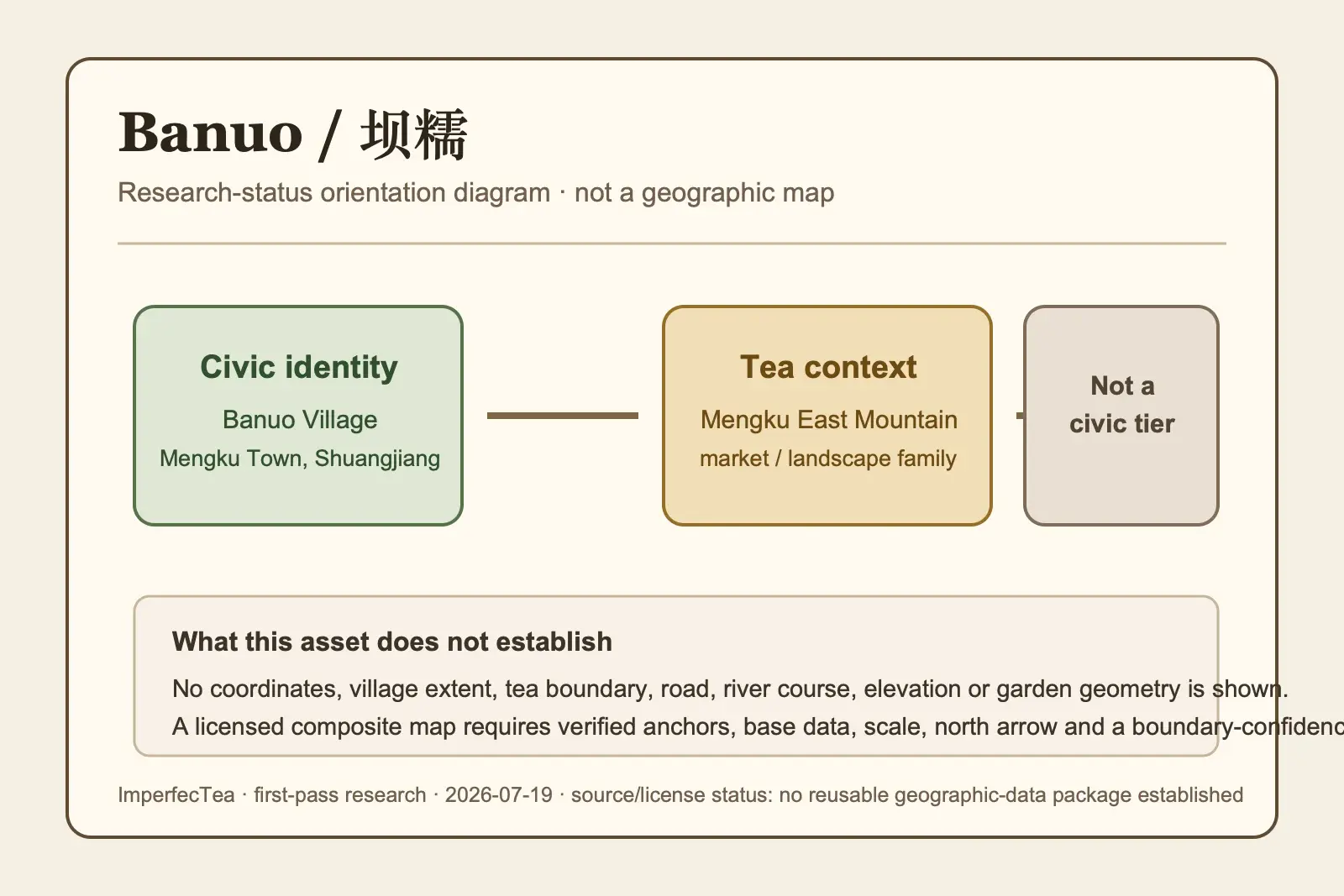
Place relationship diagram notes and sources
Diagram status: Not publication-grade: this first-pass orientation diagram deliberately contains no geographic geometry, coordinates, or boundary claim.
- ImperfecTea first-pass research-status diagram; no reusable geographic-data licence established
What might Banuo tea taste like, and why does it matter?
Banuo (坝糯, Bànuò) gives us more to work with than most small village names. It is an administrative village in Mengku Town, Shuangjiang County, Lincang, Yunnan, and tea sellers regularly group it with Mengku East Mountain / East Half-Mountain (勐库东半山). Think of “East Mountain” as river-and-ridge shorthand. It may describe a broad blend or sales family. 坝糯村 makes the much narrower place claim.
Here the paper trail gets interesting. An official 2024 notice records a Banuo Village ancient tea garden covering 321.2 mu and includes survey-boundary coordinates. A 2023 peer-reviewed comparison of sun-dried tea from four Shuangjiang origins described its Banuo samples as full/thick, strong and slightly astringent. That gives you a useful tasting question, not a guarantee. Neither source can prove the origin, tree age or flavour of a random cake. Banuo is therefore best enjoyed as a careful comparison, not as another excuse to print “sweet East Mountain” on a wrapper.
Where is Banuo, and what kind of place is it?
The image above is an explicit research-status orientation diagram, not a map. It makes no claim about Banuo’s location, distance, road, river course, village extent or tea boundary. The official resource notice provides corner coordinates for one recognized garden record, but a map needs more than four text coordinates: a lawful base layer, coordinate-system confirmation, a Yunnan/Lincang/Shuangjiang locator, independently checked settlement anchors, scale, north arrow, bilingual labels and a distinction between the administrative village and a market area. None is ready in this pass.
What can be said without pretending a tea label is a civic boundary is straightforward. The provincial administrative-village coding standard lists 坝糯村 under 勐库镇. Tea writers commonly orient Banuo on the east side of the Nanmeng/Mengku River and within the Ma’an Mountain side of Mengku. That East Mountain language helps a drinker compare broad market families, but it does not create a separate township, certify one garden, or establish a fixed east-side flavour law.
Do not confuse Banuo with Baka / 坝卡, another Mengku administrative village, or Bawai / 坝歪, a natural village in Bingdao five-village cluster. The shared 坝 character and similar Latin spelling are not origin evidence. A seller should be able to provide the characters, village level, garden or household, season and maker before Banuo is treated as more than marketing shorthand.
What to look for in a Banuo cup
The best evidence is bounded. Wang Xinyu and colleagues compared spring, summer and autumn sun-dried tea from Banuo, Bingdao, Xiaohusai and Huangshan using chemical measurements and sensory assessment. For the Banuo samples in that study, the sensory description was 浓厚强烈,微涩: full/thick, strong, and slightly astringent. The paper also found meaningful differences between origins in the same season and between seasons at the same origin. That supports a useful tasting expectation, not a promise for every Banuo-labelled cake.
Chinese field and tea-community accounts frequently describe Banuo’s vine-pruned material in terms of strength, sweetness after bitterness, and a solid rather than airy middle. These are useful local observations when named and attributed, but they are not controlled comparisons. A producer’s harvest date, leaf grade, kill-green, sun drying, storage and whether the maocha was blended can all move the cup more than the village word on the wrapper.
Use this as a disciplined tasting sheet rather than a set of guarantees:
| Dimension | What to record |
|---|---|
| Aroma | Note warmed-lid, leaf and cooled-cup aroma separately. Do not turn floral, sugar, green or herb notes into a village law. |
| Taste | Locate bitterness and the timing of its release; record whether sweetness returns after swallowing. |
| Texture | “Full/thick” is study language for one sample set. Describe coating, weight and late-steep persistence in your own sample. |
| Astringency | The study found slight astringency; distinguish a clean, brief grip from drying caused by hard extraction or rough processing. |
| Body sensation | Cha qi is a subjective report, not a geographical measurement. |
| Provenance | Record Chinese locality, season, pruning/tree claim, maker, pressing date, storage and blend status alongside every sensory note. |
The most honest comparison is a matched flight: a traceable Banuo tea, a transparent Najiao or Nasai/Zhengqitang tea from the east-side conversation, a Bingdao-cluster tea with equally clear provenance, and one broader Mengku control. Blind the labels if possible. The purpose is not to prove that four places must taste different. It is to see whether a particular origin claim remains meaningful after season and processing are held as constant as possible.
Which Banuo garden claims are actually supported?
The official recognition notice is valuable because it records a specific cultivated ancient-tea-garden resource, not merely a seller adjective. Its table names 双江自治县勐库镇坝糯村古茶园 and gives 321.2 mu plus a bounded coordinate listing. This confirms the existence and recorded extent of that resource entry. It does not say that every Banuo garden lies inside it, every plant has the same age, or every tea sold as Banuo comes from it. The notice is also not a retail authentication system.
Yunnan.cn’s 2022 reporting describes more than 1,500 mu of contiguous vine-pruned gardens in Banuo and explains the management in local horticultural terms: retain the top, cultivate the shoot, and manage lateral growth during picking. This is useful evidence of a living labour practice. The report does not publish a survey method, individual-tree dating method, experimental flavour comparison or a map suitable for reuse. Treat “vine-pruned” as a management claim that needs a garden and maker, not as a synonym for Banuo, gushu, organic production or superior quality.
A 2020 Chinese tea-community field account records oral local history of more than four centuries of tea planting and describes old-tree acreage and a smaller-leaf local expression. Those claims belong in the research conversation, but oral history and a field writer’s figures are not a dated archaeology survey or a plant census. This guide does not promote them into a hard village age, cultivar or acreage fact.
No authoritative Banuo-wide tea-garden elevation range, soil study, climate station series, forest-cover measurement, slope/aspect survey, harvest-volume record, input audit or cultivar census was secured in this pass. The wider Shuangjiang/Mengku landscape is relevant context, but it cannot explain the cup of a specific Banuo lot without lot-level evidence.
Where the evidence stops
We can say Banuo is a Mengku administrative village with one officially recorded ancient-tea-garden resource and reported vine-pruned gardens. We can say a controlled study found a particular sample set thick, strong and slightly astringent. We cannot claim that a soil type produces a mineral character in Banuo tea, that eastern exposure explains every bitter note, or that old trees automatically make better tea. Those would require garden-level measurement and matched tea samples, neither of which this guide has.
How can processing, season and storage change the result?
For raw Pu-erh, origin is only part of the chain. Leaf is rested or withered, kill-greened (shāqīng, 杀青), rolled, sun-dried to maocha, then sorted, rested, blended or kept separate, compressed and stored. Banuo-specific sources located here do not establish one universal workshop style or aging path. A grassy cup can reflect a light kill-green. Smoke can reflect heat management. Sourness can reflect difficult withering or drying. Hard extraction can exaggerate astringency. None automatically belongs to the village.
The 2023 study is especially useful because it demonstrates that season is not a footnote. Its Banuo spring, summer and autumn material differed alongside origin effects. Ask whether a tea is spring, rain-season or autumn material and whether it is single-garden maocha, village material or a broader Mengku blend. A tightly pressed young cake and rested loose maocha also need not present identically.
There is no longitudinal Banuo aging study in this source set. With clean processing and storage, a young strong tea may integrate. It is not responsible to promise a particular decade-long outcome from the village name alone.
How did people and the market shape the Banuo name?
Banuo’s history is not a decorative “ancient village” story. Contemporary accounts describe growers, household processors and a pruning practice that still requires labour and judgment. A 2016-19 tea-community field report describes a visit to a household tea factory and names the family’s account of village history. This is useful on-the-ground reporting, but not a neutral census. The tea landscape is lived and worked, not a preserved flavour machine.
For buying, read the label from broad to narrow:
- 勐库 / Mengku: town and broad tea/cultivar context.
- 东半山 / East Mountain: landscape or market shorthand; it may cover several villages or a blend.
- 坝糯村 / Banuo Village: an administrative-village claim.
- Natural village, household, garden, season and tree category: increasingly narrow claims that need increasingly direct documentation.
Ask for the Chinese characters in the farmer or maocha record, whether the tea is Banuo-only or an east-side blend, exact garden and pruning/tree claim, harvest season, processor, pressing date, storage, and a record that connects those answers to the tea. An official garden-resource entry is not a transferable certificate for every retail cake.
No two dated, comparable price observations were found, so this guide gives no price band. Fresh leaf, loose maocha and a finished cake of different age, grade and tree claim are different markets. A transparent, modestly priced Mengku tea with a clear chain is better evidence than an expensive “Banuo ancient-tree” story with none.
How should you compare Banuo at the tea table?
Start with 7 g per 100 ml in porcelain at 95-100 °C, using quick early infusions. Keep water, ratio and timings fixed when comparing. If a young tea is very sharp, shorten the first steeps before changing temperature. That lets you separate extraction from the tea’s later behaviour.
For a four-tea flight, use a traceable Banuo, a Najiao or Nasai/Zhengqitang tea, a Bingdao-area tea with stated provenance, and a broader Mengku reference. Note bitterness, astringency, returning sweetness (huigan), salivation (shengjin), texture and late-steep stamina. Add provenance confidence to the tasting sheet. A comparison is most useful when it tests a seller’s specificity rather than rewards a famous name.
What should you remember?
- Banuo / 坝糯 is an administrative village in Mengku Town. Mengku East Mountain is its site and tea-market parent, not a civic level.
- One officially recognized Banuo ancient-tea-garden resource is documented, but it cannot authenticate every Banuo-labelled tea.
- A controlled 2023 study found its Banuo samples full/thick, strong and slightly astringent. Season mattered too.
- Vine-pruned tea is a management practice, not proof of village, age or quality.
- The practical buying question is: which Chinese place, garden, season and maker does this lot actually document?
Sources and research limits
All sources accessed 19 July 2026.
- Yunnan administrative-village coding standard DB53/T 1176.9-2023 - civic hierarchy.
- Lincang municipal fourth-batch cultivated ancient-tea-resource recognition notice - Banuo Village garden entry and survey-boundary coordinates.
- Wang Xinyu et al., 2023 four-mountain Shuangjiang sun-dried-tea comparison - controlled Banuo sample evidence; not a retail-lot audit.
- Yunnan.cn, “Vine-pruned tea: a horticultural wonder” (2022) - reported local garden-management context.
- Gu Cha Ju / 网茶会习茶社, “From Banuo to Dahu Sai” (2020) and 51 Puer, “Our firsthand Mengku tea” - attributed Chinese field/community reporting, used only where labelled as such.
- Chen Sheng Academy’s regional tasting overview - commercial comparison vocabulary only; not used for hard geography or a village flavour law.
Evidence limits: The illustration is deliberately non-geographic. No licensed composite map, controlled multi-producer Banuo tasting set, village-wide environmental audit or two comparable dated price observations were found.
Quick answers
Frequently asked questions
What does the Banuo tea name identify?
Banuo is an administrative village in Mengku Town, Shuangjiang County, Lincang, Yunnan. Its most useful identity is administrative village and tea-origin label, so the name alone does not guarantee a particular garden, tree age or quality level.
What does Banuo tea taste like?
One controlled sensory study supports floral aroma, sweetness, body and returning sweetness in its tested material; season, processing and provenance keep those prompts from becoming guarantees. Use that profile as a tasting guide, not as proof of origin.
What is Banuo commonly confused with?
Banuo 坝糯 is not Baka 坝卡, Bingdao-cluster Bawai 坝歪 or a synonym for all Mengku East tea.
What should I ask before buying Banuo tea?
Start with: Is this lot from the recognized Banuo garden, another village garden or a broader blend, and who processed it? Also ask for the harvest year and season, producer or household, processing details and storage history.