Orientation guide notes and sources
Boundary confidence: Not publication-grade: the existing illustration has no verified locality geometry or reusable geographic-data licence in this pass.
- ImperfecTea legacy orientation illustration; no external geographic-data licence established in this pass
What might Baka tea taste like, and why does the name matter?
Baka (坝卡, Bàkǎ) is an administrative village in Mengku Town, Shuangjiang County, Lincang, Yunnan. Tea shops often place it in the Mengku West Mountain conversation. That helps you find the right side of the tea map, but it is market and landscape shorthand, not Baka’s civic address or a promise of one fixed flavour.
No controlled Baka tasting series supports a village fingerprint. Use a documented lot to track aroma, the timing of bitterness and astringency, salivation, texture and finish; keep its season, maker and storage attached to every observation.
The Chinese characters do some useful work here. 坝卡 is not 坝歪 (Bawai) in Bingdao’s five-village cluster, 坝糯 (Banuo) on the east side, or 坝卡囡 (Baka-nan) in Bulang Mountain, Menghai. They are easy names to muddle on a wrapper and very different claims. A search-indexed municipal notice also points to a cultivated ancient-tea-garden record for Baka Village, although the original page was unavailable during this research pass. That clue does not turn every Baka cake into old-tree tea, and it certainly does not turn Baka into Bingdao. If a seller cannot give you the characters, smaller locality, season and maker, you still have a broad market claim rather than a settled origin.
Where is Baka, and what kind of place is it?
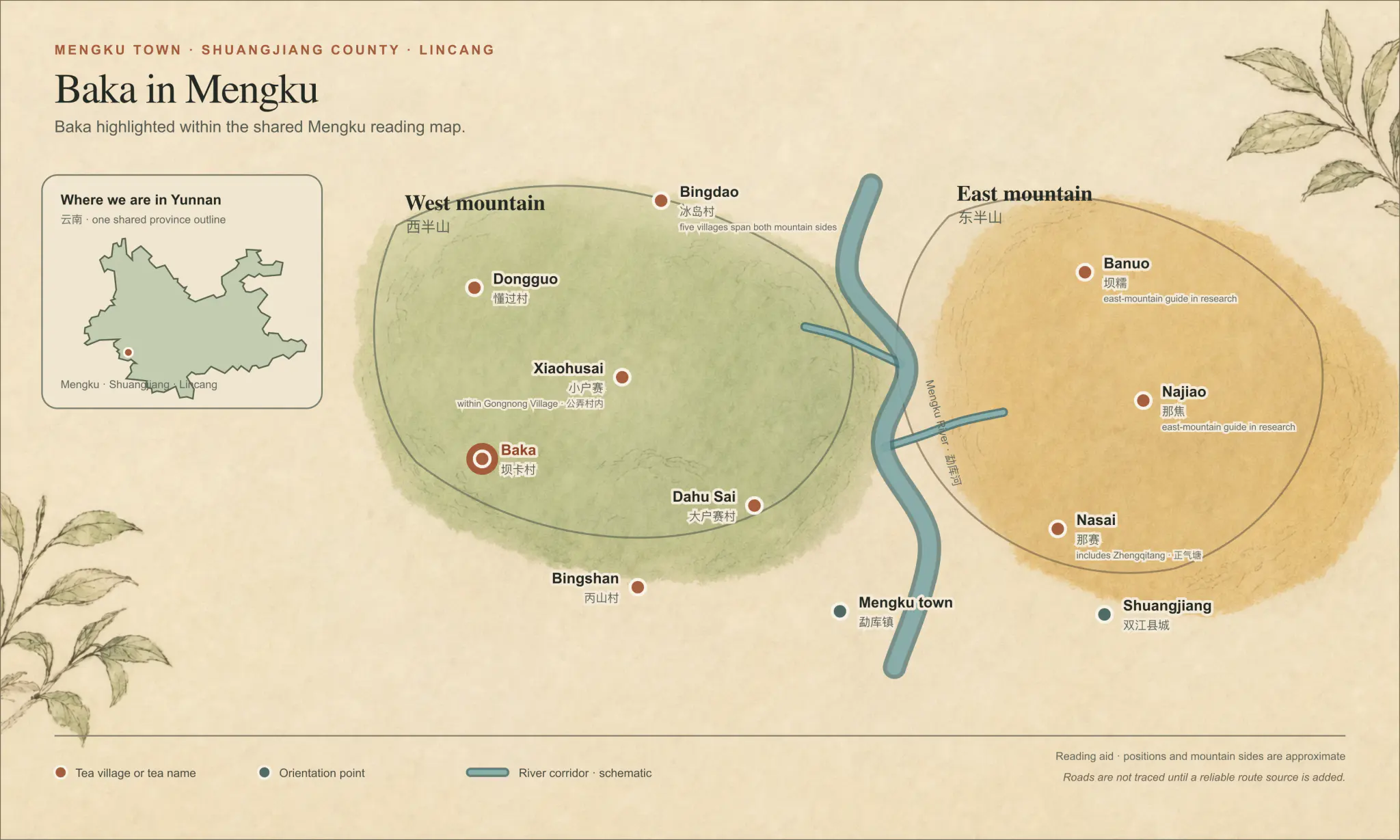
The image above is a retained orientation illustration, not a defensible composite map. Its pins, river line, mountain-side shapes and extent were not tied in this pass to licensed locality data or independently verified geometry. It cannot establish coordinates, travel routes, a tea boundary, exact village position or the limits of the recognised garden. A replacement needs licensed base data, a Yunnan locator and local detail panel, scale, north indicator, legend, production date, source credit and an explicit difference between administrative village and tea-market area.
The hierarchy is firm enough to be useful. The Yunnan administrative-village coding standard lists Baka under Mengku Town. Mengku West Mountain is a practical way to find Baka among western-side tea discussions, but it is not a village committee and it must not overwrite the civic address. The provincial and municipal documents used here do not establish a precise internal Baka settlement roster. Jiashan (甲山) appears in legacy operator/address material, but this pass does not elevate it to a leaf-source designation or a distinct tea subregion.
Which Baka-like name is actually on the label?
Baka 坝卡: this guide’s Mengku administrative village
The subject here is Baka Village under Mengku Town. A search-indexed Lincang fourth-batch cultivated ancient-tea-resource-notice lead names a Baka Village garden, but its original page was unavailable during this pass. Until the notice or a downloadable attachment can be retrieved, this is a research lead, not an established area, boundary or certification. It would not say that all Baka gardens are ancient, that all recognised plants have one measured age, or that every finished cake bearing 坝卡 came from the recorded resource.
Bawai 坝歪: a Bingdao-cluster natural village
Bawai is written differently and belongs to the Bingdao five-village discussion. It may appear nearby in a merchant’s sales language, but proximity or a similar first character is not a chain of custody. Do not translate a Bawai description, price or tasting note into a Baka claim. “Bingdao-style” is likewise a sales comparison, not an administrative relationship.
Banuo 坝糯: another Mengku village
Banuo is also not Baka. The shared character 坝 is not enough to create a common garden, cultivar lot, side-of-river placement or flavour profile. Keep the characters on tasting notes and purchase records; Romanisation alone is too weak for origin work.
Baka-nan 坝卡囡: a different place in Menghai’s Bulang Mountain
Chinese tea-community tasting pages often describe Baka-nan / 坝卡囡, but their own location is Menghai County’s Bulang Mountain, not Shuangjiang’s Mengku Town. A detailed tea-review source records a sample’s brewing and cup impressions, but it is explicitly a Baka-nan item and cannot support this guide’s Baka profile. This is the most dangerous false friend: an English search for “Baka puer” can surface a different county, mountain and community.
What to look for in a Baka cup
There is no adequate independent, multi-producer Baka tasting series in the public record located for this pass. Repeating a standard Mengku vocabulary - floral aroma, sweetness, cooling, strong bitterness - would turn market language into a village law. Instead, the best current use of a Baka label is as a tasting hypothesis that must travel with the lot’s documentation.
One established Chinese tea-community account offers a useful, limited market observation: it says Baka leaf was being drawn into Bingdao-directed trade as Bingdao demand and prices rose. Read that as a 2019 account of market pressure and possible substitution, not as proof that Baka and Bingdao are indistinguishable, nor as a current pricing report. The account does not supply producer identities, garden separation, blind tasting, harvest data or a verifiable sample set.
Use these as observation prompts rather than promises:
| Dimension | Record in the cup |
|---|---|
| Aroma | Warmed-lid, leaf and cooled-cup notes separately; distinguish flowers, sugar, herbs, fruit, smoke and green notes. |
| Structure | When bitterness and astringency arrive, where they sit and whether they clear or accumulate. |
| Return / salivation | Huigan (returning sweetness) and shengjin (salivation) are separate observations. |
| Texture / finish | Coating, dryness, throat feel and late-steep stamina; body sensations remain subjective. |
| Provenance | Characters, exact village/garden claim, season, picker/processor, pressing, storage and whether the lot was blended. |
A hard green edge may come from kill-green; smoke can come from heat management; sourness can come from difficult withering or drying. Those are processing questions before they are Baka traits. A sweet, soft cup does not demonstrate Bingdao descent, and a firm bitter cup does not prove West Mountain purity.
Which local conditions can we connect to the cup?
The search-indexed cultivated-ancient-tea-garden notice is a useful lead because it may document a landscape resource rather than repeat a seller’s adjective. Until the original record is retrieved, it is not evidence for an area, a map of every old tree, a quality ranking, a garden elevation range or an audit of individual plants. Tree-age claims on a wrapper require their own method and lot connection; trunk size, a photograph or the word gushu is not enough.
Mengku large-leaf tea is a regional plant and industry context. The regional agricultural-heritage record helps understand Mengku’s long tea landscape, while local agricultural reporting supplies cultivar and traceability context. Neither source can identify the leaf in a particular Baka cake. This pass found no current method-backed Baka soil study, weather series, garden-aspect map, cultivar census, forest-cover measurement or harvest-volume record. Those gaps are reasons to avoid numerical terroir prose, not reasons to fill it with scenic certainty.
Where the evidence stops
We can say that Baka is a Mengku administrative village and that a municipal resource-notice lead merits follow-up. We can place it in West-Mengku tea discourse without mistaking that discourse for civic geography. We cannot responsibly attribute a universal Baka flavour to altitude, soil, forest, old trees or one mountain-side label. Origin is an input to a tasting record, not the answer before brewing.
How can processing, season and storage change the result?
For raw Pu-erh, a Baka origin claim sits beside decisions about harvest date, picking standard, withering, kill-green, rolling, sun drying, sorting, blending, compression and storage. The sources found do not establish a village-wide processing style, a standard aging curve or an independently documented producer practice for Baka. A lot should therefore disclose what it can: season, whether maocha was mixed before pressing, who processed it, compression date and storage history.
Season matters even when a label is genuine. A fresh spring tea and an autumn lot may differ before processing enters the picture; a tightly pressed cake can also present differently from rested loose maocha. Avoid assigning a harsh young tea or a muted stored tea to Baka itself without controlling those variables.
What does the market name fail to prove?
The valuable history here is contemporary market history: Baka can be pulled into the gravitational field of a famous nearby name. The 2019 community account describes buyers collecting Baka leaf for Bingdao-directed trade. That is a reported account, not an enforcement finding, but it explains why character-level precision matters to buyers.
Read labels from broad to narrow:
- 勐库 / Mengku: township, cultivar and broad market context.
- 西半山 / West Mountain: landscape/market shorthand.
- 坝卡村 / Baka Village: administrative-village claim.
- Natural village, household, garden and tree category: progressively narrower claims that need progressively stronger documentation.
Ask a seller which characters appear in the farmer or maocha record; whether the leaf is a Baka-only lot, a northern-Mengku blend or material bought through a Baka-based operator; exact garden and tree-category claim; season; processor; pressing date; storage; and what documents link those answers to this cake. The official recognised garden is not a transferable certificate for any tea with 坝卡 printed on it.
No two dated, like-for-like price observations were found, so this guide gives no Baka price range. Fresh leaf, loose maocha and an aged finished cake are different markets. A transparent Mengku lot with an honest village-level claim is preferable to an expensive “Bingdao/Baka ancient-tree” story without a traceable chain.
How should you compare Baka at the tea table?
Start with 7 g per 100 ml in porcelain, 95-100 °C water and short early infusions. Keep water, ratio and timing stable. If young tea is overly sharp, shorten the initial steeps before changing temperature; this preserves the structure you are trying to compare.
For a useful four-tea flight, use a transparently documented Baka-labelled tea, a Bawai-labelled Bingdao-cluster tea, a Banuo tea and a broader Mengku control. Blind the labels if possible. Record source confidence alongside aroma, bitterness, astringency, salivation, returning sweetness, texture and late-steep stamina. The goal is not to prove that places must taste different; it is to test whether a seller’s origin claim survives careful comparison.
What should you remember?
- Baka / 坝卡 is an administrative village in Mengku Town; West Mountain is tea-market context, not a civic parent.
- A search-indexed garden-recognition lead is a reason for further research, not proof for every Baka-labelled cake.
- 坝卡 is not Bawai / 坝歪, Banuo / 坝糯 or Menghai Bulang’s Baka-nan / 坝卡囡.
- No reliable multi-producer Baka tasting set or normalized price pair was located; taste and price claims should remain lot-specific.
- The best purchase question is: which Chinese place, which garden, which season, which maker and what record follows the tea?
Sources and research limits
All sources accessed 19 July 2026.
- Yunnan administrative-village coding standard DB53/T 1176.9-2023 - Baka as a village under Mengku Town.
- Lincang municipal fourth-batch cultivated ancient-tea-resource notice - search-indexed Baka Village garden lead; original page was unavailable, so no area or status is treated as established in this guide.
- Lincang Agriculture and Rural Affairs Bureau on Mengku large-leaf tea - regional cultivar and traceability context; not a Baka lot audit.
- National Agricultural Exhibition Center: Shuangjiang Mengku ancient tea gardens and tea-culture system - regional agricultural-heritage context; not proof of a Baka wrapper.
- Gu Cha Ju / 网茶会习茶社, “Detailed flavours of Mengku noted mountains” (2019) - Chinese tea-community report of Baka/Bingdao market movement; attributed reporting, not a controlled tasting or official trade statistic.
- Ai Pu Cha, tea-friend review of Baka-nan / 坝卡囡 - used only to document that a similarly rendered name is a different, explicitly sampled product; it is not evidence about Baka / 坝卡 in Mengku.
Evidence limits: The illustration is not a verified map, and no reusable geographic-data licence was established. No controlled multi-producer Baka tasting series, defensible garden-elevation range or normalized dated price comparison was found.
Quick answers
Frequently asked questions
What does the Baka tea name identify?
Baka is an administrative village in Mengku Town, Shuangjiang County, Lincang, Yunnan. Its most useful identity is administrative village and tea-origin label, so the name alone does not guarantee a particular garden, tree age or quality level.
What does Baka tea taste like?
No controlled village tasting set exists; test each documented lot for aroma, bitterness, astringency, salivation, texture and finish instead of expecting a fixed Baka profile. Use that profile as a tasting guide, not as proof of origin.
What is Baka commonly confused with?
Baka 坝卡 is not Bingdao-cluster Bawai 坝歪, Mengku East's Banuo 坝糯 or Menghai's Baka-nan 坝卡囡.
What should I ask before buying Baka tea?
Start with: What Chinese place name, smaller locality, season and maker does this lot claim? Also ask for the harvest year and season, producer or household, processing details and storage history.