丙山
Bingshan (丙山): Mengku tea beyond the famous-name economy
A practical guide to Bingshan in western Mengku: a large working tea village, its protected old-garden context and Wa ‘Jingma tea’ tradition, with careful limits on origin and flavor claims.
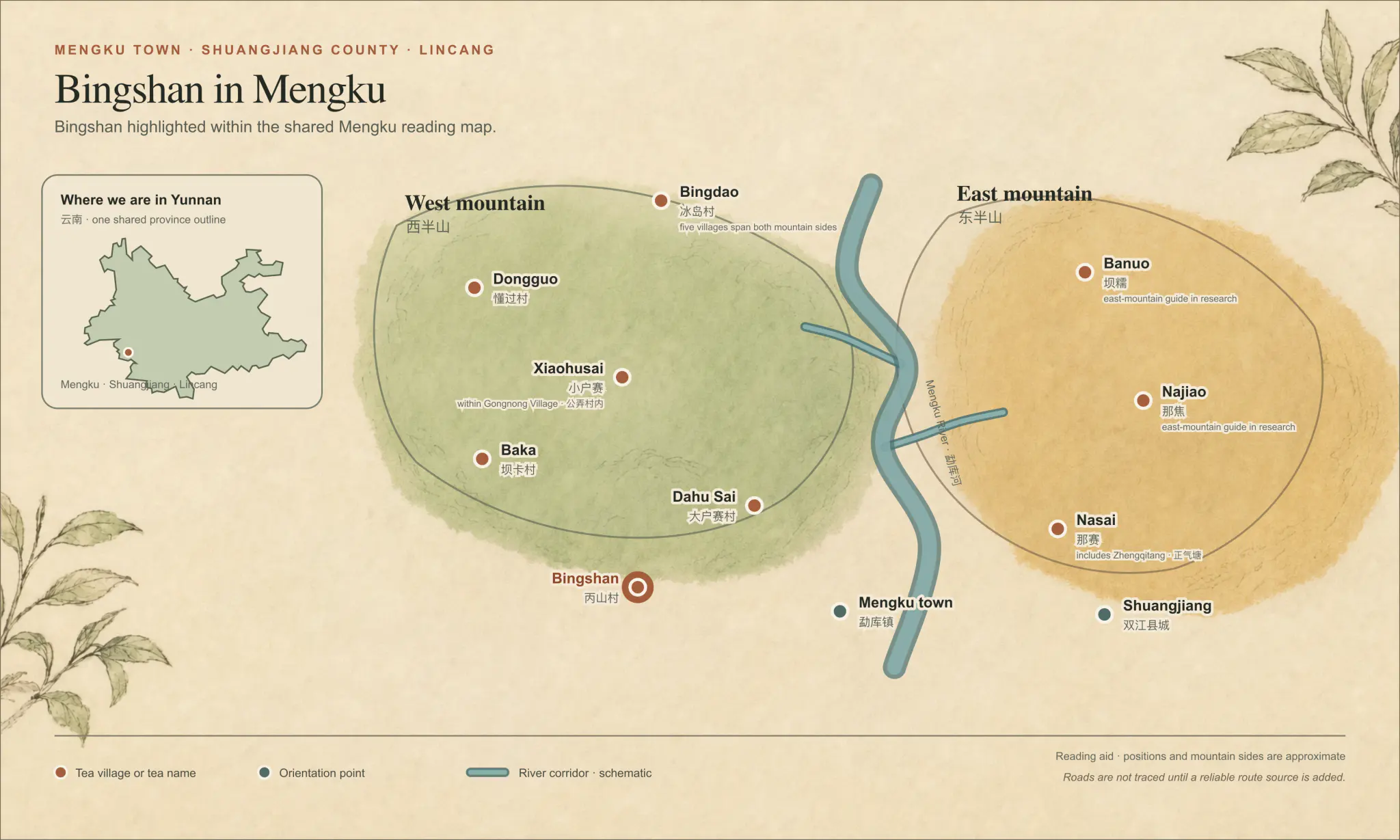
Bingshan (丙山, Bǐngshān) is easy to overlook and easy to misspell. The first character is 丙, the third of the traditional Heavenly Stems, not 冰, “ice.” It is therefore not “Ice Mountain,” not Bingdao, and not a poetic extension of the Bingdao brand. It is its own administrative village in Mengku Town, commonly placed on the West Half Mountain side in tea-market geography.
Unlike origins known mainly through premium wrappers, Bingshan appears in recent public reporting as a large, working tea village. A 2024 Yunnan report described more than 14,200 mu of harvestable tea gardens and nearly five mu per person. Earlier CCTV reporting found tea grown and processed by every one of 142 surveyed households and documented the role of a cooperative in improving processing and sales. That is more useful context than a claim that every Bingshan tea tastes the same.
At a glance
| Field | Reference |
|---|---|
| Documented place | Bingshan Village (丙山村), Mengku Town, Shuangjiang County, Lincang |
| Tea-map shorthand | Commonly grouped with western Mengku |
| Working tea base | More than 14,200 mu of harvestable gardens reported in 2024 |
| Protected context | Bingshan Village ancient tea garden appears in Lincang’s cultivated ancient-tea resource notice |
| Living tradition | Bingshan Wa “Jingma tea” processing was listed as municipal intangible cultural heritage in 2019 |
A scale worth seeing
The provincial administrative standard confirms Bingshan as a village under Mengku Town. In 2024, Yunnan media called it a major tea-producing village and reported over 14,200 mu of harvestable gardens. Lincang’s fourth-batch cultivated ancient-tea resource notice separately listed a Bingshan Village ancient tea garden covering 2,827.6 mu.
These two numbers describe overlapping but different things: the village’s broad contemporary production base and a specifically recognized ancient-garden resource. Do not combine them into “all Bingshan is ancient tea.” A modern managed plot, a recognized old-garden polygon, leaf purchased through a village processor and a single-household old-tree lot can all carry the village name while representing different products.
The CCTV account is equally important because it records change. It describes producers whose tea once sold poorly because garden management and processing lagged, followed by cooperative organization, technical improvement and contracted purchasing. Processing quality is not frozen by geography. A Bingshan tea from one decade or maker should not define the village forever.
Jingma tea is a tradition, not a generic synonym
In 2019, Lincang listed 双江勐库丙山佤族“惊马茶”传统制作工艺, the Bingshan Wa traditional “Jingma tea” processing craft, as municipal intangible cultural heritage. This gives Bingshan a documented cultural and technical association that deserves more attention than invented tasting mythology.
It also requires restraint. A heritage listing recognizes a named tradition; it does not mean every raw pu-erh cake from Bingshan was made with that technique. If a seller invokes 惊马茶, ask what process they mean, who practices it, and how the batch follows that tradition. Do not reduce Wa growers and makers to atmosphere around an “ancient mountain” story. They are contemporary producers working through cooperatives, factories and changing quality systems.
What to expect, and what not to assume
Tea-trade descriptions often give Bingshan young sheng fruit or honey aroma, firm bitterness, returning sweetness and a substantial finish. Those are plausible session notes for Mengku large-leaf raw tea, not a verified village specification. Bingshan’s large production base makes variation the responsible default: garden type, household, season, picking standard, processing and storage may all differ.
Build your notes around observables:
- Is the aroma floral, fruit-like, honeyed, green, smoky or muted?
- Does bitterness clear into sweetness and salivation, or remain rough?
- Is the liquor thin, brisk, coating or heavy?
- Does the tea become cleaner and sweeter in later infusions?
- What survives after the cup cools?
If a Bingshan sample is inexpensive, that does not make it inferior to a celebrity village. It may simply sit outside the famous-name economy. Conversely, “ancient garden” or “Jingma tradition” should not command a premium without a credible batch connection.
Buying: distinguish village, garden and process
Ask sellers to complete three separate sentences:
- Place: The leaf came from ___ settlement or garden in Bingshan Village.
- Plant material: The batch used ___ tree or garden category, picked in ___ season.
- Process: The maocha was made by ___ using ___ method; any “Jingma tea” claim refers specifically to ___.
Also ask whether the tea is a single-household lot, cooperative or factory blend, and whether it contains leaf from neighboring villages. A producer address in Bingshan supports a processing connection, not necessarily a Bingshan-only leaf claim.
For a useful tasting flight, compare a traceable Bingshan tea with Dongguo or Xiaohusai, one eastern-Mengku village, and a broad Mengku blend. Match season and age. The exercise is not to discover a permanent east-versus-west law; it is to see which differences repeat for the actual batches in front of you.
Brewing
Start at 7 g per 100 ml in porcelain with 95 to 100°C water. Use 5 to 8 second early steeps and extend gradually. If the sample is assertive, keep the water hot but shorten pours so you can observe how bitterness transforms. If it is compressed tightly, give it a brief rinse and a minute to open. When comparing cooperative and small-batch tea, keep leaf ratio and timing identical; “rustic” and “refined” are conclusions to test, not categories to assign in advance.
References
- Yunnan provincial administrative-village standard, DB53/T 1176.9, 2023, Bingshan as an administrative village under Mengku
- Yunnan Net, “临沧:茶山‘披绿衣’ 采茶制茶忙”, 2024 harvestable-garden and per-person figures
- CCTV, “云南省临沧市双江县组建茶叶合作社 茶农增收产业增效”, households, cooperative organization and processing context
- Lincang municipal fourth-batch cultivated ancient-tea resource notice, Bingshan Village ancient-garden area and boundary record
- Lincang municipal fourth-batch intangible-cultural-heritage list, Bingshan Wa Jingma tea traditional processing craft
- Lincang Agriculture and Rural Affairs Bureau on Mengku large-leaf tea, cultivar and GI context
- Natural Earth, public-domain locator data
Quick answers
Frequently asked questions
Where is Bingshan tea village?
Bingshan (丙山) is an administrative village in the western Mengku tea system of Shuangjiang County, Lincang, Yunnan. It should not be confused with Bingdao (冰岛).
What does Bingshan Pu-erh taste like?
Individual lots vary with garden, season, plant material and processing. Use regional tasting descriptions as comparison prompts, not a flavour guarantee attached to the village name.
How can I check a Bingshan tea claim?
Ask for the Chinese place name, settlement or garden, harvest season, material category, processor and batch record. The Bingshan name alone does not verify tree age or a protected old garden.